Blog

  • Things that caught my eye this week

    Indonesia is a fascinating place in and of itself and comes up with all kinds of cultural nuggets. The latest one that I came across was the Vespa Extreme moped sub-culture. Vespa scooters are plentiful in Indonesia, as is the desire to invent. Car tuning culture is big amongst the middle class. But for those who need something more affordable Vespa Extreme builds are a site to behold. The South China Morning Post put together this great documentary film on the Vespa Extreme culture and its riders.

    Like car culture there are meet-ups, cruises and even festivals organised.

    Vespa Extreme Culture.

    About half of the mobile game developers on iOS are based in China, the country’s universities turn out more programmers each year than anywhere else (including India). Yet China has still lagged behind other countries games in terms of incorporating technology and art. That’s where Black Myth: Wukong is supposed to come in. Sun Wukong is one of the names of the Monkey King in the Chinese literary classic Journey To The West. This has been a staple of Chinese animation and film for years.

    Black Myth: Wukong

    Could it be popular in China? It’s hard to tell from this pre-Alpha release footage. The biggest issues are likely to come from Chinese regulators. But hopefully the game won’t have to undergo the lengthy rewrites and changes foreign games have to do to comply. Instead the Chinese developers should be able to bake compliance in from the start. However, its China; so nothing is guaranteed.

    German software giant SAP created a Tinder-like internal matching app to connect isolated employees for virtual lunches during remote work – its an interesting approach to things I guess. Home working lacks serendipity of working in an office. There is no water cooler moments. Social interactions are limited and Zoom analogues (Microsoft Teams, GoTo Meeting etc) burden the user with a heavy cognitive load. I just hope that this is opt-in at SAP, rather than ‘enforced’ or ‘serious fun’.

    The Ikea Taiwan Facebook page faithfully created looks from their catalogue on Animal Crossing, much to the delight of their Taiwanese and Hong Kong based followers. The original post is here.

    Ikea Taiwan Animal Crossing
    The original Facebook post
    Ikea Taiwan Animal Crossing
    Front cover with Animal Crossing characters, but on Ikea furniture
    Ikea Taiwan Animal Crossing
    Side-by-side comparison between the original catalogue and a recreation using sets dressed in Animal Crossing
    Ikea Taiwan Animal Crossing
    Another example, all prices are in Taiwan dollars rather than Animal Crossing belles

    More Ikea related content here.

    Spotify is already encouraging media planners to start thinking about audio adverts for their client Christmas campaigns. More here; Spotify’s Christmas in Summer: Hear the Cheer 
  • Epic Games + more things

    Why Epic isn’t an innocent victim in the Fortnite battle with Apple, and why it deserves a loss today – BGR – interesting argument that goes against the popular media narrative. I wonder why Epic haven’t gone after console makers as well? Not all gamers might get the fact that Epic has created this crisis fully knowing it would breach the contract, fully knowing what Apple’s responses could be, and full knowing that Apple will call its bluff. That’s why it had all those lawsuits on hand and the viral commercial. Whether it expected Apple to go for the nuclear option, that’s debatable, but the same email chain above proves that Apple’s response was swift. From the moment Epic released the update, Apple let the company know that it’s risking losing access to its developer tools, which can hinder app development for games based on the Unreal engine that Epic licenses to other game makers.  The same response also details another dishonest behavior from Epic that shouldn’t be ignored. Epic took advantage of Apple’s developer tools to quietly push an update to the App Store that turned on an IAP payment functionality that Apple would never approve. Epic has been cheating, and that’s a company that’s supposedly working for other developers. That’s a company that other developers should trust when dealing with a hypothetical Epic App Store inside the App Store that would be governed by Epic’s own rules

    Vietnamese tech firm sues TikTok, alleging copyright infringement – Reuters – VNG are a highly creative outfit. They do great games, their messenger platform has done well despite Vietnam allowing access to WhatsApp and Facebook. They had some challenges over IP over five years ago and have since built up their own stable of recording artists

    Chinese-Made Smartphones Are Secretly Stealing Money From People Around The Worldhow cheap Chinese smartphones take advantage of the world’s poorest people. Current security concerns about Chinese apps and hardware have largely focused on potential back doors in Huawei’s 5G equipment. More recently, people have focused on how user data collected by TikTok could be abused by the company and the Chinese government. But an overlooked and ongoing threat is the consistent presence of malware on cheap smartphones from Chinese manufacturers and how it exacts a digital tax on people with low incomes

    Why are prices so damn high by Eric Hellend – health, education and the Baumol cost disease

    Jack Ma’s Ant Group Produces $3.5 Billion Profit in Six Months as IPO Looms – WSJ – one thing to remember is how Ma unilaterally bilked Yahoo! shareholders out of Ant Financial when Carole Bartz was CEO. Probably not a good investment for a foreigner in China

    ‘The new definition of luxury’: Highsnobiety unpacks how the landscape of high-end fashion has tilted toward accessibility – DigidayCarvalho said that through the recent research Highsnobiety performed, his team has learned that younger shoppers don’t care about exclusivity in luxury like previous generations did. Instead, they want accessibility. And for the most part, the designer brands that have successfully attracted a younger audience no longer have closed shop doors that only allow in certain clientele.  “Accessibility doesn’t mean that every consumer will have the means to purchase a product, but the doors are open for them,” he said. “The hope is that down the line” this 16- or 17-year-old will become a paying customer of the brand.” More luxury segment content and analysis here

    Frasers Group announces deal for DW Sports | RTE – buying into gyms and fitness studio business

    First, private equity holds us to ransom. Now it wants us to bail out its losses | Private equity | The GuardianIts excessive debts, once the route to fortunes and, it would say, “business discipline”, are crushing it. On top, the commercial property market no longer looks a one-way bet. It wants its vast mortgage debt guaranteed by the government, even though the interest charges drive the underlying companies into operating losses – but this has been apparent way before COVID. Private equity in these sectors has been like an unpleasant game of pass the parcel

    Chick-Fil-A Fires Employee for a Menu Hack Video That Went Viral on TikTok | Inc.com – the article points out the various different reasons why Chck-Fil-A is wrong. I get it, the challenge for businesses like this are:

    • The businesses provide a consistent experience – like McDonalds that’s their thing. This means very hierarchical structures.
    • Finally restaurants tend to make money on controlling the margins tightly, doing the right thing here would be going against pretty much every trait that makes them successful all of the time

    Imagination in China lab RISC-V deal | EETimes Europe – RISC-V is often overlooked as a platform but is has great potential

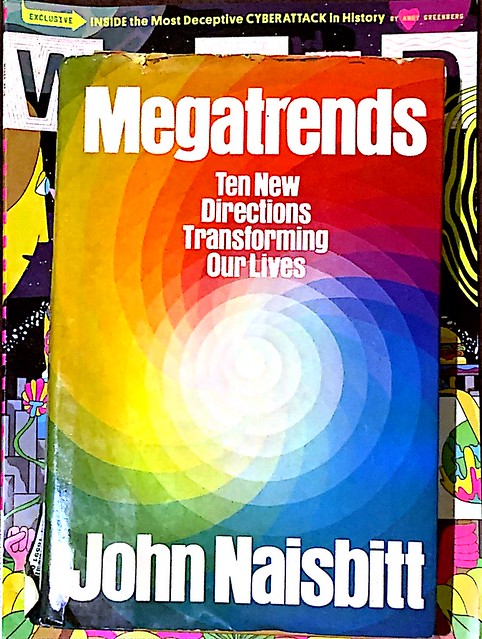
  • Megatrends by John Naisbitt

    John Naisbitt’s Megatrends was on the New York Times bestseller list when it was first published in 1982. Naisbitt outlined some big long term trends that he’d found as part of a decade of research. Hence the mega in Megatrends; though one could argue that macro may have been a more accurate term to use.

    I wasn’t that familiar with the work of Naisbitt; but came upon it by a circuitous route.

    My circuitous route to Megatrends

    I was introduced to the works of futurist Alvin Toffler in college reading Future Shock, The Third Wave and Power Shift. At the time these were cited on the technology degree courses my friends were on; as well as the marketing course I was studying.

    My house mate and I would talk about Toffler’s books as much Robert Pirsig or Emmanuel Kant, on the sofa of an evening sipping really bad instant coffee. I wouldn’t say that those were particularly happy days for me, but they did give me the time to think and read. Something that is much more of a struggle now.

    As I became more interested in Asia in the late 1990s; l read about how Toffler had influenced technocratic leaders from Singapore to China. I also started to read about John Naisbitt. Like Toffler, Naisbitt had done the Asian speaker circuits, met senior officials and conducted projects in-country through the 1990s. The management consultancy Toffler Associates eventually operated in China on government and private sector briefs.

    Compared to Toffler; Naisbitt seems to have become much more personally committed to China and central Europe. He has alternately lived in Vienna and in Tianjin, China. As the dot com boom kicked off I was reading this book. It fitted right in with similar writings from publications like Gilder Technology Report, Wired and Upside.

    LONDON
    Megatrends by John Naisbitt

    Back to the Megatrends review

    In Megatrends Naisbitt sets out X large scale long term trends that he sees in society

    • Information society and the rise of the knowledge worker
    • High tech / high touch – Naisbitt saw that roles would focus more on technology, or on ‘high touch’ sectors where humans aren’t easily replaceable like nursing care
    • Globalisation – a move in focus from the national economy to the world economy as the world becomes more interconnected
    • A move in strategic focus from short-term planning to long term planning.
    • Decentralisation of power and structures
    • A move from institutional help to self-help
    • Bottom-up governance across government and other organisations as a channel for public opinion
    • The move from hierarchies to networks
    • The population shift in the US from north to south
    • Increase in consumer choice

    At the top line we can still see much of these changes. I can see how Naisbitt’s vision of globalisation would appeal to the likes of Singapore and China. I am less sure about how Chinese technocrats would have made of bottom up decision making or as Naisbitt puts it ‘participatory democracy’.

    Naisbitt failed to take the next logical step; to look at the interactions between the trends. Instead the chapters remained siloed, rather than in context.

    For instance that the decline of hierarchies and rise of knowledge workers saw layers of management shed by organisations. Or the link between consumer choice and the rise of globalisation.

    Conclusion

    Megatrends has value in the way that looks at trends without looking at the how (usually mentioning digitalisation or some similar vehicle of transformation). This is something that we probably wouldn’t be able to do now; given that our mindset is about big data and agile processes. More book reviews here.

  • US bankruptcies + more things

    Pandemic triggers wave of billion-dollar US bankruptcies – really interesting data points and charts on large US bankruptcies in this FT article. The bigger question are these billion dollar US bankruptcies like ripping a band-aid off as their demise was inevitable, or are good businesses going to the wall in extreme times? (paywall)

    The Effects of Hong Kong’s National-Security Law Are Already Clear | 新聞 – Yahoo雅虎香港 Just a few weeks after China’s imposition of a new “national-security law” on Hong Kong, we can already see the law’s effects: It has emboldened the Chinese Communist Party (CCP) to suppress dissent, punish activism, and create fear within the city’s democracy movement. In 1997, the United Kingdom returned Hong Kong, which it had governed for 99 years under a lease extorted from the Qing Dynasty, back to the People’s Republic of China. At the time, the PRC promised to preserve the political autonomy and freedoms the city had enjoyed under the British until 2047. The national-security law and the crackdown it initiated marked the breaking of that promise.

    An Oral History of ‘Tony Hawk’s Pro Skater’ – The Ringer – the bit about motion capture purely for marketing, rather than improving game play was gold

    Gen Zer men think feminism has ‘gone too far’ | Canvas8 – ok dodgy headline. The interesting thing about this is that it questions the blanket progressiveness wrapped around gen-z. Which is also an indicator of how useless generations can be as shorthand. It would be interesting to see how they compared to previous cohorts of 18 – 29 year olds. Not terribly surprising though. More consumer behaviour related posts here.

    Here’s Why Jackie Chan Is Really Unpopular in Hong Kong | Vice – accurate, but neglects to mention a number of relevant points. That the fate of Chan’s son (arrested on drug use) rests with the Chinese government. So there was at least one point of leverage that the party has over Chan. Adding to the complex relation of Chan’s relationship to the Chinese Communist Party is is own family history. Chan’s father was a Koumintang intelligence officer hounded by the communists. After successive assassination attempts on his life; Chan’s father eventually ran away to Hong Kong and eventually Australia where he worked as a cook. Chan’s mother had smuggled opium in her past. Meanwhile his brothers who were left in China lived a life of hardship full of communist punishments because of who their father was.

    The Case of the Top Secret iPod – TidBITS – interesting article about an impressive device hack to repurpose it for other things

    DigiTimes: HiSilicon engineers abandon ship – Huawei is apparently looking to build a 45nm silicon chip fabrication plant without US tech, which DigiTimes claims is ‘mission impossible’. Kind of related form the FT: Huawei employees worry about lay-offs after tougher US sanctions. Not surprised that the global marketing team seems to be taking the cuts. It was often quoted to me that ‘the best advertising for Huawei was its employees’ and attributed to Mr Ren. This was when the company was reluctant to do co-marketing deals and advertising for handsets

  • Eat Your Greens edited by Wiemer Snijders

    Eat Your Greens is a selection of articles curated by Wiemer Snijders on all things that come up for discussion amongst account planners. Branding, marketing, some home truths about innovation and the value of creative. Much of it recycles the stuff that account planners know from reading Sharp or Field and Binet. In addition there are a few that specifically address diversity, inclusion – but excludes ageism in terms of the ways it talks about these as an issue.

    Where’s the value in Eat Your Greens? The answer to that question depends on where you are in your career. As someone who is established in my career, I found it valuable in a few different ways.

    Some of the essays from the likes of Phil Graves, Mark Ritson and Ryan Wallman, Rose and Faris Yakob, Byron Sharp and Amy Wilson are strong enough to make Eat Your Greens worthwhile in its own right. For instance here’s some of what Ritson had to say:

    “The modern marketer has created an entirely stupid dichotomy between ‘digital communications’ and ‘traditional communications’… There are just tactical tools, and they can only be valued and selected once a target and a position and a strategy are in place. What’s more, it’s clear that most successful campaigns combine multiple channels for optimum success. Most studies suggest that the more channels a campaign includes, the better the ultimate ROI.”

    Mark Ritson in Eat Your Greens

    Going through the essays allowed me to come up with recommendations of new reading materials referenced in the essays – I have been using it to bulk up my Amazon list.

    Essays that I would particularly recommend:

    • What Ails Marketing by Mark Ritson
    • Post-Truth Telly by Tess Alps
    • To Target Or Not To Target, That’s Not The Question by Shann Biglione
    • Everybody Lies – The Importance of Psychological Validity In Consumer Insight by Phil Graves
    • The Devaluation of Creativity by Bob Hoffman
    • Biting The Hand That Feeds Us? Why Advertising’s Love Of Novelty Is Doing Brands A Disservice by Kate Waters
    • Why Innovation Isn’t As Sexy As Business Books Promise by Costas Papaikonomou

    For busy marketers or junior planners, Eat Your Greens is a nice introductory point for a number of issues in marketing, such as the corrosive digitisation of marketing.

    I think it fulfils an important role. Particularly for junior planners as many agencies now rely on an army of freelance talent. Eat Your Greens isn’t a substitute for having senior staff developing younger account planning minds on the job. But given the current state of agencies, its probably one of the best options that we have. More book reviews here and my slowly updated bookshelf here.