Blog

  • Family funeral & things from last week

    I spent the weekend travelling back to Ireland for a family funeral. Despite the fact that it was a family funeral it was good to see some members of the family whom I haven’t seen since I was a teenager. It also cause me to reflect on some things, it inspired my post ‘Ramblings on consumption‘ and you might see similarly inspired future posts. I thought back to my childhood playing cards with my uncle and I have been been getting online practice of the card game Twenty Five. Twenty five had the same impact in rural Irish society that mahjong has for Chinese communities. If any of you want a game let me know.

    I came across an interesting case study on Chevrolet’s celebration of Children’s Day in China. I have put the video below so that you  can see the project, its a nice piece of work. Secondly it is worth reflecting on how this project fits into the changing media landscape. This exemplifies the cross over between brand advertising and corporate communications work that is now happening around the world. Brand advertising is leading this charge into PR’s heartland and taking some of PR’s largest budgets. In a separate note The Holmes Report found that the industry’s top inhouse PR leaders have had their budgets halved over the past six years.

    Enjoy the case study

    Winston Sterzel on shooting with China Central Television (CCTV) – think of it as PBS or the domestic BBC television service with Chinese characteristics.

    Heathrow Express’ advert featuring The Krankies was an interesting choice of creative. It’s very consistent with their brand and mildly subversive.

    GUCCI – Why are you scared of me WeChat campaign features a robot built by Hiroshi Ishiguro, director of the Intelligent Robotics Laboratory at Osaka University clad from head to toe in Gucci. When is the last time you saw a Chanel talking about:

    • What it means to be human
    • Ray Kurzweil’s concept of the singularity, where machine intelligence exceeds human intelligence?

    It then reflects on the benefits that technology have brought to date:

    Because of technology, we have turned fairy tales into animations and created memories of countless human childhoods.Because of technology, home entertainment equipment brings joy to the family, which has inspired many children’s future dreams and aspirations. Even two strangers, when they talk about the common memories they used to have because of the popularity of technology, can seem to understand each other in an instant.

    The implication being that new forms of shared memories may bond robotics in spite of negative factors like the ‘uncanny valley’.

  • Five things marketers can learn from the life and career of Aretha Franklin

    Aretha Franklin at Madame Tussaud's New York

    Aretha Franklin left a great body of work behind her over a five decade career in music. Her career had its degrees of twists and turns, both of which are reasons why she will sit along icons like David Bowie and Prince. But don’t you just die a little inside when someone on LinkedIn takes advantage of a celebrity death? They post a catchy headline like the one above about Aretha Franklin.

    They then come up with five general points that could fit into most people’s lives. They think that they are profound as Chicken Soup For The Soul or a Maya Angelou quote. In reality they are asinine crap.

    There are others who with list marketing tropes that probably first read in Philip Kotler’s Principles of Marketing; but they think are gold dust. They aren’t.

    So before you put finger to keyboard in order to boost your visibility by capitalising on the name of a dead person – don’t. I get that you want visibility to help your business or career, but at what cost? You give the industry that I work in a bad name. Which is the reason why we see commentary like this one by Bill Hicks. When marketing and advertising is trying to be relevant to society, why would professionals want to alienate society further?

    1. Did you actually know the celebrity? If not, now is not the best time for your article.
    2. Would your article be read out at a funeral as a eulogy? If not, don’t press publish.
    3. Will the celebrity’s fans appreciate your contribution to the celebration of their career? If not don’t publish.
    4. Is your article designed purely to capture the wave of interest about the celebrity? If so, don’t publish.
    5. Search your motivations, is this about you appearing as an expert rather than celebrating the career of the celebrity? If yes, or you’re not sure – don’t publish.
  • Ramblings on consumption

    We think of consumption as part of the very stuff of modern life. I clear out items on eBay. My Mum and Dad have boxes of things unopened since they moved house in 1981. A lady who lived up the road who died last year had people working for five days to clear out the things she had hoarded. The house had been packed with items from ceiling to roof.

    The role that consumption plays varies but taps into deep emotional ties. I felt both an emotional journey that I can only equate to grief and a certain release on getting rid of my record collection. I moved country for work and the bulk of it had to go. What was more distressing was not being able to make sure that it went to a good home at the time. It had defined me, brought me joy and latterly had been a weight that I only felt by its subsequent absence.

    Consumption and identity are also intertwined.

    In my pre-internet days you could get a sense of someone by visiting their sitting room or their bedroom.

    • What kind of books did they read?
    • What posters or pictures did they have?
    • Was there sports scarves, or signed shirts?
    • Family photographs
    • Taxidermied animals in either rural or ‘hunting, shooting or fishing’ households
    • What kind of videos did they have?
    • Where they a gamer?
    • What CDs, vinyl and cassettes did they have?
    • Did they have a system of hi-fi separates? What were the components like? Did they have headphones?

    You were able to build up a picture in your head about the person, their tastes and some historic touch points.

    Much of this now remains out of sight in the sitting room with the rise of cloud based services. But the picture is still here, though you will need a screen to see it.

    For many people homes are a mix of the digital and the analogue. Some young people may adopt analogue items for ‘authenticity’ in their lives. For older people its the archeology of their lives. Photos not converted to digital scans. Music that had meaning or was at a certain stage in their life. Souvenirs from holidays.

    If I look at my own parents:

    • They were more passionate about active collection of music in the 1960s before they settled down. They have finally got rid of a Philips mono turntable in plastic that hadn’t worked for years and a Sony reel to reel tape player. Both devices chosen for their luggabilty rather than quality. They had lived transcient young work lives, working away from home and living in digs
    • My Dad had spare time from shift work that he used to read a mix of reference books and fiction from the 1950s – the early 1980s. Since then he mostly reads caravan and crafting books
    • My Dad has a vast amount of tools in various states of repair that he accumulated. From when he started his apprenticeship to electronic meters bought this year
    • My Mum has a mix of cookery books from the 1950s to the 1990s and notebooks stuffed with clippings from magazines of recipes. In the notebooks are hand scribbled recipes that she exchanged with friends
    • They have carpets and stools that they crafted from kits in the 1960s before multi-channel TVs

    With time, more hasn’t mean’t better ‘quality’ consumption. Technology has provided us with more reliable electronics. Unless you are a hi-fi buff you are unlikely to know about the fragility of valve electronics or the weight of discrete solid state circuits.

    Globalisation has brought consumption of more ‘just good enough’ products. My parents still have some of the furniture that they bought when they got married. It isn’t Vitra or great Danish design, its mass producted items of its time. But the quality of the construction and materials contrasts with flat pack furniture bought later.

    Less consumption seems to have had a number of sides to it:

    • More conscious choice on quality. You couldn’t just order another on Amazon
    • Greater focus on curation of items
    • Less clothes but of a better quality
    • A macro view on ‘need’, rather than the micro view defined by the now

    You had the vintage well tailored tweed jacket or furniture that had been in the house for generations. In years to come what will all the delapidated Billy bookshelves and tchotchke fridge magnets say about us? Maybe this is a good part of the authenticity at the centre of Peter York’s ‘Hipster Handbook‘?

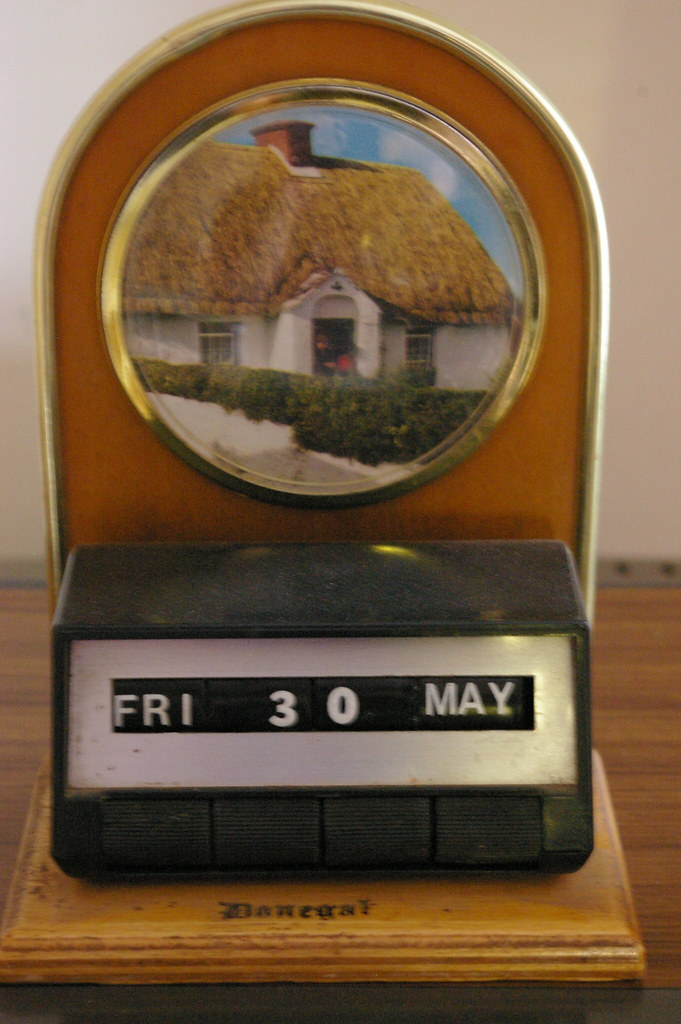
    I started to think about these things following a death in the family. My uncle lived in the ancestral home; which is a small farm in the west of Ireland. I had spent a good deal of my childhood there with him and other relatives. Life had got in the way of going back in person and there had been bigger gaps in time to my visits than I thought.

    Going back to the farm brought thoughts about consumption into sharp focus for me. My Uncle’s approach to consumption was very different to mine and likely yours as a reader.

    • He never owned a car or combustion engine-powered farm machinery. He hired in contractors and machinery when it was needed
    • As a child I had played amongst decaying wrought iron horse drawn equipment, that would have been used before the widespread use of tractors
    • I can remember when electricity was installed
    • Had a modern television but didn’t use it. He actively preferred the radio as his media of choice
    • He had a solid fuel cooker that provided central heating for the house. He also had an electric cooker and microwave oven, but refused to use the microwave
    • His music collection had been gifted to him by family over the years. They assumed that he liked local artists playing Irish traditional music. I don’t think that he went through the process I had done of exploring new music and tastes
    • He regularly read a local paper, but owned no books bar a booklet on the value of notes and coins
    • He had never travelled for leisure, but had been gifted souvenirs from my cousins. These came from Donegal to Dubai
    • Presents that he had been given decades ago remained in a drawer in case he would need them, from ties to aftershave
    • The family had tried to force him to have a cellphone and he only relented when he was in hospital during his later years and a neighbour gifted it to him
    • His idea of interactive gaming was a Benson & Hedges-branded deck of playing cards with four people around a table for a game of ‘Twenty Five

    IMGP3019.JPG

    His house remained unchanged from when my Grandmother had lived there. There wasn’t his ‘footprint’ in the house at all. From a personal point of view it meant that I could understand my Uncle in terms of ‘what’ he did; but not the ‘inner life’ that we are used to understanding through ‘reading the tea leaves’ of consumption: books, music etc. At the time I came away perplexed, a mystery that I would never understand.

    He lived in many respects a pre-industrial agrian approach to life. Time moves at the pace of the farm work rather than the clock. Your mark on the world was in the continued existence of the homestead.

    This brought into sharp focus for me the newness and ‘abnormality’ of modern consumerism. Perhaps ownership of the land provided the ‘weight’ that mass consumerism provides for many of the rest of us? And what would it mean if you had felt that ‘weight’ all of your life as my Uncle would have as the oldest son in the family?

    In contrast, my Grandmother had been more modern in her attitude to consumerism. She loved the television. She got rid of old wooden chairs that would need the occasional coat of paint for black powder coated steel and vinyl cushion seats.

    Into her late 80s she loved DVDs of traditional Irish music performances. A tape of electronica and early rap that I made at the age of 15 so she could understand what I was into at the time was a step too far for her.

  • Self doubt + more things

    Why social media and selfies are filling Hong Kong’s young women with self-doubt | South China Morning Post – 10 per cent of women in the 16 to 24 age group attributed their negative feelings to social media, while 31 per cent said it was due to friends and 28 per cent pointed to health. For older women, only 5 per cent cited social media, 18 per cent said friends and 40 per cent named health as an issue – survey of 1,010 respondents by think tank MWYO. Sample size is a little low. I suspect that self doubt and low self esteem due to social media is more than a Hong Kong phenomenon. There is a Dove brand marketing campaign in these insights. Filters and beautification camera apps probably drive this process even harder.  More on social media related topics here

    Ric Flair aka Nature Boy the veteran American wrestler from WWE appears in these ads. I love it for the nostalgia if nothing else. What’s amazing is the longevity in wrestling personality brands. World Wrestling Entertainment has an undervalued skill in building brands and sub-brand through storytelling that is timeless in nature. WWE is right up there with Disney in my book.

    Will China Let Google Back in? – MacroPolo – not likely, because China doesn’t need Alphabet.

    This is how Dutch police know you’re buying drugs online – interesting how transactions that don’t go through escrow can be compromised and how the police seem to be getting good intelligence on where the servers are located. This could be conventional police work, bad server set up or a compromise in the infrastruce of the dark web

    What does QAnon have to do with leftist Italian authors Wu Ming — Quartz – fascinating read. QAnon is definitely a pre-meditated construct, but beyond that we don’t know anything more about its creation.

  • The Conveni & things from last week

    The Conveni

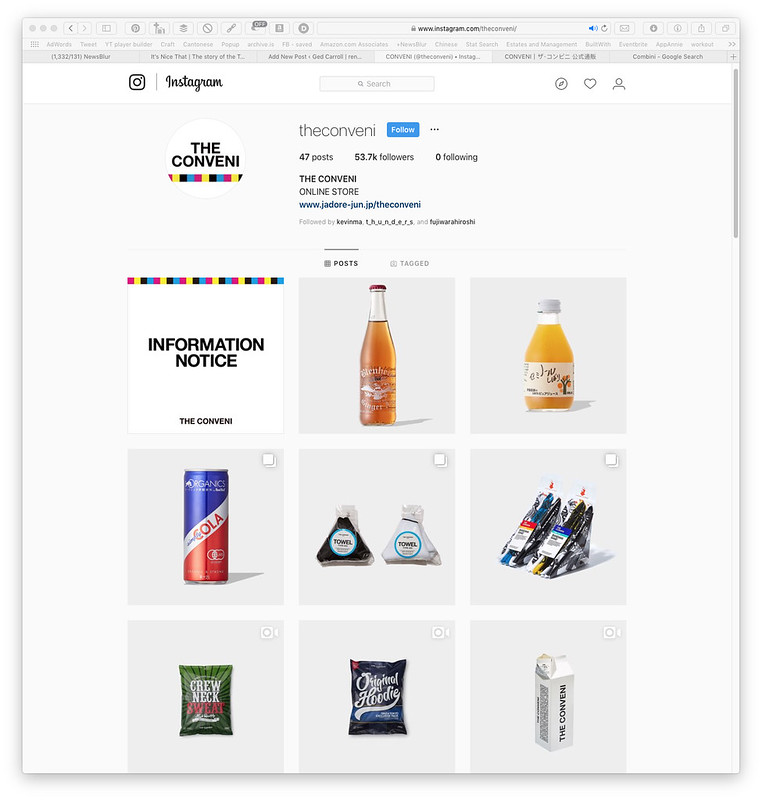
    Its hard to understand The Conveni without understanding Japanese retail. In Japan, 24/7 convenience stores play a similar role to what supermarkets have in the west. They do groceries, allow utility and mobile payments and provide other services like faxing or photocopying. They offer free wi-fi and air conditioning in hot weather. There are an essential part of of Japanese life and there is a ‘combini-culture’ around them. Hiroshi Fujiwara’s Fragment Design has taken a good deal of influence from combini culture for ‘The Conveni’ retail concept. It includes processed food, bandanas in sandwich packs, towels packaged like onigiri rice balls and sweat shirts in snack packets.

    conveni

    If you can’t get to Tokyo, you can still look at their e-store.

    Michael Gove famously said that with regards to Brexit people were tired of experts. Obviously discussions between men in a pub is the antithesis of expert discussions. So here is a podcast with a couple of knowledgeable people in a pub

    https://youtu.be/Sx4AF-3Rd44

    https://youtu.be/sju9laLqeCo

    Lippincott were working on a Toys R Us rebrand that the company couldn’t implement. I don’t know if design could have saved Toys R Us, but the work is really nice.

    Aphex Twin launched a new EP; there were posters around the world and a fantastic video by Weirdcore. Warning the video will affect people with epilepsy

    Egyptian Lover picks his favourite Roland TR-808 songs – amazing listening. Some of this brought me back to my early teenage years.