Blog

  • Glocal

    Glocal is shorthand for the maxim ‘Think global, act local’. This used to be a mantra for international marketers, but in a world of social media this springs up a myriad of complexities. Some of them good, some of them bad, particularly when global platforms filter foreign feedback into the home market. Or foreign campaigns play awkwardly back in home markets due to cultural differences.

    For years internet users pirating content have acted as a bridgehead for Japanese anime content, often much to the bemusement of the Japanese themselves. Just this week Japaneses netizens were puzzled by foreign praise heaped up a Japanese remake of My Little Pony.

    But this diffusion of local content to an international stage also has a darker side to it. Singapore Tourism Board has been embroiled in a firestorm of criticism at home when a promotional video that was made to encourage visitors from the Philippines came to the attention of Singaporean netizens.

    The reaction was so harsh that it the video was covered in The Straits Times and marketing press across the region.

    The Singapore Tourism Board took it down from YouTube and the video was reposted by netizens under the title ‘Singapore Tourism Board’s Horrid Promo Vid’. At the time of writing the reposted version has enjoyed almost 140,000 views with 230 comments and 577 dislikes.

    What would have been considered sweet and romantic for the intended audience was considered excessively syrup in its nature by Singapore netizens and I can see their point. Some of the comments include:

    Live From Asia videos: WHAT THE HELL DID I JUST SAW??? hahaha
    MegaSmilee1: STB is never gonna live this down xD
    Terence Yang: Honey, look! Its so lame…
    Jennifer Kingston: STB needs srsly needs new talent… Is this made by foreign talent too? -_-
    sporeKAfan: OMG this is such a fucking cheesy promo video! Such an embarrassment compared to our neighbouring countries’ tourism videos. What the hell is STB thinking of?
    Anurag Shivach: Was this supposed to be one of those so bad it’s good videos. I laughed all throughout, well done guys.
    Yibin Teo: My money!!!!!!! My hard earned money!!!!!God why do I pay tax?????

    The video spawned at least two parodies by Singaporeans:

    Glocal came about because doing everything from headquarters usually lacks brand resonance in local markets. In the age of worldwide social reach organisations need to move beyond the glocal model of ‘think global, act local’ to ‘think global, act local, review global’ in terms of sense and sensibility.

    From a purely selfish agency point-of-view, it is a lot easier to get teams to work on work that they can feel proud of. But poor-quality content and trying to get along with insufficient resources in some markets runs the risk of embarrassing the brand and tainting its reputation in the same way that a conventional PR crisis can. More marketing related posts here.

    More information

    Overseas reaction to Japanese My Little Pony dub is a little odd to Japanese people | RocketNews 24
    STB defends promotional video for Filipinos | Marketing Interactive
    ‘Baby surprise’ tourism promo video could have been done better: STB | Straits Times
  • Google Glass device

    I’ve blogged a few times before about the merits and flaws in the current iterations of  the Google Glass device. I consider the Google Glass device to be an interesting idea; because of the potential contextual nature of its content provision; but the product is flawed and ultimately a failure in the consumer space due to its product design and current limitations of technology. The Atlantic carried a very interesting piece that hyphothesised that Google Glass was failing because it was an assistive technology and assistive technologies make use feel week. However, if that was the case Glass should be fine with just a rebranding exercise, rather like glasses moved from being a weakness to a hipster accessory.

    Whilst I agree with the hypothesis that Google Glass can assist people, I don’t think that ‘disability aids’ are the correct analogy for Google Glass; instead Google Glass augments the majority of current users in theory; it is a telephone rather than a hearing aid. It is about making the user even better; think of it as having the personal assistant who whispers in your ear at a party the names of the people that you should know and where you met them previously, a personal concierge service like a shopper or a tour guide.

    Failings in Google Glass

    • Google Glass devices aren’t discrete. The glance up display Google Glass has a level of social and user awkwardness similar to early implementations of the touch display that tried to incorporate it with a keyboard like the HP-150. Google are on to something, the use of sneaky applications that would provide the right information at the right time. But the very act of using the device is a big tell that is both distracting and takes away the social impact of the information provided
    • Google Glass is interruption-based media. From point of view of someone conversing with a Google Glass device wearer, the sudden pauses and ‘zombie-like’ eye drift are disconcerting. Rather like if someone kept answering their phone in a meeting. The problem here is one of technology, Sony’s smart eyeglass prototype and Epson’s Moverio BT-200 which display the content directly in front of the wearers vision are more likely paths for a future successful solution as would some sort of discrete earbud with aural content delivery
    • The Google Glass device has too short a battery life. With a usable battery life of just 45 minutes usage time, users have to manage the device to husband power resources. Whilst Google calls this a design feature to try and prevent wholesale privacy invasion; the downside is the audience distraction. The reality is that I don’t think battery life is a feature but a function of battery technology failings at the moment. This could improve overtime with improvements in chip power consumption, power management techniques and incremental improvements in battery chemistry formulation

    Glass Rage
    Google Glass rage incidents happen for a number of reasons:

    • The wider socio-economic tensions that are breaking out in San Francisco between the digital haves and the local have-nots. It is a similar but more visible tension to that seen in Dorset or Cornwall as moneyed London city workers buy a weekend place or telecommute from the country and in turn drive up property prices out of the reach of local people. You can see it in Central London with bankers, foreign investors and Russian oligarchs looking for sanctuary and safety from the British legal system. The problem is of course, that gentrification kills the very elements that attract tech workers to San Francisco: authenticity, diversity, a little bit of risk-taking, arts and culture. This is what happens when Richard Florida’s cluster theory reaches a ‘point of inflection’; when the creative classes devour and destroy what they craved just by the nature of their sheer numbers
    • The unknown. The majority of Google Glass device users who have undergone a well-deserved drubbing seem to conduct themselves in an anti-social way using their device as if they have some divine right. Without wearing Glass they would be described as foolish, stupid or even borderline sociopaths. It is the same with most technologies, early adopters through their social normative compass out the window when they are trying the new, new thing and are then surprised when the world pushes back. Common sense and good manners should be a hygiene factor rather than a service pack. It takes years or longer to get this right; mobile etiquette is still an issue, some three decades after cellphones started to become popular

    There are some use cases for glass that make sense
    Glass would be much more useful, (at least until the technology is able to address some of the shortcomings listed above) in an industrial environment; for instance working in a tight space servicing a jet engine or augmenting a warehouse picking team’s work. All of this is dependent on the device being sufficiently robust to deal with a dusty, solvent-laden environment safely. It is probably no coincidence that Google is now trying to pivot towards the enterprise, but I could counsel against using Glass at the moment in customer-facing / front-of-house roles.

    More information
    People Don’t Like Google Glass Because It Makes Them Seem Weak – The Atlantic
    The Oculus Rift | Facebook post
    Epson Moverio BT-200 see-through smart glasses
    Sony Shows Smarteyeglass Prototype to Developers – CIO.com
    I like: Sony’s Smarteyglasses
    The Google Glass post

  • The Raid 2

    Coming back to the UK reminded me of how much Hong Kong is a cinema-centric culture despite the technology, mobile devices and amazing restaurants. Going to the cinema there was literally half the price of London, which means that I am much more critical of the entertainment shown. The first film I have seen that was actually worth it’s ticket price since I have got back is The Raid 2.

    The Raid put the Indonesian martial arts scene on the map with a highly kinetic film that owed much of its visual intensity to computer games. You can see shades of vintage Bruce Lee films and the ‘gun fu’ popularised by John Woo in these films. Whilst there might be a Hong Kong influence, the Indonesian martial artists definitely carve out their own path. 

    The Raid 2 follows on just hours from the first film; but is an entirely different beast.  It is much more polished. The plot is even better developed. The acting has improved. But if you love the original film  you will still have plenty to keep you happy in The Raid 2. They have added to the original formula, rather than having taken anything away. As you can see from the trailer, there is still lashings of Indonesian-style kinetic action in the second film.

    But the film’s pace ebbs and flows in order to tell a more detailed story this time around, which feels very much like an early John Woo, pre-Hollywood. There is a nod to Quentin Tarantino with some of the gimmicky characters such as the Hammer Girl character. The plot is a similar structure to A Fistful Of Dollars. Our hero goes under cover to gain the trust of an organised crime family and ends up between two factions within the one criminal organisation bent on gaining power.

  • Big life moments & digital

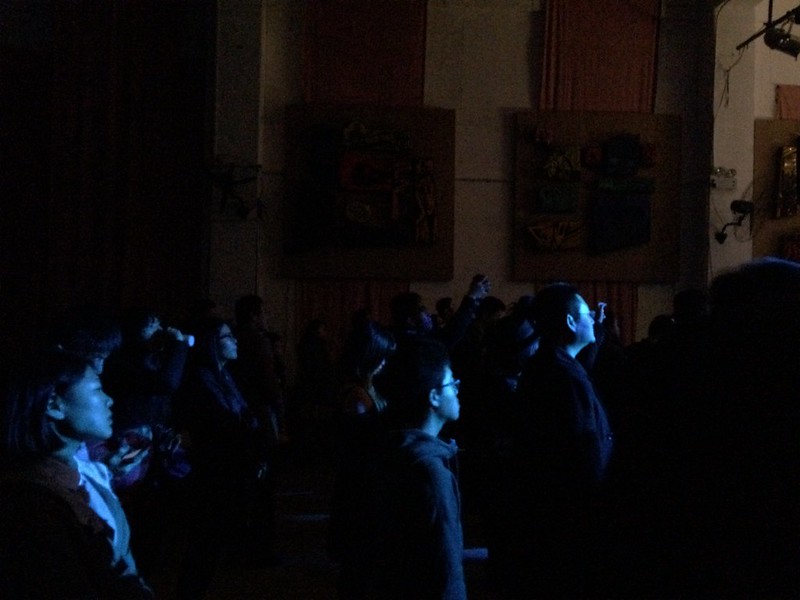
    I spent much of January in Shenzhen and went to a concert played by a local band. I can’t remember much about their music save that the lead singer work a bowler hat and seemed to influenced by 1990s Brit Pop and A Clockwork Orange. What was remarkable about the gig was that for the first time in about 10 years I saw concert goers dancing, swaying, being in the moment. There was was no digital mediation of these big life moments. More importantly I saw them watch the concert with their view unmediated by a smartphone screen which allowed them to actually participate rather than record the event.
    Untitled
    It was remarkable that digital technology had not invaded this happening as the audience were tech-savvy Chinese middle class. The ideal demographic where the smartphone has already achieved ubiquity to capture all their big life moments.

    Kevin Kelly’s book What Technology Wants posits that technology like progress is a natural unstoppable force moving forward what he calls the technium. This movement forward changes life, sometimes in ways that aren’t necessarily great. Part of the issue is that social norms don’t move at the same space as technology hence the lack of rules around digital big life moments.

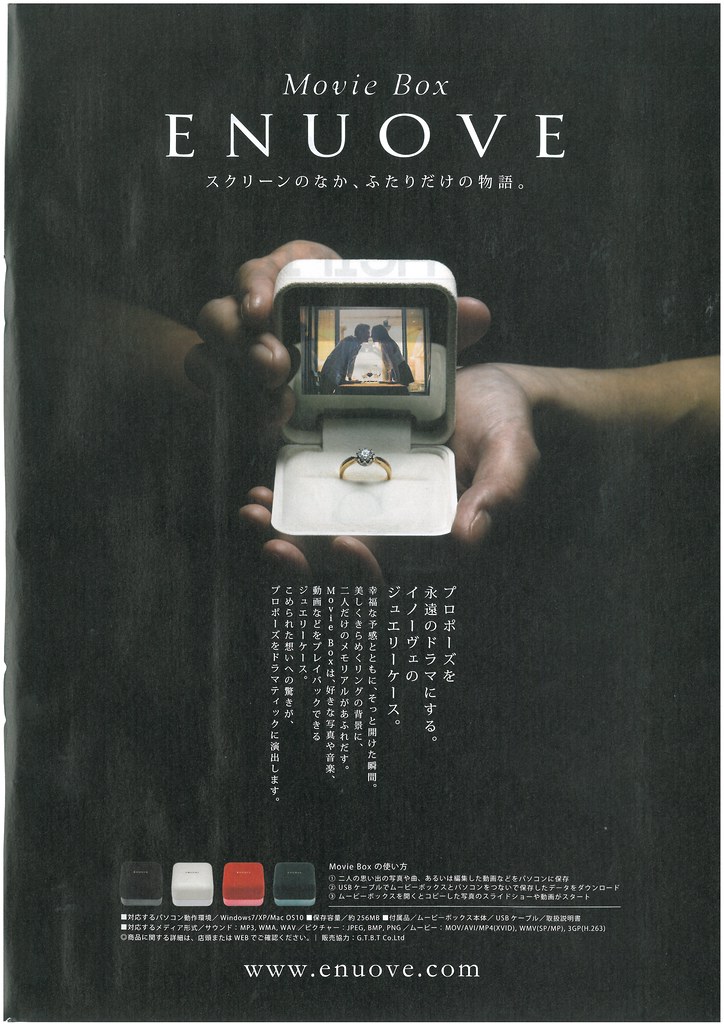
    I was looking through Smart magazine: a Japanese men’s magazine and came across an advert for a digital wedding ring box. Big life moments don’t get much bigger.
    Digital wedding ring box
    ENUOVE is a costume jewellery brand that has come up with the movie box; a small media player built into the wedding ring box which can accepts a small video clip in a number of popular formats.

    I found this advertisement interesting  and cut it out of the magazine because it was a great example of digital inserting itself into social norms of one of the most important life events of all. I tried to understand what role the digital technology would play. Usually in the west, the ring is presented with the man down on one knee whilst he asks the object of his affection to marry him whilst presenting the ring.

    My initial reaction was to think that the video allowed the man to use technology to mediate the discussion rather than having to worry about fluffing whatever speech that they had put together.  But what would the recipient think this cop out of doing a proposal by box.?

    I asked two colleagues who were currently engaged. The first one pointed out that a non-verbal proposal was considered ok if it was suitably grandiose:

    • Flying over a tropical beach in a helicopter where the proposal is written in the pristine sand below in two-storey letters
    • Having the proposal appear on an advertising board on Time Square
    • Hiring a sign writing plane to proclaim the offer across the skies

    I thought that these were pretty extreme examples? Outlier proposals? My colleague indicated that this was the case.

    The second colleague I asked introduced me to this video below, billed as the first lip dubbed wedding proposal that seemed to involved a whole neighbourhood as the cast.

    Isaac’s lip dub proposal has been seen over 25 and a half million times. She thought that the digital box was ok; it was a nice novelty and would be reasonable for a proposal if the prospective groom didn’t have the gumption to pull off something at least as epic as Isaac’s lip dub wedding.

    She might keep the box longer, as she didn’t even know where her current ring box was, it got lost after the first few weeks after the engagement.

    Now admittedly my study is very unscientific, but my conclusion was that digital had permeated the wedding proposal in a different way to what I had anticipated. YouTube has had a thermonuclear effect on what my colleagues thought was an acceptable / adequate wedding proposal. It had to have drama, spectacle and a uniqueness to it.  Their major life moments would take on a large scale cinematic element.

    The movie box offered a lower key alternative that was still acceptable due to it’s unique nature for a groom who couldn’t drill family numbers for a few months in performance of a lip dub or have their feelings writ large on a beach in the Maldives.

    Digital had already permeated our big life moments and we’re all as eccentric as Stanley Kubrick. More related content here.

    More information
    ENUOVE website
    Smart magazine (Japanese language only)
    OCT LOFT website

  • Hand scanning + more news

    Hand scanning

    Swedish city introduces payment by hand scanning – The West Australian – having your biometrics such hand scanning to be used as authentication; I am sure that there ethical issues with this. You can change a password, but you can’t change your biometrics. Fujitsu have had an ATM up and running that reads the vein patterns in its hand scanning. 

    Gadget

    Samsung Gear 2 Teardown – iFixit – interesting teardown

    1 million preorders of new HTC flagship phone on Chinese sites | WatchChinaTimes – not a bad start at all

    Slideshow: 10 Things I Saw at Bluetooth World | EE Times

    Sony Curves Images Sensors & TSMC Stacks Them | EE Times – interesting design moves

    Hong Kong

    Apocalypse Now in Hong Kong | WSJ – interesting new film (paywall)

    Japan

    Japanese company invents “Spring Santa” – We love the concept, but it’s actually a little creepy… – social gifting concept in Japan

    Luxury

    Mandarin Oriental readies its photo-sharing social app | Marketing Interactive

    Chow Tai Fook loses lustre amid poor sales in Hong Kong and Macau | SCMP

    Marketing

    Top 100 UK advertisers: BSkyB increases lead as P&G, BT and Unilever reduce adspend | Brand Republic

    Television Advertising Continues To Reign Supreme | AdPulp – not terribly surprised if one looks at a prominent FMCG brand business like Colgate | Palmolive the overwhelming majority of their advertising spend is television. Also digital doesn’t work well in brand building, if anything spend is overweight towards digital

    Was that expensive Chinese New Year campaign worth it? | Marketing Interactive – really good tips on running an international marketing campaign

    Media

    Bits Blog: Amazon Buys ComiXology | NYTimes.com – well that’s the comic industry screwed then

    Digital Intelligence :: Online ad revenue overtakes TV for first time in US

    (Re)defining multimedia journalism – Medium

    Online

    U.S. teens prefer Instagram over Twitter, Facebook – no real surprises here

    Alternatives to Paid Search on Baidu | L2 ThinkTank

    Wonga faces social media storm after forcing Twitter to remove satirical material | Brand Republic – cack-handed handling of satire that would have gone way over the heads of the working poor that Wonga preys upon has as its customer base

    Another Chinese Counterfeit Product: Social-Media Followers | Advertising Age – One Asian ad exec who asked not to be named described buying fake fans to give an ego jolt to a new venture in China. The rate, he said, was about 5 U.S. cents for a zombie that’s just a name, and 16 cents for higher-quality fakes with some content on their profiles. In addition to zombie fans, there’s a market for faux re-tweets and comments too

    QQ reaches 200 million users – surprising how it’s still climbing in the face of WeChat

    The Future of Social Media ROI: From Likes to Relational Metrics | INSEAD

    Retailing

    Beijing’s first 24-hour bookstore turns first page | WantChinaTimes.com – I wish London still had the 24-hour Borders on Oxford Street

    Burberry’s flagship Shanghai store facade responds to weather changes – Brand Republic News

    The future of retail in 5 charts | Digiday

    Software

    China Mobile Browser Industry Analysis in 2013 | China Internet Watch

    WeChat opens its image-recognition tech to the public | VentureBeat

    How Does Facebook Handle Graph Search Queries In A Timely Fashion? | AllFacebook – interesting primer on Facebook’s back-end technology

    The Box Blog » Announcing Box Open Source – good for OSS movement

    Telecoms

    Need for speed: Testing the networking performance of the top 4 cloud providers | GigaOm – I was one of the original non-US beta testers for WeberWorks – an online environment / workflow tool for doing and running PR programmes with real-time reporting and the thing that kept killing my usage of the tool was network latency, it was like working in treacle. Interesting to see GigaOm bringing this up as a key performance indicator

    Freescale and ALU show off small cell SoC – Rethink Wireless

    Web of no web

    China’s Quest for ‘MIPS in Wearable’ | EE Times – interesting move, China considers the broader internet of things to be strategically important wearables are just part of it

    On Beacons and proximity | BBH Labs

    Nike+ Fuel Lab opens to expand fitness tracking platform to third parties starting w/ RunKeeper, Strava, MyFitnessPal | 9to5Mac

    WeChat Campaign in China Offers Glimpse into the Future of Communications | Hoffman – nice case study on integrating WeChat into online and offline campaign elements

    Global wearable device shipments to triple in 2014: IDC | WantChinaTimes

    A Survival Plan for the Wild Cyborg | Slate

    Wireless

    Qualcomm, MediaTek in Two-Horse Race, Says CLSA; Game Over for BRCM, Etc. | Barrons