The value of reputation is something that various disciplines especially the public relations industry discuss ad infinitum. IPSOS have put together some interesting research and thinking that helps to quantify and shape the value of reputation. Previous discussions on reputation value that I have seen, haven’t had the same rigour behind them. The presenter calls out the assertions of former Unilever Paul Pollman as misleading.
Unlocking the value of reputation key takeaways
Shareholder value and reputation don’t necessarily correlate contrary to the assertions of Unilever’s former CEO Paul Pollman.
A better reputation means that advertising becomes more effective: more believable and more memorable.
A better reputation means that consumers are more likely to pay a premium for a product (however this is relative within category).
The value of reputation varies by region. It’s stronger in Latin America than the UK, Europe or many Asian markets, but weaker in Africa and the Middle East.
The value of reputation parleys into brand trust and brand resilience. A personal example of this for me was the wayUK consumers were much more supportive of the BP than American consumers during the Deepwater Horizon disaster.
Thanks to Stuart Bruce, I managed to get the full white paper that can be found here.
This is Financial Advice
This is Financial Advice is one of the best films that I have seen about the GameStop short squeeze.
Studio Ghibli music
While Japanese production company Studio Ghibli is recognised for its animation, the specially composed music is a key part of its ambience. It also happens to be great music for listening to while working. There’s a 120 hours of Ghibli related musical playlists here.
https://youtu.be/Cdp2qXHD96U?si=eaiL43V2J7K08Atv
Metal morphosis. Made Untamed
Toyota Australia were promoting the Toyota GR Corolla. This is the Corolla version of a GR Yaris. Same mechanicals, but five doors and a larger body shell. The Yaris was not made available in some markets such as the US and Australia, instead they got the larger car.
The creative is a mix of animation relying on precise high speed driving and a set course reminiscent of the late Ken Block’s Gymkhana series of films. The gymkhana series was in turn influenced by skate videos. Prior to being a rally driver, Block had co-founded Droors and DC Shoes prior to running his car culture brand Hoonigan and driving professionally.
Western fast fashion brands have managed to spread around the world, despite concerns over working conditions, product quality and impact on the environment. But things have gone into reverse for western fashion brands in China. Just over a decade ago saw China as a potential growth market. But over the past five years things have gone badly for them.
Looking at western fast fashion brand H&M’s presence in China, there has been a consistent decline since a 2017 peak of 507 stores in China.
Data via Daxue Consulting and South China Morning Post
The reasons cited by Chinese consumers online include:
Western fast fashion brands aren’t cut / styled for ‘Asian body types’. This sounds like a need for extended sizing
Local trends: the clothing doesn’t fit with local trends in design in the same way that local rivals can. Brands to keep an eye out for include Urban Revivo and JNBY
Other foreign brands meet the needs of young Chinese consumers better. These include Brandy Melville, and its “Malibu beach babe” look, while Chuu, is a Korean brand with K-pop aesthetics
Dentsu warns brands over tech ‘battling’ to increase ad revenue – The Media Leader – Global media buyer Dentsu’s forward-looking report said there had been an “explosion of the ad-supported segment” and that next year will see “an intensification of competition between ad platforms” with more lookalike apps, data partnership possibilities, premium subscriptions and a further proliferation of advertising formats and offerings. “Brands will have to balance these opportunities with risks to alienate audiences”, the report said. Especially given the fact digital adspend is forecast to hit $450.6bn in 2024, but its year-on-year growth is slowing to 6.2%. This means tech platforms are “battling” to increase their advertising revenue by launching new formats and carrying more placements. Some examples the report highlighted included: developments in adoption of search advertising on social media platforms like Instagram and TikTok, the rise of retail media on commerce sites, ticketing platforms and delivery apps, forecasted “spectacular growth” in advertising on connected TV (CTV), advertising video on-demand players launching new formats like YouTube’s unskippable 30-second ads, and major streaming players (and Amazon’s Audible) trialling or launching ad-supported plans
Gulnara Karimova Accused of Running Criminal Organization in New Swiss Indictment – The Diplomat – Swiss federal prosecutors filed an indictment against Gulnara Karimova, the daughter of Uzbekistan’s first president Islam Karimov, and an unnamed former general director of the Uzbek subsidiary of a Russian telecommunications company for alleged involvement in a criminal organization, money laundering, bribe taking, and forgery. The charges extend over a period of time running from 2005 to 2013 and mark the latest expansion and extension of criminal proceedings against Karimova and her associates. Karimova, once envisioned as a possible successor to her father, lived large and fell hard.
Power drives SK Telecom to AI pyramid strategy | EE News Europe – The AI Infrastructure plan consists of data centre, AI semiconductor, and multiple large language models (LLM) will serve as a technology platform. This will introduce energy-saving technologies including immersion cooling system and hydrogen fuel cells, and expand into the AI hosting business that generates higher margins by bundling these energy-saving solutions with Sapeon’s neural processing unit (NPU) and SK Hynix’s high bandwidth memory (HBM). – I am surprised that we haven’t seen similar ventures from Oracle, IBM and Fujitsu so far
Back in November 2012, my friend Wadds was researching and writing a book that would turn out to be Brand Vandals. I had a campaign going into mothers-and-babies screenings at cinemas and was in the final stages of preparing for a move to Hong Kong whilst launching an innovative facebook app for The National Lottery. The app featured a ‘scratch card’ mechanism within it, something I haven’t seen done since.
By this time Wadds and I had known each other for the best part of a decade and a half, having worked together on the 3Com (now part of HPE) and LSI Logic accounts at the start of my agency career in London.
Brand Vandals followed Wadds and Earl’s earlier book Brand Anarchy – the publishers were not enamoured with the original working title of Brand Fucked.
The Brand Vandals conversation.
The Brand Vandals conversation took place in The Stockpot in Panton Street. The Stockpot had a few branches in London was known for really cheap but good comfort food. Breakfast meant a fry up, which fitted in with our shared Northern sensibilities.
Wadds opened up with the question – had the social web failed to live up to initial expectations?
My reaction at the time was to point out the dissonance between social discourse and real life society. Twitter (or X) was where the bulk of political and media discussions happened, yet it was a small eco-system. Society in many respects hadn’t moved on from Roman times. While the intelligentsia might have had heated discussions in the forum (or on Twitter), these conversations didn’t reflect the vox populi. I name checked Juvenal, referencing Satire X ‘bread and circuses’ because it illustrated the two worlds neatly. The world of the political elites and the world of the common people with their different interests.
Ten years on, social channels have become much more ubiquitous. The early netizens who blogged and participated in forums and on Twitter have been joined by everyone else. The algorithms give people what they want, so political Twitter has its hecklers and fringe elements but still doesn’t reflect the voice of the people.
Facebook also had its fringe elements of discussion where the angry and paranoid could come together, rather like the USENET of old, but more accessible.
At the time, while I realised the digital inequalities that could be created by the data that consumers shared from the quantified self and telematics to the geolocation via their IP address. Tools in mining structured and unstructured data together with new devices putting telematics in the hand of everyone. All of that data was rip for (ab)use by corporates.
I don’t think that either of us fully realised how the world changes when it goes online.
In his book, Wadds quoted liberally fromThe Cluetrain Manifesto. What now could be seen to the last gasp of the libertarian bent of techno-hippy political thought. Doc Searls and David Weinberger’s book had more in common with The Whole Earth Catalog, The WeLL, John Perry Barlow and the back to the land counterculture movement than the modern web. Mark Zuckerberg et al represented the culture of Reagonomics rather than the ‘summer of love‘.
Scale has an effect of its own.
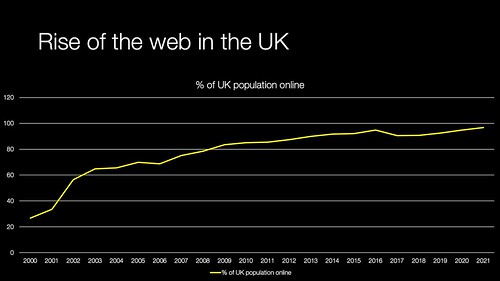
ONS data on amount of UK population online.
We didn’t fully realise what scale would do. Just like when social interactions and norms change when you go from a dinner party to an all-day music festival, the online rules changed. Looking back the scale is staggering, when you go from about a quarter of the UK population online during the dot com boom of 2000 to 88% online 12 years later. Between 2000 and 2002 the online population doubled in the UK. Part of this was driven the nascent mobile web, affordable internet service providers (giving a model more like the US) and adoption of broadband. Modern smartphones accelerated access further.
Hints of what could happen.
We had hints of the dark side through Chinese netizen culture and the phenomenon of human flesh search engine (人肉搜索) moral crusades, showing how people could come together in a common cause and be weaponised. This went back as far as the early 2000s. As far back as 2008, the Chinese judicial system was alarmed by its power and called it ‘cyber violence‘. It has been since turned loose on the wider world.
Joe Trippi, the political strategist behind Howard Dean’s campaign for the Democratic Party’s presidential nomination, showed how the web could be use to communicate, organise and fund raise back in 2004.
Information warfare found a febrile media that was ideal for its needs and was easy to scale operations on. It was no wonder in retrospect that the internet became toxic.
The Humane AI pin has been hyped for a while. Now it’s been launched as a product with what seems to be a small initial batch based on a waiting list and drop type distribution model. I thought I would wait a bit to post on the Humane AI pin and let the dust settle.
The Humane AI pin is an interesting take on a personal device. particularly with its ‘AI experience’ switching – picking the right smarts for the right task. This seem to fulfil the kind of vision that the likes of Kevin Kelly have outlined in the past. It also seems to access communications services like messaging services and the audio design in the product seems interesting. There is also a projected interface of sorts on the Humane AI pin. It’s an interesting alternative direction to the spatial computing vision of Apple’s Vision Pro.
The Humane AI device falls down in being such a network-centric device. Although it has onboard machine learning technology, its reliance on a relationship with T-Mobile US’ cellular network is problematic. Cellular connectivity is not ubiquitous. It is one of several device visions that have been articulated over the years, but what I still don’t understand is the ‘why?’
What’s going to be more interesting is what the Humane AI pin does next?
US law firms rethink China future amid economic woes, data crackdown | Reuters – Of the 73 largest U.S. law firms with a presence in China, 32 shrank their attorney presence in the last decade, according to a Reuters review of data from Leopard Solutions, which tracks law firm hiring. In Beijing, 26 of the 48 largest U.S. law firms drew down their presence since 2018. Worthwhile reading with: US consultancy Gallup withdraws from China | FT – market research was sensitive when I worked in China. Gallup’s business was closer to consulting than a pollster to get around these challenges. Interesting that they can no longer thread the needle in China
China’s family-run businesses face succession challenges – Nikkei Asia – more than 80% of China’s 1 billion private enterprises are family-owned, with about 29% of these businesses in traditional manufacturing. From 2017 to 2022, around three-quarters of China’s family businesses are in the midst of a generational leadership transition
Post-pandemic party’s over as Americans shun cognac | FT – Half of all cognac in the US is drunk by African Americans, a demographic that has been disproportionately affected by the cost of living crisis, according to analysis by Bernstein. The skew to African American consumers is in part due to the fact that French spirits producers ignored the segregation mandated by America’s Jim Crow laws and “cultivated the African American market segment in ways that other producers did not,” said David Crockett, professor of marketing at the University of Illinois Chicago. French spirits producers at the time marketed to Black-owned and targeted publications. As early as the 1970s the advertisements conveyed a message of upward socio-economic mobility, said Naa Oyo Kwate, a sociologist at Rutgers University
Wong wanted to enter the U.S. consulate. The diplomats told him that only the rooms in the St. John’s Building were on offer, and that the office tower did not offer the protection of a diplomatic compound. In Washington, Ngo took the matter up with one of Hawley’s policy advisers, reasoning that the ultra-Trumpian senator might have the president’s ear. Responding at 1 a.m., Hawley’s staffer promised to pass the message on to his boss, but nothing changed. On July 1, the national-security law passed. The diplomats’ positions were the same: Wong couldn’t enter the consulate and couldn’t apply for asylum from outside the United States. Wong and Ngo knew the rules. But they were asking for the same pathway to haven that had been granted to Fang and Chen…
The focus in Washington has moved on from Hong Kong to Taiwan. The island is under constant military threat from Beijing, which claims the territory as its own, even though the Chinese Communist Party has never controlled it. But for those in Taiwan who cherish their democracy, Hong Kong’s story offers a cautionary tale. The United States gave Hong Kong’s cause its vocal backing, then abandoned the city in its time of greatest need.
Asia is much more important to U.S. interests than the Middle East | Noahpinion – East Asian cities like Tokyo, Seoul, Singapore, and until recently, Hong Kong are arguably the world’s most magnificent — hyper-dense and efficient and bustling with life and creativity and personal freedom, but also extremely safe. East Asia is a wealthy region with high quality of life across the board, rivaled only by North Europe and parts of the Anglosphere. Maciej Cegłowski called them “Zeroth World”, and I think that is an apt description. – the burn for Hong Kong on this is real
Ideas
The challenges of sustainable societies and solar punk.
The one where Chandler Bing’s impenetrable job defined a generation | FT – André Spicer, Executive Dean of Bayes Business School, suggests a new category altogether: a “Chandler Bing job”, one indifferent to finding meaning, “low on existential rewards but relatively high on extrinsic rewards, like pay and promotion”. Chandler’s stoicism more broadly reflects Gen X’s tacit acceptance of their lot: the forgotten latchkey kids squished between the Baby Boomers and the Millennials. Jennifer Dunn, author of Friends: A Cultural History, says he “showed that we might not all find fulfilment in the first, or even the longest lasting job we will ever have.” Compared to today’s employers who are increasingly concerned about making their younger colleagues happy, few cared about Gen X’s work-life balance.
The New Working Class by Claire Ainsley is unashamedly wonkish in nature. Ainsley comes from the left of the political establishment. She is an executive director of the Joseph Rowntree Foundation. She had previously worked for Unite and as a government advisor.
Ainsley posits that the Labour Party is out of touch of who the working class are and what they care about. Deindustrialisaton and immigration has changed the nature of what working class means. They might have lower middle class incomes working in the services sector. Traditional blue collar roles declined to represent about 14 percent of the British population.
Ainsley’s The New Working Class is a testimony to how out of touch policy makers and advisers with the society that they claim to represent. This also makes wonder about the usefulness, and or, the attention paid to polling and research done by political parties in the UK. The Conservatives understanding of hard-working families shows at least some understanding at a high level of who the new working class are.
What struck me about the book is that much of the ‘new’ working class isn’t actually that new at all. The struggle to make ends meet is one that Orwell would have recognised the best part of a century earlier. The challenge of unemployment is one that haunted much of the 1970s and 1980s.
Family is still important and while society is secular, working class communities have been more socially conservative. That doesn’t mean that they hate gays or immigrants, they take a common sense approach to fairness but they will be concerned about family. The rate of change in society and the desire for working opportunities has been more of a driver over immigration than outright racism back to the rise of Enoch Powell.
I had thought I would gain new consumer insights in the same way that I have had in the past, reading books by like likes of American pollster Mark Penn, but this wasn’t the case with Ms Ainsley’s book. Ms Ainsley has clearly written for a different audience. Instead of the ‘new new’ insight, her work is a 101 guide for politicos to the society that the profess to live in and represent. That scared the hell out of me. More on the book here. You can find more book reviews here.