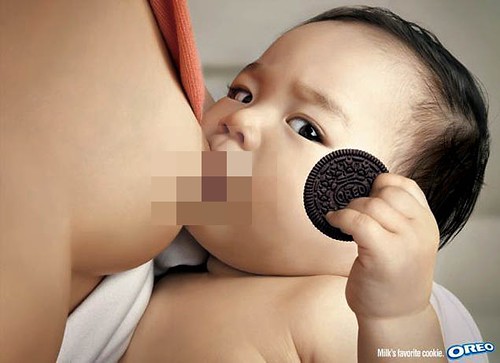
Looking at the Korean Oreo advert that seems to have caused a stir in the US, it seemed obvious to me that the advert was a case of throwing creative against the wall. It may have been used as a calling card, a way to spur debate or a mock-up for an award as Kraft seem to suggest.
In this respect it is rather like Volkswagen Polo car bomb ad that went around London agency world a number of years ago.
Korea like Singapore and China is a quite conservative country and has a higher proportion of practicing christians than you would expect. So I am not inclined to think that this was really designed to go out as marketing material from the band.
The Korean public would create uproar. Korean consumers have a reputation for staging protests and product boycotts. That would be way too risky for a foreign brand like Kraft.
I also found it is also interesting that Kraft has thrown Cheil under the bus really fast on this.
For what it’s worth I think that this could be a great creative if it had the right context – say targeting young men as a snack rather their more traditional demographic of family decision-makers – housewives. But you would have to select your media very carefully and be prepared for Lynx / Axe type backlash. More related content here.
I started posts on the Facebook acquisition of Instagram a number of times but got nowhere, so I thought I would collect up some of them thoughts and put them here. So here are some of those random thoughts:
Instagram and Facebook are very different types of social network. Instagram seems to tape into a latent passion for us to be creators, it came up with an application that flatters us into thinking that we may have a good eye for photography. Facebook is much more about gathering and sharing humint with their loose network, a poorly designed address book and an event organisation platform
Instagram and Facebook have very different design philosophies. Instagram is much more of a traditional web 2.0 firm. It’s product does one thing very well and makes the complex simpler for the consumer. Facebook’s user experience is well shit. This is probably for a number of reasons:
Facebook has a culture were engineering trumps design rather than the two disciplines been seen as equal partners like say Apple
Competition – Facebook has evolved from its original mission adding additional features as it was threatened by different platforms: notably Twitter. But the user experience hasn’t scaled as well
Monetisation – Facebook has been working hard to monetise its business with its advertising units, but you need content to advertise against. Much of the design is about wringing content out of consumers (and then having the opportunity to sell inventory against it)
Privacy – In order to get the humint to share with audiences, Facebook needs to strike a balance keeping the law and privacy advocates at bay whilst making it sufficiently difficult that consumers don’t lock down their data and consequently constrict advertising opportunities
An extension of the design difference between Instagram and Facebook makes me wonder about how long the Instagram talent will actually stay at Facebook beyond any lock-in period? I am making assumption that the deal was at least partly motivated by the Instagram’s team expertise in mobile service development and that would be dependent on retaining the talent.
Talent retention is also critical if Facebook acquired Instagram as a defensive play like it did with Octazen. In this case Facebook would be looking to lock up talent for as long as they could.
1 billion dollars in shares isn’t as expensive as 1 billion dollars in cash; consequently the cost is probably relatively cheap for Zuckerberg. Think of it this way – how real is the money that you make when the value of your house goes up or down until you actually come to sell the house? Cisco was a past master at large share-only purchases when it was a hot stock. This hasn’t impacted Facebook’s cash-flow, but it has shaken the institutional investors looking at Facebook’s IPO. Again this doesn’t really matter to Zuckerberg because Facebook shares will sell anyway because of the heat around the company. Zuckerberg has less to lose than the Cisco team did because of the way that Facebook’s voting stock is structured allowing its CEO to retain power
It used to be that there were a number of start-ups whose business model was to sell themselves on to a large dominant industry player. Over time the industry player changed: Cisco, Microsoft, Google but the business model remained constant. I expect the new target acquirer to be Facebook as entrepreneurs and venture capitalists dream of a quick buck rather than building something great
10 years from now, I still don’t know whether we will be looking back on the Instagram acquisition as being a similar folly to Yahoo!’s purchase of Broadcast.com now looks in hindsight. On one hand I feel confident because of the deal structure being in Facebook shares, and the price being small in comparison to the current notional value of the Facebook business. But for the reasons I have outlined above I am less convinced in terms of long-term fit with the business and relative importance of Instagram
Instagram were right to say yes. The timing couldn’t have been better, on the one hand in the short term Instagram is growing fast; its move on to the Android platform previously being an iOS-only application. In retrospect, this looks like Instagram moving from early adopter usage to early majority service users. At the same time a number of services are now integrating Instagram-type filters into their mobile applications, one of the examples I use is Tencent’s Weixin (WeChat) application, so it could be rapidly becoming a feature rather than a reason for purchase
Bob Barker is a client that I worked with on nascent digital work for RFI Studios. Bob worked as the CMO of Alterian. Alterian started off in customer experience management, they did a series of acquisitions when I worked with them including Mediasurface the CMS company. The company was acquired by SDL and some part of it was sold on to private investors.
Flip video camera
Bob decided to delve into social media and understand it as a marketer. The Flip Video camera which includes basic software inspired him to do video content. Bob had a ‘Gorilla tripod‘ for the Flip and the lighting was just done with daylight. I did an interview with Bob Barker for his blog last week, you can read his take on things on his blog.
I realise that we talk through a number of social platforms, so here is a list of what I use:
iMessage – though I have found it to be flaky
Skype
Fastladder.com for RSS feeds. I am currently experimenting with FavShare as a Fastladder client on my iPad and iPhone which started after my interview with Bob
Pinboard.in for social bookmarking
IFTTT to syndicate content
Microblogging: I use the Twitter client on my Macs at home, and m.twitter.com on my iPhone. I use Weibo’s iPhone client and WeiLark for the Mac to post on my Sina.com Weibo account, rather than Sina’s sluggish web interface
I use Kakao Talk and Tencent Weixin (WeChat) social messaging clients on my iPhone. The international versions of these tools don’t have all the features the local ones.
I use a mix of technology:
MacBook Pro
Dell 22 inch widescreen display
MacBook Air
iPhone
iPad
Samsung feature phone with dual SIMs
The video is on YouTube so may not be available to all readers. You can find Bob’s video channel here.
Ferdinand A. Porsche, 76, Dies – Designed Celebrated 911 – NYTimes.com – Butzi Porsche dead. Butzi Porsche came from a family of engineers. His grandfather led the original team behind the Volkswagen Beetle. His father had been part of that engineering team and went on to found what we now know as Porsche. However, Butzi Porsche wasn’t engineer but a designer with technical chops. After an infamous meeting of the Porsche family, no members were allowed to work at Porsche. Butzi Porsche didn’t get to do more after he designed the 911. Instead Butzi Porsche started Porsche Design. Butzi Porsche did product design for other companies. Porsche Design also came out with its own products with Butzi Porsche designing watches, glasses and more. Butzi Porsche resigned from Porsche Design in 2005 due to ill health.
Why Are So Many Americans Single? : The New Yorker – single living was not a social aberration but an inevitable outgrowth of mainstream liberal values. Supported by modern communications platforms and urban living infrastructure: coffee shops, laundrettes
Kraft break-up yields marketing shift: Warc.com – the break-up is ironic when you look at the trouble they went to, in order to buy Cadburys and then break their business down broadly into Cadburys + Jacobs Suchard vs Kraft US.
HK’s rich hesitate to have babies | SCMP.com – interesting takeaways: didn’t want the emotional commitment, time poverty, financial stability / too small a living space and concerned about the local environment not being suitable for children. It was interesting that the education system was given such a hard time, given that it’s better than the UK system (paywall)
agnès b. | VICE – great interview with French fashion designer agnés b
Marketing
Fueling the hunger for The Hunger Games – The New York Times – really interesting comment: …during the 1980s you bought the poster and once a year went to a convention and met your people for something like Star Trek (and Star Wars). It misses out the fact that you are likely to have had real-world friends that you would have talked about it with as well – marketers now seem blindsided to the real-world
The idea of green fatigue encouraged me to reflect on FMCG marketing in the 1980s. In the late 1980s we’d started to see mainstream brands selling ‘green’ products: washing-up liquid and clothes detergents that were more friendly to the environment. Concerns about phosphate-based detergents in water supplies, organo-lead compounds in petrol and the effect of chloro-fluoro carbons on the ozone layer drove a wider consumer awareness of the environment setting a zeitgeist that was ripe to sell more environmentally conscious fast-moving consumer products.
Sales of these products dropped as the recession changed consumers focus from being environmentally responsible to paying down personal debt and worrying whether they would have a job next year.
Ipsos research
According to Ipsos as reported by Le Monde; an increasing number of consumers feel ‘too much is being done about climate change‘. A combination of ‘green wash’ products.
Green conspiracy
It was interesting to see that environmental groups seen to be part of a green conspiracy (just look at your typical Greenpeace campaign and it kind of makes sense). Greenpeace themselves have admitted that they won’t let the truth get in the way of their campaigns. They have also ran some questionable lobbying campaigns in Africa as documented by Stewart Brand’s Whole Earth Manifesto.
They also have a feeling that consumers greening efforts don’t move the needle in the first place. Le Monde describes this as green fatigue. Again a good deal of this is down to the nature of the way green campaigning is delivered. What is less apparent is whether there is a wider political aspect to this. Is there a fundamental divergence in values from the progressive consensus around globalist responsibility for climate change?