Blog

  • Gordon Moore + more things

    Gordon Moore

    I was introduced to Gordon Moore and Moore’s Law through a college class on innovation taught by my friend Neil Keegan. I have also just read Michael Malone’s The Big Score; an account written in the early 1980s that Gordon Moore featured in as one of the co-founders of Intel.
    OnInnovation Interview: Gordon Moore
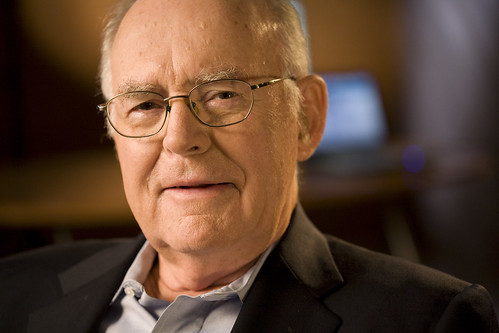
    Gordon Moore taken for an OnInnovation interview he was doing circa 2008 for the Henry Ford Museum of American Innovation

    Gordon Moore was a San Franciscan by birth but educated at John Hopkins University, rather than Stanford University. He worked at Shockley and at Fairchild Semiconductor prior to co-founding Intel. In many respects Gordon Moore was more low-key than other Intel founders like Bob Noyce or Andy Grove – but the ideas behind Moore’s Law echoed around the world. The law has been interpreted and misinterpreted by technologists, economists, journalists and policy makers the world over.

    Moore’s Law

    Gordon Moore made an observation that was published in 1965 and became an immutable forecast for the rest of the 20th century that would guide the direction of the semiconductor industry and every industry that relied upon it.

    It started off with an article that Gordon Moore had published in Electronics magazine on April 19, 1965. He observed that the number of transistors were doubling every year over a 10-year period. This relationship was widely known by people working in the field. But the semiconductor field was a small community and the name Moore’s Law eventually stuck.

    The complexity for minimum component costs has increased at a rate of roughly a factor of two per year. Certainly over the short term this rate can be expected to continue, if not to increase. Over the longer term, the rate of increase is a bit more uncertain, although there is no reason to believe it will not remain nearly constant for at least 10 years.

    Once, that had been proven correct in 1975, Gordon Moore went on to revise his model to assume a similar effect very two years. This was presented in a speech at the IEEE International Electron Devices Meeting that year.

    All of this meant that technologists like those at the Computer Science Lab at Xerox PARC could spend large amounts of money building foundational technologies and know that the ability to commercially produce these items would catch up ten years hence. Robert X. Cringely posits that much of the dot com bust was down to an industry getting too ahead of itself in terms of what it estimated Moore’s Law could achieve in the mid-to-late 1990s.

    Integrated circuits started finding their way into everyday products and facilitating new product categories such as laptops, smartphones and the modern web.

    Gordon Moore left us on March 24, 2023.

    Beauty

    How millennial faces fell out of fashion | Financial Times 

    China

    The world according to Xi | The Economist 

    China detains staff, raids office of US due diligence firm Mintz Group | Reuters“Red alerts should be going off in all boardrooms right now about risks in China,” the source, who did not wish to be identified due to the sensitive nature of the matter, said. China has said it welcomes foreign trade and investment but stressed that security comes before development. U.S. businesses operating in China are increasingly pessimistic about their prospects in the world’s second-largest economy, according to a survey released this month by the American Chamber of Commerce in China. Two-thirds of the respondents cited rising U.S.-China tensions as the top business challenge. Western due diligence companies have got into trouble with Chinese authorities before. British corporate investigator Peter Humphrey and his American wife Yu Yingzeng, who ran risk consultancy ChinaWhys, were detained in 2013 following work they did for British pharmaceuticals group GSK. Humphrey, who spent two years in jail for allegedly acquiring personal information by illegal means, which he denied, told Reuters that providing due diligence in China was even harder now because of a “massive tightening in access to information.” – Ok a bit of context. If Gordon Moore hadn’t died this post would have been Mintz Group + more things – this is how big this is. The Mintz Group is a respected due diligence research company. If you are looking to:

    • Buy a business and want to know if its real, or what the states of the assets are
    • Want to ensure that you are not doing business with legally sanctioned entities
    • If you are a finance firm and want to ensure that the people you are considering to invest in are who they say they are and the business actually exists and works in the way they claim
    • If you are trying to find out if your supplier is conducting themselves in an honest manner with you

    The more opaque China becomes, the less tenable it becomes to conduct work there, do business with Chinese companies or invest in Chinese companies and the Chinese economy. The timing is less likely to be intentionally symbolic than happenstance, but either way it isn’t good news.

    Energy

    Solar power: Europe attempts to get out of China’s shadow | Financial Times 

    Finance

    Marking US banks to Market | FT – interesting and a bit concerning

    Luxury

    How the effect of COVID-19 continues to ripple through markets: Fewer Engagements Bite Into Signet Jewelry Sales 03/20/2023 

    Marketing

    Inside Food: a new agency for a complex world | Creative Review co-founded by my friend Iain Tait

    Media

    Negativity drives online news consumption | Nature Human Behaviour – and that poses a problem for its advertising based funding model looking for brand safety as well as the move to ‘barbell’ political discourse

    Online

    Lessig for the Internet Archive. This is the transcript from a video I… | by Lessig | Mar, 2023 | Medium – Internet Archive under attack by commercial media

    TikTok’s CEO Isn’t The Boss – by Alex Kantrowitz – this pretty much sums up the outcomes from the Congress star chamber. While I feel sorry for the gentleman, he knew precious little about his business. More here: TikTok Hearing: The End of an Era. This Kevin Xu helps you understand a small part of the bigger picture here: RESTRICT China – by Kevin Xu – Interconnected

    Tax Heaven 3000 – a dating sim that does your taxes by MSCHF

    Software

    ChatGPT Gets Its “Wolfram Superpowers”!—Stephen Wolfram Writings 

    ongoing by Tim Bray · The LLM Problem – excellent essay by Tim Bray on large language model systems (ChatGPT, Bard etc). Tim knows what he is talking about having helped found OpenText and going on to hold senior roles at Sun Microsystems, Google and Amazon. Bill Gates as more techno-utopian take on machine learning (of which LLM is a subset) – The Age of AI has begun | Bill Gates 

    Apple ‘Porn’ Filter | Techrights – a disturbing development that opens a Pandora’s box of possible censorship and authoritarian measures in the wrong hands – which its likely to fall given the global ubquity of Apple’s technology

  • Vietnam requiem + more things

    Vietnam Requiem

    Horns that seemed to portent the apocalypse and stuttering dialogue: ‘none of them received a heroes welcome, none of them, none of them. None of them received a heroes welcome’. This was the soundtrack of 1985 as part of Vietnam Requiem sampling 19 by Paul Hardcastle. At the time the sampling got me interested in music, production, technology and DJ’ing – which pretty much set the path for the various stages of my career to date.

    The best part of four decades later and I finally got the see documentary that was responsible for much of the samples in 19. I can understand how Vietnam Requiem might have profoundly affected Paul Hardcastle at the time.

    https://youtu.be/t2q-_Z0xdDs

    SVB (again)

    Scott Galloway on Silicon Valley Bank’s collapse and the rise of Saudi Arabia. More on SVB here.

    BMW M1

    I am a huge fan of the BMW M1 and have written about it before. So I wanted to share this documentary by Jason Cammisa on the car. The putdown of modern BMW’s current 2-series range as ‘Grand Corollas’ is actually an insult to Toyota.

    Driving Japan

    Before I moved to London, I had a car and drove everywhere. I even drove for leisure. One of my favourite drives was going past the local oil refinery and associated chemical works late at night for the dystopian cyberpunk vibes of mercury vapour lamps reflected from matt zinc coated lagging.

    These videos of driving in Japan gave me a similar sense of enjoyment.

    Au campaign

    KDDI cellphone service brand Au are looking at metaverse and Web 3.0 value added services, which partly explains this new campaign. I think that it is interesting as it reminded me of CD-ROM era motion comic and how Midjourney and Stable Diffusion can be used to reduce production costs on a campaign.

    If this all feels a bit 2021, its because large corporate take time to catch up with where things are. I can also understand the attractiveness of the metaverse and digital assets as a concept in modern Japanese culture. Even if it is out far, far ahead of where technology is actually going.

  • The Big Score by Michael Malone

    The author of The Big Score is a lifetime inhabitant of Silicon Valley, Michael Malone. Malone went to school with Steve Jobs and spent his entire working life as a journalist covering technology companies of the area. His own career sounds like a veritable history of technology sector business reporting. Malone had written and or edited for the San Jose Mercury News, Fast Company, Upside, Forbes (ASAP), The New York Times, Wall Street Journal and Wired magazine. Now he co-hosts a weekly podcast on the goings on in Silicon Valley.

    The book was originally published in 1985 and has been finished prior to the launch of the Apple Macintosh. At the the time of writing, Malone had been an early to mid-career journalist.

    Silicon Valley time capsule

    His book is time capsule of how Silicon Valley would have likely seen itself. The people portrayed in it lack the kind of artifice that pioneering PR people like Pam Edstrom would later drum into a young Bill Gates with media interview training and briefing books. Companies have since gone a step further and seldom engage with the media at all; instead putting out news by blog post or staged video production a la Apple under Steve Jobs and Tim Cook.

    Steve Jobs on Apple’s future back in 1997

    When we come to understand modern-day Silicon Valley five decades into the future, we won’t have the same level of intellectual honesty that we have in The Big Score because the artefacts and interviews will be so vanilla.

    The book had become a largely forgotten business history book. Michael Malone revisited much of the history of covered in the book with a slightly longer term perspective in his 2002 work The Valley of Hearts Delight, which covered the history of the area from the 1960s to the dot com era. While The Big Score might have been forgotten, it was resurrected when Stripe through its publishing arm put it out again in 2021. They did this because while the book was forgotten by the general public, it has been read in libraries by university students and in their own collections by people like me who followed the technology sector.

    IMG_0008

    Getting things wrong

    In the introduction to the book, late career Malone freely admits the three things that he got wrong in The Big Score:

    • The impact of the internet. While it didn’t reach public consciousness until I was in college; as a high schooler in 1969 Michael Malone had got a chance to try the ARPAnet during a class visit to Xerox PARC (Palo Alto Research Center). Secondly, the San Jose Mercury News had been using email and bulletin boards as part of their business process and offering since the 1980s. Yet Malone’s past familiarity gave him little idea of what was likely to lie ahead. His elevated access as a journalist to the great and the good of the technology sector didn’t help either; in fact Bill Gates made a similar error to Malone in the first edition of his book The Road Ahead. Gates worked very quickly with the publishers to get out a second edition that corrected his mistake. But I think Malone’s inability to see and his intellectual honesty about that is instructive for all of us
    • While he had the chance to meet Doug Engelbart, Malone wrongly assumed that Engelbart was an eccentric inventor trying to get people to pay him his dues for technology that got bypassed. So, Engelbart doesn’t feature in The Big Score at all, despite The Mother of All Demos
    • Intel’s Andy Grove, who Malone now considers to be the most important business man in the history of Silicon Valley doesn’t get a prominent role in the book. That’s not so bad as Andy Grove managed to write a lot in his own right, notably Only The Paranoid Survive

    The Big Score on excess, greed and ethics

    Malone’s The Big Score like Robert X Cringely’s later work Accidental Empires wastes no time in showing Silicon Valley’s underbelly. At the time of writing there was a large amount of industrial espionage happening between hardware companies, many start-ups were being developed by greedy experienced executives and top performing workers were burning out by trying to keep up self medicating with drugs and stimulants and alcohol to take the edge off. Something you still see today with engineers using Adderall to help them focus.

    In this respect The Big Score is very different from other works that cover this era such as Chip War, Fire In The Valley and Where Wizards Stay Up Late.

    The Big Score by Michael Malone tells the tale of Silicon Valley before the Apple Macintosh and the large media companies of Yahoo!, Excite, Alphabet or Meta et al.

    While the counterculture did play a substantial role in the PC revolution, much of early Silicon Valley was about trying to accumulate wealth and while the successful are lionised for a while; most people did middling to ok at best. There was a work culture of hard working and hard drinking which meant that marriages didn’t last. The first barrier that Silicon Valley broke through was one of class, if you were bright and successful enough, class didn’t matter.

    Robert X. Cringely in his later book Accidental Empires talked about how Bob Noyce (a key player at Shockley Labs, Fairchild Semiconductor and Intel) was rejected from joining a local country club despite his business success. Class still existed, but not within these companies to the same extent. Michael Malone in The Big Score conveys how the culture clash over class between its workers and those who funded it, ripped apart Silicon Valley and created an explosion of semiconductor companies that dominated from the late 1960s to the mid-1980s and beyond.

    While Silicon Valley provided a greater egalitarian opportunity for the corporate man who worked there, women are seldom mentioned.

    (Aside: At the start of my career in agency life I had LSI Logic as a client. LSI Logic was founded by Wilf Corrigan a veteran of Fairchild Semiconductor. Even then at the height of the dot com bubble; ‘real men’ were engineers or salesmen and women worked as secretaries or in public relations. As the company had grown their female corporate marketing manager had been pushed out of the headquarters and to the far flung European office, which was the smallest part of the business were she could do the least damage. I still remember how awkward it was to see her treated with distain by her main colleagues. She had many faults, but the treatment lacked decorum and discretion. This kind of culture is fostered from the top of an organisation down. Despite all this she had still been granted shares in the business and a good deal of share options meaning she could be comfortably well off and fund various American christian endeavours.

    I even got to meet Corrigan, the son of a Liverpool docker came across as a Silicon Valley analogue of Michael Gambon’s character in The Layer Cake – rich but not sophisticated. Someone who mistook his mix of hard work and good fortune as a divine right.)

    While much is said about the egalitarian nature of David Packard, William Hewlett and Bob Noyce, they still had the social conservatism of Leave It To Beaver. Malone eulogised Hewlett and Packard in his later award winning business history Bill and Dave. The Big Score portrays them with a clearer eye. But Bill and Dave came out later on when Silicon Valley was starting to lose its moral compass. H-P under Carly Fiorina had ruptured the H-P way and was an indicator of what was to come – so Malone recast them as mythical heroes.

    Silicon Valley soap opera

    Malone’s description in The Big Score of the break away of talent from Shockley Labs and Fairchild Semiconductor is accurate. But the story itself is engaging in the same way that the family drama of the soap operas that my Mam used to follow.

    Stripe Press

    Stripe Press have given The Big Score a much needed needed design refresh. They typography makes it easy to read and the book is immensely well read. The hardback cover, binding and paper are high quality for a book of this nature. It is the kind of book that will be an heirloom that can be handed on down to the next generation. If not for the value, for the historical knowledge. Beyond the self penned introduction at the front, the contents of the book itself were left alone.

    Recommendation?

    If you are student of Silicon Valley history or have read Malone’s other books The Big Score is a great complementary read. The republishing of the book by Stripe Press is timely given the fads of the metaverse and NFTs that have swept through the technology sector recently.

    However if you wanted one book to start you off on your Silicon Valley journey, I wouldn’t recommend it. I would suggest that you read the following books before getting to The Big Score. Its not because these books are better, but that they provide a better initial entry point into the world of Silicon Valley and its history. Malone’s book was written relatively early one and other books can provide a better basic knowledge framework because of The Big Score‘s age:

    • Accidental Empires by Robert X Cringely was something so different to what I’d been used to. I’d worked in industry, but hadn’t experienced anything like this. There are similarly great books to read like Fire In The Valley and Where Wizards Stay Up Late – but they aren’t as entertaining to read as Accidental Empires and pull their punches in order to be seen as ‘serious’ business books
    • Architects Of The Web by Robert H. Reid. He wrote up the profiles of many of the pioneer web companies including Netscape, Real Networks, Marimba, Yahoo! and Silicon Graphics. It’s helpful to revisit the future the way it was envisaged during the late 1990s and see how the future has changed. 
    • Bill and Dave by Michael Malone tells the story of Silicon Valley pioneers Bill Hewlett and Dave Packard. Nowadays people think of them as just a brand of laptops or printers. But Hewlett Packard was much more. They pioneered the Silicon Valley start-up, their successor businesses Agilient, HPE and HP. Bill and Dave’s biggest impact was in Silicon Valley culture and lore. They built the company in a garage and started the egalitarian culture with The HP Way.
    • Chip War by Chris Miller. Miller is a think tank wonk and history professor who tells the story of the semiconductor industry specifically through its relationship with the military industrial complex and its relationship with national security. Chip War deservedly was recommended as one of the FT’s business book’s of the year 2022.
    • Dogfight by Fred Vogelstein. Fred Vogelstein is an experienced journalist who most notably covered the technology sector for Wired magazine. If your familiarity with the tech industry starts with Google and Apple. Dogfight is a great entry point.
    • The New, New Thing by Michael Lewis. Pretty much every book that Lewis writes will compare unfavourably to his first book Liar’s Poker, but that book doesn’t mean that The New, New Thing shouldn’t be read. The book profiles Jim Clark, who founded Netscape and Silicon Graphics and aimed at the time to turn the healthcare industry with a new project. Lewis is capturing Clark when he is past his prime from a creative point of view. What Lewis does capture is the optimism and hubris in Silicon Valley that it can change anything.
    • What The Dormouse Said by John Markoff. John Markoff is one of the titans of reporting on the business of technology alongside Steve Lohr and Walt Mossberg. In this book Markoff draws a line between the counterculture of the 1960s and the personal computing revolution through to Web 2.0

    More on The Big Score here.

  • Silicon Valley Bank + more stuff

    Silicon Valley Bank (SVB)

    Silicon Valley Bank funded this documentary about their history from their founding in 1983 to 2003. It’s now preserved by the Computer History Museum in Mountain View – one of the towns that make up Silicon Valley.

    Business

    POP MART dominates blind box toys market with co-branding | Daxue Consulting – interesting differentiation from Funko with a particular focus on young women and white collar workers. But I can’t see them appealing to the manly men that the Chinese government seeks to have reflected in youth culture

    Why M&A is not a good path for Qualcomm | Digits to Dollars 

    China

    Interesting use of AI by China’s government and academics: AI just predicted the price tag for Beijing’s South China Sea ambitions | South China Morning Post – apparently it was used to help design a high capacity dredger

    China Cultivates Thousands of ‘Little Giants’ in Aerospace, Telecom to Outdo U.S. – WSJ 

    Why did Lego choose Vietnam, not China, to build first carbon-neutral factory? | South China Morning Post – Toy behemoth’s move reflects how like-minded multinational firms are diversifying supply chains away from what has been known for decades as the world’s factory. Lost investment dollars amid the US-China trade war and pandemic have sparked concerns within China

    Economics

    ‘No other option’: Russia’s unequal economic marriage with China – Hong Kong Free Press HKFP – the Ukraine war has cemented Russia as China’s little brother rather than peer. Add to that China’s nationalists still smarting from losing Vladivostok to the Russian empire and one could see how Russia may have trouble on at least two fronts in the future

    Finance

    Longtime China investor Anatole to open ‘outpost’ in Singapore | Financial Times – it makes sense that they would follow the expansion of the global supply chain, but doesn’t reflect long term confidence in China’s dual circulation model

    Silicon Valley Bank / II

    Bloomberg have done a programme explaining about what happened with Silicon Valley Bank and how it went under so quickly. Silicon Valley Bank had problems due to raising interest rates, issues with their risk management and an abnormally high amount of customers withdrawing funds. However there was also an issue about the way Silicon Valley Bank communicated with the market, which in turn created a crisis in depositor confidence.

    Health

    Alphabet’s keynote and plans for the health industries. Usual nod to privacy (hahahaha), cloud computing, consumer devices and AI.

    Hong Kong

    HK’s first AV actress, Erena to star in debut adult film with renowned Japanese actor, Ken Shimizu, Culture, Sports and Tourism Bureau denounces false congratulations – Dimsum Daily 

    Hong Kong bans rapper who joked about hurting the feelings of the Chinese people — Radio Free AsiaThis makes it more likely that artists … will express their loyalty to Xi Jinping, if they know what’s good for them

    Korea

    Inspired by a traditional silver wedding band, Seoul is building the world’s largest spokeless Ferris wheel 

    Luxury

    Chinese tourists unwilling to pay extra for sustainable travel options even as concern about climate change on the rise, McKinsey and Trip.com report says | South China Morning PostChinese travellers are increasingly concerned about climate change and are aware of their environmental footprint, but are still not ready to pay extra for sustainable travel, according to a recent report by consulting firm McKinsey & Company and Chinese travel services provider Trip.com Group. Data from McKinsey, which surveyed a total of 5,457 respondents from 13 countries including China, the United States, India and Saudi Arabia, showed that more than 60 per cent of Chinese travellers were worried about climate change and believed that commercial aviation should become carbon neutral in the future, putting China near the top among the countries surveyed. A separate survey conducted by Trip.com last year showed that almost 85 per cent of Chinese travellers rated sustainable travel as important or very important. However, compared to travellers from other countries, Chinese tourists are reluctant to pay a premium for sustainable travel. Only 20 per cent of surveyed Chinese tourists said they would pay 2 per cent extra for carbon-neutral airline tickets, ranking near the bottom among the countries surveyed – well what would you expect when you have been repeatedly told by your government and media that the west and the United States is to blame for it all anyway? Secondly, civil society like Greenpeace or the Sierra Club can’t operate in China which will also affect awareness

    More on the serious issue of violent crime for luxury watches in London. I wrote recently about the ‘London Watch‘ where watch wearers have an empty wrist when going around central London. This is going to negatively impact everything from luxury sales to hospitality and tourism in the UK at a time when the economy can ill-afford to turn down business.

    Media

    Pornhub owner sold to Canadian private equity firm | Financial Times – I guess the financiers believe that the business has been largely de-risked by the prosecutions against MindGeek owners and clearing out of the platform

    Online

    Deepfake ‘news’ videos ramp up misinformation in Venezuela | Financial Times – it sounds like something from a thriller, but its more insidious and banal all at the same time

    Security

    You Should Really Think About Blurring Your Home on Google Maps – CNET – handy life hack from CNET

    Technology

    The Man Who Made Xilinx | Electronics Weekle – interesting profile of Xilinx co-founder Bernie Vondersmitt. I have been reading Stripe Press’ republication of the 1985 book The Big Score by Michael Malone, so this article felt particularly apropos. More on The Big Score shortly

    Telecoms

    Huawei has replaced thousands of U.S.-banned parts in its products, founder says | Reuters – Ren Zhengfei said Huawei had over the past three years replaced the 13,000 components with domestic Chinese substitutes and had redesigned 4,000 circuit boards for its products.

    Musk brought internet to Brazil’s Amazon. Criminals love it. | AP News 

  • London Watch

    The YouTube algorithm can take you into odd places, so it was with me and the London Watch. The watch collecting community is a global connected bunch of super passionate and and seriously nerdy people. It’s not the kind of stuff I would generally have bothered with. Watch collectors, particularly at the premium to luxury end of the scale have have started to talk about London (and by the implication, the rest of the UK) as hive of crime.

    Watch community YouTubers often do a wrist check to show what timepiece they have on. Usually you will see a luxury or cult timepiece. But I have started to notice a few videos talking about the presenters empty wrist as a London Watch. You can see it on this live stream by Paul Thorpe just after the 9-minute mark. He was doing the video from right by the Oxford Circus shopping area in Central London.

    The implication being that only going watchless or wearing a plain looking Casio is the right ‘watch to wear’ in Central London.

    Rolex GMT-Master II 116710

    Crime tsunami

    A random walk through Google News yielded these examples:

    It took seven years for YouTube celebrity Yianni to talk about having his watch taken in a violent robbery that occurred back in 2016

    My list of robberies isn’t exhaustive, but the constant drip, drip, drip of this news helped drive the idea of the London Watch.

    Staggering scale

    In October 2022, a luxury auction house ran a public safety campaign advising watch collectors to leave their pieces at home after they were alarmed by the Metropolitan Police’s own crime numbers. This came after the police tried and failed to assure Londoners and tourists over the summer. In April and May 2022, there was a 60 percent increase in high value watch robberies just in Central London with a 100 having been reported and investigated by the Metropolitan Police.

    Watch crime has been happening in European tourist spots as well such as Barcelona and Paris, but the UK seems to be particularly blighted. London based watch crime has even attracted the attention of US watch collector hobbyist site Hodinkee who featured it heavily in an article on the international view.

    Between January and July 2021 there were 377 reported watch thefts, according to the Met Police compared to 621 in the same period during 2022.

    Brazen watch robberies fuel shock rise in violent thefts in London ITV News

    Police have attempted to stop some incidents in progress, but the scale of the problem seems to be beyond their current capability and capacity.

    Possible contributing factors

    • Rich opportunity. London is an international city and hosts high net worth individuals from different countries all year round. Many choose to make it their home
    • Luxury watches get a good return for the thieves. Apparently a watch will net the thief half its face value when fenced. By comparison diamond or gold jewellery will fetch roughly 10 percent of its value. I was surprised by this as all high end watches have a traceable serial number, which would make it harder to pass on. Many are apparently stolen and shipped out of the country, though some end up for sale online
    • Thieves have very little chance of getting caught. The amount of incidents that are happening versus the amount of successful police investigations means that both watch and phone thefts are a low risk, lucrative option for thieves. Despite London have a large amount of CCTV systems, only a small percentage of the crimes are solved. Finally the police are under-resourced for the scale of the task they face

    The high level of violence involved is troubling and reason for it isn’t immediately apparent.

    What does the London Watch phenomenon mean?

    Impact on global tourism business. When Hong Kong’s South China Morning Post is running articles like Wearing your Rolex or Patek Philippe in Europe? Why you should be worried about London and Paris’ spikes in luxury watch theft – you realise that your city has a reputation problem with high spending East Asian travellers. The UK’s Daily Telegraph points out that the crime particularly targets the wealthy and tourists with impunity.

    Thieves seem to use social media research and spotters to find their mark. Many of these spotters work as staff in restaurants, hotels, bars and night clubs frequented by the rich.

    • Luxury sales will be impacted, this looks like the likely reason that auction houses are actively warning people in London about the risk and how to mitigate it through public information campaigns
    • Tourists are less likely to spend money in hospitality if they feel that some of the staff might be setting them up to be robbed
    • Tourists and business travellers are less likely to come to London, if they feel that the risk of violent crime is disproportionate

    For the time being, be sensible and stay safe out there by wearing a London Watch.