Category: branding | 品牌推廣 | 브랜드 마케팅 | ブランディング

The dictionary definition of branding is the promotion of a particular product or company by means of advertising and distinctive design.

I have covered many different things in branding including:

  • Genesis – the luxury Korean automotive brand
  • Life Bread – the iconic Hong Kong bread brand that would be equivalent of wonder loaf in the US
  • Virgil Abloh and the brand collaborations that he was involved in
  • Luxury streetwear brands
  • Burger King campaigns with Crispin Porter Bogusky
  • Dettol #washtocare and ‘back to work’ campaigns
  • Volkswagen ‘see the unseen’ campaign for its Taureg off road vehicle
  • SAS Airline – What is truly Scandinavian?
  • Brand advertising during Chinese New Year (across China, Hong Kong, Singapore and Malaysia)
  • Lovemarks as a perspective on branding
  • BMW NEXTGen event and Legend of Old McLanden campaign
  • Procter & Gamble’s Gillette toxic masculinity ads
  • Kraft Mother’s Day campaign
  • Kraft Heinz brand destruction
  • Porsche Design in the smartphone space
  • Ermenegildo Zegna
  • Nike’s work with Colin Kaepernick
  • Counterfeit brands on Instagram, Alibaba and Amazon
  • Gaytime Indonesian ice cream
  • Western Digital
  • Louis Vuitton collaboration with Supreme
  • Nokia
  • Nike Korea’s ‘Be Heard’ campaign
  • Mercedes SLS coupe campaign
  • Brand collaborations in Hong Kong
  • Beats headphones
  • Apple
  • Henrion Ludlow Schmidt’s considerations of branding
  • Cathay Pacific
  • Bosch
  • Mitt Romney’s failed presidential bid
  • Microsoft Surface launch
  • Oreo Korean campaign
  • Chain coffee shop brands and branding
  • Samsung’s corporate brand
  • North Face’s brand overeach in South Korea
  • Mr Pizza Korean pizza restaurant and delivery service brand
  • Amoy Hong Kong food brand
  • Chevrolet Corvette ‘roar’ campaign promoting a build your own car service
  • Keeping it gangster with Jingjing

    Hong Kong is familiar to many westerners as a backdrop for gangster films from Enter the Dragon to Jackie Chan’s Police Story, PTU and the Infernal Affairs trilogy.

    In fact, the society is much more organised and less violent than the likes of the UK. Even the old public housing projects in Aberdeen don’t really compare to south London. However, why let the truth get in the way of a good story or movie? Which is why the Beijing Olympics mascot Jingjing made me laugh.

    Olympic mascots - check out the gangster panda with the hand-gun

    You can see Jingjing giving it the full gangster style in shooting. Also note the red face of drunken rage. And he is also an accomplished fighter and tasty with a baseball bat. This has been featured across Beijing 2008 marketing materials and souvenirs.

    JingJing1.jpg

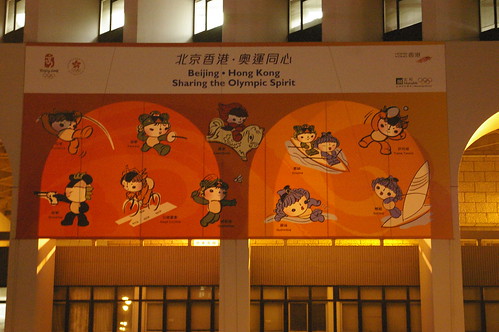
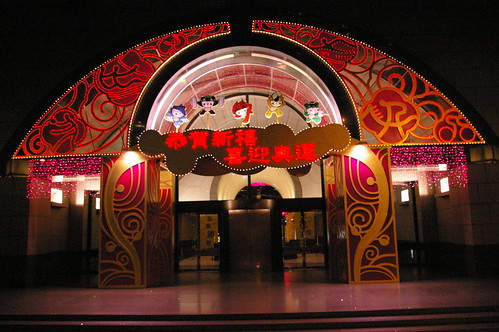
    On a more serious note the games event pictograms are an interesting organic interpretation of what Otl Aicher did for the 1972 Munich Olympics. You can see them in this surround at the Bank of China building (click on the picture if you want to see in more detail.) They remind me of early Chinese character pictograms in terms of their feel, a kind of future primitive design aesthetic. You can see how pride and nationalism are coming through in the designs.

    Bank of China

    More China related coverage here.

  • Greenpeace reputation sails into dangerous waters

    Greenpeace has been hauled over the coals with allegations that the large multinational pressure group used classic spin tactics of lies, disinformation and sensationalism. Roughly Drafted has gone toe-to-toe with the well financed pressure group to press for the truth around their greener electonics campaign:


    The PR problem for Greenpeace is pretty simple, once they start being discovered using such underhand tactics they will appear less credible and start to lose the funding and goodwill they need to make some of their more valid campaigns and devalue what
    dedicated supporters have already achieved.

    Roughly Drafted also cites well known mistakes by the large multinational pressure group including damaging a healthy coral reef in the Phillipines because they had the wrong maps and a series of lies told during the Shell Brent Spar debacle.

    As media becomes more transparent with the blogosphere, both corporates and not-for-profits cannot afford to step out of line.

    This time Greenpeace did not ignite the kind of media furore that Edelman and Wal-Mart caused, but if they keep on going they may be on the receiving end of protestors both online and in ‘meat space’.

    Greenpeace relies on the fact that it is doing the right thing to protect them and most corporate won’t go toe-to-toe. However that doesn’t mean that individuals and activist organisations won’t.

    Think about it this way:

    • Greenpeace is a large multinational organisation with 360 million USD revenues recorded for 2005, it has a network of international offices and a fleet of ships
    • The organisation has a well-known high profile brand that runs against the grain (like many large fashion brands from Nike to Stussy would like to position themselves)
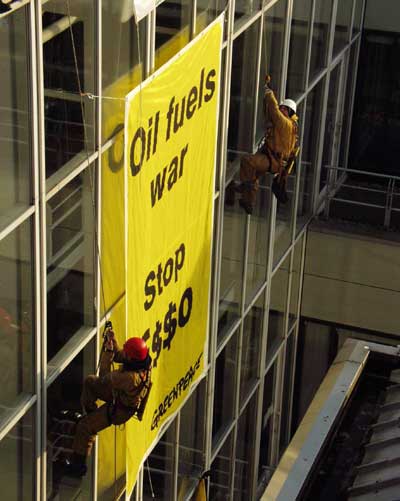
    • You could even consider a lot of their protests as an extreme sports marketing campaign (abseiling, scuba diving, sailing, running around in RIBs and thumbing their nose at authority like skateboarders or graffiti artists)

    Sounds like a large corporate in structure and behaviour?

    Image from Wikipedia (click link for copyright statement)

  • Chocolate as a name

    I was walking down Oxford Street and struck by how the LG Chocolate stuck out from the rest of the phone models in phone shops that seem to have sprung up like weeds right along the road from Regent Street to Tottenham Court Road tube.I am not a number, I am a free man

    Whilst I am sure that LG would assure me that Chocolate is the cats meow, and I am sure that they have bought prominent placement with discounts and shelf space payola, I think that it stands out cleverly because of its name.

    Motorola has played at this with the SLVR, RAZR and PEBL; an ironic take on text-speak and talking about the tactile properties of their phone. LG with its challenger status as a mobile handset manufacturer can afford to be daring and has gone much further.

    Chocolate implies:

    • A certain size and is an interesting (maybe unintentional) reference to the way customers used to describe the Sony CMH 333 a decade before and the industry term of ‘candy bar’ to describe the classic Nokia form-factor of the late 1990’s and early 2K’s
    • An affordable luxury or indulgence providing the product with a certain cache
    • Implies the easy-to-hand convenience that a mobile phone provides to on-the-go lives, which the role chocolate plays for them as food

    Product naming is a tricky and lucrative business with people who advocate numbering pointing out the success of BMW. Numbers also prevent arguments based around subjective criteria that everyone who can be bothered getting involved has an opinion about; I launched a web-based product where senior management changed the name of the product 72 hours before launch.

    Bringing a consultant, usually a move to get around the internal choke points outlined often just makes the whole thing worse as the Royal Mail / Consignia debacle proved.

    However for every BMW there is a 100 companies that you know the company name but the products themselves don’t have a distinctive brand personality (the Sony CMH 333-example being a case in point). Only my most nerdy friends would be able to tell you what model number of Motorola StarTac phone they had, but they remember that they had a StarTac, I bet it will be the same way with the RAZR.

    I remember when I was working on the launch of the Palm m100, Palm’s entry-level PDA designed for college students and first-jobbers; its project codename was Kelvin.

    We hoped that it would launch with this name as Kelvin gave it a personality that matched what the product wanted to be.

    Eventually the company adopted what are to my mind bland and meaningless range names: Tungsten and Zire and then inherited Treo from the Handspring acquisition; but what do these names mean to the average consumer?

    If you want to continue the debate on names or numbers, free free to leave a comment below. More related content can be found here.

  • Pop Truth and Power at the Coca-Cola Company by Constance Hays

    The journey back north gave me time to read Constance Hays expose of the accidental success that is the Coca-Cola company Pop Truth and Power at the Coca-Cola Company.

    The book was a bit repetitive in parts and could have been reined in with some proper direction and editing, but that’s a problem of the editor rather than the author per se. Despite these flaws it provided an interesting insight into how a company had become such a colossal success in spite of itself and a parable on what happens when you try and shaft distribution channel partners.

    The Coca-Cola Company used interesting accounting arrangements and stuffed its distribution channel in order to deliver results. But this just moved revenue allowed them to book revenue early rather than creating business growth. In this respect is similar to the way IBM started selling rather than leasing mainframes to book sales early whilst personal computing ate into its business market. It used an off-balance sheet transaction to set up a separate distribution company and then buy up its partners bottling operations. Eventually this arrangement together with product disasters like New Coke and Dasani caught up with them

    Unlike Enron these weren’t bad people, they were just trying to keep Coke enjoying the kind of success it had always been in a changing world. The changing world increasing dominated by savvy consumers and operators like Wal Mart that have a touch of the night about them. Where it gets interesting is how someone like Warren Buffett could get taken for the ride by the Coca-Cola Company.

    It is full of high-drama like directors being called to meetings in distant aircraft hangars, being fired by key shareholders and then all of them going home in their own Gulfstream jets – quality, you couldn’t make Pop Truth and Power up, even if you wanted to.

  • Charles Dunstone

    Charles Dunstone at LSE Entrepreneurs Group

    On February 27, 2006 Charles Dunstone founder and CEO of Carphone Warehouse spoke at the London School of Economics Entrepreneurs Group.We posted Charles Dunstone’s main speech here straight after the meeting, but didn’t have time to type up some of the interesting responses that came out of the Q&A session afterwards. Commentary by Charles Dunstone is in italics.

    On funding…

    Funding Carphone Warehouse was partly luck because of being in an amazingly fast-growing marketplace. Probably the most amazing part of it was that I put my 6,000 GBP of savings into the business; from 1989 to 2000 there was never any other investment in the company and we never borrowed any money.

    We just used our working capital and what became part of our DNA was ‘make sure you’ve sold before you’ve got to pay for it’ and we funded the whole business from our suppliers. Erm, I’ve no shame about that at all their money is the cheapest and least questioning money you’ll ever get. So, the great thing is to get supplier funding in whatever you do, they’re much less likely to throw you to the wolves like the banks or a venture capital company or someone are. And I guess the second part of that is, however tempting it is at the time, equity is priceless. I see lots of people who are trying to raise a bit of money and they feel like they’re giving away the equity to raise the money. They’ll rue that when the business is successful and is worth a lot of money. Do everything you can not to give equity away.

    On Vodafone…

    In reality at the time, everyone says they paid an awful lot of money for Mannesman, by buying it with overinflated paper. It was a ludicrous exchange rate with over-inflated share prices and I think that thing that people should be ever respectful of what Chris Gent managed to achieve was a very, very simple rule if you look at every transaction that he made: he bought for paper and sold for cash.He never exposed, if he was over paying for a business it was because the stock market was too high, he was just as high as the business that he was acquiring in the long term he made sure that he got cash in the bank. That is why when we come to 2001 or so Vodafone was the only telco that didn’t have massive amounts of debt; BT had to demerge Cellnet or O2 as it is now, France Telecom and Deutsche Telekom had to sell assets they had run up enormous debt.

    On maintaining a strong internal culture…

    Passion is difficult and I kind of refer to the point that I didn’t, wasn’t really sure how we created the culture. Part of it was my personal involvement. I think that a lot of it is consistent leadership. Leadership may not get everything right, but the bigger the organisation the greater the need for a sense of consistency, a sense of orientation and the values of that organisation.

    And if I look at the people that supply us, its very interesting to see how their fortunes have changed. Originally you had Vodafone with very consistent leadership under Jerry Went and then Chris Gent, then you had Orange with very consistent leadership under Hans Snook at the same time you had One-2-One and Cellnet had different CEOs every two years business all over the place: absolute chaos.

    Then you get a change: Orange gets sold, France Telecom changes the leadership of Orange constantly: Orange becomes a complete mess. O2 gets consistent leadership, O2 becomes a successful business: sold to Telefonica for enormous sums of money and through all of this I don’t think that you can underestimate the value of having really consistent leadership. This has an impact on passion and people.

    On VoIP (voice over Internet Protocol)…

    I think that the difference between Europe (particularly the UK) and the US is that VoIP will be very big in businesses, in residential homes you can’t have broadband without having an exchange line: that’s the way the regulator has decided it wanted to make sure that BT can make a living. If you’ve got broadband, if if you don’t want it, if you pick your phone up you’re going to get a dial tone that you can make a phone call from. Once you’ve got broadband unbundling, once you’ve got a connection from the exchange to the home it doesn’t cost you anything to connect a call whether its over broadband or you pick the normal phone up.

    So suddenly a normal phone has the exact same economics as Skype, so I think what will happen, what you will see people like us do is offer VoIP-priced services on your normal phone at home without you having to put a headset in your PC or mess around and do all that kind of stuff. There are some people who will find reasons to do it and things that they want to do within it. The majority of people with a fixed-line are people with a family, over 30 years old, 50 per cent of it is there home alarm and ring people, 50 per cent of it is that they want to be able to ring the fire brigade if the house catches fire in the middle of the night. You won’t get them to use their mobile or use VoIP as they want to sit by their bed, get a dial tone and dial 999.

    So I think in residential its not going to have a massive impact, in businesses its a different thing, with VoIP you can have multiple lines over one exchange line and that’s going to completely revolutionise business telephony.

    Vonage is already more expensive than we are for your phone service and we’re not even using an unbundled broadband line on it. The economic difference is very different here than it is in the US.

    On where mobile phones are going…

    I don’t have a clue where things will be in ten years. A few predictions on mobile phones, it is a unique device because the last 15 years have changed the world, more than it had changed for 500 years before that. 15 years ago, no one left their home without their money and their keys, now no one leaves home without their keys money and mobile phone and its taken a part in peoples lives that no other product has for hundreds and hundreds of years.

    That relationship is so powerful that if a producer wants to gets content to you, they can guarantee if if they can get it to a mobile phone, so that’s why we see cameras, now everyone carries a camera and a mobile phone. Soon everyone will be an iPod and a camera and they’ll keep getting better and better. By next Christmas you’ll be able to buy cameras with flashes, zoom all this kind of stuff. I think that video is going on mobile phones, I think that payment is coming, payment systems is coming onto them and Carphone Warehouse is the largest retailer of digital cameras in the UK by accident. We didn’t mean to sell one of them, they just come in the products that we sell as standard and its just that everyone else’s business is morphing into ours because of the unique relationship the product has.

    My final prediction on phones on the next year to two is that fashion is about to become a big thing in phones, at the moment they are driven by technology. We had an extraordinary experience this Christmas with a pink(Motorola RAZR) V3 we brought out. We’ve done some analysis that absolutely blew us a way, you’re starting to see the manufacturers talk to the big brands about putting things into phones and people spend stupid money on pens and watches and shoes and clothes. I think that all that madness is also going to end up in mobile phones as its such a public personal accessory.

    On the competiton…

    I’ve basically got two types of competition: people like Phones4U and The Link who are trying to do what we do and we just get up early and try and do it better and try and beat them up every day. And we have a team, we meet at 8 am every single morning and look at everybody else’s prices and reprice based on what happened that day its that brutal. We fight, fight, fight.

    My other competition is the network stores which is a combination of wanting to have some direct impact with customers and a certain amount of vanity about wanting their brand on the hight street. They don’t compete with us in terms of the volumes of sales that they do, as the market gets more fragmented I think that its less likely that the customer is going to say I just want to go and see the world according to Orange today, rather than even going to one of my normal competitors. In reality it will be let me go and compare Orange with everybody. I think that its going to change but there’s not a very strong economic rationale for them in the first place.

    On handsets…

    The networks are kind of frightened by handsets, as its the handsets that drive churn in the marketplace, the networks would like to just to have a dozen hand handsets across the world. We know when we talk to customers that handsets are the only reason that they’ve come in the first place. People love handsets, they hate networks; so they want to see the widest possible range of handsets available.

    On the role of technology in solving world poverty…

    I have no idea, but I have my doubts and I don’t stand here saying that the mobile phone is a fantastic thing that has improved the world, you can easily argue that actually the mobile phone and Blackberry and these kind of devices are doing are polarising the world and are allowing certain people to have even more power and faster decision making and disenfranscishing a huge proportion of the population. So I am no defendant of the mobile phone, people want to buy them, they feel that they can’t live without them; then its my job to help them with that.

    The developing world has made the leap absolutely and it may well be that they never feel the need to go and dig the street, dig the roads up and put copper in. However, I am skeptical as to the mobile phone as those peoples communications needs develop will ever give them the access speeds that they will really want to run fast broadband-type services. At some stage someone is going to have to do something: maybe its four G, WiMax whatever to bring high-speed bandwidth into those areas. McNicholas aren’t going to dig the road up to put in more copper wire. We use it in countries like this because its there and why wouldn’t you? If you were rolling it out here again you probably wouldn’t do the same thing.

    On the transition of phones to computers…

    Absolutely they’re changing into computers, they start to have bugs, they start to have all kinds of usability issues. Our job is very simple and I think the worst thing that could have happened for me is that there could have been one mobile phone network and one really simple phone and the people understand it so that they did not need anyone to help them set it up and work out which one to buy. So we absolutely love complex markets as this gives us something to offer and something to do we have to keep changing. I just watch in delight as Microsoft come into the marketplace because that’s not going to work is it? Its going to have lots of bugs and crash and do all these sorts of things that needs tons of support. Lots of competing systems Symbian and others, so its another level of complexity alongside all the complexity of the operators, all the complexity of the tarrifs – Bring it on.

    On suppliers...

    We have a guy at one of our suppliers who we’ve named Del Amitri from that song ‘nothing happens, nothing ever happens at all’.

    About Charles Dunstone

    Charles Dunstone is the founder of Carphone Warehouse. Dunstone had been working at NEC as a sales man after dropping out of university. NEC was an early cellphone manufacturer and saw the opportunity. Charles Dunstone and two partners started the business out of Dunstone’s flat on Marylebone Road in 1989. This was back when mobile phone contracts were sold by companies over the phone and by fax. The average tabloid newspaper back then would have had a good readership from self employed tradesmen, and the pages between sports and TV were covered in adverts for companies like his. As Carphone Warehouse grew, Charles Dunstone expanded its retail footprint to most high streets.

    Over time Charles Dunstone branched out into consumer electronics sales with Best Buy. Eventually, Charles Dunstone merged Carphone Warehouse with the Dixons Group. More business related content here.