Dimensions of luxury as a post came together thinking about fictional influence account Gstaad Guy, Horizon Catalyst’s New Codes of Luxury report and Sense Worldwide’s Future of Luxury report.
Dimensions of luxury breaks down into three areas which Catalyst calls:
Traditional luxury
Contemporary luxury
Personal luxury
Nowadays, most luxury brands won’t fit neatly into these classifications. For instance the Swiss watch brand Blancpain would be considered to be traditional luxury, but the Swatch x Blancpain collaboration which borrows the design language of the 50 Fathoms dive watch is very much contemporary luxury. Part of this has been driven by many brands being part of large combines:
LVMH – depending when you look at the stock price, Europe’s largest company by value run by Bernard Arnault. Related to L Catterton private equity fund which has been financed deals such as Birkenstocks.
Kering – LVMH’s rival best known for Gucci. It is currently run by François-Henri Pinault
Richemont – Swiss listed group focused more on jewellery and watches than rivals. It has a range of brands including Dunhill, Montblanc and Panerai.
Swatch Group – which owns most of Switzerland’s premier watch brands
Fosun – China-based multi-sector conglomerate which owns a hodge podge of western heritage and luxury brands including Ahava, Folli Follie, Lanvin, Sergio Rossi, Silver Cross prams and St John knitwear.
Notable independents include The Rolex Trust and Hermés.
Traditional luxury
Unsurprisingly this is the kind of luxury that most people would think of. Timeless style, heirloom designs and peerless quality are likely to be the kind of language that springs to mind. When the luxury industry talks about sustainability and the circular economy, the lives of these traditional luxury products come into focus, since they are often passed down. The influencer behind Gstaad Guy in an interview with the FT talks about his favourite item of clothing being a Loro Piana vest that was his Grandad’s.
What we think of as ‘traditional’ luxury brands came out of businesses with heritage that are known for their quality
Loro Piana and Zegna were both high end fabric manufacturers before becoming ‘luxury brands’
Rolex made high quality reliable tool watches, as did Omega and Panerai.
Louis Vuitton made high quality robust trunks for travellers.
Zero Halliburton and Rimowa made cases that were ideal for air travel and protecting sensitive instruments and camera equipment. The Halliburton in Zero Halliburton actually refers to Halliburton Company who are famous for providing oilfield services.
Contemporary luxury
Contemporary luxury is where the greatest controversies of luxury tend to lie. Horizon Catalyst tend to tie up premium brands like AirBnB and Apple together with the luxury sector. It includes values like innovation and sustainability. But it doesn’t discuss what Dana Thomas calls the massification of luxury, with traditional European brands being more often being ‘Made In China’. This has driven a drive for brands to try and ‘shortcut’ their way to success. Luxury brands have adopted the techniques of streetwear brands were scarcity and limited drops fuel the ‘hype’. What Sense Worldwide called ‘Supremification’. Chanel is opening special UHNWI only boutiques. And ‘Made In China’ allowed China to develop its own ateliers.
Personal luxury
Catalyst defines personal luxury as subjective in nature, individual to each person and having a deeper connection with personal values. It could be items that might be considered treats like having their groceries delivered. Their discussion of everyday luxury would be familiar to marketers in terms of the ‘Lipstick effect’ familiar from Juliet Schor’s work during recessions. But it’s interesting that luxury is being defined by consumers and followed by brands. The classic example of this would be brands from Nike to LVMH getting on board with NFTs, following consumers and creators.
Intuit Mailchimp are brave in terms of the the approach that they take to their marketing and Clustomers is a prime example of this.
Clustomers is a great campaign that builds on the frustrations that marketers face about segmentation and personalisation of communications. It is fantastically single-minded in its execution, which is what you want in an effective advert. I could have been seen how the rats nest of people could have come across as creepy rather than surreal and the art direction gets the tone right wonderfully.
But I think that the communications around clustomers to be more nuanced.
The Clustomers campaign
The Clustomers advert itself is the first point of evidence I would use is a brand building, distinctly non-personal campaign. The fact that I am writing about it, speaks a lot to its ‘talkability’. It has carved out its own small part of culture.
It looks to place MailChimp as the marketing technology vendor for start-ups and small to medium sized businesses. But like many political campaigns, it promises a simple solution to a challenge that might be more complex.
But this isn’t a campaign that will be only seen by the small business owner, or someone with a slide hustle. The message of personalisation might be received, without the nuanced understanding of marketing that MailChimp has demonstrated in the way that they’ve built the campaign. CFOs don’t have a sufficient understanding of marketing to understand this. For many of them it’s just a set of line items on the wrong side of a spreadsheet.
C-suite misconceptions
As I’ve said, I think that the message Clustomers gives is problematic in a wider context. A good deal of that problem is down to business founders and the C-suite having fundamental misconceptions on what marketing communications purpose is and how it does it.
Advertising isn’t fluffy or all about colouring in. It’s a legitimate and important tool for driving business success. The trouble is that CEOs, CFOs, founders and investors sometimes forget that fact. They’re sceptical about advertising at the best of times and often pull the plug when the economy feels wobbly.
Clustomers fuels a perception that personalisation is the key to marketing and by implication performance marketing is the only marketing required. The reality is more complex. The Ehrensberg Bass Institute’s Byron Sharp talks of ‘smart mass marketing’ and brand building as being the key for the majority of marketing activity in conjunction with personalised communication. The Institute of Practioners in Advertising has been doing sterling work trying to educate the C-suite, but technology specialists like Adobe, Google and Meta have been negating a lot of that good work done.
Portumna
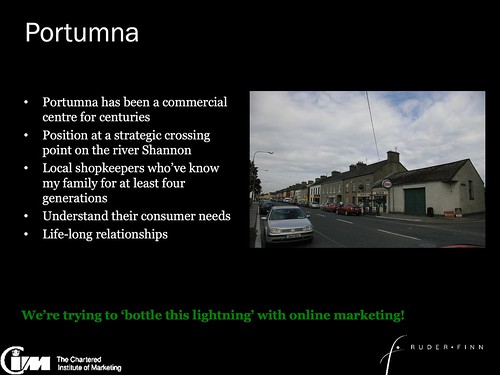
Prior to COVID-19, back when I presented a lot more in public I used to present the following slide and when I talked to it I probably reflected some of what MailChimp customers would look for, and was behind Clustomers.
Portumna is the closest market town to where my family originated. My cousin still works part-time on the family farm. Portumna has been a commercial centre for centuries because of geography. It sits at a strategic crossing of the River Shannon. The Shannon divides the east of Ireland from the west of Ireland and has been a shipping way from centuries past to the present day.
A number of the shops including grocery stores, hardware and farm supplies, the sub-post office and the local pharmacy are family businesses. At least four generations of shopkeepers in the town knew my family and did business with them over the centuries.
There were life-long relationships formed. When I go home, I am loyal to the grocery store and pharmacy that my Uncle and grandparents used. The shopkeepers understood the needs of relatives who lived in the area and the kind of farm that they ran. The kind of online marketing that clustomers seeks to bring forward, is the kind of relationships that were in place in Portumna for centuries.
But those relationships were not just about personalised communications. There was a wider cultural context and even ‘brand’.
The fact that the family in question had built up trust in the community.
That they were known to be ‘respectable’.
That they had delivered for my family and people that they new in the past.
These brands were local oligarchs. They had one or two competitors at best.
So the customer mental models around farm supplies, the butcher or the grocer were very strong and constantly reinforced. And this is the kind of stuff that advertising as part of non-personal communications is best at doing.
Hyundai have pushed out a campaign to teach British people how to pronounce the companies name properly. This is a well trodden path for foreign brands like Hyundai. My childhood featured ‘Nestle’s Milky Bars’ as the advertising jingle ignored the é at the end of Nestlé. I can only presume that it would be assumed to be too sophisticated for our palates rather than a playground staple.
More recently, I spent a couple of minutes coaching Arsenal footballing legend Ian Wright on how to say Huawei prior to him shooting some online video content for a smartphone launch. So I can relate to the challenge that Hyundai faces in gaining the correct pronunciation.
Getting the pronunciation right will allow Hyundai to use global English language assets, rather than having to do localisation. A small but important saving as it looks to compete for the UK and Irish electric car markets.
The advertising plays on the common pain-point of Siri and Google Voice failing to pick up on pronunciation in order to use humour to get Hyundai across correctly.
Older women and younger men relationships explored in this documentary. Prior to going to college in the mid-1990s I worked for a company that put coatings on materials to make stickers, stamps and labels. My boss there was a guy called Mark who married the PE teacher from school, once he’d finished his university degree. At that time Mark’s relationship was considered unusual in nature.
Design
Great film compilation of retrofuturist footage
Watching this film on the intersection of military clothing design and fashion reminded me of William Gibson’s Zero History novel.
New China-focused think tank staffed and advised by a number of prominent Hong Kong dissidents: China Strategic Risks Institute
Mainland Chinese visitors start to return to Hong Kong after Covid-19 restrictions lifted, but most tours low-cost and short stay, figures reveal | South China Morning Post – Tourism figures from February to this month show 86 per cent of tour trips from mainland China lasted one to two days and 54 per cent cost less than 500 yuan. Travel Industry Authority confirms it is investigating allegations of cigarette smuggling by mainland Chinese tour groups – it will be only a matter of time before the impact of this behaviour change ripples out to Hong Kong’s retail landlords and the luxury brands who have stores in the city. Hoteliers and the hospitality industry haven’t benefited from opening up the borders
Indonesia
Indonesia is an economic powerhouse in the making, but there are forces ripping away at its society that could leave it as inequitable as its neighbour Malaysia – which has been suffering from a brain drain and political stagnation. Indonesia like Malaysia before it seems to be coming under the sway of Gulf Arab traditions of Islam rather than the indigenous variant of the belief. Singaporean news programme CNA Insider did a good documentary on it all.
If we go back to 1949 Dutch economics Petrus Johannes Verdoorn came up with a law – the long run productivity generally grows proportionally to the square root of output. This law addresses the relationship between the growth of output and the growth of productivity. Faster growth in output increases productivity due to increased returns.
“in the long run a change in the volume of production, say about 10 per cent, tends to be associated with an average increase in labor productivity of 4.5 per cent.”
Causes of the Slow Growth in the United Kingdom Nicholas Kaldor (1966) Cambridge University Press
A heuristic called Vandoorn’s coefficient of 0.484 was found in estimates of the law following Vandoorn’s original publication. Nicholas Kaldor who made similar points as far back as 1960 in his work Essays on Value and Distribution. Kaldor built on Verdoorn’s Law observing that manufacturing was the best way of increasing output.
Slater, Walker Securities
The UK economic hole isn’t anything new. Back when I was a child we saw UK industry disappearing at about 1.5% of industrial capacity a month. The source of the destruction was apparent in the post war period, although manufacturing innovation had been underbanked and under invested for decades. Jim Slater and his financial vehicle Slater, Walker Securities was the harbinger of forces that unleashed the UK economic hole.
The State We’re In
Economics editor Will Hutton wrote the The State We’re In and I got to read it while I was in college. It caught the policy wonk zeitgeist of the future Blair administration – making the argument for long termism and manufacturing as a creator of wealth together with Keynesian economics.
Slow Growth Britain to Cool Britannia
Hutton wasn’t alone in his viewpoint but building on the expertise and experience. Wilfred Beckerman in his book Slow Growth in Britain: Causes & Consequences published in 1979 is a case in point. As you read these books the same points are made over and over again about what has become the UK economic hole. The discovery and exploitation of North Sea oil provided a sticking plaster from 1982 through to 1999. But production in UK oil and gas fields have been in decline since. Any economic productivity benefit provided to British industry through a massive shake out was transferred to unemployment relief. Secondly industrial eco-systems or ‘clusters’ as Richard Florida would term them in his work Who’s Your City? disappeared, causing the manufacturing base to lose critical mass. Any gains were largely spent by 1990. Manufacturing was a driver and a shock absorber for productivity related issues – this is important for the subsequent UK economic hole.
While Hutton was read by the future Blair administration they did little about it, due to the Augean task that confronted them.
Following the decline of manufacturing the UK, focused on financial services which turned toxic in 2006. There were additional smaller bets on professional services and the creative industry (remember pre-millennium awkwardness of Cool Britannia)? As an economic rational decision maker, I pivoted my career out of industry and into the creative sector – thankfully I was young enough to be able to do it. Many couldn’t and were trapped in low value services jobs or living on long term sickness benefits to massage unemployment figures.
Young tax-paying workers
The collapse of financial services saw the current productivity collapse and stagnation amplifying the long standing UK economic hole. Brexit could be seen as a wail of pain and anger. The reality was that being in the EU allowed cheaper skilled workers to move to the UK and use existing manufacturing plants for the likes of Cadbury’s and Unilever. So the UK benefited from young tax-paying Europeans, but lost out in terms of wage depression. Brexit severed that last gasp of productivity increases.
What is really driving ExxonMobil’s clean energy commitments? | Financial Times – the decades long algae biofuels programme failed. Back when I worked in the oil industry at the start of my work life, ExxonMobil had the best research and development / innovation team in the oil industry. They were way ahead of the likes of Shell or BP. The heuristic within the industry went something along the lines of: BP could find oil anywhere, Occidental could get a contract to drill anywhere, Shell could market any product successfully and ExxonMobil could out-innovate the rest of them.
Mobil 1 oil on the shelf at a motor factors courtesy of Mike Mozart
For instance Mobil were decades ahead of everyone else with their Mobil 1 synthetic lubricating oil back in 1974. Castrol was processing petroleum oil and calling it synthetic, they were eventually caught out in 1998 – with Mobil winning a moral victory if not a court case. The point is that if ExxonMobil can’t get algae to work, I doubt any company can – energy desperately needs its semiconductor moment.
Talking about a semiconductor moment, one of the places where this would be really welcome would be green hydrogen. I had hoped that Ireland would be able to convert its wind power bounty into generating hydrogen by electrolysis as a way of moving and storing energy in a way that electrical batteries can’t match.
Only the Global-Health Emergency Has Ended – The Atlantic – “This virus is here to stay. It is still killing, and it’s still changing,” Tedros Adhanom Ghebreyesus, the director general of the WHO – the cadence of an emergency might be finished but there is still subtantial health risk. It has declined to ‘only’ the fourth most common cause of death…
Genesis G80 Electrified vs. BMW i4 M50 | MACAU DAILY TIMES 澳門每日時報 – the G80 is closer to a 7 series than the i4 which is somewhere between the 3 and the 5 series. Overall I would prefer to go with a Genesis given the reliability issues that BMWs have had for the past two decades.
The Disconnect on Undersea Cable Security – Lawfare – The fibre-optic submarine cable sector is a vital, but ignored, part of the world’s critical infrastructure. Many members of Congress and the U.S. government, see the risks to subsea cables quite differently than cable owners and manufacturers. Brookings Institute’s Joseph Keller examines this disconnect, suggesting ways that the policy community can protect and advance this critical industry.
Thailand
Thailand legalised cannabis and an industry boom occurred. A key part is trying to integrate and provide value to the country’s hospitality, tourism and travel sectors.
Huamei Qiu is now an intellectual property lawyer based in Germany. Three years ago she featured in a New York Times documentary about the pressures on Chinese women to marry. She comes across in the film as bright, smart and engaging. She’s pretty in a girl-next-door kind of way with a flattering pixie haircut and definitely someone’s potential partner in a marriage rather than merely a trophy wife.
She has followed the party’s advice to build a good future for herself. As woman in China, she should be a hot commodity relatively speaking in the dating pool. As we see Huamei Qiu face a match maker; you realise that something is very rotten in the Chinese dating market. What Ms Qiu is looking for isn’t that much. Someone who is respectful, educated and ambitious. What I thought would have been hygiene factors? Instead, Huamei Qiu is told, her time is running out and she needs to settle fast.
China has more men than women in the marriage market, which should mean they would have to compete harder if you think about it as an economic model. Instead Huamei Qiu existed in a Kaftaesque world. I know about the government policy about leftover women, but this just left me feeling angry and frustrated on her behalf.
Beauty
The Class Politics of Instagram Face – Tablet Magazine – by approaching universality, Instagram Face actually secured its role as an instrument of class distinction—a mark of a certain kind of woman. The women who don’t mind looking like others, or the conspicuousness of the work they’ve had done. Those who think otherwise just haven’t spent enough time with them in real life. Instagram Face goes with implants, middle-aged dates and nails too long to pick up the check. Batting false eyelashes, there in the restaurant it orders for dinner all the food groups of nouveau riche Dubai: caviar, truffle, fillers, foie gras, Botox, bottle service, bodycon silhouettes. The look, in that restaurant and everywhere, has reached a definite status. It’s the girlfriend, not the wife
What party control means in China | The Economist – The workings of Chinese power are not easy for outsiders to follow. Visitors to some official buildings, for example, are greeted by two vertical signboards, one bearing black characters, the other red. The black-lettered sign denotes a government department. Red characters signal an organ of the Communist Party. In bureaucratic slang this is known as “party and government on one shoulder-pole”. Sometimes the two offices oversee the same policy area, and employ some of the same officials. They are not equally transparent. Especially when meeting foreigners, officials may present name cards bearing government titles but stay quiet about party positions which may or may not outrank their state jobs. Many party branches are not publicly marked at all. It is a good moment to remember this quirk of Chinese governance. The annual session of the National People’s Congress (npc), the country’s largely ceremonial legislature, is under way from March 5th to 13th. This year’s npc meeting comes after a big party congress last October. At that gathering China’s supreme leader, President Xi Jinping, secured a norm-trampling third term
Google – Headless chicken pt. II – Radio Free Mobile – this reminds me of Yahoo! in the mid-2000s, when I worked there. Its size and prior success ensnares it. Projects are likely being started and closed rapidly. It is struggling to meaningfully redefine itself and regain its agility
Studying Ukraine war, China’s military minds fret over US missiles, Starlink | Reuters – the Ukrainian conflict had provided impetus to long-standing efforts by China’s military scientists to develop cyber-warfare models and find ways of better protecting armour from modern Western weapons. “Starlink is really something new for them to worry about; the military application of advanced civilian technology that they can’t easily replicate,” Koh said. Beyond technology, Koh said he was not surprised that Ukrainian special forces operations inside Russia were being studied by China, which, like Russia, moves troops and weapons by rail, making them vulnerable to sabotage.