Category: consumer behaviour | 消費者行為 | 소비자 행동

Consumer behaviour is central to my role as an account planner and about how I look at the world.

Being from an Irish household growing up in the North West of England, everything was alien. I felt that I was interloping observer who was eternally curious.

The same traits stand today, I just get paid for them. Consumer behaviour and its interactions with the environment and societal structures are fascinating to me.

The hive mind of Wikipedia defines it as

‘the study of individuals, groups, or organizations and all the activities associated with the purchase, use and disposal of goods and services.’

It is considered to consist of how the consumer’s emotions, attitudes and preferences affect buying behaviour. Consumer behaviour emerged in the 1940–1950s as a distinct sub-discipline of marketing, but has become an interdisciplinary social science that blends elements from psychology, sociology, social anthropology, anthropology, ethnography, marketing and economics (especially behavioural economics or nudge theory as its often known).

I tend to store a mix of third party insights and links to research papers here. If you were to read one thing on this blog about consumer behaviour, I would recommend this post I wrote on generations. This points out different ways that consumer behaviour can be misattributed, missed or misinterpreted.

Often the devil is in the context, which goes back to the wide ranging nature of this blog hinted at by the ‘renaissance’ in renaissance chambara. Back then I knew that I needed to have wide interests but hadn’t worked on defining the ‘why’ of having spread such a wide net in terms of subject matter.

  • Platform utility

    Silicon Valley VC Andreessen Horowitz put togethers slides that cover platform utility and the role of network effects. The  presentation does a good job at providing a taxonomy on different products. It comes in handy when thinking about channel role / platform utility from a media planning perspective and also evaluating start-up ideas. They define platform in terms of development, but for advertisers we can think of it wider as we are likely to be making API calls in terms of data, targeting and ad placement. It is something that we are building demand or brand equity on.

    Key takeouts from the presentation

    • A network effect occurs when a product or service becomes more valuable to users as more people use it

    Network effect benefits

    • Create barriers to exit for existing users
    • Create barriers to entry for new companies
    • Protect from competitors eating away at margins
    • Creates a winner takes all style market

    Communications networks laws that provide indicators likely platform utility

    • Sarnoff’s law – the value of a network is proportional to the number of viewers
    • Metcalfe’s law – the value of a network is proportional to the square of number of connected users
    • Reed’s law – value of a group forming network is proportional to the number and ease with which groups form within it (subgroups grow faster than sheer number of P2P participants

    If it isn’t clear where they fall within these networks, it’s a warning flag for brands on whether to invest in the platform.

    User modes

    • Single ‘player’ mode – the product has immediate utility for a single user. Examples would be Flickr in the early days for photo storage, Foursquare in the early days to bookmark places you’d been to as a locative memory. Social bookmarking sites like Pinboard, or Delicious would have been in here had it not been retired
    • ‘Multiplayer’ mode – the product has no utility for a single user. This is particularly true for communications products. Examples would be Viber, Skype, Slack, Zoom etc.
    • Products can be both single player and multiplayer. So the community that built around Flickr for example.
    • Single player is more powerful when accompanied by an initial tactic to drive early network growth. Instagram photo filters was a way to post pictures on Twitter before there was enough critical mass. They help with adoption in the early days of a product when network effects aren’t sufficiently strong yet.
    • What’s the initial growth lever or tactic that will get it to scale?

    Case studies

    • Facebook found that connecting a new user to 10 friends within 14 days of sign-up was key to improving retention
    • Focus on daily usage (habit building) to help grow network. Focus on engagement rather than just overall number growth
    • Growth usage, even as user numbers grow is a sure sign of network effects at work
    • Facebook took a clustered approach: Harvard, then Stanford and eventually other universities in the US and abroad. Rather than focusing on growth. The immediate ‘single player’ utility they offered was an online school directory
    • WhatsApp had a different network type to Facebook. Each WhatsApp user had about 20 connections compared to approximately 980 friends on Facebook. Fewer connections also meant clustering around family, close friends of interest based WhatsApp groups with more engagement
    • AirBnB had two sides of their network. More hosts attract more guests and even become guests themselves. More guests means more business and money for hosts
    • Medium found that ‘single player mode’ can help get to ‘multiplayer mode’ through building sufficient critical mass.
  • Online advertising targeting

    Ad blocking has become a thing; with a UK government minister likening it to a protection racket kneecapping online advertising targeting. This felt similar to  the the early 2000s and political action against file sharing.

    A cursory glance of publicly available data shows a few  things:

    • Correctly targeted advertising (in terms of content type, context and placement) would have a substantial receptive audience – if consumer opinions are to be believed
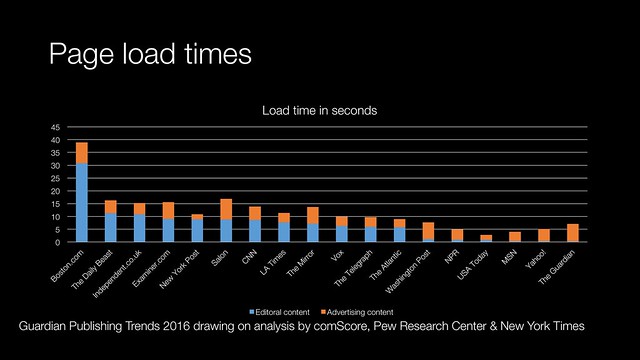
    • Current advertising technologies are negatively impacting consumer web experience by driving up page load times dramatically
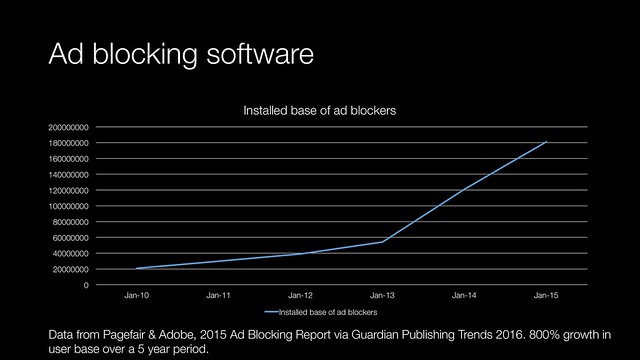
    • Ad-blocking usage is steadily increasing, so governments have their work cut out regulating it out of existence

    This starts to paint a picture of something being broken in the way advertisers deploy targeting technologies and the way targeting technologies work.

    Government regulation is only likely to delay industry change. If the music industry is an analogue to follow ad blocking would look at legal means to slow things down and then technological means to resolve the issue.

    The bigger question is, is the problem resolvable? The ad industry is being squeezed on multiple fronts:

    • Ad blockers don’t like the detrimental user experience that they get from interception-based advertising and extremely long page load times
    • The economics of ad funded content doesn’t work for a lot of online publications, leading to a flight to subscription based business models. This would negate ad blocking; because there would be less ad inventory to block
    • Power in online advertising is coalescing in the hands of Amazon, Facebook and Google in the West. In China the equivalent companies would be Tencent, Baidu and Alibaba. Ad blocking is probably the least of many online advertising companies worries
    • In general, online advertising is used in an ineffective short-termist way. Marketing campaigns are becoming less efficient. Marketers are starting to pay attention to this, although the change may take a lot of time. Again this represents a bigger worry in the medium to long term for online advertisers than ad blocking

    More information

    IAB Ad Blocking FAQs 2015 (PDF download)
    IAB Believes Ad Blocking Is Wrong
    Adblocking is a ‘modern-day protection racket’, says culture secretary | The Guardian
    Advertising isn’t the problem with ad-blockers – telecoms edition
    Advertising isn’t the problem with ad-blockers

  • Lotte + more news

    Lotte

    Lotte shareholders reject bid to remove Chairman Shin Dong-bin as family feud continues | The Japan Times – particularly interesting Chaebol feud given the unique Japan-Korea structure of Lotte. Lotte in Korea is huge in FMCG, entertainment, hospitality and retailing. Lotte has been driven out of China by the government. More Korea related posts here

    Business

    Changing of the Guard – Edelman – nice bit of shade by Richard Edelman on group margins and independent versus publicly listed holding groups

    Consumer behaviour

    Which Generation is Most Distracted by Their Phones? | Priceonomics

    Economics

    Silicon Valley Has Not Saved Us From a Productivity Slowdown – The New York Times – In mature economies, higher productivity typically is required for sustained increases in living standards, but the productivity numbers in the United States have been mediocre. Labor productivity has been growing at an average of only 1.3 percent annually since the start of 2005, compared with 2.8 percent annually in the preceding 10 years – Silicon Valley failed

    How to

    Tracking story changes with NewsBlur – as if NewsBlur’s learning technology and mobile clients aren’t enough, being able to track changes on stories is a powerful online journalism tool

    Ideas

    The People’s Net – Douglas Rushkoff’s original article on the dot com crash for Yahoo! Internet Life revisited for the current age of unicorns – Time to channel my inner Dave Winer – Joi Ito’s Web and Joichi Ito on the same theme

    The rise of American authoritarianism – Vox – scientific explanation behind Trump but also the pervasive fear of terrorism that has gripped the west

    Korea

    As 4th trial nears, Samsung asks judge: Make Apple stop talking about Korea | Ars Technica – it because perhaps they’ve mentioned the dishonest involvement in political slush funds as background to explain relative brand honesty and trustworthiness?

    Media

    Maxus launches mood-based planning tool | Marketing Interactive – interesting, particularly with political campaigns

    Welcome to the Era of Programmable Marketing – The AppNexus Impressionist – great primer on programmatic

    China’s new television rules ban homosexuality, drinking, and vengeance – Quartz – so that leaves dramas about patriotic war against the Japanese sans Nanking massacre and dramas about Mao sans cultural revolution

    Online

    Apple is Running BitTorrent Trackers in Cupertino – TorrentFreak – Using the file-sharing protocol, we launched a side-project called Murder and after a few days (and especially nights) of nervous full-site tinkering, it turned a 40 minute deploy process into one that lasted just 12 seconds – interesting article that touches on the enterprise use of BitTorrent. I suspect Apple’s use of trackers is IP enforcement related

    Retailing

    It’s Discounted, but Is It a Deal? How List Prices Lost Their Meaning | NYTimes.com – interesting article. I remember being shocked when I was first guided through Shenzhen’s markets where products originally destined for UK markets were sold to local consumers – with price reduction tags already attached.

    No surprise with Powa | Steven Prowse – almost as good as The Kernel’s legendary dissection of SpinVox

    So how much was Powa Technologies really worth? | FT Alphaville – clear gap between claimed value and real value even before administration (paywall)

    Adidas to operate 12,000 shops in China by 2020 in bid to tap growth in leisure wear, sports participation – interesting that they are going to 3,000 additional real-world stores rather than focus on e-tailing (paywall)

    Security

    Swarm of Tiny Pirate Transmitters Gets the Message out in Syria – could also reinvigorate pirate radio…

    The FBI Might Be Apple’s Best Ally In iPhone Encryption Flap | Fast Company – the government messed up and its backfired

    Software

    Microsoft canceled $8 billion Slack bid due to Bill Gates and Satya Nadella pushback – Business Insider – Qi Lu would have known Butterfield from Yahoo! ,both worked in the search business at the some time

    Why I’m breaking up with Slack | Quartz – interesting perspective

    Wireless

    In Search of the Amazingly Elusive Non-Smartphone Owner | Recode – not really surprising. I imagine the privacy aspects might encourage a small set to follow them

  • Ad blockers

    If you work in the advertising or media sectors, the elephant in the room will be the problem ad blockers. Specially developed software designed to stop ad tracking and ad vending online.
    ad blocker
    Over five years from 2010 to 2015 the installed base of ad blockers has increased eight-fold. The root problem is a that of a poor web experience. It is a well known heuristic since the late 1990s that page load time and the likelihood of a consumer to click away to another page have inverse relationship with each other.
    page load times

    Can it be the ads themselves?

    Display ads have been around almost as long as the commercial web.

    Secondly, Google research found that 56.1 per cent of display ads vended in a trial were not viewable by the audience.

    But that number is a problem for advertising customers as they want to get greater efficiency and effectiveness in their marketing campaigns.

    Unilever’s CMO Keith Weed went on record last year demanding 100% viewability for digital advertising. In order to support this, there needs to be tracking technology deployed to monitor the advertising experience.

    This is on top of tracking technology that is used to conduct retargeting and aid programmatic selling of advertising. All of this slows page load times as information is conveyed to a plethora tracking servers, which then controls which ads are served.

    Retargeting is a tool that is particularly crudely used, audiences aren’t that impressed by brands stalking them throughout their online journey. More media related content can be found here.

    More information

    IAB: 100% Viewability of Digital Ads Is ‘Not Yet Possible’ | Advertising Age
    5 Factors of Display Visibility | Think With Google (US)
    The Future of Viewability | 360i
    CPM is dead: a guide to viewability in online advertising | Econsultancy GooglePlus account
    Measuring Ad Viewability | Think With Google
    Why viewability will become one of the key issues in digital advertising in 2016 | The Drum
    State of Viewability Transaction 2015 | iab
    Unilever’s Keith Weed: ‘Digital ads must be 100% viewable’ | Marketing Week
    Ad Blockers and the Next Chapter of the Internet | HBR – retargeting blamed (hat tip Daniel Appelquist)

  • MWC 2016 as a case study on talkability, brand mentions and brand performance

    Mobile World Congress (or in industry parlance MWC 2016) is where the telecoms industry goes to set out its stand. It has gradually changed from being a conference where the big issues of the day are hashed out, to more of a trade show a la CES or CeBIT.

    From a brand point of view, it was of interest to me for two reasons:

    • It offers largely culture neutral brand discussions, many of which occur online
    • I have an interest, having worked on a few mobile brands during my agency career (Palm, Ericsson, Verizon Wireless, Samsung, Qualcomm, Telenor Myanmar and Huawei)

    I pulled this slide ware together for a talk I am giving at an internal event at an agency.

    The first data that I have put together is looking at the amount of mentions that occurred regardless of the channel. It is a relatively easy data point to pull out of monitoring systems very quickly.

    Obviously the value of mentions will depend on how many people view them, what is the context that the mention appears in. What was the content around it? Who said it, are they expert or trustworthy? So looking purely at the number of mentions would be crude, offering little value apart from nice PowerPoint slides.

    Breaking the mentions down by platform gives an idea of relative marketing communications competencies of brands. So looking at Huawei and Xiaomi shows contrasting approach to building talkability and conversations. Huawei focuses on traditional media channels where as Xiaomi focuses on social.

    By comparison LG and Samsung seem to have a more holistic approach.

    I then moved on beyond the mention data to try and look at relative authority of whoever mentioned the brand and looking at the relative distribution by brand and channel.

    I had done some initial analysis on the event in general here. These numbers showed how well brands had built high authority communities and the discussions around them.

    What was quite surprising was the polarised authority of mainstream media sources. Newswire syndication had destroyed authority of many online traditional media channels. A second cross brand observation was the relatively low authority of the blogosphere.

    These slides only start to delve into understanding talkability and are time consuming to create in comparison to looking at raw mention numbers, but offer superior strategic insight for both earned and paid media approaches for future launches.

    I did some broad profiling of online conversations around MWC here.