Category: consumer behaviour | 消費者行為 | 소비자 행동

Consumer behaviour is central to my role as an account planner and about how I look at the world.

Being from an Irish household growing up in the North West of England, everything was alien. I felt that I was interloping observer who was eternally curious.

The same traits stand today, I just get paid for them. Consumer behaviour and its interactions with the environment and societal structures are fascinating to me.

The hive mind of Wikipedia defines it as

‘the study of individuals, groups, or organizations and all the activities associated with the purchase, use and disposal of goods and services.’

It is considered to consist of how the consumer’s emotions, attitudes and preferences affect buying behaviour. Consumer behaviour emerged in the 1940–1950s as a distinct sub-discipline of marketing, but has become an interdisciplinary social science that blends elements from psychology, sociology, social anthropology, anthropology, ethnography, marketing and economics (especially behavioural economics or nudge theory as its often known).

I tend to store a mix of third party insights and links to research papers here. If you were to read one thing on this blog about consumer behaviour, I would recommend this post I wrote on generations. This points out different ways that consumer behaviour can be misattributed, missed or misinterpreted.

Often the devil is in the context, which goes back to the wide ranging nature of this blog hinted at by the ‘renaissance’ in renaissance chambara. Back then I knew that I needed to have wide interests but hadn’t worked on defining the ‘why’ of having spread such a wide net in terms of subject matter.

  • Ageism + more things

    Ageism row: WPP CEO Mark Read apologises on Twitter | More About Advertising – interesting to see how this debate about ageism in marketing services has gathered steam. I was at Paul Armstrong’s conference TBD where it was talked about as an ‘unspoken issue’ and now Mark Read seems to have elevated it inadvertently. The concept of digital natives is becoming less tenable in general.

    Although it is unspoken in Read’s interview and apology I think this strikes down a number of fault lines that advertising is trying to address. Digital is an analogue for performance media marketing and television an analogue for brand building. I believe that the pendulum is swaying slightly more in favour of brand marketing than it had been in recent years. I also believe that digital advertising platforms haven’t done that good a job in setting out their case for roll in brand building activities; but have instead tried to put old ‘performance marketing’ wine in brand marketing bottles. I suspect that the evidence of ageism cited is as much about the relentless cost-cutting of marketing combines as anything else

    About — Yahoo Creative Dept. – interesting that they’re touting their wares to all comers, rather than being purely focused on inhouse work. And no exclamation mark on Yahoo! in the meta data either. Yahoo! is the company a Yahoo is someone who works (or has worked) for Yahoo! More Yahoo!-related content here.

    [outages] Level3 (globally?) impacted (IPv4 only) – fascinating to read, I wonder what caused it?

    ByteDance’s Global Chief Security Officer Says That The Chinese Government Cannot Get Hold Of TikTok Users Data Since its Servers Are Based In The United States / Digital Information World – interesting but not completely truthful. Even Huawei admitted that

    “Article 77 of the State Security Law sets out an obligation on organisations and individuals to provide assistance with work relating to State Security”.

    Sophie Batas, director for cybersecurity and data privacy at Huawei Europe

    And if you want an idea of what state security means, have a careful read of the Law of the People’s Republic of China on Safeguarding National Security in the Hong Kong Special Administrative Region as an example. It is vague, expansive and extra-territorial in nature.

    China Tightens Tech Export Rules Amid TikTok Talks – WSJ – interesting tech that China wants to keep at home….

    Saudi Arabia’s women gamers want to be taken seriously – Rest of World – a young, rapidly growing population – it makes sense that Saudi Arabia could become an e-sports powerhouse

    Google, Facebook Dump Hong Kong Cable After U.S. Security Alarm – Bloomberg – potentially huge given Hong Kong’s position in terms of international finance where high speed networks are key. Another thing to watch is the ratio is if the ratio of population to Cisco certified engineers starts to drop in Hong Kong which could be a real possibility with the departure of data centre occupants like Facebook, Amazon Web Services, Google etc… No cloud services again make international finance difficult.
  • Podcasting + more things

    Listening in – Podcasting provides a space for free thought in China | China | The Economist – I suspect that podcasting will represent a new frontier in censorship for Chinese regulators. China has an eco-system that allows paid subscription via podcasting platforms for experts in different fields such as business or investing. More China-related content here.

    Mike Pompeo renews attack on HSBC as bank walks line between US and China | Financial Times – HSBC is about to get a lot of trouble coming its way. It has managed to make enemies of the Chinese government over Huawei, the US government over Hong Kong sanctions busting and the UK government over its support of the Hong Kong national security law. I don’t think that they will be able to wriggle out of the mess that they have got themselves into

    Chinese Diplomats Helped Military Scholars Visiting the U.S. Evade FBI Scrutiny, U.S. Says – WSJ – not terribly surprising

    Can virtual fit technology step up and replace fitting rooms? | Vogue Business – this could also accelerate the move to digital

    Alibaba wants American brands. The same ones as Amazon | Vogue Business – this could kill JD.com and Amazon China

    Rolls-Royce unveils “confident but quiet” rebrand by Pentagram – move away from skeuomorphic 3D branding lends itself better for apps online etc etc

    Are creatives better at creativity? | Contagious – While we’re always interested in the nature of creativity, it’s important to put experiments like these into perspective – there’s a lot more to being an agency creative than what was tested here. After all, being good at keep-ups doesn’t mean you can play professional football.

    Tech war chronicles: How a Silicon Valley chip pioneer landed in China  – Reuters – really interesting. MIPS, SPARC and RISC-V are arguably better architectures than ARM’s Core series of processors. MIPS has been ubiquitous in high performance computing to embedded electronics. It is very well understood, in terms of both design and writing software for it

    Wilderness of Mirrors – The Burning Shore – great meditation on the nature of conspiracy theories and culture

    KFC temporarily drops ‘finger lickin’ slogan in first global campaign – KFC believes its slogan is “inappropriate” at a time when hygiene is top of mind and so is dropping it temporarily, but is on the lookout for an interim replacement.

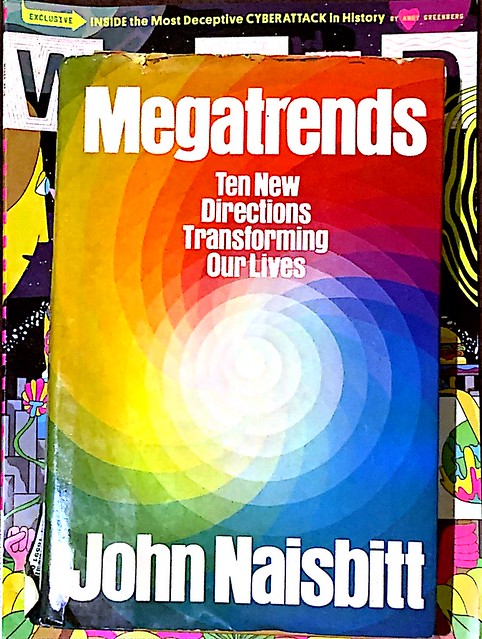
  • Megatrends by John Naisbitt

    John Naisbitt’s Megatrends was on the New York Times bestseller list when it was first published in 1982. Naisbitt outlined some big long term trends that he’d found as part of a decade of research. Hence the mega in Megatrends; though one could argue that macro may have been a more accurate term to use.

    I wasn’t that familiar with the work of Naisbitt; but came upon it by a circuitous route.

    My circuitous route to Megatrends

    I was introduced to the works of futurist Alvin Toffler in college reading Future Shock, The Third Wave and Power Shift. At the time these were cited on the technology degree courses my friends were on; as well as the marketing course I was studying.

    My house mate and I would talk about Toffler’s books as much Robert Pirsig or Emmanuel Kant, on the sofa of an evening sipping really bad instant coffee. I wouldn’t say that those were particularly happy days for me, but they did give me the time to think and read. Something that is much more of a struggle now.

    As I became more interested in Asia in the late 1990s; l read about how Toffler had influenced technocratic leaders from Singapore to China. I also started to read about John Naisbitt. Like Toffler, Naisbitt had done the Asian speaker circuits, met senior officials and conducted projects in-country through the 1990s. The management consultancy Toffler Associates eventually operated in China on government and private sector briefs.

    Compared to Toffler; Naisbitt seems to have become much more personally committed to China and central Europe. He has alternately lived in Vienna and in Tianjin, China. As the dot com boom kicked off I was reading this book. It fitted right in with similar writings from publications like Gilder Technology Report, Wired and Upside.

    LONDON
    Megatrends by John Naisbitt

    Back to the Megatrends review

    In Megatrends Naisbitt sets out X large scale long term trends that he sees in society

    • Information society and the rise of the knowledge worker
    • High tech / high touch – Naisbitt saw that roles would focus more on technology, or on ‘high touch’ sectors where humans aren’t easily replaceable like nursing care
    • Globalisation – a move in focus from the national economy to the world economy as the world becomes more interconnected
    • A move in strategic focus from short-term planning to long term planning.
    • Decentralisation of power and structures
    • A move from institutional help to self-help
    • Bottom-up governance across government and other organisations as a channel for public opinion
    • The move from hierarchies to networks
    • The population shift in the US from north to south
    • Increase in consumer choice

    At the top line we can still see much of these changes. I can see how Naisbitt’s vision of globalisation would appeal to the likes of Singapore and China. I am less sure about how Chinese technocrats would have made of bottom up decision making or as Naisbitt puts it ‘participatory democracy’.

    Naisbitt failed to take the next logical step; to look at the interactions between the trends. Instead the chapters remained siloed, rather than in context.

    For instance that the decline of hierarchies and rise of knowledge workers saw layers of management shed by organisations. Or the link between consumer choice and the rise of globalisation.

    Conclusion

    Megatrends has value in the way that looks at trends without looking at the how (usually mentioning digitalisation or some similar vehicle of transformation). This is something that we probably wouldn’t be able to do now; given that our mindset is about big data and agile processes. More book reviews here.

  • Eat Your Greens edited by Wiemer Snijders

    Eat Your Greens is a selection of articles curated by Wiemer Snijders on all things that come up for discussion amongst account planners. Branding, marketing, some home truths about innovation and the value of creative. Much of it recycles the stuff that account planners know from reading Sharp or Field and Binet. In addition there are a few that specifically address diversity, inclusion – but excludes ageism in terms of the ways it talks about these as an issue.

    Where’s the value in Eat Your Greens? The answer to that question depends on where you are in your career. As someone who is established in my career, I found it valuable in a few different ways.

    Some of the essays from the likes of Phil Graves, Mark Ritson and Ryan Wallman, Rose and Faris Yakob, Byron Sharp and Amy Wilson are strong enough to make Eat Your Greens worthwhile in its own right. For instance here’s some of what Ritson had to say:

    “The modern marketer has created an entirely stupid dichotomy between ‘digital communications’ and ‘traditional communications’… There are just tactical tools, and they can only be valued and selected once a target and a position and a strategy are in place. What’s more, it’s clear that most successful campaigns combine multiple channels for optimum success. Most studies suggest that the more channels a campaign includes, the better the ultimate ROI.”

    Mark Ritson in Eat Your Greens

    Going through the essays allowed me to come up with recommendations of new reading materials referenced in the essays – I have been using it to bulk up my Amazon list.

    Essays that I would particularly recommend:

    • What Ails Marketing by Mark Ritson
    • Post-Truth Telly by Tess Alps
    • To Target Or Not To Target, That’s Not The Question by Shann Biglione
    • Everybody Lies – The Importance of Psychological Validity In Consumer Insight by Phil Graves
    • The Devaluation of Creativity by Bob Hoffman
    • Biting The Hand That Feeds Us? Why Advertising’s Love Of Novelty Is Doing Brands A Disservice by Kate Waters
    • Why Innovation Isn’t As Sexy As Business Books Promise by Costas Papaikonomou

    For busy marketers or junior planners, Eat Your Greens is a nice introductory point for a number of issues in marketing, such as the corrosive digitisation of marketing.

    I think it fulfils an important role. Particularly for junior planners as many agencies now rely on an army of freelance talent. Eat Your Greens isn’t a substitute for having senior staff developing younger account planning minds on the job. But given the current state of agencies, its probably one of the best options that we have. More book reviews here and my slowly updated bookshelf here.

  • Influencer endorsements + more stuff

    Influencer endorsements fail to influence purchase decisions | WARC – Influencer endorsements play only a small role in affecting the purchase decisions of their followers, according to research from influencer endorsements platform Influencer and GlobalWebIndex. In their survey of consumers in the UK and US who follow influencers on social media, just 15% said influencer endorsements motivates them to make a purchase – the tenth most common response. In comparison, more than half of consumers who follow influencers say free delivery (57%) and offers/promotions (52%) would motivate them to make a purchase. – Interesting in light of the high amount of spend put around influencer endorsements by the likes of Unilever personal care and beauty products. Is this a lack of ‘influence’ or being more budget conscious that is the driver? There might need to be a readjustment of charges for influencer endorsements. Also as WARC notes, a long term test is required.

    Jailed WeChat User Says Chinese Police Monitor Overseas Accounts TooJin Chun, a former big data engineer at Huawei’s Nanjing Research Institute, meanwhile recently told reporters that all Chinese communications companies and internet service providers companies are required to monitor users on behalf of the ruling Chinese Communist Party. Faced with an official request for data, no company will resist, because they would cease to operate, he said. More on China here.

    Will Blaize Trailblaze Edge AI Market?   | EE Times – what people tend to miss about this is the pushback against the cloud, even with 5G connectivity

    Puncturing the paradox: group cohesion and the generational myth – BBH Labs – yet more evidence against generations

    Google giving far-right users’ data to law enforcement, documents reveal | Technology | The GuardianSaira Hussein, a staff attorney at the Electronic Frontiers Foundation, said in a phone conversation that EFF was concerned about the “vast amounts of user data” Google appeared to be voluntarily passing on to law enforcement, but questioned Google’s goal in doing so. “Are they expecting law enforcement to do something, or is this just a way of covering themselves? Does Google see its responsibility as simply reporting this to law enforcement and moving on?”

    Automated assistants – Wunderman Thompson Intelligence – limited but coming

    China drought, heavy rains spark concern over grain supply as Xi Jinping launches campaign against food waste | South China Morning Post – interesting when one reflects on this in conjunction with the Chinese government ‘clean plate’ initiative in the news last week

    She Helped Wreck the News Business. Here’s Her Plan to Fix It | WIRED – TL;DR brand safety is destroying online advertising in news and current affairs

    New Cold War With China Demands Radical Industrial Rethink for United StatesSince March alone, China has threatened to withhold medical equipment from the United States and Europe during the coronavirus pandemic; launched the biggest cyberattack against Australia in the country’s history; hacked U.S. firms to acquire secrets related to the coronavirus vaccine; and engaged in massive disinformation campaigns on a global scale. China even hacked the Vatican. These incidents reflect the power China wields through its control of supply chains and information hardware. They show the peril of ceding control of vast swaths of the world’s manufacturing to a regime that builds at home, and exports abroad, a model of governance that is fundamentally in conflict with American values and democracies everywhere. And they pale in comparison to what China will have the capacity to do as its confrontation with the United States sharpens

    Miss M: Guarding the City We Call Home | We Are HKersLike many of our forefathers, Mainland Chinese flee to Hong Kong and even overseas for obvious reasons.Among the younger students in my school, 80% have Mainland Chinese backgrounds (they are either from China or they speak Mandarin at home). Many treat learning English with disdain and fantasise that China will rule the world in the near future and foreigners will have to learn Mandarin to please the Chinese. This is a tragedy. Their parents send them to Hong Kong to study despite all the hardship, but the kids fail to forego their conservative Chinese mindset. This happens not only in Hong Kong, but also in Canada. The CCP have already gotten their hands on Chinese language newspapers such as Mingpao and Sing Tao Daily. Lennon Walls in Canadian universities are destroyed within days by Mainland Chinese students and their physical attacks on Hong Kong students are common – the degree of population change is quite phenomenal

    Why marketers should embrace Share of Search as a metric | WARC“The SoS calculation itself is simple. Calculate a rolling 12-month average of the various brands to be analysed, including your own. Total this. Divide each individual brand’s 12-month rolling average by the total and turn into a %. This is Share of Search, using Google Trends data.”