Category: culture | 文明 | 미디어와 예술 | 人文

Culture was the central point of my reason to start this blog. I thought that there was so much to explore in Asian culture to try and understand the future.

Initially my interest was focused very much on Japan and Hong Kong. It’s ironic that before the Japanese government’s ‘Cool Japan’ initiative there was much more content out there about what was happening in Japan. Great and really missed publications like the Japan Trends blog and Ping magazine.

Hong Kong’s film industry had past its peak in the mid 1990s, but was still doing interesting stuff and the city was a great place to synthesise both eastern and western ideas to make them its own. Hong Kong because its so densely populated has served as a laboratory of sorts for the mobile industry.

Way before there was Uber Eats or Food Panda, Hong Kongers would send their order over WhatsApp before going over to pay for and pick up their food. Even my local McDonalds used to have a WhatsApp number that they gave out to regular customers. All of this worked because Hong Kong was a higher trust society than the UK or China. In many respects in terms of trust, its more like Japan.

Korea quickly became a country of interest as I caught the ‘Korean wave’ or hallyu on its way up. I also have discussed Chinese culture and how it has synthesised other cultures.

More recently, aspect of Chinese culture that I have covered has taken a darker turn due to a number of factors.

  • Nozoe Kuniaki & more news

    Nozoe Kuniaki

    Former CEO of Fujitsu Nozoe Kuniaki (野副州旦) – blackmail forced his resignation | Japan: Stippy – interesting story of boardroom intrigue. Nozoe Kuniaki was originally said to have resigned due to ill health. The FT reported that Nozoe Kuniaki was really forced to resign by Fujitsu. Apparently Nozoe Kuniaki was forced to resign over links to a company of “unfavourable reputation”. The FT hints the roots of this palace putsch: apparently Nozoe Kuniaki was opposed by colleagues due to his drive to refocus the group on IT services at the expense of unprofitable electronics divisions, including its hard disk drive business.

    China

    FT.com / China – China faces shortages of migrant workers – this is more about structural change than an economic problem, the demographic bomb hasn’t kicked in yet. Shenzhen and similar areas will go to higher value products and industry permeate deeper into the country FT.com / Asia-Pacific – Labour shortage hits China export recovery

    Consumer behaviour

    When Trying to Preserve the Planet Strains the Relationship – NYTimes.com – environmentalism causing maritial strife

    Culture

    Axe Cop – genius: a 5 year-old script writer and a 29 year-old illustrator create an awesome comic

    From Quantic Dream, a Child Killer and a Tormented Dad – NYTimes.com – interesting new direction in gaming. In some ways it reminds me of Myst and the vision that Philips had for the CD-i platform

    Economics

    Economists Urge Government to Stop War on Piracy | TorrentFreakDigital Economy Bill-type measures don’t make economic sense according to Spanish economists

    Innovation

    Op-Ed Contributor – Microsoft’s Creative Destruction – NYTimes.com“Microsoft has become a clumsy, uncompetitive innovator. Its products are lampooned, often unfairly but sometimes with good reason. Its image has never recovered from the antitrust prosecution of the 1990s. Its marketing has been inept for years; remember the 2008 ad in which Bill Gates was somehow persuaded to literally wiggle his behind at the camera?” and “Microsoft’s huge profits — $6.7 billion for the past quarter — come almost entirely from Windows and Office programs first developed decades ago. Like G.M. with its trucks and S.U.V.’s, Microsoft can’t count on these venerable products to sustain it forever.”

    Chinese Premier Talks Up Internet of Things – NYTimes.com – interesting stuff here, however we need to move to IPv6 addresses fast in order to take advantage of it

    Ireland

    RTÉ News: ‘Guerrilla street’ hurling in US capital

    Japan

    Grads return to watches as job-hunter prop | The Japan Times Online – watches used to give the impression of being well-organised

    Tech Lawyers Say ‘Uh Oh’ as Microsoft Outsources Legal Work to India

    Google and antitrust: Searching questions | The Economist

    Slapdash Bill will damage Britain’s digital economy – The Irish Times – Fri, Nov 27, 2009 – external perspective on the forthcoming Digital Economy Bill

    Media

    Leaked UK record industry memo sets out plans for breaking UK copyright – Boing Boing – WTF. The BPI-authored changes the effect of which was that “the security services concerns were not being met” and then goes on to talk about the irony that the Open Rights Group and the Security Services being on the same side as if it validates his standpoint

    ivi.ru — смотрите фильмы и сериалы с комфортом! – Russian answer to Hulu and iPlayer. Really nicely designed.

    When using open source makes you an enemy of the state | Technology | guardian.co.uk – interesting evidence against MPAA and RIAA of trying to incite unilateral US government actions against Indonesia because it uses open source software

    Online

    U.K. Kids Start Social Networking Way Under the Age Limit | Fast Company

    Philippines

    Sinatra Song Often Strikes Deadly Chord – NYTimes.comMy Way correlates with karaoke-related killings in the Philippines. Fascinating bit of newspaper anthropology

    Retailing

    FT.com / Comment / Analysis – China: The jailed salesman – background on the Gome business

    Security

    China PLA officer urges new Internet control agency | Reuters – People’s Liberation Army Major General Huang Yongyin ‘For national security, the Internet has already become a new battlefield without gunpowder’

    Google Case Highlights Gaps in Computer Security – NYTimes.com – interesting take on security

    Software

    The best health apps for your iPhone | The Guardian

    Wireless

    FT.com / Telecoms – Students power BlackBerry growth – I can completely understand this, I miss a proper keyboard a la the Nokia Communicator

    Motorola’s First-Quarter Forecast Hurts Shares – NYTimes.com – Android failing to save Motorola’s bacon


  • Google Music China

    I spent some time in Shenzhen and tried the Google Music China service. It was unlike anything else I have seen and was designed especially for consumers in mainland China.

    Google Music China

    Google Music China is impressive in terms of the size of its catalogue and ease-of-use. You have a mix of western artists and Chinese artists on the service. There didn’t seem to be a lot of censorship going on. You could download the full expletive riven Eminem experience. The music is downloaded into your computer as MP3 files and doesn’t have any DRM on it. I put it into my iTunes library. The service is powered by a Chinese partner for Google, which becomes apparent when you look at the URL on the page for an individual track.

    There didn’t seem to be a restriction on the amount of music that you could download. I got a mix of material from jazz to techno including a number of albums by The Jazz Messengers.

    Much of the music seems to have been licensed through the US right holders of the music; such as this Astralwerks license for a Fat Boy Slim track below.

    The service is free, in that I didn’t have to pay per track, or pay a subscription. Instead the music is ad funded with display ads as shown below.

    Google Music banner ad

    I do wonder what the click through rates are on the adverts that periodically get vended on the service?  More China-related content here.

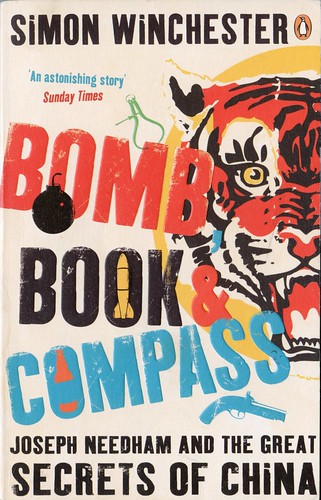
  • Bomb, Book and Compass: Joseph Needham and The Great Secret of China by Simon Winchester

    Bomb, Book and Compass

    Simon Winchester’s Bomb, Book and Compass delves into the history of science and innovation. The old adage of the victor writing history applies not only to wars but also the history of innovation and science. Everything you were taught in school about the history of science is likely to be wrong. It usually having a European focus; from the Greeks and Romans to the Italian-based renaissance via the wisdom preserved within the monasteries of Europe during the dark and early medieval ages.

    Book, the book and the compass

    The Chinese, in comparison, were seen as inscrutable and cunning rather like the Fu Manchu character of Sax Rohmer’s novels but less sophisticated than their European counterparts. This diacotomy helped assuage the consciences of empire-builders who had designs on the riches of the Chinese market, from bringing away silk and porcelain to finding a ready market for Indian-grown opium and laying the foundations for the modern-day heroin trade.

    Up until the European’s arrived China was the world’s largest manufacturer, counting for about 30 per cent of the economic activity by value in the world. This time of weakness is what the Chinese refer to as the century of shame, which was finally laid to rest when they claimed back Macau in 1999.

    Joseph Needham

    Bomb, Book & Compass is the story of Cambridge biochemistry professor Joseph Needham and his quest to find the real truth behind the history of science and China’s role within it, he did this during the chaos of the second world war, when he had the chance to get at the documentary evidence.
    He then spent the rest of his life curating and writing material for a vast series of books Science and Civilisation in China. These books were not only a historical record that put China closer to the centre stage position that they deserved in science, but also put the country on a more even standing with the ‘civilised world’ restoring or enhancing its reputation. In some respects Needham’s work could be considered to be the largest unpaid (in that China didn’t pay for it) corporate reputation campaign in the annals of public relations.

    Bomb, Book & Compass is a compelling read, by turns adventure, travelogue and political intrigue. I would recommend it, if nothing else for the very human portrait it paints of Joseph Needham as a man of great intellect and passion, but also a man with some very human failings. More book reviews here.

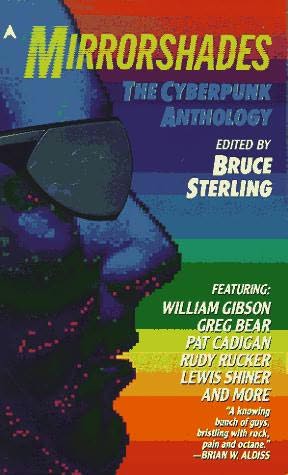
  • Mirrorshades – The Cyberpunk Anthology edited by Bruce Sterling

    Cyberpunk is a type of science fiction that has been very influential in the creation of the web as we know it. As with most predictions about the future, the now has both over-and-under achieved. Since we are at an economic inflection point, I thought I’d revisit one of the seminal publications of the cyberpunk genre Mirrorshades.

    Mirrorshades

    Mirrorshades is a collection of stories that were created by authors considered to be representative of that genre by one of their own Bruce Sterling. Mirrorshades refers to the Oakley type-lenses in sunglasses that were considered to be a cultural artifact for this genre, in the same way that chromed rocket fins graced US-made cars of the 1950s and 60s.

    In some ways the stories echoed the kind of ideas I would expect appearing in feature articles of Wired magazine: private artificial islands based on a libertarian ideal to fuel commerce, artificial-eye implants, radical Islam-inspired cyber-terrorism and gene therapy. All of this feels familiar in a post-truth era of late stage capitalism where authoritarianism vies with liberal democracy for legitimancy

    Others were exceptionally dated: depending on the the Soviet Bloc to still be a bulwark against global capitalism. The rampant artificial drug use in the stories mirrored the US decent from hippy-inspired pot heads to mainstream cocaine use and new drugs that were then coming online including crack cocaine and MDMA. There was an assumption that the leisure pharmaceutical industry would carry on this spurt of commercial innovation through product development.

    Mirrorshades is a good read, but the ideas have been so pillaged by later works that you have to keep yourself in check and remember that for much of the films and books in this area, Mirrorshades (often filtered through other authors later works) was the genesis; the source material from which they sprang. More book reviews here.

  • Cultural energy crisis?

    Mark Fisher argued that there was an effective cultural energy crisis in his article Running on empty published in the New Statesman online. His premise was that culture lacked the energy it had in previous decades. That the noughties are encompassed by a sense of cultural deceleration. He argues that cultural changes were driven by technology and that these technologies gave cultures their indelible mark: what he calls a ‘technological rapture’ that is absent from present culture.

    The present moment might in fact be best characterised by a discrepancy between the onward march of technology and the stalling, stagnation and retardation of culture.

    He characterises the web in its ‘web 2.0’ incarnation as regurgitating older media forms and having a parasitic relationship on ‘old media’ forms and that web 2.0 encourages us to ‘behave like spectators’. That web 2.0 deprives cultural movements of a ‘laboratory’ to evolve before hitting the mainstream and the networked world provides us with a broadly homogenised culture. Fisher summarises that ‘that technology will not deliver new forms of culture all on its own’.

    I think that Fisher’s rhetoric is first-rate, many of the assertions can be disproved (if we had a homogeneous culture, then why is Clear Channel’s radio business going through a long and lingering death spiral)?

    I find his point about technology not delivering new forms of culture all on its own most interesting though as I don’t believe that it ever did deliver new forms of culture. It helped them certainly, but it is only one ingredient in cultural change.

    The 1960s and the 1970s were as much about a new individual consumerism and a disillusionment with government as much as technological leap forwards. The acid house and rave movement, whilst influenced by cheap computing, digital samplers, MDMA manufacture and cheaper analogue synthesisers it was also influenced by the depressing soulless nature of the 1980s.

    Secondly, I’d argue that technological innnovation is ‘lumpy’ at the moment there isn’t one ‘world changing’ paradigm shift recently. Recent ones would have been the ‘web, affordable jet travel, the contraceptive pill, colour television, desktop page layout software and the ubiquitous mobile phone.

    Many of the energetic sub-cultures that Fisher describes had a similar parasitic nature on old media and cultures that he attributes to web 2.0. Jungle would have been nowhere without the Amen Break from the b-side to Color Him Father by The Winstons released back in 1969. Acid house pioneers saw a clear lineage between themselves and electronic music pioneers like Kraftwerk. House and garage were as much about recreating in electronic means the sounds of the Salsoul record label as they were about blazing a new trail. And I haven’t even mentioned Andy Warhol or the way rock music raped and plundered rhythm and blues.

    Finally maybe cultural progress or energy has moved from being a linear track of occurrences: hippies -> progressive rock -> glam rock -> punk and disco -> new romantics -> rave to a massively parallel cultural shift as we can access and tune into Japanese music, Korean films and read about Finnish design in a moment-by-moment way that wouldn’t have been possible before? More on culture here.