Design was something that was important to me from the start of this blog, over different incarnations of the blog, I featured interesting design related news. Design is defined as a plan or drawing produced to show the look and function or workings of a building, garment, interfaces or other object before it is made.
But none of the definition really talks about what design really is in the way that Dieter Rams principles of good design do. His principles are:
It is innovative
It makes a product useful
It is aesthetic
It makes a product understandable
It is unobtrusive
It is honest
It is long-lasting
It is thorough down to the last detail
It is environmentally-friendly – it can and must maintain its contribution towards protecting and sustaining the environment.
It is as little design as possible
Bitcoin isn’t long lasting as a network, which is why people found the need to fork the blockchain and build other cryptocurrencies.
Bitcoin uses 91 terawatts of energy annually or about the entire energy consumption of Finland.
The Bitcoin network relies on thousands of miners running energy intensive machines 24/7 to verify and add transactions to the blockchain. This system is known as “proof-of-work.” Bitcoin’s energy usage depends on how many miners are operating on its network at any given time. – So Bitcoin is environmentally unfriendly by design.
On the other hand, Apple products, which are often claimed to be also influenced by Dieter Rams also fail his principles. They aren’t necessarily environmentally friendly as some like AirPods are impossible to repair or recycle.
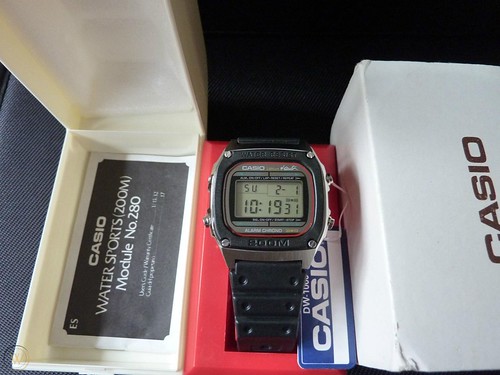
My story with the Casio DW-100 began in the school canteen. One of the people that I used to hang with as I ate my packed lunch was a guy called Neil. Neil was one of the better off people in my school, he had a maths tutor. His Mum ran a green grocers and we occasionally heard about giant spiders turning up in boxes of bananas that had been picked up from the wholesale market.
The Chiba connection
Neil’s Dad was a ships carpenter by trade who ended up working for Shell. He was assigned to different places and inspected tankers that were under construction or being repaired. Because of this, he worked away for most of the year. During the summer or Christmas Neil would get to visit his job in places like Nigeria, Singapore or Japan. He spent a good deal of time in Chiba, Japan as his Dad was inspecting ships being built at Mitsui Engineering and Shipbuilding.
When you have a well paid parent who doesn’t see you very often and access to the latest greatest products, you end up the most well heeled kid on the block. At the time, a lot of the best Japanese products didn’t get as far as the UK. Neil had a better Walkman than anyone else and he had the Casio DW-100.
Casio DW-100
After coming back from visiting the Far East Neil came a new Casio DW-1000.
Why Casio?
Casio watches had a battery that would usually last a couple of years, which was why they were holding their own against competitors like Commodore or Sekonda. Before the lithium ‘coat button’ batteries, watches had smaller ‘shirt button’ sized batteries that lasted 12 months if you were lucky. The smaller buttons also seemed to leak ruining the watch beyond repair.
Back then our equivalent of Hodinkee magazine was the Argos catalogue. My local Rolex authorised dealer seemed like it was a space ship from another world. My Dad’s 1960s vintage Omega felt like adult unobtainium. Seiko and Citizen watches were things I aspired to have when got to hold down a job in the adult world of work that felt so far off at the time. It was the 1980s so even being able to work felt more hopeful than reality.
They were also cheaper than the likes of Seiko or Citizen digital watches. It was fortunate to have a Casio Marlin W750; which was a step above most digital watches at the time with water resistance of 50 meters. This was the best Casio digital watch that was available at the time in Argos catalogue. This 50M water resistance capability was shown with a marlin fish on the front of it. Otherwise it looked like every other Casio watch. What that meant that it was able to survive getting washed or having a shower. This was important as my school was full of light-fingered pupils.
The G-Shock before the G-Shock
Neil’s Casio DW-100 caught the eye for a number of reasons:
It was an unusual combination of resin strap and metal case
The strap was beefier
The case was predominantly brushed finish rather than shiny and discernibly larger
It had a plastic bumper on the front to protect the easily scratched plastic glass
“Water Resist 200M” embossed on plastic bumper. Dive watch level water resistance seemed like an ability to blast off into space.
Staring at the grey glass a bit harder and you would see a stylised scuba diver where my own watch featured a marlin.
Function-wise it was very similar to my own watch. The screen had the exact same three segments on the screen. There would be a half hour chime function, which was the soundtrack of my classroom in the same way that iPhone alerts are the soundtrack of the office today.
While these watches were robust, they would soon resemble a hard-working Land Rover. The front bumper scarred and chewed up as if it was mauled by a lion. Many of them were probably prefectly useable up to the day that they were thrown away or put in a drawer. One of them featured in an advertising campaign that Casio ran in the US in 2019.
The development of the G-Shock also implies that many of the drops that the DW-100 damaged it in a similar way to cheaper watches. The LCD screen would break and there wasn’t the kind of replacement services that we know have for broken smartphone screens.
Cult item
While the Casio DW-100 was not well known in the UK, they were sold in the US as well as Japan. in 1986, they were a key item in an episode of the TV show MacGyver. And have now been coveted by watch collectors and adult fans of the show.
Epilogue
I haven’t spoken to Neil in decades, we fell out of touch. He got sponsored for his first degree; did a doctorate after leaving the sponsor and has spent the rest of his career in the oil industry. The last I heard of him he was involved in oilfield maintenance and engineering in the Middle East.
KanDenko is a Japanese construction company that specialises in infrastructure. This advert communicates effectively what they do in a creative manner. KanDenko must have spent a good deal of money to have this film produced. But it is well worth it.
Vintage Singapore
Footage of Singapore‘s North Boat Quay circa 1983. This area has now been redeveloped with the shop houses refurbished and now holding cafés, restaurants and bars. What this video shows is traditional Chinese life that would have been similar to the mainland prior to Mao’s ‘new China’ which culminated in the cultural revolution.
Thankfully overseas Chinese and Taiwan had preserved the culture and beliefs.
Stussy x Nike
Nike and Stüssy have collaborated on bringing an old Nike model back to life.
New Order’s Blue Monday on 1930s instruments
The BBC made a video of Orchestra Obsolete using early electronic instruments (including a Thermin) alongside traditional instruments to reproduce New Order’s Blue Monday
Distorted Kowloon City
When I first saw this footage of Distorted Kowloon City, I was reminded of the locative art discussed in William Gibson’s novel Spook Country. I read this shortly after being switched on to where 2.0 services while working at Yahoo! on search and Flickr offerings. Yahoo! bought Whereonearth, to better understand what ‘local’ meant with its InternetLocality product set. At the time Whereonearth worked with Three on local mobile services and was a data provider to the likes of insurance companies and credit reference agencies. Yahoo! engineers like Dan Catt and Paul Hammond worked on projects like ZoneTag and including location data in the EXIF metadata of photography; something we just accept as normal on smartphones now.
Distorted Kowloon City is a piece of immersive digital abstract art. Or according to The Hong Kong Trade Development Council (HKTDC)
Kowloon City is full of collective memories of Hong Kong people. Spanning the old town with restaurants and specialty shops, Checkered Hill (also known as Radar Hill), tree-lined parks, the historical remains of the Kowloon Walled City and the former Kai Tak Airport, Kowloon City is as diverse as Hong Kong.
To re-interpret how we perceive, how we feel and how we see Kowloon City, moon.moon weaved the sensory data elements of the real world into an 360-degree audio-visual experience with the aid of original music and technologies (e.g. Point Cloud Processing and drone photography), allowing the public to re-discover Kowloon City from abstract art perspective.
Design Inspire | HKTDC
From this explanation, its a mix of history, Hong Kong culture and geography blended into the art work.
The work was done by local digital artist Moon Hung.
Fractured markets
The effect of low interest rates in the aftermath of 2008 on financial investors was to encourage increased risk taking and one of the first casualties of interest rate increases were UK pensions under management. The FT goes into more depth in a video documentary.
Ian Hislop is well known in the UK as being the editor of Private Eye and managing to bring the snark of the paper into real life. In this interview with the politics channel of Joe, he seems flummoxed by the state of politics in the UK over the past year or so.
In this video, Ian Hislop talks about the year with clear sense of exasperation. The laughs are for relief rather than humour. The commentary by Ian Hislop on collective short term memory is very interesting.
Tiananmen Square killings
CNN put together an interesting collection of footage around the Tianamen Square protests and put some context around what was happening in China when the protests happened. CNN seemed to have done a better job than most western media at the time in its coverage of the protests. If anything the footage seems even more harrowing now than the bit I remember from the time.
CNN
Darlie Malaysia travel promotion
Back when I worked on Colgate brands in Asia, Darlie was the ‘entry level’ brand. As such its one of the best selling toothpaste brands in Asia and you can see it in any pharmacy or supermarket you walk into in China, Hong Kong and across Southeast Asia. It’s actually an old brand founded in the 1930s in Shanghai that latched on to the popularity of Al Johnson to promote the teeth whitening effect of their toothpaste.
The brand seems to have changed to Darlie around about 1990.
Colgate Palmolive
Moving forward three decades Darlie is still wrestling with its heritage in the eyes of western stakeholders important to Colgate Palmolive. Darlie is a best selling brand.
In Malaysia it seems to have got involved in a package promotion with local travel brand Klook to provide travel vouchers and hotel discounts as Malaysia kick started its domestic tourism and hospitality industries. Much of the promotion revolves around the use of influencers (to appeal to the three main ethnic groups in Malaysia – Chinese, South Asians and Malays).
I am not a huge fan of their books generally, but if the Darlie adverts spark your interest, then the Lonely Planet travel guide is your best option for the two main areas to see: Kuala Lumpur (KL) and Georgetown on Penang island.
The Reflex
I have been listening to this mix a few times this week.
Zone Energy
Zone Energy drinks targeted students sitting exams with adverts on the Tokyo subway that only. they could see using the red plastic sheet lens that is used to decode answers in their work books.
The US Army’s Land Warrior programme was in development for some 33 years. The idea behind it is that better informed soldiers who are connected to support assets can do more with less and survive.
Chris Capelluto put together a good accessible history of the programme.
Burning chrome
About a decade after the rise of cyberpunk developed as a literature genre, the defence thinkers realised the potential of modern technologies that would have sounded similar to Case’s cyber deck in Neuromancer.
Head up displays, small but connected and powerful networked computers and connected weapon sights of the Land Warrior programme have taken over three decades to fulfil the original vision. Technology takes time, while Land Warrior has taken three plus decades; artificial intelligence is taking a lot longer again.
Human factors
Even now the Land Warrior programme isn’t completely sorted. The Microsoft Halolens AR displays are said to cause debilitating nausea, headaches and eye strain. More than 80% of those who experienced discomfort suffered symptoms within three hours of using the Land Warrior AR headset.
The wearable computer of the Land Warrior programme is an Android powered Smartphone sized device, but would be using very different networks. The network is both the strength and the point of weakness in the Land Warrior programme.
How the networked structures of Land Warrior will fully affect military culture and power structures will be interesting. All of it will be creating tensions in the millennia of ‘hard-wiring’ humans have had since before the dawn of civilisation as we know it and the impact will be much deeper than just the physical tiredness from head up display googles.
Just think about the benefits and ills of social media, or how the world has shrunk through video calls. In my parent’s lifetime, people leaving their homes in Ireland to emigrate to the US or Australia used to have a wake at their leaving. In some respects that departure was a form of death. That is very different to the relationship that I have with family and friends around the world now. Changes coming through from Land Warrior might be equally deep over time.
A lament for the age of apathy | Financial Times – Turnout in the US election of 1996 fell below 50 per cent. In Britain five years later, it was the lowest since the Great war. Most pop culture either side of the millennium wasn’t even allusively or allegorically political. You can read Jane Austen — goes the old line — without knowing that Napoleon was cutting through Europe. You can watch Friends without knowing that America has a government. The peak of the apolitical age was Big Brother, which, in sealing contestants from the news, didn’t disrupt their lives much. – I think a large amount of society still live in that bubble
I was watching this video and I could it imagine something similar being done to describe the luck of many market towns in the west of Ireland with the identikit feel
The video below is a good run down on the short term aspects of the current state of the UK economy. However UK productivity has been going wrong for decades. Several reasons:
The UK relies on services rather than manufacturing – While the UK was in the EU, those factories that remained imported more productive workers from the east. With Brexit the manufacturing and warehouses went east instead along with income tax revenues
The UK has a serious skills gap, there isn’t the prevalence of night colleges any more
The UK has been declining in automation. The classic example is trying to find an automatic car wash. During the 1970s and 1980s these were all over the UK. Now you get a bunch of people with buckets. UK warehouses are much less automated than most other places. This is partly down to several decades of short termism that Will Hutton wrote about back in The State We’re In circa 1995
Brexit has permanently re-eingineered supply chains around the UK
Too much UK investment has gone into real estate, you only have to see all the developments in London and Manchester
Universities are now developed for the benefit of foriegn students rather than domestic talent growth, innovation. And the universities are over leveraged in property development and are likely to go under if there is a reduction in foreign students or a rise in interest rates
Epson to End All Laser Printer Sales by 2026 – ExtremeTech – quietly chosen to stop selling laser printer hardware by 2026. The company will instead focus on its more environmentally-friendly inkjet printers, according to a statement obtained by The Register. Although the company stopped selling laser printers in the United States a while back, it had maintained the line in other markets, including Europe and Asia. Consumers will no longer be able to purchase new Epson laser printers as of 2026, but Epson has promised to continue supporting existing customers via supplies and spare parts. Epson itself claims its inkjets are up to 85 percent more energy efficient than its laser units and produce 85 percent less carbon dioxide. Interesting move, western companies would be virtue signalling the hell out of this.
Really impressive piece of technology and engineering by Sony. But I can’t work out why it was done. By this time Citizen, Casio and Sony were already making LCD televisions. Back in the day Sony used to some products, just because the engineers could. I also love how this looks like a miniature version of a Sony 14″ portable TV circa 1984, even down to the homage to the Trinitron branding.
There seems to be a lack of appreciation for economic trajectory that Hong Kong is on; inextricably linked in China
They don’t seem to understand the political trajectory Hong Kong is on
They aren’t the kind of talent that Hong Kong needs to plug losses in healthcare, education, social services and the creative industries
More developed countries aren’t likely to want ‘stepping stone’ Chinese people from Hong Kong. Their choices might be as limited as are on the mainland
This will only accelerate simmering nativist hostility and more Hong Kongers may leave via BNO visas etc.
If Hong Kong has been in a recession, what must the real state of the China economy be? Are they way worse than PMI and official numbers seem to suggest?
Finally, China has disliked Hong Kong being a vehicle for capital flight. With a greying workforce and declining birth rate will they dislike the talent flight of middle class Chinese through ‘stepping stone’ Hong Kong?
Ideas
Interesting viewpoint on Russia from author Ian Garner. You can find out more about his book here.
China’s puffer jacket obsession: Its not just Moncler and Canada Goose, homegrown brands are taking off | Campaign Asia – Domestic Chinese and international puffer jacket brands are battling for market share in the mainland. We take a look at which names are emerging victorious. China’s puffer jacket obsession: Its not just Moncler and Canada Goose, homegrown brands are taking offWhen temperatures in China started to cool down in early October, one of the biggest fashion trends to return was the puffer jacket. Alongside higher-priced brands like Canada Goose — which saw 20 percent higher sales compared to the previous year — homegrown puffer jacket labels such as Bosideng, Xue Zhong Fei, and Yaya all reported that their gross merchandise value (GMV) growth rate on Tmall exceeded 100 percent. Meanwhile, European brand Moncler sold out of its classic Maya coat on the first day of its debut on Tmall Luxury Pavilion in October.
Media
Why Hong Kong’s outdoor advertising is underperforming | Media | Campaign Asia – Based on a recent study by Hong Kong Baptist University, OOH ads are failing to capture people as they severely lack creativity. Dang, I feel bad for you son, that’s burn to the Hong Kong agency scene right there. Seriously though I would be curious about the methodology
The $300 Million Sneaker King Comes Undone – WSJ – In May, Mr. Malekzadeh’s fiancée—also the company’s finance chief—pushed for both of them to come clean, according to people familiar with the situation. Federal prosecutors a few months later charged the couple with bank fraud and Mr. Malekzadeh with wire fraud and money laundering. Customers claim they paid millions of dollars for shoes that never arrived. A court-appointed receiver is sorting out the remaining inventory of the entrepreneur’s company, Zadeh Kicks. Early last year, Mr. Malekzadeh collected orders for about 600,000 pairs of Air Jordan 11 Cool Grey sneakers months before they hit stores, netting over $70 million, according to prosecutors. He priced the sneakers between $115 and $200 a pair, cheaper than their expected retail price of around $225
Hackers breach energy orgs via bugs in discontinued web server – state-backed Chinese hacking groups (including one traced as RedEcho) targeted multiple Indian electrical grid operators, compromising an Indian national emergency response system and the subsidiary of a multinational logistics company. The attackers gained access to the internal networks of the hacked entities via Internet-exposed cameras on their networks as command-and-control servers. – The software being hacked is the Boa web server. Boa was originally written by university student Paul Phillips. Phillips became CTO of Go2Net.
Go2Net ran several websites including 100Hot – a website ranking service; payment processing service Authorize.Net, metasearch engine Dogpile, Haggle Online who provided online auction and PlaySite who ran multiplayer games.Prior to being acquired by InfoSpace Go2Net touted their technology behind these sites and selling services to customers.
Boa’s afterlife on IoT systems
So having a CTO who had written a small footprint web server like Boa made a lot of sense. At some point, Phillips stopped working on Boa. Instead maintenance was handed over Larry Doolittle and Jon Nelson who maintained the code for three years or so. Since then, Boa has not been maintained. Its small size made it very popular with Internet of Things products including CCTV systems. Which is the reason why Boa server software has been repeatedly hacked.
How you treat the ‘non-elite’ is key to beating populism | Financial Times – Middle-status people, social scientists have shown, are more conservative and cautious than the poor (who can afford to take risks because they have so little to lose) and elites (whose privilege allows them to bounce back from failures). They show more respect for authority for a simple reason: being “disruptive” may be highly valued among Silicon Valley elites but, in blue- or pink-collar jobs, it merely gets you fired
Ethics
Kanye West Used Porn, Bullying, ‘Mind Games’ to Control Staff – Rolling Stone – West looked down at his foot, stared up at the woman, and told her, “I want you to make me a shoe I can fuck.” Adidas representatives — including a vice president involved in the apparel giant’s billion-dollar licensing partnership with West’s influential brand — did not confront West about his alleged remark, the two attendees claim. The woman took a leave of absence before moving to a job elsewhere at Adidas (in an email, she declined to comment and requested that her name be withheld from this article.) Former Yeezy and Adidas employees, however, point to the alleged incident as one of many experiences — over the course of a decade — in which, they say, West used intimidation tactics with the staff of his fashion empire that were provocative, frequently sexualized, and often directed toward women. – what were Adidas doing and why the sudden change of conscience now, when all this was going on for the best part of a decade?
Metabolism and the capsule building were a uniquely Japanese phenomenon. Its a much more expansive vision of manufactured housing than post war pre-fab housing in the west.
Rolex Is Reportedly Building a New $1 Billion Factory – Robb Report – it sounds like a large amount of money. However tooling on a car production line would be 150+ million pounds alone. Rolex makes everything on site, rather than relying on a range of supplier partners. 1 Billion dollars almost sounds cheap.
‘We’re mandating its use’: Estée Lauder turns to TikTok marketing after reach on Instagram stalls – Digiday – When Estée Lauder’s reach on Instagram started to slow across EMEA, its marketers turned to TikTok. Obviously, there’s more to it. The early success of the brand’s global TikTok account, for one. But the crux of the brand’s decision to be on TikTok came down to Instagram. Estée Lauder’s marketers realized that no matter how big they tried to go in terms of reaching more people on the Meta-owned social network, they were stuck talking to a limited part of its desired audience, said Lubna Mohsin, the social media and content manager for Estée Lauder. Moreover, it was the same core people in the same cohort who were being reached over and again
The tragic romance of China and Hollywood – The China Project – “Beijing offered up access to its market in exchange for a decade-long tutorial from Hollywood on how to replicate its filmmaking process.” Now that China has caught up (somewhat), there’s less incentive to collaborate. Beijing-based director Daniel Zhao agrees, with a caveat. “The overarching policy of the central government now is to build a self-reliant ecosystem (自循环 zìxúnhuán), but I do see gaps where China still needs to import international technology and personnel,” Zhao told The China Project. He has worked in China’s film industry for over a decade, including a stint with Fenton’s company DMG. China’s film industry has made great strides, thanks in part to its Hollywood’s partnerships. It is now home to some of the largest production sites in the world. China is rapidly developing new virtual production capabilities and improving its 3-D animation quality. In recent years, China has demonstrated that it can pioneer fresh aesthetics and produce domestic successes without Hollywood’s guidance.
How retailers are reshaping the advertising industry | Financial Times – shopper marketing for e-tailing. Interesting how this budget would likely have been previously spent on paid placement in Google Shopping etc. and yet now in the shift to mobile Google (and other search engines) are now losing out on the opportunity for product search. Part of this is them re-optimising around local search like where’s the nearest coffee shop with free wifi and CBD infused kombucha? Meanwhile online retail destinations like eBay and Amazon became product search engines
What about the layoffs at Meta and Twitter? Elon is crazy! WTF??? | I, Cringely – I first arrived in Silicon Valley in 1977 — 45 years ago. I was 24 years old and had accepted a Stanford fellowship paying $2,575 for the academic year. My on-campus apartment rent was $175 per month and a year later I’d buy my first Palo Alto house for $57,000 (sold 21 years later for $990,000). It was an exciting time to be living and working in Silicon Valley. And it still is. We’re right now in a period of economic confusion and reflection when many of the loudest voices have little to no sense of history. Well my old brain is crammed with history and I’m here to tell you that the current situation — despite the news coverage — is no big deal. This, too, shall pass – vintage Bob Cringely