Design was something that was important to me from the start of this blog, over different incarnations of the blog, I featured interesting design related news. Design is defined as a plan or drawing produced to show the look and function or workings of a building, garment, interfaces or other object before it is made.
But none of the definition really talks about what design really is in the way that Dieter Rams principles of good design do. His principles are:
It is innovative
It makes a product useful
It is aesthetic
It makes a product understandable
It is unobtrusive
It is honest
It is long-lasting
It is thorough down to the last detail
It is environmentally-friendly – it can and must maintain its contribution towards protecting and sustaining the environment.
It is as little design as possible
Bitcoin isn’t long lasting as a network, which is why people found the need to fork the blockchain and build other cryptocurrencies.
Bitcoin uses 91 terawatts of energy annually or about the entire energy consumption of Finland.
The Bitcoin network relies on thousands of miners running energy intensive machines 24/7 to verify and add transactions to the blockchain. This system is known as “proof-of-work.” Bitcoin’s energy usage depends on how many miners are operating on its network at any given time. – So Bitcoin is environmentally unfriendly by design.
On the other hand, Apple products, which are often claimed to be also influenced by Dieter Rams also fail his principles. They aren’t necessarily environmentally friendly as some like AirPods are impossible to repair or recycle.
Green Tomato is a Hong Kong based innovation consultancy founded in 2003. They specialise in developing mobile enterprise solutions and creation of great mobile apps that have won awards. Green Tomato is a winner of several technology and marketing awards including Asia Pacific ICT Alliance Grand Award winner and Red Herring Global 100.
Green Tomato developed TalkBox a proto-OTT voice messenger solution before WhatsApp and WeChat came along. TalkBox has since moved way from being a consumer product to become an enterprise push-to-talk (PTT) competitor. More recently Green Tomato have done a lot of work on the integration of mobile apps, with ‘other screen content’. They have done great work on digital retailing experiences in Hong Kong. Unfortunately their work has been ahead of its time and risks eclipsed by other people building on the likes of iBeacon.
I particularly like the Green Tomato Pointcast demo below. It was done for Coca-Cola Hong Kong. The app works with a Coca-Cola video advert to increase engagement. It could be applied just as easily with with traditional media like cinema or TV advertising or new video advertising formats on YouTube or YouKu. It makes the advertising spend work harder which is one of the key reasons why Mondelez are so excited by mobile marketing.
It also helps make traditional media brand building AND brand activation as well.
The challenge with this technology is that it makes the job of creative directors harder. Interaction becomes a key part of the experience rather than just a story amplifier. The technology is less amenable than social media to be bolted on to the side of a campaign like a rocket motor. On the plus side, it protects creative by providing additional arguments for continued traditional media. The innovation side of things will be an effective bulwark against the media agency skewing plans towards digital because its more profitable. For more content like Green Tomato click here.
I’ve blogged a few times before about the merits and flaws in the current iterations of the Google Glass device. I consider the Google Glass device to be an interesting idea; because of the potential contextual nature of its content provision; but the product is flawed and ultimately a failure in the consumer space due to its product design and current limitations of technology. The Atlantic carried a very interesting piece that hyphothesised that Google Glass was failing because it was an assistive technology and assistive technologies make use feel week. However, if that was the case Glass should be fine with just a rebranding exercise, rather like glasses moved from being a weakness to a hipster accessory.
Whilst I agree with the hypothesis that Google Glass can assist people, I don’t think that ‘disability aids’ are the correct analogy for Google Glass; instead Google Glass augments the majority of current users in theory; it is a telephone rather than a hearing aid. It is about making the user even better; think of it as having the personal assistant who whispers in your ear at a party the names of the people that you should know and where you met them previously, a personal concierge service like a shopper or a tour guide.
Failings in Google Glass
Google Glass devices aren’t discrete. The glance up display Google Glass has a level of social and user awkwardness similar to early implementations of the touch display that tried to incorporate it with a keyboard like the HP-150. Google are on to something, the use of sneaky applications that would provide the right information at the right time. But the very act of using the device is a big tell that is both distracting and takes away the social impact of the information provided
Google Glass is interruption-based media. From point of view of someone conversing with a Google Glass device wearer, the sudden pauses and ‘zombie-like’ eye drift are disconcerting. Rather like if someone kept answering their phone in a meeting. The problem here is one of technology, Sony’s smart eyeglass prototype and Epson’s Moverio BT-200 which display the content directly in front of the wearers vision are more likely paths for a future successful solution as would some sort of discrete earbud with aural content delivery
The Google Glass device has too short a battery life. With a usable battery life of just 45 minutes usage time, users have to manage the device to husband power resources. Whilst Google calls this a design feature to try and prevent wholesale privacy invasion; the downside is the audience distraction. The reality is that I don’t think battery life is a feature but a function of battery technology failings at the moment. This could improve overtime with improvements in chip power consumption, power management techniques and incremental improvements in battery chemistry formulation
Glass Rage
Google Glass rage incidents happen for a number of reasons:
The wider socio-economic tensions that are breaking out in San Francisco between the digital haves and the local have-nots. It is a similar but more visible tension to that seen in Dorset or Cornwall as moneyed London city workers buy a weekend place or telecommute from the country and in turn drive up property prices out of the reach of local people. You can see it in Central London with bankers, foreign investors and Russian oligarchs looking for sanctuary and safety from the British legal system. The problem is of course, that gentrification kills the very elements that attract tech workers to San Francisco: authenticity, diversity, a little bit of risk-taking, arts and culture. This is what happens when Richard Florida’s cluster theory reaches a ‘point of inflection’; when the creative classes devour and destroy what they craved just by the nature of their sheer numbers
The unknown. The majority of Google Glass device users who have undergone a well-deserved drubbing seem to conduct themselves in an anti-social way using their device as if they have some divine right. Without wearing Glass they would be described as foolish, stupid or even borderline sociopaths. It is the same with most technologies, early adopters through their social normative compass out the window when they are trying the new, new thing and are then surprised when the world pushes back. Common sense and good manners should be a hygiene factor rather than a service pack. It takes years or longer to get this right; mobile etiquette is still an issue, some three decades after cellphones started to become popular
There are some use cases for glass that make sense
Glass would be much more useful, (at least until the technology is able to address some of the shortcomings listed above) in an industrial environment; for instance working in a tight space servicing a jet engine or augmenting a warehouse picking team’s work. All of this is dependent on the device being sufficiently robust to deal with a dusty, solvent-laden environment safely. It is probably no coincidence that Google is now trying to pivot towards the enterprise, but I could counsel against using Glass at the moment in customer-facing / front-of-house roles.
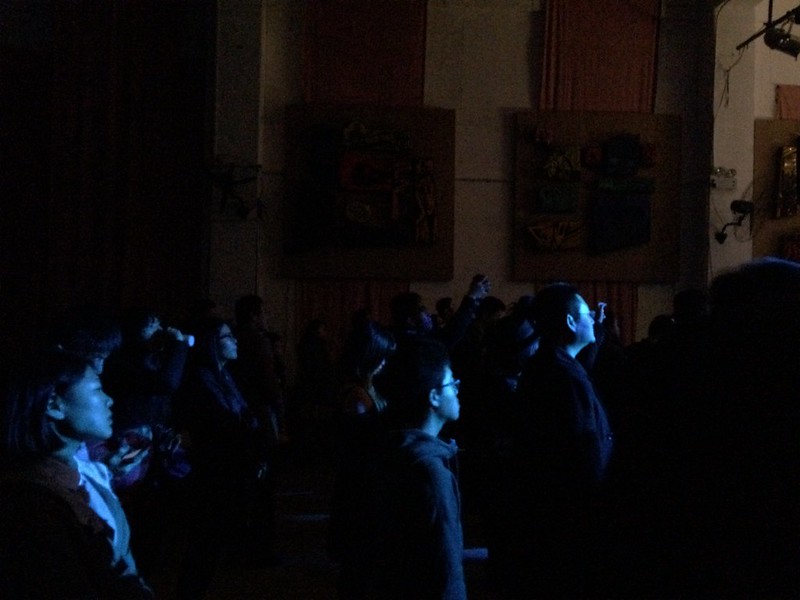
I spent much of January in Shenzhen and went to a concert played by a local band. I can’t remember much about their music save that the lead singer work a bowler hat and seemed to influenced by 1990s Brit Pop and A Clockwork Orange. What was remarkable about the gig was that for the first time in about 10 years I saw concert goers dancing, swaying, being in the moment. There was was no digital mediation of these big life moments. More importantly I saw them watch the concert with their view unmediated by a smartphone screen which allowed them to actually participate rather than record the event.
It was remarkable that digital technology had not invaded this happening as the audience were tech-savvy Chinese middle class. The ideal demographic where the smartphone has already achieved ubiquity to capture all their big life moments.
Kevin Kelly’s book What Technology Wants posits that technology like progress is a natural unstoppable force moving forward what he calls the technium. This movement forward changes life, sometimes in ways that aren’t necessarily great. Part of the issue is that social norms don’t move at the same space as technology hence the lack of rules around digital big life moments.
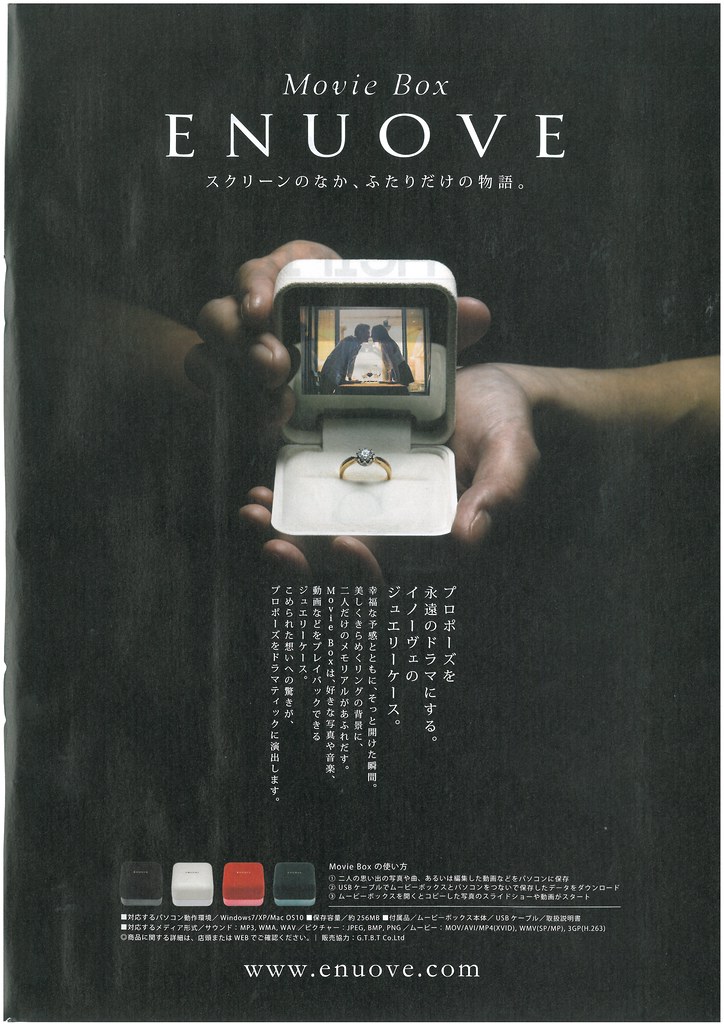
I was looking through Smart magazine: a Japanese men’s magazine and came across an advert for a digital wedding ring box. Big life moments don’t get much bigger.
ENUOVE is a costume jewellery brand that has come up with the movie box; a small media player built into the wedding ring box which can accepts a small video clip in a number of popular formats.
I found this advertisement interesting and cut it out of the magazine because it was a great example of digital inserting itself into social norms of one of the most important life events of all. I tried to understand what role the digital technology would play. Usually in the west, the ring is presented with the man down on one knee whilst he asks the object of his affection to marry him whilst presenting the ring.
My initial reaction was to think that the video allowed the man to use technology to mediate the discussion rather than having to worry about fluffing whatever speech that they had put together. But what would the recipient think this cop out of doing a proposal by box.?
I asked two colleagues who were currently engaged. The first one pointed out that a non-verbal proposal was considered ok if it was suitably grandiose:
Flying over a tropical beach in a helicopter where the proposal is written in the pristine sand below in two-storey letters
Having the proposal appear on an advertising board on Time Square
Hiring a sign writing plane to proclaim the offer across the skies
I thought that these were pretty extreme examples? Outlier proposals? My colleague indicated that this was the case.
The second colleague I asked introduced me to this video below, billed as the first lip dubbed wedding proposal that seemed to involved a whole neighbourhood as the cast.
Isaac’s lip dub proposal has been seen over 25 and a half million times. She thought that the digital box was ok; it was a nice novelty and would be reasonable for a proposal if the prospective groom didn’t have the gumption to pull off something at least as epic as Isaac’s lip dub wedding.
She might keep the box longer, as she didn’t even know where her current ring box was, it got lost after the first few weeks after the engagement.
Now admittedly my study is very unscientific, but my conclusion was that digital had permeated the wedding proposal in a different way to what I had anticipated. YouTube has had a thermonuclear effect on what my colleagues thought was an acceptable / adequate wedding proposal. It had to have drama, spectacle and a uniqueness to it. Their major life moments would take on a large scale cinematic element.
The movie box offered a lower key alternative that was still acceptable due to it’s unique nature for a groom who couldn’t drill family numbers for a few months in performance of a lip dub or have their feelings writ large on a beach in the Maldives.
Digital had already permeated our big life moments and we’re all as eccentric as Stanley Kubrick. More related content here.
Consumers Want More Mobile Data, But Simply Don’t Want to Pay | Parks Associates – this analysis of mobile data makes me think that mobile providers have failed to articulate the benefits of mobile data. Secondly it is probably also a symptom of the way mobile devices are used a lot in the home and tethered to the home wi-fi. The visions of mobile lifestyle used to sell mobile data have little utility and value to customers. This attitude to mobile data likely won’t likely change until horizontality changes in the mobile device and service stack. For instance differentiated high quality voice calls
At the end of last week Amazon unveiled Amazon Dash: an accessory to aid ordering from its Fresh grocery service. Fresh promises free same-day delivery on orders of over $35 of more than 500,000 Amazon items including fresh and local products; including products from respected restaurants and coffee shops. It has been rolled out in three major US markets: San Francisco, Seattle and Southern California.
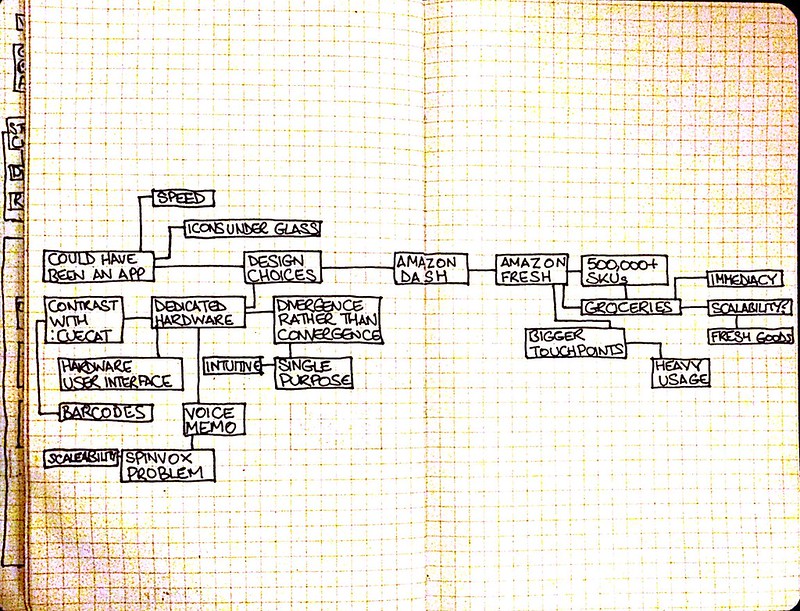
Fresh has a mobile application on both Android and iOS to aid in shopping – which makes the launch of Dash much more curious. Dash is a piece of dedicated hardware which implies a failing in terms of ease-of-use for the smartphone application. Amazon obviously thinks that Fresh customers will be heavy high-touch, high-value consumers in order to spend this much trouble engineering and manufacturing the hardware and supporting services to make Dash work.
Dash is a product that wouldn’t be out of place in a collection of Braun kitchen appliances. It’s hardware interface so simple it looks really intuitive.
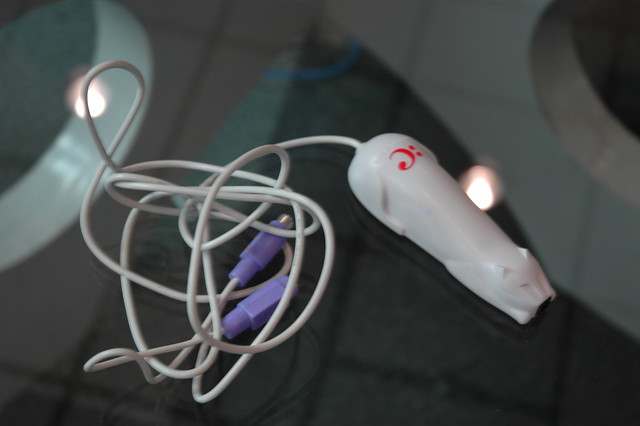
The Amazon Dash can be seen as part of a wider movement from converged general purpose devices to dedicated hardware. It is interesting to compare and contrast the Amazon Dash with the :CueCat; how just over a decade can make such a difference to a product. Back in 2000, Wired magazine sent out the :CueCat to US subscribers of their magazine. The :CueCat was a barcode scanner that allowed readers to augment the print content with a link to web content. Think a prehistoric QRCode. It didn’t work that well for a number of reasons. The codes were proprietary, partly due to consumer privacy requirements and intellectual property around barcodes. In order to use the :CueCat one needed to be connected to an internet-enabled PC via a wired USB or PS2 connection. Using the :CueCat was no easier than typing in a URL or searching via Google; a search engine on the ascendancy at the time. The :CueCat was a spectactular failing for the media industry looking to get to grips with digital media.
Moving forward to the Amazon Dash, the equivalent computing power of that desktop PC has been squeezed into a device that fits in the palm of your hand. Wireless connectivity provides a more flexible connection that removes contextual restrictions on the Dash compared to the :CueCat. The web extended computing so that the website and the PC or mobile device in a symbiotic relationship where it isn’t clear to consumers just were one starts and the other finishes.
The Dash takes inputs via a product barcode and voice memos. Despite the technology advances over the past ten years with the likes of Siri and S-Voice; there will likely be some sort of human intervention required to make these voice memos work. This is at odds with Amazon’s warehouse robot systems and lack of a human customer service face over a telephone line.
This voice memo challenge is not trivial, it was a contributing factor in SpinVox’s failure. The Fresh programme because of its logistical challenges will be hard to scale, and the economics of the Dash have to be carefully balanced between existing products that are repurchased via barcode scan and new or fresh products that would use the voice memo. Acquiring basket growth becomes incrementally more expensive. Over time the system may learn voice commands rather like Google’s old telephone-powered search; on the one hand local area focus is likely to limit dialect variations, on the other sample size maybe hard to scale to be statistically significant for machine learning. More related content here.