Category: ethics | 倫理 | 윤리학

Ethics: moral principles that govern a person’s behavior or the conducting of an activity. I went to school with people who ended up on the wrong side of the law. I knew more of them when I used to DJ which was my hobby since before I went to college.

I probably still have some post-it notes around the place that I used as bookmarks from when I used to work at a call centre but that was about the extent of my ethical transgressions.

My business experience meant that I dealt with a lot of unpleasant unprofessional clients, but didn’t necessarily see anything unethical in nature. When I started writing this blog I was thinking about culture rather than ethics and the most part still do.

But business and work changed. Ethics became more important:

  • When I started in social and digital campaigns I didn’t think about ethics as a standalone thing. It was just part of doing a good job. It went without saying.
  • I don’t think any of us back then would have foreseen slut shaming, trolling, online bullying, dark patterns and misinformation

Now things are different. The lack of ethics is impacting all parts of business life.

  • How ad tech data is used
  • How content is created
  • How services are designed
  • How products are made

I think that much of the problems with ethics is cultural and generational in nature. The current generation of entrepreneurs have perverted knowledge in the quest of growth hacking and continual improvement and change for its own sake. Its a sickness at the centre of technology

  • Pwnplug + more news

    Pwnplug

    The Little White Box That Can Hack Your Network | Wired.com – the Pwnplug is a low-powered Linux computer loaded with hacking tool kits. The Pwnplug can crack wi-fi or power over ethernet connections in theory. It also illustrates the James Bond world that we live in, where the Pwnplug could look like anything, the only challenge being power. Bring your own technology poses additional challenges and would help conceal a Pwnplug. Also IT can’t dismantle or x-ray every every plug socket, phone charger, desk fan or extension lead in the building looking or a Pwnplug. Over time the components for a Pwnplug will get smaller and smaller

    Beauty

    L’Oreal: Educating Chinese Consumers Through Sports & Online Video | The China Observer

    Consumer behaviour

    New Study In Germany Finds Fears Of The Internet Are Much Higher Than Expected – Worldcrunch

    Cheap and cheerful – downgrading by UK consumers

    Beijing couples stay together for the sake of the house: law firm|WantChinaTimes.com

    China accounts for one-third of world’s smokers|WantChinaTimes.com

    Design

    The Engadget Interview: Nokia VP of Industrial Design Stefan Pannenbecker at MWC 2012 (video) — Engadget

    Expandable formal dining table that seats ten and fits in a closet – really nice solution to a problem that most of us face. Interesting that Google’s Sketchup is used as a CAD file format

    Economics

    A Barclays report suggests that the recent decline in the labor participation rate has more to do with demographics than discouraged workers | TIME.com

    Productivity: When small isn’t beautiful | The Economist – emphasis on small businesses rather than growth businesses has crippled Europe

    How to get a job in porn | The Next Great Generation – really interesting research on the economics of the adult entertainment industry

    China’s economic growth ‘unsustainable’ – RTHK – according to World Bank president. Reflects the law of big numbers and China’s own refocus beyond GDP

    Ethics

    Microsoft v Google: How not to win friends and influence people | The Economist – someone needs to tell Frank X Shaw to let it alone, and one would have thought that Burson Marsteller would have known better with all the integrity guff they do when they wheel out Harold Burson

    Why Are Harvard Graduates in the Mailroom? – NYTimes.com – anyone thinking about the equity of internships should read this article

    Finance

    Why the Fed Ignored Warnings and Let Banks Pay Shareholders Billions | Mother Jones

    FMCG

    Sugar Cane 洗护包-牛仔裤洗护包心水推荐“洗濯屋 仕上屋” ‹ CatWhy 潮流追踪 – interesting move by Sugar Cane jeans – detergent to keep your denim in tip-top shape, coming in both premium care and vintage wash look options

    Starbucks Plots International Revival Through Local Campaigns

    McDonald’s to Tout Quality in China – WSJ.com – taking brands back to their essence as a quality mark

    How to

    Google+ Hangouts get digital masks to enhance your next video chat | The Verge – really nice social object embedded into Google+ hangouts

    Remove items from your Web History – Google Accounts Help

    Hong Kong

    What A Free And Hungry Hong Kong Press Looks Like From China – Worldcrunch

    Ideas

    REVEALED: How Giant Patent Troll Intellectual Ventures Does Business

    Not a Film, Not a Game, But a Living Novel – transmedia storytelling

    Innovation

    NTT researchers develop breakthrough optical memory device

    Vortex radio waves could boost wireless capacity “infinitely” | ExtremeTech

    The energy race, featuring Bill Gates, Steven Chu, and Bill Clinton | The Oil and the Glory

    The Pirate Scene Nimbly Adopts New x264 Video Codec | SiliconANGLE – innovation

    Innovation and the Bell Labs Miracle – NYTimes.com

    Sharp develops modules for digital signage players ‹ Japan Today – interesting that Sharp thinks that there is a market for PC-free controllers, a small move away from the general purpose computer

    Ireland

    Ireland Signs Controversial ‘Irish SOPA’ Into Law; Kicks Off New Censorship Regime | Techdirt – great reason why you shouldn’t invest in Ireland

    Japan

    Nissan May Revive Datsun – WSJ.com – brings back memories of the headmistress at my primary school who used to drive a Datsun Cherry 100a two-door in bright yellow (ironically this had sportier styling than the Coupé which looked more like a van from some angles)

    GUCCI Official Japanese Language Blog – interesting that is showcasing traditional Japanese crafts

    Korea

    Seoul Food: Treating Your Idol to Lunch Is the True Test of Fandom – WSJ.com – fandom and Korean culture came up with a new cottage industry. The power of of Hallyu

    Luxury

    Shanghai Tang Hints At New Hong Kong Flagship With Facebook “Teaser” Contest « Jing Daily – I love how Shanghai Tang have made lemonade from the lemons they were dealt when Abercrombie and Fitch bid way too much money to get their store in the Pedder Building. Hong Kong retail property prices have gone insane

    Issey Miyake Collaborates With Scientists On Origami Fashion Line [Pics] @PSFK

    London’s White Cube Arrives in Hong Kong, Its First Outpost in Asia – WSJ

    Marketing

    How Microsoft is killing off the Zune and Windows Live brands in Windows 8 | The Verge

    Media

    Anonymous, Decentralized and Uncensored File-Sharing is Booming | TorrentFreak In the long run this might drive more casual downloaders to legitimate alternatives, if these are available. Those who keep on sharing could move to smaller communities, darknets, and anonymous connections.

    Update: Court Filings Suggest Google Fighting Feds Over Megaupload Emails | paidContent

    Kim Dotcom’s first TV interview: ‘I’m no piracy king’ – 3 News

    Michael Geist – Assessing ACTA: My Appearance Before the European Parliament INTA Workshop on ACTA

    Labels And Spotify Still Struggle To Convince Some Artists On Stream Rates | paidContent:UK

    Sony Music Boss: Censored YouTube Videos Cost Us Millions | TorrentFreak

    Online

    The truth about the iPad in Russia revealed | DaniWeb

    How Three Germans Are Cloning the Web – Businessweek – Rocket Internet’s fast follower model which they deploy before American rivals can scale into markets

    Facebook’s “Premium” – A User’s Nightmare? – what about the user context, is Facebook screwing itself over in the longer term with less engaged consumers

    Japan Warns Google Over New Privacy Policy – on top of investigations in South Korea and US

    I, Cringely » Yet another way China and Google are different – Google inflexibility compared to US stereotypes about China

    So It’s the Kodak Patent Strategy for Yahoo Against Facebook – AllThingsD

    Is it Really Full Steam Ahead for Facebook? « Sysomos Blog – really interesting post taking a good look at Facebook

    Is the honeymoon over for Facebook gaming? — Tech News and Analysis

    Retailing

    Where to Buy Android Tablets Safely From China | gizchina.com

    Security

    Censorship is inseparable from surveillance | guardian.co.uk – or why the UK is digitally screwed

    Social Network Login Status Detector Demo – really nice hack

    I’m Being Followed: How Google—and 104 Other Companies—Are Tracking Me on the Web – The Atlantic

    Wanted: Secure Android App Whitelisting – BYTE

    Attack on Vatican Web Site Offers View of Hacker Group’s Tactics – NYTimes.com

    GPS ‘spoofers’ could be used for high-frequency financial trading fraud (Wired UK) – GPS provides precise timing for time stamps on transactions

    Are Twitter And Facebook A Serious Threat To Your Privacy? [INFOGRAPHIC] « AllTwitter – yes

    Software

    Steve Jobs was right: Dropbox is a feature, not a product | PandoDaily

    Windows 8: Sugar coating on Microsoft’s hard-to-swallow tablet • The Register

    Telecoms

    S&P cuts Nokia rating to lowest step of investment grade – teetering just above junk status

    Web of no web

    HaptiMap project, FP7-ICT-224675 – really interesting project looking to integrate haptics and other stimuli into location-based services

    Wii workouts unlikely to improve fitness • reghardware

    Wireless

    Pew: Smartphones overtake feature phones among adults in the U.S.
    Communities Dominate Brands: The State of the Union blog for Mobile Industry – all the stats and facts for 2012

  • Perfect market on internet?

    Online perfect market introduction

    The train of thought on this blog post about online as a perfect market coalesced when I was re-reading Kevin Kelly’s New Rules for the New Economy for the first time in a decade. Kelly’s book built on the work done by fellow Wired contributor John Browning who pulled together The Encyclopedia of the New Economy which was published over a couple of issues of Wired magazine and as a compilation in a now out-of-print pamphlet that used to sold via the Wired web site.

    What is the new economy?

    Back in the 1990s when the internet started to move out research and academia into the commercial and consumer world lot’s of things were happening.

    The cold war had finished, television viewers had seen CNN revolutionise coverage of the Gulf War conflict and the Iraqi army had been routed largely due to technology (and overwhelming firepower). Proto-reality show The Real World was fresh, with David ‘Puck’ Rainey becoming the first reality TV villain to capture the public’s imagination. The M in MTV still stood for music; but also stood for ‘much innovative programming’; Gap had some of the coolest ads on TV and the record industry was making money like music sales were going out of style.

    Francis Fukuyama’s political philosophy tract The End of History (and the Last Man) seemed to catch the spirit of the time in terms of a utopian vision of the future, even if most of the people who name-dropped his work had never read it.

    People realised that the internet would change things, just in the same way that mobile phones had started to change everyday life (punctuality suddenly became passé, when you could phone ahead give your excuses and have a much more fluid schedule). It was going to change lots of industries perhaps creating a ‘new economy’ of online businesses. From a cultural point-of-view the new economy and the information superhighway was something to hitch one’s utopian hopes to with echoes of Roosevelt’s New Deal some 60 years earlier.

     The assumptions

    The new economy was thought to bring about what economists would call a perfect market. Consumers would have information available at their finger tips and be able to compare the price of products throughout the world to get the best deal. There were even those who thought that consumers would have software agents to do this on their behalf and companies would have their power reduced by consumers. All of this change would be brought about by connected information and the rise of hobbyist communities who often knew more about a company’s products than the company themselves. This was seen to be a logical extension based on what people knew of the power of networks.

    Consumer opportunities

    Many of the early e-commerce businesses were arbitrage plays. Boxman had complex software from IBM that bought CDs from the cheapest distributors across Europe, shipped to its warehouse in Belgium and then shipped to consumers with some of arbitrage gained reflected in their discounted price. CD-WOW.com sold CDs from Hong Kong and other markets to UK consumers at prices that were up to 25 per cent cheaper than other suppliers. In the end, Boxman was brought down by poor software performance due to IBM learning about e-commerce as they went along and eventually CD-WOW had to pay £41 million pounds damages due to a prosecution brought by the BPI under the Copyright, Designs and Patents Act of 1988.

    The ruling gave record companies a free hand to continue predation on UK consumers by supporting excessive prices on CDs compared to non-European markets. If it had been a bank instead of a record label, they would have been labeled loan sharks.

    I worked on agencyside on the launch of a comparison shopping service called Dealtime UK (it re-branded to Shopping.com and is now part of eBay) which showed the price of CDs, consumer electronics shops and compared them across a swathe of retailers. Eventually search became a big part of the comparison shopping play with Google having its product search function and Yahoo! buying Kelkoo and tapping into that expertise to roll-out Yahoo! Shopping functionality across the international Yahoo! network.

    Big Data

    The demise of the dot com era saw changes in media consumption that went hand-in-hand with the roughly 30 per cent decline in online advertising spend bottoming out in 2002. Consumers started to find their way around the web in a different manner. Instead of having there homepage of their browser  as a personalised melange of news, weather and horoscopes served up by a portal website like Yahoo!, Excite or MSN; there was instead a search box from Google, Baidu, Naver or Yandex depending where you lived in the world.

    As search engines tried to provide better results, they realised that context was important and that a record of what searches people did may make some sense of it. This data is immensely powerful. An example of how powerful it is was show by the AOL Search debacle. In August 2006, an AOL Research project put three month’s worth of search data for 650,000 users online. The data had been anonymised, but that didn’t stop the New York Times tracking down Thelma Arnold based on her search data. At the time I worked at Yahoo! we were gathering as much data each day from consumers as would be held in the US Library of Congress two times over.

    It wasn’t only search engines that had this inferred data inside it, other businesses like Amazon had been gathering information about consumer’s preferences towards different products. Netflix like AOL released anonymised consumer data into the public as part of a programme to crowd-source a better recommendation algorithm. Privacy concerns were raised following work done by the University of Texas and Netflix pulled the data set following an agreement with the FTC.

    Web 2.0 impact on the perfect market

    The web as a platform or web 2.0 came about out the ashes of the dot.com crash. The idea was that the web, had become a web of data that could be used through APIs to build new services and become more useful through mashing the data up. The key concepts that pioneers focused on was making the data usable and ensuring attribution of the data sets – (I’d recommend having a look at Tom Coates’ Native to a Web of Data presentation as a primer.)

    One of the key things about this was that a number of the pioneers in this area like Flickr’s founder Stewart Butterfield said that APIs gave consumers power over their data, they could back up their images or take it elsewhere. Their content was exportable and market forces kept all the players honest and competitive.

    However it could also be easily matched with existing data sets and much greater inferences derived from it.

    Secondly, over time the moral imperative changed in these businesses. Facebook developed its site as being a digital equivalent of the Hotel California where you data can enter, but never leave. So as a marketer you have never had so much consumer information between the big data, inferred data and the ability of blending in further data to refine the knowledge further moves the needle from consumer to marketer in terms of economic power.

    How could this be used to nullify a perfect market?

    • Targeted advertising – based on understanding of the consumer behaviour, consumer spending power, life-state information. If you want to know the power of this information, look at how US supermarket Target wants to get hold of consumers as they are ready to start a family.
    • Targeted offers – save your best offers for people who are most likely to act on them
    • Dynamic cross-selling and up-selling opportunities – one of the biggest problems that we as marketers faced when I worked at MBNA a number of years ago was the irate consumers who would reach out when they had been offered a superior deal by us via mail. This need never happen again, instead inventory could be used to target them with additional services from a trusted brand
    • Differentiated pricing – this is where things get interesting. For luxury brands you could deliberately use differentiated pricing as a barrier to the kind of consumers you don’t want. For insurance companies you could use a much wider set of data to make inferences about likely risks for everything from health to their likely driving-style

    The trust issue

    As the Edelman Trust Barometer has shown for the past decade or so trust is extremely important in consumer – organisation interactions and ongoing relationships and impacts on the perception of a perfect market. Or as Kelly puts it:

    With the decreased importance of productivity, relationships and their allies become the main economic event.

    He lists attributes of trust that shows how difficult it is to foster, and how fragile it can be to maintain:

    Trust is a peculiar quality. It can’t be bought. It can’t be downloaded. It can’t be instant

    So where does trust leave the information imbalance between consumers and the organisation that they interact with? It’s a big challenge, Kelly points out that for trust to work consumers have to know who has the knowledge and a full understanding of that they know.  The problem is that organisations aren’t ready to have that adult conversation and full disclosure, particularly about what they can infer from the data that they have access to. The benefit that the consumer gets in relational activity is much less than what the organisation derives from that data. This would be especially true for someone like Facebook:
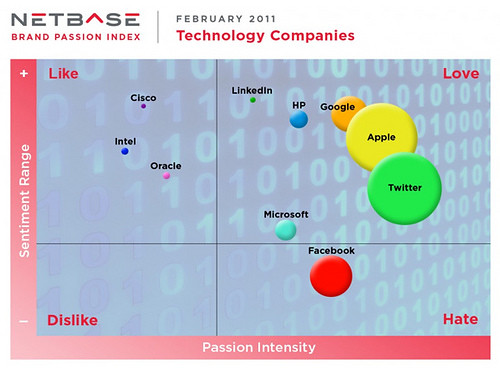
    netbase on Facebook
    Netbase looked at how consumers relate to brands, it indicates that many people feel that they have to be on Facebook rather than they want to be indicating that the consumer benefit is low, so the corresponding trust they are prepared to put into the social network regarding their privacy is low.

    Companies like Facebook and Path are treating privacy as an inconvenient hang-up of consumers that they must run an end game around rather than engendering trust. The less engagement these businesses have with their audience the lower the quality of the information and the consequent lower utility that they have for marketers. There is no perfect market in online advertising.

    In the same way that consumers have a reduced trust in the media following incidents at organisations like News International; there is likely to be an inciting incident at some point between consumers and the online advertising eco-system that is likely to bring trust to a head. The perfect market knowledge advantage then becomes mute.

    The internet becoming a too perfect market kills the golden goose being bad for consumers and bad for advertisers. The challenge is that the eco-system is a victim of its own success from 2002 to the end of 2011 the US online advertising market grew over four times to roughly 8 billion dollars a quarter. If someone steps back from the plate to take a more considered approach, someone else will rush in.

    A prime example of this is the use of facial recognition software which even Google’s chairman Eric Schmidt agrees is a step too far, Facebook has already implemented it and Google has rolled it out as an opt-in feature on Google+. The problem with the opt-in is that Google doesn’t spell out to the consumer the full ramifications of the technology – yet it was obviously concerned at the highest level in order for Schmidt to go on record about it at a conference.

    Looking at all this; it is counter-intuitive, but the market for consumer privacy should actually be with the brands that they are trying to engage them. How powerful would it be if a brand said: we can do all these things skulking around behind your back, pulling the strings but we aren’t going to and we don’t want to. We want to be a brand that you can address on your own terms.

    The clock is ticking for the brand that will make that leap and the advertising eco-system that won’t. It was the Cluetrain Manifesto accused PR people of being afraid of their publics; were now in a situation where the online advertising eco-system is afraid of being completely honest with its audiences and afraid of their advertisers.

    As Chuck D said:

    The easiest and the hardest word to say is NO

    More related content here.

    More information

    Here’s What Really Scares Eric Schmidt – Allthings D
    Google+ Introduces Automatic Face Recognition To Photo Tagging (But It’s Completely Opt-In) – TechCrunch

    Facial Recognition Technology: Facebook photo matching is just the start – PC World
    Netflix Cancels Contest After Concerns Are Raised About Privacy – New York Times
    CD Settlement forces prices up – BBC News
    Tom Coates famous ‘Native to a web of data’ presentation that he gave at Future of Web Apps back in 2006  and Simon Willison’s write up of the presentation
    How Companies Learn Your Secrets – NYTimes.com – How Target zeros in on consumers right around the birth of a child, when parents are exhausted and overwhelmed and their shopping patterns and brand loyalties are up for grabs
    Where’s the Market for Online Privacy? | The Precursor Blog by Scott Cleland

  • Intellectual property and the EU

    Intellectual property legislation has been in the news for the past few weeks as years of lobbying by industry bodies like the RIAA, MPAA and the IFPI have hit a consumer road block. In the UK, the Digital Economy Act which was largely due to the work of the lobbying team at the BPI squeezed in as a dying gasp of Gordon Brown’s Labour administration. This legislation has been in rallied around by the Conservative faction of the current government whilst ignoring consumer rights and many of the digital businesses that it thinks will help to lead the country out of recession.

    At a European level, consumers were rallied to the issue of intellectual property by the widespread publicity given to the US SOPA and Protect IP bills that were going through the US parliamentary process. This acted as an entreé for the main course ACTA; which many countries signed up to by surreptitious process to run an end game around likely technology sector counter-lobbying. What this did instead was bring about a militant consumer and political reaction to the agreement which is likely to scupper it.

    This has tapped into an anti-American sentiment where intellectual property looks like trade protectionism rather than legitimate concerns; and an anti-media industry sentiment driven by a number of elements:

    • A lack of trust in content and the media in general
    • The inability of businesses to adapt to consumers changing needs for consuming content and the long tail
    • A long-held feeling that consumers are getting gouged in terms of how much they pay for content
    • A perception that these companies are dishonest in their dealings with their artists – Kenny Rogers is currently suing EMI, Cheap Trick and the Allman Brothers have filed against Sony Music, Rick James and Chuck D have taken action against Universal, and Sister Sledge are taking action against Warner Music. This is further exasperated by labels enthusiasm for streaming isn’t matched by artists
    • Frustration and regional restrictions on content and predatory pricing – which becomes more transparent when you look at different Amazon sites and media news websites around the world

    The media industry has increasingly tried to have a free ride by passing on costs and responsibility for enforcement to the online property owners like Google and other companies. A less talked about recent development was that the European Court of Justice found against Belgian music royalties collection society SABAM in a case it took against Netlog. It found that courts forcing social networks to monitor for illegal file sharing would strike the wrong balance between the rights of consumers, service providers and content owners.

    Looking around the brute force lobbying tactics of the media industry aren’t working; they need to come up with a better, more attractive idea to consumers. One of the key problems in achieving this is they need to have the technology sector on board to make that happen so fence building is required. Media companies also need to get their house in order in terms of being seen to be fair with consumers and artists which requires extensive business re-engineering and a ‘mucking out’ of established management practices – these changes will then take a while to be communicated and believed by consumers.

    Finally, the countries that have acted as key drivers around intellectual property rights need to look carefully at how they can achieve reputational damage reduction in Europe.

    There is a lot of work to be done before a fair and adult approach can be taken to resolving intellectual property rights in the digital age.

    Archived from the blog that I used to write for PR Week. More media related content can be found here.

  • Lunar new year culture clash

    Just before lunar new year an incident happened on Hong Kong’s MTR mass transit system between a group of ‘mainlanders’ and Hong Kong natives.

    So what drove this flare up around lunar new year? There are a number of points at which friction occurs between the two societies.

    The modern city of Hong Kong has largely been built on the rule of law. It has the second largest police force in the world in term of number of police per member of the population. The ICAC (Independent Commission Against Corruption) cleaned up Hong Kong bureaucracy for the past four decades to a standard that surpasses countries like the UK and the US.

    Hong Kong runs on rules that are designed to keep things civil but without the rigidity of say Singapore. China is a bit different. It has gone through enormous wrenching changes over the past three decades and societal norms and customs have struggled to keep pace. Wider altruism that was fostered during Mao’s era is frowned upon and there are legal implications around being a good samaritan that are an unintended consequence of Chinese case law. That doesn’t mean to say that the civic society doesn’t exist, but that it exists in a more laissez-faire environment which can be good in terms of less barriers and more experimental approaches to social problems.

    As a Chinese friend once told me:

    In the UK you can largely say what you like, in China you can largely do what you like

    This is a foundation for some of the very different world views. Then there are specific points at which friction arises, some of which is similar to the kind of inter-territory rivalry you see between London and other UK cities, or different counties in Ireland:

    • Perceived levels of sophistication and urbane living versus ignorance, a lack of taste and poor manners
    • Perceived focus on money and consumerism over everything else in life
    • Culture or the lack of it (language and food being the main fault lines)

    Some of which is legitimate, to name two:

    • Mainland Chinese desperate to ensure their kids have a Hong Kong identity using underhand techniques to have their children born in Hong Kong. One can understand the desire to do the best for one’s child, but I can also see the Hong Kong side to this as well. In addition, all of this running around cloak-and-dagger style adds additional risk and stress – which can’t be good for mother or child?
    • Over exploitation of Mainland tourists being forced to shop in certain stores and spend money. This is partly due the subsidised business model that tour operators used to get mainland Chinese to go on shopping trips to Hong Kong. The subsidy came from ensuring that they purchased from certain Hong Kong shops. It is similar in nature to the cheap or free holidays offered to sell timeshare properties in Spain and Portugal – immoral but the rational consumer would realise what they were likely to be stepping into

    Here is the video on Tudou without English subtitles:

    More related content here.

  • Product design stalemate?

    Kurt Anderson wrote an essay in Vanity Fair where he argued that product design in everything from fashion to homewares has stood still over the past two decades. It was an interesting that got me thinking about hypothetical reasons why his theory maybe true.
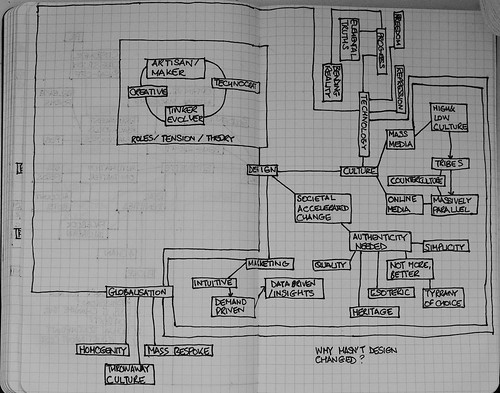
    Why hasn't design changed
    There were a number of possible factors that I came up with:

    Design – product design education has gone global – design professionals now know more about product design than they ever have done before. You now have product designers who can access the same influences from all over the world from the same place. The design computerised tools haven’t changed radically from the early 1990s but they have become more pervasive. Product design and culture are inextricably linked and culture as we previously knew it has been disrupted.

    Culture – The structure of culture has changed. Where the mass-media, publishers like Taschen and (often hard-to-get) style magazines or fanzines were the arbitors of the latest tribe, high and low culture trends, now Google is likely to turn up images and blogs about what whatever you want. This has meant that fashion is no longer linear in its timeline, but massively parallel: from cosplay and rockabilly  to ‘rugged’ style – fashion sensibilities resonates around the world in a self-sustaining loop with more power than previously.

    The pressures on culture have also changed; in the west there is no longer a sense that progress is inevitable. Even up to the 1990s with the Hubble space telescope and the Channel tunnel; big exciting things were being done and aspects of technology were interesting or exciting. You still have this; only its in China, Brazil and India. Environmental concerns and a wider anti-science movement that has gained momentum have squeezed the joy out of progress.

    Societal change – seems on some levels to be going at an ever faster pace, which means that culture values things like authenticity, by looking to simpler times in the near past. Authenticity comes from:

    • Simplicity
    • Heritage
    • Esoterism
    • Quality

    Globalisation – Autenticity can also be seen to be a backlash against the tyranny of choice that globalsiation has provided. Retailers in the west have created giant sheds to handle their massively expanded but similar product lines. This has promoted a homogeneity in many product lines and product design in those product categories. It has also promoted a throwaway culture: H&M clothing for instance – which is at odds with environmental concerns, particularly when you think about what goes into growing cotton. On the plus side it has also created opportunities for mass bespoke manufacture – supporting various subcultures through ecommerce and better logistics.

    Marketing – finally marketing has changed from being intuitative and demand-driven to being much more data and insights driven in nature and this has affected the product development process with every aspect of it undergoing scrutiny. The key challenge is that often people don’t really know that they want, but the space for vision is now lacking.

    You can find more design related content here.