Category: event | 事件 | 그룹 회의 | 出来事

If you look at the dictionary definition for event it comes out as:

  • A thing that happens or takes place, especially one of importance
  • A planned public or social occasion.

It’s also a synonym for contests that might be part of a larger sports competition. I can’t think of any event that I have covered in this blog on the basis of my being a speaker or attendee would really qualify as one of importance.

Event is a category that I get to use sporadically. You will find a mixed bag of posts in here.

Social media marketing conferences that I spoke at or attended, particularly when social media was immature sector. The ironic thing is the lack memory in the sector. The problems that people are having are still the problems that were being had on social media marketing over a decade and a half ago.

In that respect I feel that conferences were a poor investment of my time. The benefit from the events were the people that I met and got to have sidebar conversations with. Thats were the most interesting conversations happened, some of which influenced thinking that I have shared here down the line.

I also managed to go to a few talks including one by the likes of Charles Dunstone who was then the head of Carphone Warehouse. Carphone Warehouse were a major retail presence in the UK, Ireland and some continental European countries as an intermediary between the mobile network provider and the customer.

That business now seems to be largely gone. And my record of his speech is of historical interest only.

  • How the Panama Papers story broke online

    The Panama Papers are 2.6 TB worth of documents provided to German paper Sueddeutsche Zeitung by an anonymous source in August 2015. The documents cover 40 years of work by a Panamanian corporate law firm Mossack Fonseca on behalf of clients around the world.

    The documents detail corporate services provided to the rich and powerful around the world. The first stories from the data trove were published on April 3, 2016 with more expected by early May 2016.

    Many of the stories within the trove of information is likely to be never told. This is due to the vast volume of data provided. It would still need to be interpreted and mapped out into a story. That story would then need to go through legal review at a media outlet.
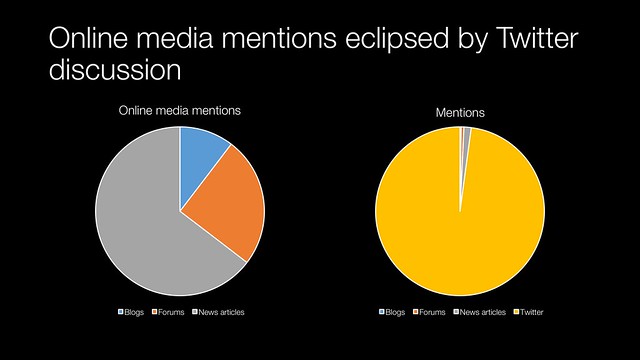
    Mentions by medium
    Looking at social media listening services we can see how the story rolled out online.

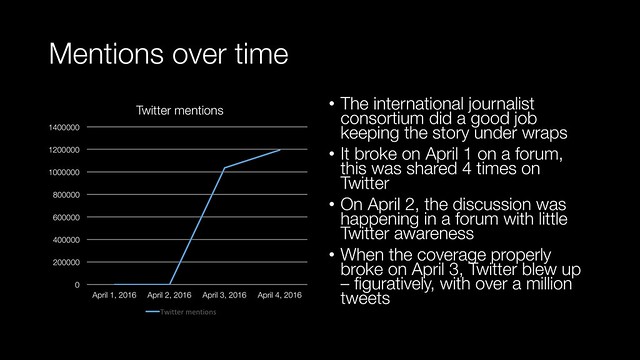
    Forums gave an early ‘canary in the coal mine’ for the story, a day before the story broke.  But it was Twitter that provided a massive accelerant. Twitter’s audience belies the platforms size versus Facebook. It is one of the few platforms that provides data like this for a price.

    The challenge for Twitter is monetising the power that they have in a way that will satisfy shareholders.
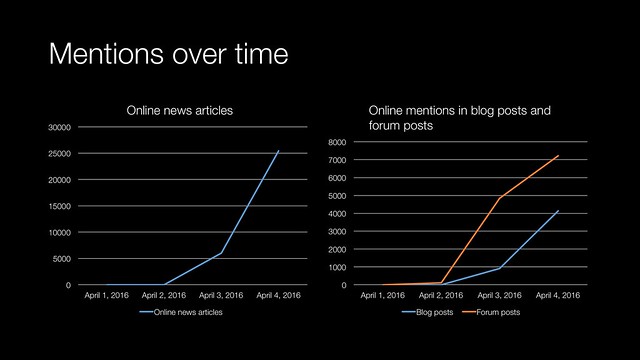
    Mentions over time
    Mentions over time

    It was clear that the mainstream media was needed as a catalyst to drive the story. Both the mainstream media and Twitter share the same monetisation problem.

    A secondary effect of the Panama Papers story was the way the story cemented Edward Snowden’s place as a media brand. His media brand specialises in privacy and transparency – he was the most retweeted commentator in the first 24 hours of the story being out there.
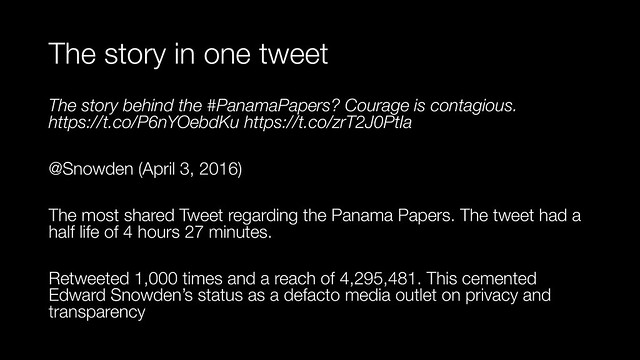
    The story in one tweet
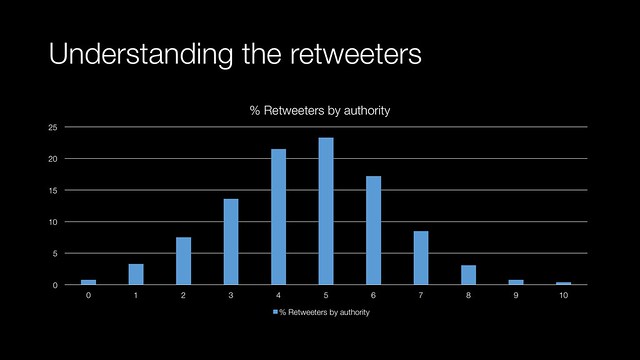
    Understanding the retweeters
    About me
    More on Slideshare. I also analysed the VS250 crisis and got some lessons from the data.

  • My 10 most popular (trafficked) blog posts of 2015

    These are the ten most trafficked posts of 2015, in reverse order:

    Throwback gadget: Nokia N900 – I tried Nokia’s first Maemo-based phone. It was amazing how useless it was as one forgets how linked the modern smartphone is to web services. Despite these problems one could see the now lost potential of the phone. More on the Nokia N900 at GSMarena.

    Generational user experience effects – a meditation on user experience from the analogue era to the present

    2015: just where is it all going? – I had a think about where digital and technology would go over the next 12 months or so. You can see how I did here.

    Reflecting on Yahoo!’s Q2 2015 progress report on product prioritisation – by June this year, the product rationalisation that Yahoo! underwent provided ample opportunity to show that it’s core offering was collapsing in many international markets. Rather than it being a market wide condition, the data pointed to Yahoo! specific issues.

    Traackr – beyond the buzzword event – a post about how a diverse range of organisations from Coca-Cola to a luxury jeweller were thinking about influencer marketing.

    Throwback gadget: Made 2 Fade (by KAM) GM-25 Mk II phono pre-amp and mixer – a review of a mixer that has been lost in dance music culture history, yet was responsible for much of its popularity outside the super clubs.

    That Jeremy Clarkson post (or lies, damn lies and sentiment analysis) – or why everyone from the mainstream media to PR Week got the story so wrong about Jeremy Clarkson’s departure from Top Gear.

    An experiment on fake Twitter followers – I spent some of my hard-earned cash to see what difference if any buying fake followers had. I chose Twitter as a channel mainly because it would be easier to measure any impact, otherwise it could have just as easily been Facebook followers, Pinterest subscribers or Instagram followers. My overall conclusion on the fake follower business is that it almost purely about personal vanity rather than gaming a system.

    O2O (online to offline) or what we can learn from the Chinese – East Asia is way ahead of marketers in the west in terms of multi-channel marketing particularly the integration of of online with offline aspects.

    48 hours with the Apple Watch – hands down the most popular post of this year on my blog was my short experience living with the Apple Watch. I felt that it was a nicely designed, but un-Apple experience. It also convinced me that the use case for wearables wasn’t here yet.

    That’s the end of my posts of 2015.

  • Microsoft Windows event

    I’ve been in-and-out of meetings that prevented me from reflecting fully on the Microsoft Windows 10 event of October 7, 2015. Microsoft put a lot of content out there which is worthwhile picking through. I have put these items in the order that they occur to me rather than an order of importance.
    Windows 10 : Everything You Need To Know About

    Microsoft Windows 10 is designed to run on a wide range of devices, a by-product of this is that the PC on your desk maybe a phone connected to a screen and keyboard. Now this may not work for all applications, but it could be enough for browser-based needs. It also means that bring-your-own-device could move beyond having your email on your phone.

    The Surface Pro 4

    Whilst Microsoft has undergone a regime change since the launch of the original Surface, somethings haven’t changed. I think that the Surface Pro 4 represents a continued effort to decapitate the Microsoft PC eco-system. The targets in the frame are devices like:

    • Lenovo La Vie Z
    • Lenovo Yoga 3 Pro
    • H-P Spectre 13x 360
    • Dell XPS 13

    All of these devices broadly fit into the 13 ultra notebook format that Apple plays in, but I think that the goal is to maximise Microsoft’s revenue share of the Windows eco-system. The hardware design hasn’t done the wider Microsoft brand any harm at all.

    New Lumia devices

    The 950 and 950XL put Microsoft in the game, at least from a hardware perspective with the Android eco-system, comparing favourably on hardware specifications with the likes of Huawei, LG and Samsung. What I found more interesting is the allusion in Microsoft’s own commentary of the event that the phones would face a gradual rollout in markets and Microsoft wouldn’t be rolling it out to all markets in Europe.  Don’t necessarily expect to see these handsets being rolled out in multi-national companies without an extensive availability and support network.

    Whilst mobile network providers would like a third eco-system to reduce the power of Android and iPhone, there doesn’t seem to have been universal carrier acceptance of the devices. This maybe partly due to the tighter integration of Skype in the Windows 10 OS?

    Xbox on Windows 10

    Xbox need to bring more customers on board and having backwards compatibility with Xbox 360 games provides a more cost effective gaming experience thanks to eBay and other used console game exchanges. It also does beg the question about possible non-gaming or even enterprise use that could be made of the new Xbox (beyond running Linux on them).

    Rolling out an OS so universal as Windows 10 is an interesting move. It presents some risks:

    • Compromised user experience due to different user contexts (gaming, business desktop computing, consumer PC usage, tablet experiences). A touch orientated interface on a laptop is sub-optimal for content creators who can touch type for example
    • Bloat due to the ‘Swiss Army knife’ requirements catering at a core level for different form factors and displays

    More information
    The Secret of iOS 7 | I, Cringely
    Final 2014 prediction: the end of the PC as we knew it | I, Cringely
    Thoughts on Microsoft Surface | renaissance chambara
    Skype in Windows 10 Preview: Built into Windows 10 so you can do more with friends across devices | Big Blog (Skype owned blog)
    Windows 10 Devices: a new chapter | Microsoft News

  • Ron Arad’s tablet design concept for LG

    Ron Arad is more famous for his architecture and art than product design. I went along to see him speak at an event that is part of London Design Festival last week thanks to the China-Britain Cultural Exchange Association. Arad’s presentation felt largely unplanned as the curator of the talk asked him to jump around from project to project rather than a clear narrative being presented. Arad showed imagery or video that he then talked around.

    During the presentation he showed off the design concept that he did for LG that pre-dated the iPad. It sounded at the event like Ron Arad had started his thinking in 1997, but the sources I looked at online stated that this project was done in 2002 and the video copy I found on YouTube states that the copyright is 2003.


    The video is quite prescient in a number of ways

    • The device was primarily about content consumption and messaging
    • He nailed the in-home use case, with the exception of realising that the iPad may be a communal shared device rather than belonging to an individual
    • It has a flat design interface (though this might be a limitation of their ability to create it on video and a spin on the circular LG logo)
    • The soft keyboard on screen
    • There is no stylus
      There was auto-rotation of the screen
    • It has no user serviceable parts (this was at the time when cellphones and laptops came with detachable batteries)
    • Inductive charging with a table rather than the small pad used by the like of the Microsoft/Nokia Lumia devices
    • The way the controls where superimposed on footage of the user working with the device is reminiscent of the way TV and films are now treating parts of a plot that involves messaging

    There were a few things that it got wrong:

    • Arad clearly didn’t understand the significance of the iPod, so the device had an optical drive rather than side loaded video content
    • The device is really big, more like a laptop screen than a phablet, a la the iPad Mini or Galaxy Tab
    • The form factor was too thick, understandably so when they are trying to squeeze a battery and optical drive in the device, the thickness had a benefit in that the device was self-standing. Apple relied on covers and cases to provide the standing mechanism

    More gadget-related posts here.

    More information

    The Israeli designer who (almost) invented the iPad | Times of Israel
    The Simple Way “Sherlock” Solved Hollywood’s Problem With Text Messaging | Fast Company

  • MWC 2015 from the Sidelines: Day Zero

    Mobile World Congress (MWC) 2015 in Barcelona has kicked off, though for many of my Racepoint colleagues the event started months ago. During this week we’ll see the pay-off from preparation that involved long days and late nights burning the midnight oil.

    I won’t be there this year and so have been watching the event unfold from the sidelines.

    In contrast to previous years, MWC 2015 now has a de-facto day zero as HTC, Huawei, LG and Samsung all launched consumer devices on the Sunday. Android devices are no longer lagging in industrial design with all the smartphones launched eschewing plastic in favour of a metal chassis, or glass and metal case design; in order to provide a premium-looking product.

    Secondly wearables are improving in leaps and bounds with the Android Wear devices looking more polished than the new Pebble discussed over the previous few weeks. The Apple Watch won’t have the same gap in industrial design to competitor products that the Apple iPhone enjoyed on launch.

    HTC launched an Occulus Rift rival in association with games platform Valve. However the Vive was notable more for its clunky industrial design rather than technological disruption.

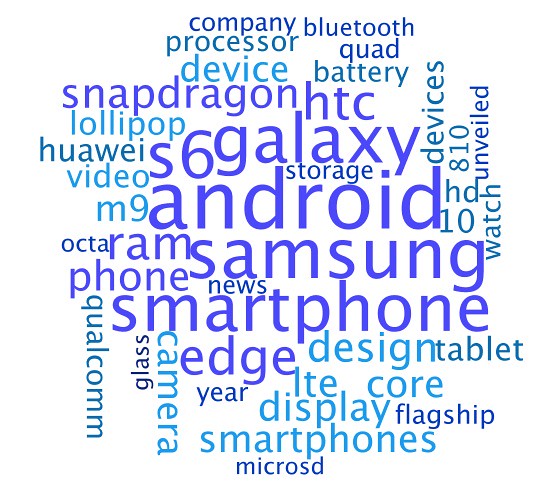
    Whist there were great leaps forward being made in product design for wearables, online discussions still centred around smartphone devices, with early adopters being focused on device core hardware – at the expense of features that provide a differentiated consumer experience.
    pr

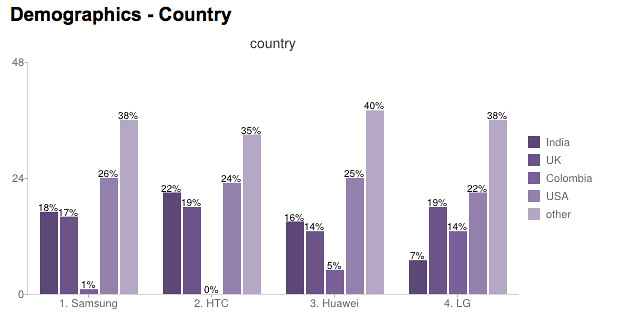
    It was immediately apparent from running analytics on online chatter was the prominence in social as a vehicle for challenger brands to get their message across, and the huge interest in MWC launches from the US.

    country by country
    Would a device launched at the US CTIA event have a similar global consumer impact?

    There is a wider question which remains to be answered regarding the efficacy of a ‘going early’ media launch strategy at MWC; particularly when one’s competitors have all adopted a similar strategy.

    It is hard to judge the answer to this question purely on the response to the Microsoft and Sony events earlier this morning. It would be unfair to compare their relatively lacklustre handset line-up in comparison to the day before. Whilst HTC, Huawei, LG and Samsung focused primarily focused on premium devices, Microsoft and Sony featured at least some mid-market handsets.

    More information
    LG launches LG Watch Urbane at MWC, but disappoints with lack of G4 flagship | The Telegraph
    MWC 2015: Huawei MediaPad X2, Watch, Talkband N1 and N2 | GSM Arena
    Live from Samsung’s Galaxy Unpacked event at MWC! | Engadget
    MWC 2015: HTC One M9, Grip hands-on | GSM Arena
    Pebble Time: Hands-on with the most successful Kickstarter project ever | Pocket Lint

    All the day  derived in the charts using Sysomos MAP.