Category: ideas | 想法 | 생각 | 考える

Ideas were at the at the heart of why I started this blog. One of the first posts that I wrote there being a sweet spot in the complexity of products based on the ideas of Dan Greer. I wrote about the first online election fought by Howard Dean, which now looks like a precursor to the Obama and Trump presidential bids.

I articulated a belief I still have in the benefits of USB thumb drives as the Thumb Drive Gospel. The odd rant about IT, a reflection on the power of loose social networks, thoughts on internet freedom – an idea that that I have come back to touch on numerous times over the years as the online environment has changed.

Many of the ideas that I discussed came from books like Kim and Mauborgne’s Blue Ocean Strategy.

I was able to provide an insider perspective on Brad Garlinghouse’s infamous Peanut Butter-gate debacle. It says a lot about the lack of leadership that Garlinghouse didn’t get fired for what was a power play. Garlinghouse has gone on to become CEO of Ripple.

I built on initial thoughts by Stephen Davies on the intersection between online and public relations with a particular focus on definition to try and come up with unifying ideas.

Or why thought leadership is a less useful idea than demonstrating authority of a particular subject.

I touched on various retailing ideas including the massive expansion in private label products with grades of ‘premiumness’.

I’ve also spent a good deal of time thinking about the role of technology to separate us from the hoi polloi. But this was about active choice rather than an algorithmic filter bubble.


  • Vice TV news

    Over the past few weeks I have been watching the team at Vice magazine’s new TV documentary series. The content is familiar territory to people who have watched the Vice YouTube channel, just the segments are joined up into cohesive themes. At the beginning of each episode you can hear Shane Smith introduce the programme with the following refrain:

    The world is changing,
    And no one knows where it’s going
    But we’ll be there uncovering the news, culture and politics
    And expose the absurdity of the modern condition
    This is the world through our eyes,
    This is the world of Vice

    Vice’s news media offering comes from a position that mainstream media has failed to give consumers the information and insights that they need and deserve as part of a modern society. Having heard Shane Smith talk about the offering you get the sense of frustration that has driven the programming. Smith cited the anger felt by the youth that they came across, research that indicated younger consumers were interested in the world around them, but weren’t engaged by current news offerings.

    This is blamed on a lack of integrity within the western news media which is viewed by some to have sold out during the post-9/11 period. And an inability to come to terms with a changing media landscape of social media publishing combining with a smartphone becoming a broadcast studio in the palm of your hand.

    For me Vice looks to have re-invented the news media by going back and borrowing from the journalism of the past. Firstly, Vice stories are one of personal exploration of an issue: a travelogue to find out the different sides of the situation they are examining: whether it is smoking in Indonesia or gun markets in the border regions of Pakistan. This is very reminiscent of the New Journalism movement from Truman Capote and Tom Wolfe to Hunter S. Thompson which put the narrator into the story.

    The edgy, surprising and shocking material reminded me of Italian film-makers Gualtiero Jacopetti and Franco Prosperi’s Mondo series of films. These were often travel vignettes offered up within a theme including:

      • Mondo Cane – focused on different cultural practices around the world that would be alien to a western audience
      • Africa Addio – documented the move to post-colonial government across the continent; with some of the little documentary footage shot of the Zanzibar revolution

    Vice is managing to make the future of news media with ingredients from genres of journalism that grew out of the counterculture.

  • Eight trends for the future

    I have been thinking about were things are going and boiled this down into eight trends or areas. Some of these areas overlap and enable each other, so it’s often hard to tease apart the post-modern tangle into neat categories. But I hope to drill down into these eight trends in more depth in future posts. For now I will give you a high level view of these eight trends for the future:

    • Social hygiene – social as a channel has become engrained into our lives just like the mobile phone, the web and the telephone directory before it. It is no longer a brave new frontier, but a place were audiences expect brands to have even a minimal presence. In the same way that a business without an office address, company accounts or website that can be Googled is found suspect, so it is with their presence on social properties now. In addition, there are consumer expectations to be met in the way that they expect to be able to transact business
    • Contextual technology – from the rise of search to location-based services and consumer preference for applications – much of this has been driven by consumer preference for informations and services that are contextually relevant
    • Divergence – whilst smartphones and tablets may look like general purpose devices that support convergence what is actually happening is that divergence is taking place around different fault lines, understanding those fault-lines is key
    • Prosumption realised – the idea of consumers being the producers, or at least being part of the process within a modern industrial context was envisioned back in 1970 with Alvin Toffler’s book Future Shock as consumers started to be more involved in the delivery of their own services and products from ATMs to phone calls made without operator intervention. The internet has extended it further
    • Brands as online tribes – brands are as much totems of who we are online as in real-life. Communities allow us to self-reinforce our passions in a way that wasn’t possible before. This is further reinforced by algorithms to provide the audience with only the world view they want to see
    • Web-of-no-web – the web as we know it was built on a set of underlying technologies which enable information transport. Not all information is mean’t to reside in a database to be searched, but instead relies on context like location, weather or the contents of your fridge. Web technologies provided an lingua franca for these contextual settings and mobile technologies have facilitated them further. What hasn’t been done too well so far has been the interface to the human
    • Immersive as well as interactive experiences – at the moment the focus has been on interactive content. But contrary to the belief of technologists good quality older passive mediums didn’t disappear. The reason for this was that they allowed consumers to immerse themselves in them, suspend disbelief in ways that haven’t yet been done by interactive media
    • Digital interruption – by the late 1950s the US civil rights movement found that discourse and letters hadn’t moved the needle meaningfully and it took events like Rosa Parkes sit-down protest and the Stonewall riots to move the process forwards towards a more equal rights for all. Underlying internet technologies have facilitated a step-change in protest; moving from vigorous discourse and petitions to website blackouts; denial of service attacks, defacement and account hacking (a digital equivalent of an effective picket line)
  • Rituals and artefacts

    I have been reflecting on rituals and artefacts. This line of thought started when I met up with Marc Sparrow and we talked about many things. The one that stuck out in my mind the most was that we were two tablet computer owners, but we both insisted on reading the Sunday newspaper in a dead tree format.

    Marc went on to tell me that he saw from his friend’s Facebook updates that they were passing on rituals including getting a print Sunday newspaper on to their children too. The Sunday Times was no longer about news and analysis but a marker for Sunday like the traditional roast dinner or church service and a way of unwinding before the week ahead.
    Patek Philippe advert
    When one looks at Patek Philippe’s adverts the thing that stands out is the strapline:

    You never actually own a Patek Philippe.
    You merely look after it for the next generation.

    Whilst being a clever bit of marketing, I think that it says a lot about some brands and contexts. In particular, how rituals and artefacts are central to context. Whilst brands like Louis Vuitton and Gucci have blurred the line between fashion and luxury; the great Swiss watch brands like Rolex rely on old-fashioned word-of-mouth. Omega is part of my evoked set (despite my not liking a lot of their watch designs or the way way they have fashionised the brand) because of my parents. I got my first Rolex because I had a bad experience diving with a Seiko watch and my dive buddies explained why they thought Rolex was more resilient.

    This didn’t happen in Facebook but in Snowdonia, in the dead of winter in front of a man-made lake that had killed a number of scuba divers. Within half an hour of my having made a forced ascent as my dive watch had popped off my wrist and sailed to the bottom of the lake some 80 metres down.

    As an industry we often forget about physical context, rituals and artefacts. Ironically it is about going back to marketing 101 and the year 1960. E. Jerome McCarthy came up with what was then the four Ps, to which were added another three over time. Since then marketers have thought about looking at these from a consumer point of view and you had other models like the four Cs, but for the sake of simplicity I will list out the 7 Ps:

    • Product
    • Price
    • Place
    • Promotion
    • Physical Evidence
    • People
    • Process

    I would argue that physical evidence is more than the salesroom experience and people are the customer base as well as the sales and supply chain. Think about how on the road arrogance affected the perception of certain car marques in the UK:

    • Mondeo Man
    • The Volvo Driver
    • White-Van Man

    All of these stereotypes have had a grain of truth to them and affected the way we think about the brands. Look at the way Burberry and Stone Island got affected by their football casual customer base.

    As clever marketers we can also create rituals:

    • Mother’s Day
    • Take a break, have a Kit-Kat
    • Royal British Legion poppy campaign
    • Guinness co-opting St Patrick’s Day

    More related content can be found here

  • Vivid cyberspace

    I have been thinking about a vivid cyberspace. I left my original iPad with my parents so we could have regular talks over Skype. I set up my new iPad (I have gone for a mini this time) and pulled up photos from my old iPad back-up. I used the screen capture function as a way of taking notes (usually infographics or adverts that caught my eye) to form a scrapbook on my iPad.

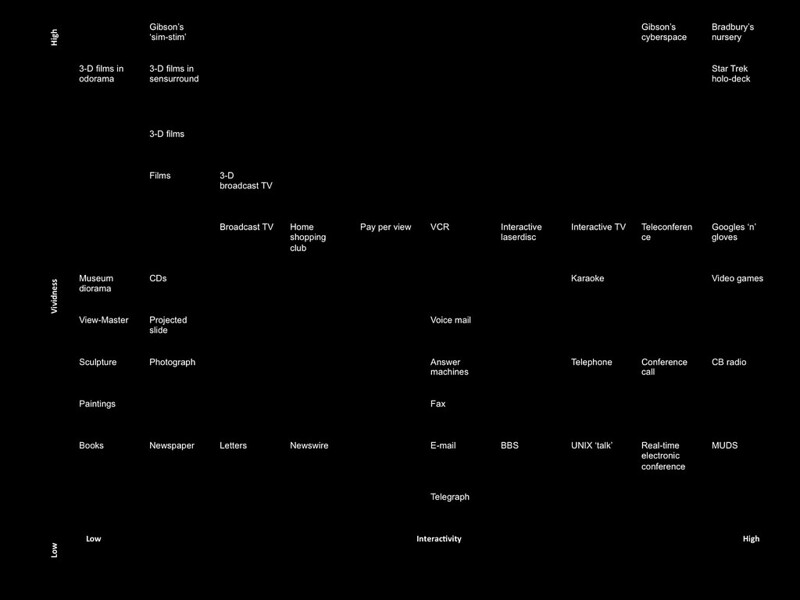
    I was reviewing this images and came across a diagram from Max Whitby that looked media in terms of two sets of attributes: vividness and interactivity. I have redrawn the diagram here:
    Interactivity versus Vividness

    What becomes immediately apparent is that outside of literature, development of vivid cyberspace experiences has been a bit of a wash-out. In fact, with many of the most vivid experiences that have been created were attempted in the movie industry or amusement parks 50+ years ago.

    Secondly, there has been a decline in ambition amongst products that do get to market. During the first spurts of the commercial web ambitions of vividness and interactivity went hand-in-hand. Virtual reality headsets had moved out of the military and laboratory environment to some high-end arcades.

    Zeiss made glasses that provided a virtual screen to provide the big-screen TV experience in a smaller space. Mark Pesce’s VRML portented a vivid 3-D web experience that didn’t come to pass. VRML eventually became X3D, but some two decades later, I still don’t have cyberspace as envisaged by William Gibson.

    Haptics are moving along at a snails pace and augmented reality moving along a little faster.

    Before RSS, there was push technology; the PointCast Network and client software provided a more vivid experience than any RSS reader, some eight years before Twitter. Developments of products like Facebook and twitter have iterated on prior social platforms from internet chat and forums to messaging platforms. But all of these ‘developments’ haven’t moved the needle in terms of providing vivid experiences.

    From a marketing perspective both content and interactivity have become more important as brands become social and build ‘content factories’ yet there hasn’t been any efforts to provide vivid brand experiences that would be engaging to the consumer. Pop-up stores and experiential events are fleeting spurts of creating a vivid brand with varying degrees of success. There is a lot more mileage yet in the black spaces of the diagram above. More related content can be found here.

  • Windows 8 sales

    From the changing interface to an absence of a start button, the analysts came out with reasons that felt unsatisfactory. It isn’t a lack of quality, if you look at the reviews by the technology press of Windows’95, you’ll see a product that sucked in a way that made Vista look perfect by comparison; yet it went on to be the best-selling Microsoft product ever. Windows 8 has its problems, but in comparison to Vista its a really well made product. The fundamentally-flawed Windows 95 was the acme of Microsoft’s position in the marketplace. Given all this spurious debate, I thought I would throw some ideas out instead:

    • The economy – China now has single digit growth, economists generally agree that India isn’t living up to its economic potential. Brazil has problems, Europe is still going through the great restructure. The US is growing slowly but full of turmoil as government spending is causing uncertainty. All of these factors will affect purchases across IT and consumer electronics
    • The web – the biggest thing the web did was negate operating system specific file formats like those on Windows 8 applications. You no longer need to write a document in Word or a spreadsheet in Excel. Enterprise applications no longer need to have a client piece of software running on a PC. This also means that you don’t need to follow software release cycles to keep your PC relevant. Given that the killer app for the PC is the web, replacement cycles for computers have lengthened. A friend of mine, recently had their iPad, iPhone 5 and PowerBook stolen in their house. Yes, that’s right I said PowerBook, their laptop which they were happy with was about seven years old…
    • Opportunity costs – So you have a computer that’s a few years old, but you are still happy with it and smartphones moving forwards more rapidly, so need to be replaced every 18 months to two years. The new PC purchase will get put on the back-burner
    • Substitute products for a Windows 8 PC – This is the classic butter-margarine example that economics teachers used to trot out before low-fat spreads caught the awareness of coronary wary consumers. But in a web-based world tablets that provide a PC like web experience are a substitute for a full-blooded personal computer. An iPad can run Myst, show video and communicate with others via the internet
    • A lack of a compelling reason to upgrade – Robert X. Cringely wrote his book Accidental Empires back in the early 1990s, had a whole chapter on the future of computing. One of the most striking parts of this chapter for me was a paragraph with a quote from Ken Okin who worked at Sun Microsystems at the time:  Ken Okin, who was in charge of hardware engineering for the Lisa and now heads the group designing Sun Microsystems’ newest workstations, keeps a Lisa in his office at Sun just to help his people put their work in perspective. “We still have a multitasking operating system with a graphical user interface and bit-mapped screen, but back then we did it with half a mip [one mip equals one million computer instructions per second] in 1 megabyte of RAM,” he said. “Today on my desk I have basically the same system, but this time I have 16 mips and an editor that doesn’t seem to run in anything less than 20 megabytes of RAM. It runs faster, sure, but what will it do that is different from the Lisa? It can do round windows; that’s all I can find that’s new. Round windows, great!”  So even back as far as the early 1990s there was a lack of a compelling reason to upgrade from machine-to-machine. This is even more of the case now. Cringely claimed that in order to have a radical jump in software appearance you would need a corresponding jump in the hardware. The last big jump that we had in personal computing was the tablet PDA
    • The declining power of the IT guy – between BYOD (bring your own device) and the rise of small or freelance businesses there are less traditional corporate users. The power of the Microsoft Certified system is diminished and with that decline has gone the ability to specify a Windows-based computer
    • The law of big numbers – Microsoft already has a huge installed user base, most sales will not be won from its competitors but from itself. That’s a tough place to be if people are looking for stellar growth
    • Paradigm shifts mean deskilling people – Metro represents a new way of using a computer. It threatens consumers current computer literacy knowledge. For many consumers there was no on-ramp
    • Divergence, convergence and the sitting room – a perfect storm of dedicated media server substitute products (Roku, Boxee, Apple TV), smart TVs, games consoles and tablets have squeezed the laptop, media PC and gaming machine in ‘lean back entertainment’ scenarios. We are seeing traditional brown goods being replaced by other goods (often providing a more convenient but poorer quality experience) in the living room that have also subverted multimedia computing

    Does Windows 8 mean Microsoft is doomed? No.