Category: ideas | 想法 | 생각 | 考える

Ideas were at the at the heart of why I started this blog. One of the first posts that I wrote there being a sweet spot in the complexity of products based on the ideas of Dan Greer. I wrote about the first online election fought by Howard Dean, which now looks like a precursor to the Obama and Trump presidential bids.

I articulated a belief I still have in the benefits of USB thumb drives as the Thumb Drive Gospel. The odd rant about IT, a reflection on the power of loose social networks, thoughts on internet freedom – an idea that that I have come back to touch on numerous times over the years as the online environment has changed.

Many of the ideas that I discussed came from books like Kim and Mauborgne’s Blue Ocean Strategy.

I was able to provide an insider perspective on Brad Garlinghouse’s infamous Peanut Butter-gate debacle. It says a lot about the lack of leadership that Garlinghouse didn’t get fired for what was a power play. Garlinghouse has gone on to become CEO of Ripple.

I built on initial thoughts by Stephen Davies on the intersection between online and public relations with a particular focus on definition to try and come up with unifying ideas.

Or why thought leadership is a less useful idea than demonstrating authority of a particular subject.

I touched on various retailing ideas including the massive expansion in private label products with grades of ‘premiumness’.

I’ve also spent a good deal of time thinking about the role of technology to separate us from the hoi polloi. But this was about active choice rather than an algorithmic filter bubble.


  • Connected leadership + more

    Connected Leadership

    Connected Leadership, Powered by Brunswick | Brunswick – worth a read during your lunchtime. 9 out of 10 financial readers cite the importance of social media communications by CEOs during a crisis. There were also findings that equate CEO social presence with employer brand. Reading about connected leadership reminded me of the oft quoted wisdom that history doesn’t repeat itself, but it rhymes. Connected Leadership had reminded me of research that I remember seeing around the time of the original dot com boom (and bust). I think that the research had been done by Weber Shandwick in the US; and I had heard Larry Weber cite it when he came through Europe every so often.

    At that time the connected leadership type content was focused on CEOs with a media profile. The research showed a positive correlation between a highly visible CEO, better stock market performance and greater resilience when the brand was facing challenging times. This was back when Larry Ellison, Steve Jobs and Bill Gates courted the business and ‘business of technology’ media. Like any model it can be only taken so far, as Bernie Ebbers at WorldCom, Jeff Skilling at Enron and Steve Case at AOL showed that a high profile won’t stop a terminal decline.

    Prior to Oracle’s acquisition of Sun Microsystems, then CEO was criticised for a lack of focus on the business problem. The twice weekly blog posts that marked his connected leadership style were not appreciated by activist shareholders.

    A more modern example of connected leadership would be the cult like following that Donald Trump managed to build up over the past five years in politics. A future Democratic president would like appear less on social and in the media, being more focused on the task at hand rather than demonstrating connected leadership.

    For businesses, a connected leadership style brings challenges from a regulatory point of view, could their content be sifted for potential class action suit material?

    WGSN – Future Drivers 2023 – WGSNAfter the dust settles on the tumult of 2020, companies and consumers will shift to new ways of designing, making, selling and consuming in 2023. In an age of uncertainty, executives can bank on the importance of the four C’s – connection, conservation, communication and community. This report identifies seven global drivers that will reshape the macroeconomic and business landscape in 2023, and provides key strategies that businesses can action today for future success. 

    • Radical Reform: this will be front and centre for 2023. Be prepared to be held accountable for diversity, sustainability and CSR practices 
    • Safety & Security: this will drive innovation in defensive materials, an increase in home and neighbourhood security networks, and make touchless payments and products mainstream 
    • The Tech Paradox: cobots (collaborative robots that interact with humans) and democratised digital literacy will gain ground, but on the flip side, infodemics, influencer fatigue and the politics of global technology will drive a tech reset 
    • Community 3.0: look to the growth of community supply chains, staff who are steps away from the stores, and up-skilling locals to keep community money intact 
    • Environment: From Urgency to Emergency: regenerative businesses are creating a sustainable future, while made-to-order manufacturing and nearshoring are reshaping distribution models 
    • The Recession Generation: unstable job markets and a new gig economy will drive new generational spending and consumption habits 
    • New Alliances: international relations are being reshaped and this is underscoring political tensions, with growing knock-on effects

    Lightest 5G smartphone with graphene batteryAppear is launching the lightest and first graphene battery-powered smartphone with innovative water-resistant technology. There is already a lot of interest in this smartphone. Appear has begun receiving orders and projections call for a million units sold in the first six months. The smartphone would be available in stores and major online retailers by March 2021. To meet growing demands, Appear has partnered with Foxconn India for its manufacturing needs

    Research specialist Qamcom joins European partners in 6G driveHexa-X research project is EU funded and expected to run for two and a half years with the aim of laying the foundation for next generation 6G networks. Bringing together a number of technologically advanced European partners, the Hexa-X research project aims to develop the next generation of mobile networks, namely 6G or sixth generation. The project, which is EU-funded, is expected to start in January 2021 and last for about two and a half years. The purpose of the project is to lay the foundation for a global standard and to define principles for the 6G system itself – which will serve as a base for the entire telecom industry and its future services and products. On a more philosophical level, the project’s purpose can be described as technology connecting our human and physical world with the digital world. Qamcom’s research will focus on localisation and network optimisation

    Why minimalists are maximally important » strategythe minimalist demo are predominantly suburbanites, more than half of whom (59%) are married couples with kids, with moderate household incomes. While they haven’t previously been majorly digitally inclined, the group has been making its first major foray into online shopping. Minimalist shopping activity on mobile phones and tablets was up 31% among this audience segment, with gaming activity increasing by 19% and 43% on mobile devices and consoles, respectively. Minimalists’ propensity to order online food has almost doubled since lockdown began, and marketers should be mindful that QSRs could really benefit from attracting this segment

    Boots UK sales struggle despite better than expected results for parent company | Cosmetics Business 

    The Chinese ski market: how China is going crazy for snow with the upcoming Winter Olympics 

    Banning Trump from digital platforms sets a dangerous precedent | ProMarketI find them a dangerous precedent, which concentrates power irreversibly in the hands of a few private firms. Everybody, but especially people from the Left, should be worried: soon, this power will be used against them.  If Trump violated the law with his tweets, he should be prosecuted according to the law. Why did Twitter and Facebook take the law into their own hands as self-appointed vigilantes? If his tweets did not violate the law, why did Twitter and Facebook kick him out? Twitter and Facebook, many would object, are private companies, which can create their own rules of engagement. This is certainly true. But these rules should be consistently enforced and here they are not. According to Twitter’s own statement, Trump was permanently suspended because of the following two tweets, sent on January 8:   “The 75,000,000 great American Patriots who voted for me, AMERICA FIRST, and MAKE AMERICA GREAT AGAIN, will have a GIANT VOICE long into the future. They will not be disrespected or treated unfairly in any way, shape or form!!!” “To all of those who have asked, I will not be going to the Inauguration on January 20th.” “These two Tweets,” writes Twitter, “must be read in the context of broader events in the country and the ways in which the President’s statements can be mobilized by different audiences, including to incite violence.” The context Twitter is referring to are the potential plans for a secondary attack on January 17—even though Trump’s tweets did not mention such plans

    Pennies to Dollars: The Problems With Amazon’s Plans for Detroit – Amazon Chronicles – sketchy property deals and minimum wage jobs

    A bit reactionary but it’s still worthwhile watching Chris Chappell interview with Winston Sterzel and Matthew Tye. Sterzel and Tye’s observations are spot on and tally with my own experience in China and Hong Kong.

    Escapist retail – Wunderman Thompson Intelligence – Digital fashion and virtual spaces are getting dreamy, engaging shoppers’ imaginations—and dissolving the traditional boundaries of retail. All of which is fine if you’re on the ‘upper leg’ of the K-shaped economic recovery. Not so great if you’re Primark. More retailing related content here.

    Well worth a read: Beatie Wolfe, digital artist and musician – Wunderman Thompson Intelligence 

    Why going global has proved so hard for the big banks | Financial Times – despite gains from globalisation in the lead-up to the financial crisis, the overall international record of the industry is poor. Just last week came a reminder of the challenges of a global bank: Deutsche Bank agreeing to pay US regulators $125m to resolve allegations that it paid bribes to win clients in the Middle East. Its not an isolated example, though Deutsche Bank does have a higher appetite for risk than many of its peers. Other examples, Goldman Sachs had to pay $3.9bn to settle the 1MDB bribery scandal in Malaysia. JPMorgan agreed to pay $264m to settle a US probe into its practice of hiring scions of the Chinese elite as its new business strategy. Its not like these bank failings are a new phenomenon. HSBC was able to buy the Midland Bank because it had been so weakened by its majority stake holding in Crocker National of California. At the time of purchase in 1980, Crocker was the tenth largest bank in the US. It has been one of the first banks in the US to use ATMs. Eventually it was sold due to the losses that Midland endured while owning it. Crocker had a large amount of bad loans on its books.

    2021 and the Conspiracies of ‘Johnny Mnemonic’ | WIREDGibson’s cyberspace was always bound up with the body. Data can be wet-wired; manipulating files requires Power Gloves and an “Eyephone.” When Johnny jacks in, it kind of hurts. Such meat-meets-metal has, in the quarter-century since Johnny Mnemonic came out, been called a failure of prediction. Our internet ended up disembodied, virtualized, socially distanced, our iPhones more of a figurative prosthesis. Yet, this last year, we sat slack at our desks, muscles atrophying, nerves attenuating, as we doomscrolled our way to new aches, new anxieties, new ailments. Some wild-eyes went so far as to claim that 5G triggered the pandemic, which is the most Gibson-sounding conspiracy of all. In Johnny’s world, the black shakes are caused not by a virus but by a signal. Epidemic through technic. There’s something in the air, no matter what you do. You’re already sick, you’re already dying. Connectivity is killing you

    Don’t Toss It, Fix It! Europe Is Guaranteeing Citizens the “Right to Repair” – expect a wide range of protests from auto manufacturers (like Tesla), to gadget makers (Apple) and agriculture titan John Deere

    Solar power – How governments spurred the rise of solar power | Technology Quarterly | The Economist – like other developments before it, solar demonstrates the need for government to play a role in innovation

    China consumer prices rise but worries persist over core inflation | Financial Times 

    Twitter vs Trump: has Big Tech gone too far? | Financial Times – Mr Trump has been barred from Facebook and Twitter due to events in the US last week. Apple, Google and Amazon have all taken steps to clamp down on Parler, the right wing social network.  This has set up a fierce debate about where the balance lies between a tech company’s right to censor users who breach their content policies versus an individual’s right to freedom of expression. A second aspect is the right for governments to regulate services versus the US approach of laissez faire – Angela Merkel attacks Twitter over Trump ban | Financial Times and a more US perspective – Superspreader Down: How Trump’s Exile from Social Media Alters the Future of Politics, Security, and Public Health – Defense One 

    Taiwan manufacturers quit China over trade tensions and rising costs | Financial Times – really interesting article. Taiwan’s biggest weakness seems to be the small and medium sized manufacturers with operations in China.

    I’ve chosen to not get drawn into the events at the Capitol in Washington DC. It is interesting that Arnold Schwarzenegger is far more articulate and coherent than the politicians in office.

    Quantum science leaps forward in China under Xi’s support: report | Apple Daily 

    Announcement for the connection problem faced by Hong Kong users|HKChroniclesFrom the evening of 6th January, 2021 (Hong Kong Time), the chief editor of HKChronicles, Naomi Chan, has received numerous reports from users located in Hong Kong. They noticed that the website was inaccessible when using the Internet service provided by some ISPs in Hong Kong. After looking into the analytics, we also found that the number of visitors from Hong Kong decreased drastically. Because of the scenario, there are some rumors on the Internet regarding to the status of service on our website – Hong Kong ISPs blocking the site. It has lots of good information on organised crime affiliated police, business people and political extremists. More Hong Kong related content here.

    Sex workers say ‘defunding Pornhub’ puts their livelihoods at risk – BBC News 

    Bitcoin Mining and Its Environmental Effects by Şerif DİLEK* & Yunus FURUNCU – an academic paper that show just how bad bitcoin is for the environment. It isn’t just bitcoin mining, but even blockchain and wallet management. TL;DR here is the money quote: Bitcoin’s energy consumption causes serious damage to the environment and faces us as one of the most significant obstacles in the development of Bitcoin.

    Concerns raised about cameras at self-service supermarket checkouts | Irish Examiner – not terribly surprising that Tesco loss prevention techniques give people the privacy creeps. But then they wouldn’t need to if the tills were manned….

    How PewDiePie is trying to dodge his taxes | Input magazine – clickbait headline, the real point is that top level influencers now are big enough to give effective tax management serious consideration

    Telegram: Contact @durov – Telegram laying into WhatsApp. But a little something to think about from seven years ago to consider before you move to Telegram: Cryptography Dispatches: The Most Backdoor-Looking Bug I’ve Ever Seen • Buttondown 

    Mark Ritson’s marketing effectiveness lessons

    • Qualitative and quantitative diagnosis
    • Clear strategic objectives
    • Long, mass-marketing brand building
    • Shorter, targeted performance
    • Tight, differentiated position
    • Heavily, consistently codified
    • Investing more than competitors
    • Astonishing creativity
  • PDI

    PDI or purpose driven innovation is Trendwatching’s approach to identifying and help clients act on ‘meaningful’ business opportunities. I think its interesting as it captures the aspirations of corporate responsibility professionals in businesses; a case in point being the steady changes that Unilever have made in their business over the past decade or so, like their concentrated aerosol can design.

    PDI factors

    In their own words:

    Make a difference through innovation

    Turn overwhelm into opportunity

    Move from anticipating and meeting customer expectations to setting them

    The principles that it holds itself to are:

    Don’t extract from the earth

    Don’t produce harmful substances

    Don’t degrade nature

    Don’t overwork people (wellbeing)

    Everyone’s voice matters (inclusivity)

    Help people to self-develop (empowerment)

    Don’t discriminate (fairness/justice)

    Celebrate diversity

    While Unilever’s concentrated aerosol can initiative leaves a lighter footprint on the earth, it would still fail on some of Trendwatching’s purpose driven innovation principles. In particular degradation of nature and extracting from the earth, due to its use of aluminium and butane gas propellant.

    The sweet spot for any idea that fits in with their principles is at the intersection of: drivers of change, innovation and consumer basic needs – like most other successful trend driven ideas. At a macro level this net out to accelerating societal and cultural trends that are moving from the edge to the mainstream, behaviour change and both demand and supply-side economics.

    PDI approach examples

    Patagonia’s ReCrafted range is the kind of project that Trendwatching would hope to get out of PDI.

    Patagonia ReCrafted – a classic example of the kind of project PDI should generate

    More design related content here.

    More information

    Unilever shakes up the aerosol world | Packaging World and Unilever’s compressed aerosols cut carbon footprint by 25% per can | The Guardian on Unilever’s concentrated aerosol can design.

    Patagonia Launches ReCrafted, a New Collection of Upcycled Gear | Make Fashion Better – Patagonia’s up cycled clothing range

    More on the Trendwatching approach here.

  • Big sky theory

    Bob Cringely was writing about the concept of big sky in one of his recent columns and I thought that it was worthwhile sharing here.

    Big Sky
    Big sky by Whatknot. (The picture was originally taken in Nevada).

    Origins of big sky theory in early flight

    Big Sky theory came from early aviation. The main problem pilots faced was crashing into the ground rather than a mid-air collision. There was relatively few planes happening compared to the big sky out there. That meant the odds of collision were so low as to be not worth worrying about.

    Or as Cringely put it:

    Another version of Big Sky is Inshallah, an Arabic language expression meaning “if God wills” or “God willing.” The term is mentioned in the Quran and Muslims often use it when speaking about future events. Climate change or organized crime or the well running dry or uncontrolled instrument flight won’t negatively affect us if we are on the correct side of God, Inshallah.

    Bob Cringely

    It was only with the increasing air travel of the mid-1950s that the air traffic controller directed traffic we are used to now came into force. This traffic controller directed process is known as positive control.

    Data as antidote

    The phrase is used in areas such as environmental concerns around climate change, deforestation or peak oil. It makes the most sense when based on individual empirical experience or opinion. It works really well in rhetoric. Often dangerously so. It is usually countered by the use of data. Data provides qualitative risk calculations. Data is now used to conduct planes along airways one after the other. It is the same with shipping lanes.

    From economics to pandemic prevention data based regulation has proved it’s worth.

    In essence it represents thinking 180 degrees away from Malthusian ideas. More similar content here.

  • CD ROM history + more news

    CD ROM reflections

    How “God Makes God” is a 1993 CD ROM about probability, game theory, genetic algorithms, and evolutionary strategies | Boing Boing – I remember having my mind blown by this CD ROM at college. It reminded me of Jostein Gaarder’s book Sophie’s World in terms of its approach to making philosophy entertaining and accessible. I remember reading Sophie’s World around the same time as having played How God Makes God. There was something about HyperCard and the CD ROM authoring tools that followed. Amidst all the brochureware there were creators who drove extraordinary media projects, most notably for me was the game Myst, which I don’t think has been bettered. I suspect part of it was the excitement of new ‘hyper-media’, the limitations of the tools (though 640MB storage at the time seemed vast when I was using an Apple PowerBook 165 with 4MB of RAM and an 80MB hard drive at the time) and the media economics of the time. CD-ROM authoring tools were becoming more sophisticated. CD manufacturing plants were proliferating, lowering the cost per CD ROM disk and CD recordable drives were relatively affordable in the price range of $10,000 – $20,000. Still eye wateringly expensive, but this was a vast improvement from just two years before and allowed for better prototyping, small production runs and testing across devices.

    Design

    3D printed IKEA hack experiences by Uppgradera on Etsy – really interesting aspects to the designs

    Ethics

    Instacart Is a Parasite and a Sham | The New RepublicThe gig economy company, like many of its peers, has seen business skyrocket during the pandemic—while exploiting workers and even failing to turn a profit. That last bit reminds me a lot of the first generation dot com companies who tried to break through the wall of economics and succeed by moving at internet speed. This time they seem to have supplemented the usual ‘throw money at it’ approach with a lack of morality

    Ideas

    How Claude Shannon’s Information Theory Invented the Future | Quanta Magazine – the idea of binary encrypted signals

    Innovation

    Activist Firm Urges Intel to ‘Explore Alternatives’ to Manufacturing Its Own Chips – ExtremeTech – there are national security issues with this. I suspect this is just an opening salvo by Dan Loeb

    Regulators tell Jack Ma’s Ant Group to rectify five problemsthe five areas included: Ant’s inadequate governance; regulatory negligence; unlawful profit-seeking; monopolistic practices and; infringement of consumer rights, said China’s central bank vice governor Pan Gongsheng.

    China orders Ant Group to rein in unfettered expansion as regulators put up fences around financial risks | South China Morning PostAnt must return to its origins in online payments and prohibit irregular competition, protect customers’ privacy in operating its personal credit rating business, establish a financial holding company to manage its businesses, rectify any irregularities in its insurance, wealth management and credit businesses, and run its asset-backed securities business in accordance with regulations, the People’s Bank of China’s deputy governor Pan Gongsheng said in a statement on Sunday.

    Luxury

    From TikTok to Depop: Fashion’s new trend funnel | Vogue Businesstrends like leather, feathers, neutrals or hot pinks, were relatively easy to follow: the trend funnel moved from runway to rack, with some help from popular culture along the way. This year, Gen Z users on TikTok and Depop jumpstarted a new trend funnel, quickly giving rise to aesthetics like “cottagecore” and “dark academia”, influencing young shoppers’s purchases. “If one of your favourite [TikTok] creators changes their aesthetic due to a particular trend, a whole style can be born out of it,” says Yazmin How, TikTok’s content lead. “The fashion industry is no longer the only voice directing the new season’s trends. People are tapping into TikTok to see what emerging styles are ‘in’ and what previously popular trends are coming back around.” TikTok trends manifest into purchases on Depop, where 90 per cent of users are Gen Z. In step with the rise of the cottagecore trend on TikTok, search for the term on Depop rose 900 per cent between March to August, when it reached its peak. Greater connectivity and increased time at home has boosted the amount of these consumer-led movements, and brands whose aesthetics fit the trends are benefiting, like LoveShackFancy, who specialises in the prairie dresses and gingham blouses associated with cottagecore’s countryside aesthetic – reminds me a bit of the Harajuku trends from the past 30 years. Culture and the trends that come out of it, are now massively parallel in nature

    Online

    FarmVille Once Took Over Facebook. Now Everything Is FarmVille. – The New York Times – legacy is in growth hacking techniques used to make it popular in the first place

    Why Bella Poarch’s “M to the B” video was the top TikTok of 2020 – VoxTikTok automates the mix of all these topics, going farther than any other platform to mimic the human editor.” At the same time, he says, it’s also “an eternal channel flip, and the flip is the point: there is no settled point of interes t to land on. Nothing is meant to sustain your attention.” The result, he argues, is what essentially amounts to “soft censorship,” or a feed that becomes as “glossy, appealing, and homogenous as possible rather than the truest reflection of either reality or a user’s desires.” How did a perfectly average competitive dancer become the No. 1 internet celebrity in the world? Why did half a billion people watch Poarch’s face bob up and down? Because these two women are the logical endpoint of the world’s most powerful entertainment algorithm: young people centering their conventional attractiveness in easily repeatable formats

    Retailing

    Amazon and the Rise of the Retail “Sniffer” Algorithm | The Fashion Lawthe “sniffer algorithm” – or better yet, “one or more” sniffer algorithms that not only sniff out topics that a speaker is potentially interested in but that also “attempt to identify trigger words in the voice content, which can indicate a level of interest of the user.” For example, as Amazon’s patent application states, “A keyword that is repeated multiple times in a conversation might be given assigned a higher priority than other keywords, tagged with a priority tag.” At the same time, “a keyword following a ‘strong’ trigger word, such as ‘love’ might be given a higher priority or weighting than for an intermediate trigger word such as ‘purchased.’” – when does assistance become creepy?

    Security

    NSO used real people’s location data to pitch its contact-tracing tech, researchers say | TechCrunch – and here is the original report on which the article is based Nso Group’s Breach Of Private Data With ‘fleming’, A Covid-19 Contact-tracing Software ← Forensic Architecture 

    Insecure wheels: Police turn to car data to destroy suspects’ alibis | NBC Newsinvestigators have realized that automobiles — particularly newer models — can be treasure troves of digital evidence. Their onboard computers generate and store data that can be used to reconstruct where a vehicle has been and what its passengers were doing. They reveal everything from location, speed and acceleration to when doors were opened and closed, whether texts and calls were made while the cellphone was plugged into the infotainment system, as well as voice commands and web histories. But that boon for forensic investigators creates fear for privacy activists, who warn that the lack of information security baked into vehicles’ computers poses a risk to consumers and who call for safeguards to be put in place

    Web of no web

    Tencent backs Chinese healthcare portal DXY in $500M round | TechCrunch – China has done a lot of work to move towards telemedicine and technology augmented health. Tencent’s WeChat was used by local governments for their COVID certificates, tracking and tracing applications. More Tencent related content here.

  • Looking back at 2020

    Looking back at 2020 was based on desk research I undertook at the end of March through to the beginning of May this year for 90TEN; with a healthy dollop of hindsight added.

    Looking back at change in 2020

    The first thing that I tried to make sense of was all the noise from experts who claimed that everything was going to change. Clearly that wasn’t going to be the case. But what would elements would be most affected? I narrowed it down to a combination of three factors:

    • Demand side and supply side economic change
    • Accelerating trends
    • Behavioural change

    Where you have an intersection of all three, then you are more likely to have lasting change.

    Vectors of change

    Behavioural change on its own won’t work. When we had the Spanish flu, there was a similar level of masking and social separation. But what followed was the hedonism of the roaring 20s. But all three factors together would act as a push-and-pull on sustained behaviour change.

    Acceleration

    Thinking specifically about acceleration, we saw a number of things happen.

    • Changes in sectors and practices that would have taken years have taken months. Such as the adoption of remote working practices
    • Things that were on the edge suddenly became mainstream, like mask wearing that was previously only popular in east asian countries like Korea, Taiwan, Hong Kong and Japan
    Accelerating trends

    The rise of e-commerce and food delivery was a classic edge case to mainstream move.

    Behaviour change

    Looking back 2020, one of the topics is the speed of change in circumstances and the relative lack of change in human behaviour. One academic claimed that it revealed what really mattered to a population. Although this misses out that the competency of a government as a key determining factor.

    Canvas8 presented a model of human behaviour during an epidemic, which I shared in looking back at 2020. This shaped a key part of my thinking around human behaviour.

    Human pandemic response

    Like the grief process, the pandemic human behaviour model starts with denial.

    Denial

    And then anxiety…

    Anxiety

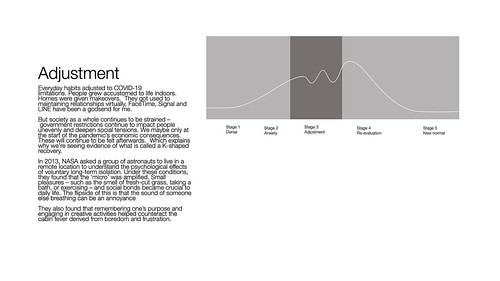
    Adjustment is how people have adapted to the circumstances. Society as a whole is still under strain.

    Adjustment

    Life is reconsidered moving forward, a classic example of this would be the Wuhan EDM pool party held in the autumn.

    Reevaluation

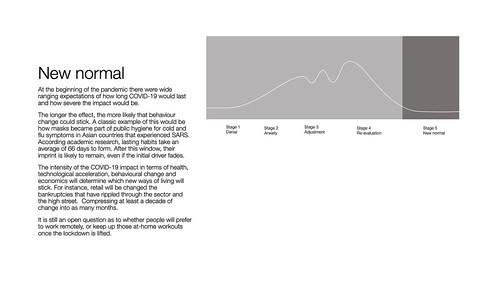
    The new normal where COVID-19 is now under control and will have shaped future consumer behaviour.

    New normal

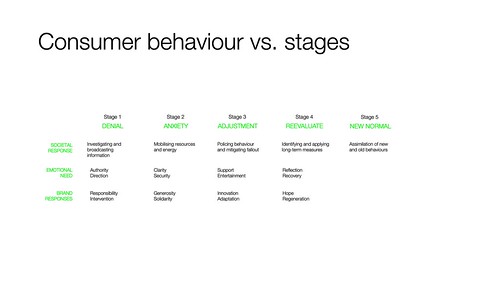
    Canvas8 also mapped out likely consumer behaviour against the stages.

    Consumer behaviour vs. stages

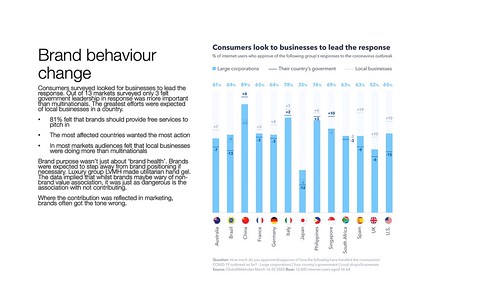
    Consumers had a clear view of what they wanted from brands. Brands often struggled to match the expectations of consumers. Dettol’s UK marketing efforts being an exemplary example of how to get it wrong. Looking back at 2020, we had the opportunity to do fantastic marketing work utilising digital and TV platforms, but very little of that opportunity was utilised.

    A couple of organisations deserve for their efforts to be highlighted. My former colleagues at LONDON Advertising used their own marketing during the middle of the crisis to demonstrate the power of marketing. Secondly, the IPA ran a sustained campaign in the FT promoting the power of advertising to the c-suite.

    Brand behaviour change
    Economics

    The economic factors that will be a driver in societal change, made up the third factor alongside behavioural aspects and acceleration of existing trends.

    Initial negative economic forecasts

    The initial economic forecasts were very negative which drove a ‘correction’ in the stock markets.

    Economic forecasts

    Past trends indicate that these kind of crises cause an economic decline that countries bounce back from. However a lot of the change happening is non-COVID related or only tangentially related like China’s escalating trade sanctions on Australia.

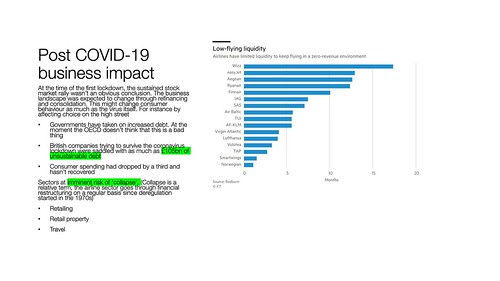
    Post COVID-19 business impact

    Post COVID-19 economic impact is like dropping industry sectors in a time machine. The kind of change that would normally have taken years to run its course has happened in months. What is more worrying is the amount of unsustainable debt that has been taken on board by businesses across sectors. Over time this will benefit larger established businesses over smaller, or newer ones.

    The young

    I put in an extra section into looking back at 2020 about the young because the insights challenge many of marketers holy cows in terms of views on younger members of society.

    Telemedicine

    Telemedicine attitudes and usage shows that the heuristic of young people being technology adopters doesn’t hold up. Which is usually presumed in sentiment around digital natives.

    The resisters

    The resisters shatters a stereotype of young people being progressive, purpose driven people. And they are media literate and media savvy by nature. Yet they are exhibiting behaviours that would be more in tune with older people with reactionary views.

    References and sources
    References

    I put in the links to the sources that I mention in the presentation. However I formed my views by looking at much more material. Just over a gigabyte of data sources that relate to COVID-19 which I went through is on Google Drive. Everything from consumer behaviour to economic data is available here. The looking back at 2020 presentation is available for download here. (More on issues related consumer behaviour here.)