Category: ireland | 愛爾蘭| 아일랜드 | アイルランド

Céad míle fáilte – welcome to the Ireland category of this blog. This is where I share anything that relates to the Republic of Ireland, business issues relating to Ireland, the Irish people, or Irish culture.

Given that I am Irish, a number of these posts are more personal in nature and based on observation when taking time out to see the family. If I am honest about it, there is less of these posts than there should be. Life gets in the way and I don’t get to the home country as much as I would like.

Often posts that appear in this category will appear in other categories as well. So if Aer Lingus launched a new advert that I thought was particularly notable that might appear in branding as well as Ireland. It is a small market of seven million or so and doesn’t have that many distinct brands.

Or if there was a new white paper from UCD (University College Dublin), that might appear in ideas and Ireland. If there is Irish related subjects that you think would fit with this blog, feel free to let me know by leaving a comment in the ‘Get in touch’ section of this blog here.

  • Family funeral & things from last week

    I spent the weekend travelling back to Ireland for a family funeral. Despite the fact that it was a family funeral it was good to see some members of the family whom I haven’t seen since I was a teenager. It also cause me to reflect on some things, it inspired my post ‘Ramblings on consumption‘ and you might see similarly inspired future posts. I thought back to my childhood playing cards with my uncle and I have been been getting online practice of the card game Twenty Five. Twenty five had the same impact in rural Irish society that mahjong has for Chinese communities. If any of you want a game let me know.

    I came across an interesting case study on Chevrolet’s celebration of Children’s Day in China. I have put the video below so that you  can see the project, its a nice piece of work. Secondly it is worth reflecting on how this project fits into the changing media landscape. This exemplifies the cross over between brand advertising and corporate communications work that is now happening around the world. Brand advertising is leading this charge into PR’s heartland and taking some of PR’s largest budgets. In a separate note The Holmes Report found that the industry’s top inhouse PR leaders have had their budgets halved over the past six years.

    Enjoy the case study

    Winston Sterzel on shooting with China Central Television (CCTV) – think of it as PBS or the domestic BBC television service with Chinese characteristics.

    Heathrow Express’ advert featuring The Krankies was an interesting choice of creative. It’s very consistent with their brand and mildly subversive.

    GUCCI – Why are you scared of me WeChat campaign features a robot built by Hiroshi Ishiguro, director of the Intelligent Robotics Laboratory at Osaka University clad from head to toe in Gucci. When is the last time you saw a Chanel talking about:

    • What it means to be human
    • Ray Kurzweil’s concept of the singularity, where machine intelligence exceeds human intelligence?

    It then reflects on the benefits that technology have brought to date:

    Because of technology, we have turned fairy tales into animations and created memories of countless human childhoods.Because of technology, home entertainment equipment brings joy to the family, which has inspired many children’s future dreams and aspirations. Even two strangers, when they talk about the common memories they used to have because of the popularity of technology, can seem to understand each other in an instant.

    The implication being that new forms of shared memories may bond robotics in spite of negative factors like the ‘uncanny valley’.

  • Ramblings on consumption

    We think of consumption as part of the very stuff of modern life. I clear out items on eBay. My Mum and Dad have boxes of things unopened since they moved house in 1981. A lady who lived up the road who died last year had people working for five days to clear out the things she had hoarded. The house had been packed with items from ceiling to roof.

    The role that consumption plays varies but taps into deep emotional ties. I felt both an emotional journey that I can only equate to grief and a certain release on getting rid of my record collection. I moved country for work and the bulk of it had to go. What was more distressing was not being able to make sure that it went to a good home at the time. It had defined me, brought me joy and latterly had been a weight that I only felt by its subsequent absence.

    Consumption and identity are also intertwined.

    In my pre-internet days you could get a sense of someone by visiting their sitting room or their bedroom.

    • What kind of books did they read?
    • What posters or pictures did they have?
    • Was there sports scarves, or signed shirts?
    • Family photographs
    • Taxidermied animals in either rural or ‘hunting, shooting or fishing’ households
    • What kind of videos did they have?
    • Where they a gamer?
    • What CDs, vinyl and cassettes did they have?
    • Did they have a system of hi-fi separates? What were the components like? Did they have headphones?

    You were able to build up a picture in your head about the person, their tastes and some historic touch points.

    Much of this now remains out of sight in the sitting room with the rise of cloud based services. But the picture is still here, though you will need a screen to see it.

    For many people homes are a mix of the digital and the analogue. Some young people may adopt analogue items for ‘authenticity’ in their lives. For older people its the archeology of their lives. Photos not converted to digital scans. Music that had meaning or was at a certain stage in their life. Souvenirs from holidays.

    If I look at my own parents:

    • They were more passionate about active collection of music in the 1960s before they settled down. They have finally got rid of a Philips mono turntable in plastic that hadn’t worked for years and a Sony reel to reel tape player. Both devices chosen for their luggabilty rather than quality. They had lived transcient young work lives, working away from home and living in digs
    • My Dad had spare time from shift work that he used to read a mix of reference books and fiction from the 1950s – the early 1980s. Since then he mostly reads caravan and crafting books
    • My Dad has a vast amount of tools in various states of repair that he accumulated. From when he started his apprenticeship to electronic meters bought this year
    • My Mum has a mix of cookery books from the 1950s to the 1990s and notebooks stuffed with clippings from magazines of recipes. In the notebooks are hand scribbled recipes that she exchanged with friends
    • They have carpets and stools that they crafted from kits in the 1960s before multi-channel TVs

    With time, more hasn’t mean’t better ‘quality’ consumption. Technology has provided us with more reliable electronics. Unless you are a hi-fi buff you are unlikely to know about the fragility of valve electronics or the weight of discrete solid state circuits.

    Globalisation has brought consumption of more ‘just good enough’ products. My parents still have some of the furniture that they bought when they got married. It isn’t Vitra or great Danish design, its mass producted items of its time. But the quality of the construction and materials contrasts with flat pack furniture bought later.

    Less consumption seems to have had a number of sides to it:

    • More conscious choice on quality. You couldn’t just order another on Amazon
    • Greater focus on curation of items
    • Less clothes but of a better quality
    • A macro view on ‘need’, rather than the micro view defined by the now

    You had the vintage well tailored tweed jacket or furniture that had been in the house for generations. In years to come what will all the delapidated Billy bookshelves and tchotchke fridge magnets say about us? Maybe this is a good part of the authenticity at the centre of Peter York’s ‘Hipster Handbook‘?

    I started to think about these things following a death in the family. My uncle lived in the ancestral home; which is a small farm in the west of Ireland. I had spent a good deal of my childhood there with him and other relatives. Life had got in the way of going back in person and there had been bigger gaps in time to my visits than I thought.

    Going back to the farm brought thoughts about consumption into sharp focus for me. My Uncle’s approach to consumption was very different to mine and likely yours as a reader.

    • He never owned a car or combustion engine-powered farm machinery. He hired in contractors and machinery when it was needed
    • As a child I had played amongst decaying wrought iron horse drawn equipment, that would have been used before the widespread use of tractors
    • I can remember when electricity was installed
    • Had a modern television but didn’t use it. He actively preferred the radio as his media of choice
    • He had a solid fuel cooker that provided central heating for the house. He also had an electric cooker and microwave oven, but refused to use the microwave
    • His music collection had been gifted to him by family over the years. They assumed that he liked local artists playing Irish traditional music. I don’t think that he went through the process I had done of exploring new music and tastes
    • He regularly read a local paper, but owned no books bar a booklet on the value of notes and coins
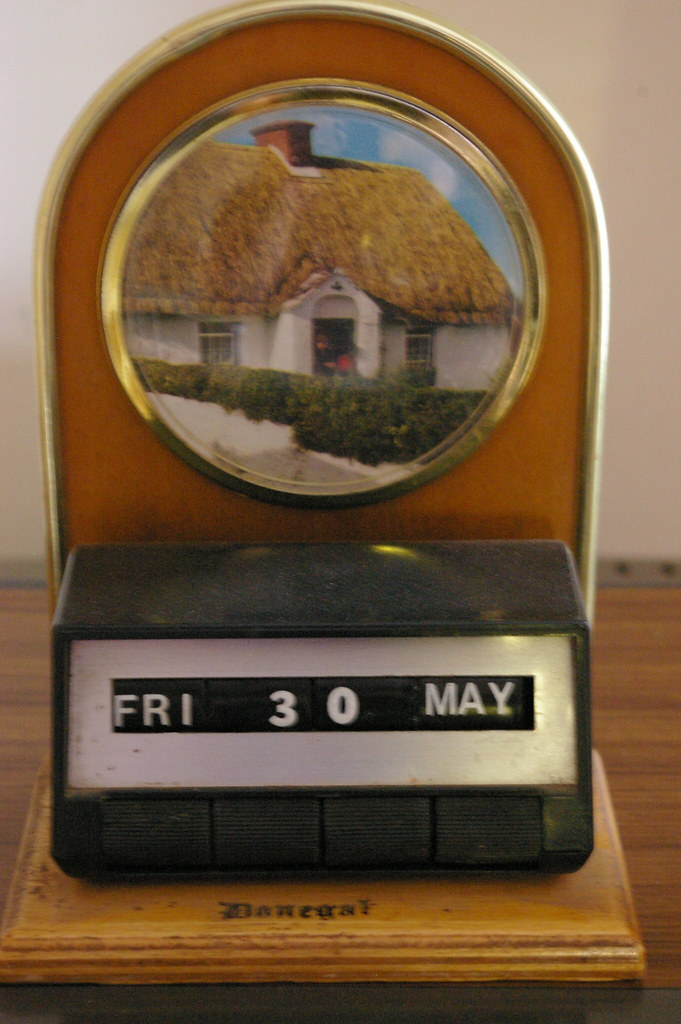
    • He had never travelled for leisure, but had been gifted souvenirs from my cousins. These came from Donegal to Dubai
    • Presents that he had been given decades ago remained in a drawer in case he would need them, from ties to aftershave
    • The family had tried to force him to have a cellphone and he only relented when he was in hospital during his later years and a neighbour gifted it to him
    • His idea of interactive gaming was a Benson & Hedges-branded deck of playing cards with four people around a table for a game of ‘Twenty Five

    IMGP3019.JPG

    His house remained unchanged from when my Grandmother had lived there. There wasn’t his ‘footprint’ in the house at all. From a personal point of view it meant that I could understand my Uncle in terms of ‘what’ he did; but not the ‘inner life’ that we are used to understanding through ‘reading the tea leaves’ of consumption: books, music etc. At the time I came away perplexed, a mystery that I would never understand.

    He lived in many respects a pre-industrial agrian approach to life. Time moves at the pace of the farm work rather than the clock. Your mark on the world was in the continued existence of the homestead.

    This brought into sharp focus for me the newness and ‘abnormality’ of modern consumerism. Perhaps ownership of the land provided the ‘weight’ that mass consumerism provides for many of the rest of us? And what would it mean if you had felt that ‘weight’ all of your life as my Uncle would have as the oldest son in the family?

    In contrast, my Grandmother had been more modern in her attitude to consumerism. She loved the television. She got rid of old wooden chairs that would need the occasional coat of paint for black powder coated steel and vinyl cushion seats.

    Into her late 80s she loved DVDs of traditional Irish music performances. A tape of electronica and early rap that I made at the age of 15 so she could understand what I was into at the time was a step too far for her.

  • The Bureau season 3 & other things

    The Bureau season 3 on Amazon. It is one of the most well written series I have watched in a long time. The Bureau season 1 and 2 where taunt thrillers that were James Bond reimagined by John Le Carre. It is the show that Spooks should have been. The ending was on a cliff hanger and I didn’t think that we’d see The Bureau season 3 The Bureau season 3 sees our protagonist captured by ISIS. Guillaume Debailly is captured by ISIS who know him by his former cover of Paul Lefebvre.

    A brass band cover  of Rage Against The Machine’s Killing In The Name

    This amazing episode of NPR’s Tiny Desk Concert featuring Rakim (of Eric B & Rakim fame). What people tend to forget is the difference that Rakim made to hip-hop. Before him, most rappers rapped on the beat. Rakim used his rhymes the way a jazz musician plays their instrument. They go around the beat, yet are in time.

    With Amazon delivering analytical data like this, I wouldn’t be surprised if there are a lot more sites signing up to Amazon’s affiliate marketing scheme, even if they don’t want to sell anything for the beast of Seattle. The recommendation areas draws from its massive retail data set that shows what consumers are interested in across various different product categories.

    This week I have mostly been working my way through John Kelly’s Mystery Train for my listening pleasure.  Kelly is a veteran Irish DJ who has a rare skill in the quality of his sections. Naturally this is all backed by the massive music library of RTÉ. The original run of it in the mid to late 1990s was legendary and thankfully Irish state broadcaster resurrected it. Kelly just nails music selection. More culture related content here.

  • Video ads + more news

    Sources say Adidas has paused its video ads on Facebook while it reviews their efficacy – Digiday – From my perspective it really depends what the video ads are supposed to do.  What kind of job that they want Facebook video ads to do in the customer journey? More adidas marketing content here.

    Armed with better perspective, Sir Martin Sorrell vows to ‘start again’ | Marketing Interactive – this is interesting, particularly as a number of clients put WPP on review after he left. I am not sure that he will be able to build another WPP; but he could build a great consultancy for procurement departments at major brands. I hope that he doesn’t go digital only, or go and work for a platform like Google or Facebook; selling Facebook video advertising

    James Murdoch Won’t Move to Disney if Fox Deal Closes – WSJ – makes sense given his time at Rawkus Records, there is probably an itch to scratch getting out and doing his own thing

    Facebook will not be accepting referendum related ads from advertisers based outside of Ireland – issues with international pro-life groups

    The United States of Japan | The New Yorker – interesting analysis

    Microsoft wants serious, non-gaming developers to make more money • The Register – this will put pressure on Apple’s services revenue in particular the Mac store

    Ray Ozzie’s Encryption Backdoor – Schneier on Security – Scheier nails it. The sad thing is that Ozzie has been one of the few universally respected technologists over the years

    The Netflix generation doesn’t do compromise | The Times – a few things about the media consumption in this. There are still shared experiences: landmark shows like Sherlock, McMafia, Game of Thrones, Stranger Things, or Black Mirror. Fragmentation of audiences didn’t start with Netflix but with video cassette recorders, multiplex cinemas, Channel 4 and cable and satellite TV. There was a certain delicious irony reading about how media plurality is ‘bad’ in a paper owned by the Murdoch media empire. I committed a greater sin than the Netflix millennials and opted out of watching TV quite happily for seven years until I was gifted a Sony Trinitron TV set by a friend who was getting a flat screen –  which would probably count as even more ill tempered. The comments on online discussion are natural. Do Times readers invite objectionable opinions around to dinner parties in the name of diverse thinking? I would imagine not that often unless there are other ties (like familial links). (Paywall)

    SenseTime: The billion-dollar, Alibaba-backed AI company that’s quietly watching everyone in China — Quartz

    Report: Chinese government is behind a decade of hacks on software companies | Ars Technica

  • GDPR resources

    Partly due to Cambridge Analytica, General Data Protection Regulation (GDPR) is going to have a more profound impact on data usage globally. GDPR would have been seen as an extra-legal reach, but Facebook is making it look like a good idea.

    I thought I would pull together a few resources that I thought would be of interest around GDPR since there is a lot of snake oil being sold as consultancy around it at the moment. I am not going to pretend that I am an expert, so I thought it would be useful to share some of the GDPR related resources that I have been looking to learn from.

    Not only in terms of what the regulation is, but what techniques can be deplored to act in the spirit as well as the letter of regulations. Demonstrating a basic respect for the consumer won’t harm any brand, but might point to badly designed KPIs that direct and digital marketers might be measured from.

    Andreessen Horowitz put together a good podcast on it.

    Privacy by Design – The 7 Foundational Principles by Ann Cavoukian, Ph.D. (PDF) – is a must read paper for creative agencies and product teams. It is based on work that was started in the late 1990s. Cavoukian lists a site as a reference ‘privacybydesign.ca’ – but that seems to be down.

    1. Start by thinking about privacy by design from the start or as Cavoukian says preventative rather than remedial, proactive rather than reactive
    2.  Privacy as the default setting
    3. Privacy embedded into the design of systems and processes (which sounds like a reinforcement of her first point
    4. Not viewing consent in terms of a zero-sum
    5. Privacy secured throughout the lifecycle from end to end.
    6. Being open and transparent about processes to keep the organisation honest and stakeholders informed
    7. Respect for user privacy based on a user-centric ethos

    Via James Whatley’s newsletter this article on UX –  GDPR: 10 examples of best practice UX for obtaining marketing consent seems to be complementary to Cavoukian’s work. This is in sharp contrast to the dark patterns often used to force consent by many sites.

    More related posts here.