Category: korea | 韓國 | 한국 | 韓国

Annyeonghaseyo – welcome to the Korean category of this blog. This is where I share anything that relates to the Republic of Korea, business issues relating to Korea, the Korean people, Korean culture and the Korean language.

At the time of writing this category descriptor its been about 10 years since I have last been able to visit Korea. In that time the country has risen on the world stage.

There have been continual disputes with Japan and more recently continual bitter disputes with China. The Japanese disputes are related to history and territory. Korea had been occupied as part of the Imperial Japanese empire. Independence came with the end of the second world war.

The Chinese disputes are more complex. Chinese investors are buying up Korean property particularly in Seoul, Busan and Jeju island, while many Koreans can no longer get on the property ladder. Chinese tourists blitz Korean shops in a similar way to what they’ve previously done in Hong Kong.

Chinese nationalism has seen claims made on Korean cultural assets from the national dress to kimchi. Finally China has interfered in Korea’s efforts to defend itself from the threat in the north.

Often posts that appear in this category will appear in other categories as well. So if Samsung launched a new smartphone that I thought was particularly notable that might appear in wireless as well as Korea. If there is Korean subjects that you think would fit with this blog, feel free to let me know by leaving a comment in the ‘Get in touch’ section of this blog here.

  • App constellations 2018 research

    I initially looked at app constellations back in 2014, when Fred Wilson put a name to the the phenomena. And every two years or so I have gone back and looked at a number of major internet companies to see how many different types of apps that they had in play.

    I originally selected the companies back in 2014 because I felt that they represented the largest and best of their ilk. It skews Asian because the west can be viewed as one eco-system represented by Google, Facebook and Microsoft.

    China is an enclosed eco-system; though Microsoft is actively engaged in the app eco-system there. I chose Tencent and NetEase as being my Chinese bellwethers. DaumKakao and Naver were representative of the Korean eco-system which blends highly-used domestic services with western platforms. Finally LINE of Japan (a subsidiary of Korean company Naver) provided a similar bellwether of the hybrid Japanese eco-system which mirrors Korea.

    App constellations survey methodology

    For the sake of convenience I have compared the contents of Apple’s mobile app store for each of the companies. While most of the internet companies have some Android-only or iOS-only apps; the iOS app store is still a good indicator of their app activity.

    I stayed true to the definition of app constellations in terms of deciding what kind of app should go in.

    App constellation definition

    I manually assessed each app, rather than relying on the category that the app had been submitted into. Tencent and Netease, had a number of mobile utilities that aided discussion and kept players updated on their favourite game. These didn’t fit within the definition.

    Changes in the environment

    Since 2016, a couple of things have changed:

    • Apple had a purge of apps that didn’t support 64 bit processing
    • They moved away from supporting the app store within iTunes application and on the web; to within the app store on the device

    2018 marks over a decade of mobile apps in the Apple store. Many of the major players have delisted almost as many Android and iOS apps as they currently have in the store. This happens for a number of reasons:

    • The app was serving a purpose for a fixed time
    • It is an application that has fallen so far out of favour that it is no longer worth maintaining
    • The code base no longer meets Apple’s or Google’s minimum standards
    Data analysis

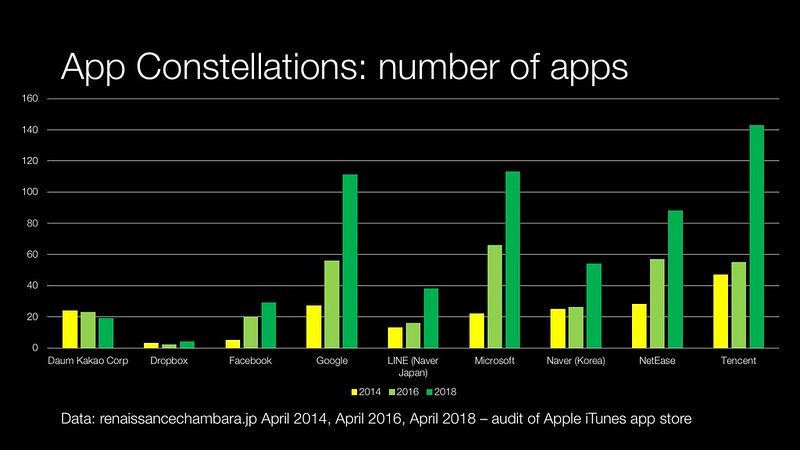
    I started off by looking at the number of apps. In terms of app constellations:  Tencent, Microsoft and Google were clear winners.

    Number of apps

    Both Microsoft and Google’s growth has been driven by ‘experimental’ apps that they have put out in the public for their own reasons and enterprise focused apps.

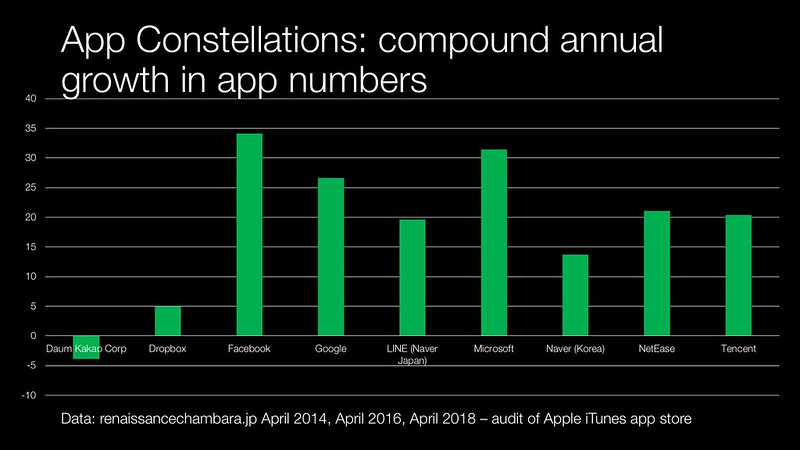
    compound annual growth in app number

    But it was quickly apparent to me that the number of apps developed were only part of the story. What about the rate of change in numbers of apps developed? This would be indicative of the rate of change in moving to mobile. Here both Facebook and Microsoft’s pivot became immediately apparent. The Asian companies looked less impressive as they had been able to keep steady in their focus on mobile.

    All of this growth in the number of apps developed by major internet companies is all the more remarkable when you consider the following:

    • In mature markets consumers are not really downloading new apps
    • They are sticking with a few in terms of regular usage. Many of the apps on their phones don’t get used
    Notes on a few of the companies in terms of their app constellations
    • Daum Kakao – notable for being the only company who I looked at who had a decline in the number of applications versus 2016. A lot of this seems to be in service consolidation of both Daum and Kakao to remove duplications or non-core services. It is the Daum brand that has taken the biggest impact. This is understandable, since Daum struggled on the move to smartphones and Kakao is a mobile-first brand.
    • Dropbox – the growth in apps has been down to the larger business acquisition strategy at Dropbox. I don’t expect further growth like what we have seen with  Facebook’s pivot to mobile
    • Facebook – Facebook’s pivot to mobile was one of the reason why I decided to look at compound annual growth rate as well as the size of app constellation in terms of app numbers. In terms of raw app ‘SKUs’ Facebook is dwarfed by most of the other companies that I have looked at. It is only by looking at the growth in apps developed where one can really see their move to mobile
    • Netease – was interesting for its focus in a couple of areas. Like other Asian internet companies, education was a big target area, but Netease went into it with major commitment. Both NetEase and Tencent were big in magazine and book apps as well. I think this is down to the fact that ‘traditional’ web surfing is harder to do with (at the moment) when URLs are written in western script and numbers.
    • Tencent – the raw app numbers beggars belief. There are a number of reasons for this. Like NetEase, Tencent has a lot of apps solely optimised for the iPad and a separate iPhone app. There are free and paid-for product variants. Lastly Tencent will have four or five apps competing in a given category like streaming music which seems insane. Only time will tell if Tencent is spreading itself too thin; like when Yahoo! was described Brad Garlinghouse’s Peanut Butter Manifesto
    More information

    Jargon watch: app constellation – back in 2014 when I wrote this post, it still took me the best part of a week to research and describe each of the apps in the main eco-systems. It would take me much longer today due to the growth in apps

    Peanut Buttergate – analysis of Garlinghouse’s original memo about Yahoo! from back in 2006

  • Join hands on apps + more news

    China smartphone makers join hands on apps, pose threat to WeChat | Reuters – this effort by vendors to join hands on apps reminds me of work that Google did on ‘streaming’ apps as needed that went a bit quiet. Interesting that the manufacturers are willing to go against Tencent. In a mature market handset providers want a bite of services, but is there an advantage with brands to throw in with one or more of the handset eco-systems given their disparate app stores?

    Americans less likely to trust Facebook than rivals on personal data: Reuters/Ipsos poll – trust and leaving the platform are two different things. What was surprising is how low a rating Apple had compared to its tech peers given its efforts in privacy protection by design. Facebook starts looking looking like Microsoft did as a brand

    South Korea fines Facebook $369K for slowing user internet connections – The Verge – why was Facebook ‘trumpeting’ their traffic about the place? This is really odd, almost like there was ‘man in the middle’ inspection of data going on. The fine Facebook faces represents about 0.05% of Facebook’s Korean revenue for a year

    Having Your Smartphone Nearby Takes a Toll on Your Thinking (Even When It’s Silent and Facedown) – interesting research. Think of the relationship as similar to Gollum and the one ring

    Yahoo Japan Plans To Launch Cryptocurrency Exchange Amid FSA Crackdown | ZeroHedge – interesting move by SoftBank. Yahoo! Japan brand is a strategic asset, yet Son-san is willing to risk it on cryptocurrency which I perceive to be a tactical play. I can’t see continued interest in consumer speculation on it in the longer term. More related content here

    Dennis Yu on the Facebook debacleDennis is the chief technology officer Facebook marketing business called BlitzMetrics. If anyone knows their stuff its likely to be him

  • Spotify scam & other news

    Spotify scam

    The great big Spotify scam: Did a Bulgarian playlister swindle their way to a fortune on streaming service? – Music Business Worldwide – the Spotify scam is ingenious. But this also shows how topsy turvy the economics of Spotify are. It is ironic that real artists on Spotify are being paid so little, which is arguably the real Spotify scam (with complicit record labels). There will be always arbitrage opportunities in online services like Spotify

    Business

    China is quickly becoming the dominant force in startups | Quartz – makes you wonder about Silicon Valley. A lot of this problem is down to the lack of focus on hard innovation in Silicon Valley. For instance where is the modern day equivalent of the treacherous eight

    WSJ City | Five signals sent by China’s Anbang takeover – Reining in big spenders (spending capital abroad in an untargeted manner), reduction of systemic financial risk, concern over complex short-term high-yielding wealth products

    WPP Vows to Do Better After Weak Results, Nervous Outlook Send Shares Plunging – The New York Times – WPP plans to accelerate a programme to simplify the business by aligning digital systems, platforms and capabilities to provide bespoke teams for its clients as opposed to the different agencies that currently compete with each other to win contracts.

    Consumer behaviour

    Opinion | The Tyranny of Convenience – The New York Times – Americans say they prize competition, a proliferation of choices, the little guy. Yet our taste for convenience begets more convenience, through a combination of the economics of scale and the power of habit. The easier it is to use Amazon, the more powerful Amazon becomes — and thus the easier it becomes to use Amazon. Convenience and monopoly seem to be natural bedfellows. – great article by Tim Wu

    Wealthy Chinese Women Are Unique in APAC: Agility Research | Jing Daily – interesting dissonance between Hong Kong and Chinese high net worth consumers

    FMCG

    Tea Turns Up Temperature in Fight Against Coffee – WSJ – what tea misses is ritual

    Finance

    Daring Fireball: Berkshire Hathaway’s 2017 Annual Report (PDF) – they know how to play to small town audiences well

    Innovation

    Levi’s Invented A Laser-Wielding Robot That Makes Ethical Jeans | Fast Company – the laser and chemical free treatment remind me a lot of the work that Frontline Clothing in Hong Kong have been doing for years in association with their Chinese supply chain partners

    Marketing

    Burson Cohn & Wolfe – SixtySecondView – like any other business merger the focus will keep the eye off the ball at a time when the PR industry is seeing exceptionally low growth rates. I have friends and former colleagues on both sides of this in both Asia and Europe; so I hope it works out well.

    Media

    Amazon Has Officially Invaded The Advertising Industry | Forrester Research – the bit this misses is that consumers already use Amazon’s search page as a first port of call for things

    LittleThings online publisher shuts down, blames Facebook’s algorithm – Business Insider – not terribly surprising, one only had to look at the games companies that built their businesses on Facebook and got eviscerated

    Online

    WeChat New Year Data Report 2018 – China Channel

    Quality

    Smart homes and vegetable peelers — Benedict Evans – interesting starting point, but I think that there should be a second layer. Can the intelligence be local (like lighting sensors based on movement and presence in office buildings) or does it need cloud computing? Why can’t smart lightbulbs be at the edge rather than in the cloud. Why does a Nest thermostat need to be in the cloud?

    Samsung says it’s going to stop pumping out features and start making devices good instead – BGR – “We developed mobile phones earlier than China, and we were obsessed with being the world’s first and industry’s first rather than thinking about how this innovation would be meaningful to consumers,” Koh said. “Being the first turns out to be meaningless today, and our strategy is to launch something that consumers believe meaningful and valuable at a right time.” – this reads like a slap in the face to Huawei’s approach on innovation and features

    Retailing

    Struggling Esprit to close more than 40 shops in Europe | South China Morning Post – it plans to close more than 40 “heavy loss-making” shops in “core” European countries, or make around a 10 to 15 per cent reduction in its controlled space in these countries

    Security

    Huawei distances itself from executive’s comments that rivals using politics to keep it out of US | South China Morning Post  – Huawei did not authorise Yu to make comments about the US on behalf of the company, and does not agree with his views, Chen said. Yu did not immediately respond to a text message seeking comment – Richard Yu is known for going off-piste with media

  • Facebook eroding & other news

    Facebook eroding

    The tweet about Facebook eroding is part of a greater issue of what Facebook is calling internally ‘context collapse‘. Facebook recognised the issue back in 2015. There are several likely reasons for Facebook eroding:

    • Negative network effects
    • Societal norming on social media content
    • Lack of trust in the facebook brand
    • People just don’t like Facebook as a platform that much

    Business

    After Anbang Takeover, China’s Deal Money, Already Ebbing, Could Slow Further – The New York Times

    Hello, mobile operators? This is your age of disruption calling | McKinsey & Company – lots of buzz words, diagnosis but not a glimpse of a way forward

    Edelman Revenue Up 2.1% In 2018 To $894m | Holmes Report – given that all the global PR groups have had exceptionally low growth or even declines

    How Douyin became China’s top short-video App in 500 days – WalktheChat

    Wireless

    Nokia on 5G at MWC, what struck me is the sales pitch was more like an enterprise software company like IBM or Oracle than a telecoms vendor. There is lots of tech in the networks but there isn’t a recognisable killer app. His warnings about 5G upgradeable products ring true though.

    Consumer behaviour

    Asian Boss do some really nice street interviews in different Asian cities and this one about Apple iPhones in Korea is particularly instructive. Samsung is seen as the default phone as they assemble phones (mostly for Asian markets) in Korea. Whereas in Europe all of the are made in China. When I lived in Hong Kong, both Samsung and LG emphasised that they made their phones in Korea with an implicit quality guarantee. 

    The iPhone seems to have won out on product design amongst younger people. but one shouldn’t ignore the desire to support the national brand. 

  • Siri vs Siri + more news

    Siri vs Siri: What Apple’s AI can and can’t do on every Apple device | Macworld – Siri vs Siri implies context based on device, but they need to raise the game in particular on the Mac. More related content here.

    How Russia’s ‘red tourism’ is luring wealthy Chinese visitors bored with Paris and Milan | South China Morning Post – Russian department stores TSUM and GUM become important for foreign Chinese luxury sales

    May braced for Unilever decision on headquarters | FT  – Unilever: ‘stichting’ up a move to the Netherlands, which would make sense. 100VE is a leased building, its overcrowded and a number of the people there were contractors like me. The team that I worked in had already upped sticks to the Netherlands with the roles moving but not many of the people were redeployed, let go or didn’t have their contracts renewed

    Millennial insecurity is reshaping the UK economy – interesting impact – not moving out of region to take a job like I did when I had a degree affecting productivity and entrepreneurship. One could see how Brexit will exasperate things further. It doesn’t imply that there will be a corresponding youthquake to overturn it at a later date

    The Case Against Google – The New York Times – the problem with Found’em and the way the story was started is that it came off a bit cray cray a decade ago when it first popped up. They weren’t cut from the same cloth as Silicon Valley wunderkinder. That and they looked like Microsoft finger puppets. You had the SCO vs. Novell court case over the future of Linux at the time and there was evidence of Microsoft’s finger prints all over it (via Wikipedia): “On March 4, 2004, a leaked SCO internal e-mail detailed how Microsoft had raised up to $106 million via the BayStar referral and other means. Blake Stowell of SCO confirmed the memo was real. BayStar claimed the deal was suggested by Microsoft, but that no money for it came directly from them. In addition to the Baystar involvement, Microsoft paid SCO $6M (USD) in May 2003 for a license to “Unix and Unix-related patents”, despite the lack of Unix-related patents owned by SCO. This deal was widely seen in the press as a boost to SCO’s finances which would help SCO with its lawsuit against IBM” – And at the time if it had the taint of Microsoft involvement that overwrote any Google wrong. People seem to have forgotten the Judge Jackson trial and what an evil sack of shite Microsoft was shown to be. It would have been really hard sell to the media

    NASA Is Bringing Back Cold War-Era Atomic Rockets to Get to Mars – Bloomberg

    Amazon is merging Prime Now and AmazonFresh – Business Insider – it should add clarity from a brand point of view as well. Now they just need to get the Prime Now app to work properly

    Apple in Talks to Buy Cobalt Directly From Miners – Bloomberg – sounds like a smart use of their capital pile given the rising cost of cobalt due to electric vehicle batteries

    Dr. Penelope Boston: “Seeking the Tricorder: The Hunt for Extraterrestrial Life” | Talks at Google – YouTube – interesting challenges in terms of identification, methodology and analysis

    APAC Millennials Lead for Sharing Branded Social Content – GlobalWebIndex Blog

    George Soros may invest more in fighting Big Tech – Axios – the noose is slowly tightening around big technology

    You can call me Al (but you really shouldn’t) – The overclaims of Artificial Intelligence « Comms Planning « Planning Above and Beyond – many technologies take a number of runs to get it right; machine language translation or VoIP being the classic case study. AI takes much more to get it right; this is a timely reminder that we are in an ‘AI summer’ at the moment and may hit an AI winter

    “Just an Ass-Backward Tech Company”: How Twitter Lost the Internet War | Vanity Fair – to be fair this is probably a similar situation with Facebook as well