First of all I live in London, I put down my roots here because of work. Commuting from the outside towns into the city takes a long time. People only tend to do that when they don’t have to come in every day or getting their kids into a good school is important for them.
Secondly it is an area distinct from the rest of the UK, this is partly down to history and the current economic reality. It is distinct in terms of population make-up and economic opportunity. London has a culture that is distinct from the rest of the UK, partly due to its population make-up. Over 30 percent of the city’s inhabitants were born in another country. From music to fashion, its like a different country:
As one women’s clothing retailer once said on a news interview ‘The further north you go; the more skin you see’.
The weekend is a huge thing outside the city. By comparison, it isn’t the big deal in London. The reason was that there were things you could enjoy every night of the week.
You can get a good cup of coffee
The city was using cashless payments way before it became universal elsewhere in the country
The line has extended into politics. London opposed Brexit. London, like other major cities it is one of the last holdouts of Labour party support in the 2019 UK general election
London posts often appear in other categories, as it fulfils multiple categories.
If there are London subjects that you think would fit with this blog, feel free to let me know by leaving a comment in the ‘Get in touch’ section of this blog here.
Creative agency Endeavour sent out the first Christmas card that I received. This year they focused on content rather than design with everything that you need Christmas 2020 – Endeavour.
There was guidance on how to make paper Christmas trees including a green PDF that you can print out if you don’t like the snow white look of unprinted paper and a Spotify playlist.
The Financial Times have put together a series article looking atThe Future of the City. The City in question being the London’s international financial services sector, whose traditional home is the City of London – think Wall Street in New York, or Central in Hong Kong. I found How London grew into a financial powerhouseparticularly informative and all the articles are chock full of charts.
A relatively modern Carroll family Christmas tradition has been my Dad and I watching the BBC adaptations of Tinker, Tailor, Soldier, Spy and Smiley’s People. It will carry extra weight this year due to social distancing and the recent death of John Le Carre. My Dad read his books whilst working shifts during the late 1960s and early 1970s. He used to buy books second hand from a florrid looking book dealer in the local market. I in turn, read my Dad’s books (Len Deighton, Alistair Maclean, Hammond Innes, Robert Ludlum and John Le Carre) as I went through the early years of secondary school. Le Carre was the only one of these authors that I decided to read more than once.
This time, we’ll both be watching them on Blu-Ray whilst keeping the video open on FaceTime to discuss it as we go along.
It doesn’t get more 1990s than this. A skateboarder reading his self-authored poetry. Mike Vallely a professional skateboarder. If my memory serves me right, Vallely rode for Powell Peralta (Bones Brigade) factory team a few separate times during his career. In this video he gives the poetry reading in a LA skate shop back in 1996.
https://youtu.be/QTr2Mvz873c
The Luxury Society held a panel in Shanghai talking about luxury brands and the digital behaviour of the Chinese consumer. More luxury related content here.
The Irreparable Damage Boris Johnson Is Wreaking on Britain – Carnegie Endowment for International Peace – unlike many members of his party, UK Prime Minister Boris Johnson does not have any particular animus toward foreigners. He has betrayed pretty well everyone in his various lives as philanderer, journalist, and politician: wives, mistresses, editors, readers, party colleagues, Parliament, and the wider public. EU negotiators are merely the latest victims of his boundless treachery – wow a sick burn, but factual and truthful in their analysis of Boris Johnson
Pooj Morjaria, founder, Did They Help? – Wunderman Thompson Intelligence – A growing pattern of morally driven consumption has emerged over the past few years, from ethical fashion edits to anti-excess beauty to carbon credit spending to cruelty-free travel. But what was once pioneered by a niche group of true believers is ballooning into a base rate, fundamental expectation of brands. Morally and ethically sound practices are increasingly considered table stakes for brands—and are an important factor in consumers’ path to purchase.The difficulty, according to Pooj Morjaria, was tracking and cataloguing brand behavior. Which is why he created Did They Help?, an independent watchdog website that keeps a running record of brands’ good and bad deeds
Science-backed brands – Wunderman Thompson Intelligence – A heightened focus on health is reshuffling the hierarchy of consumer priorities. In the wake of a global pandemic, consumers are putting more stock in medically and scientifically endorsed offerings. 89% of Americans put their trust in medical scientists, and those reporting a great deal of confidence in medical scientists has gone up from 35% before the outbreak to 43% in April, according to findings from Pew Research Center. Now, brands are harnessing that trust by enlisting medical professionals and spotlighting scientific credentials
Beats by Dr. Dre Sets Its First-Ever Campaign on TikTok – I like when campaigns actually inspire creative action. For this challenge, people need a bit more creative than just replicating a dance. I really liked the emphasis on color, which works well on TikTok as a full-screen, immersive experience. You couldn’t really replicate this on other platforms. What we’re starting to see on TikTok is this mass participation in creativity. The concept of UGC isn’t new, but TikTok has made UGC so much more powerful. – Good TikTok Creative newsletter on the campaign
China’s top 100 brands: National pride affects rankings | Marketing | Campaign Asia – With some world markets souring on particular Chinese brands, people in China rally round homegrown heroes. – the move towards rallying around the flag started before world markets went off some Chinese brands. The current environment has only accelerated this process somewhat
Ex-Google boss Eric Schmidt: US ‘dropped the ball’ on innovation – BBC News – In the battle for tech supremacy between the US and China, America has “dropped the ball” in funding for basic research, according to former Google chief executive Eric Schmidt. And that’s one of the key reasons why China has been able to catch up. Dr Schmidt, who is currently the Chair of the US Department of Defense’s innovation board, said he thinks the US is still ahead of China in tech innovation, for now. – The irony is that at Google Schmidt & co. pretended that this was precisely what they were doing
The 1999 eclipse, also called millennium eclipse as it would be the last total solar eclipse of the 2oth century popped up recently on the BBC.
For me it was a big online event. Eclipses don’t happen often. The last one in the UK had been some 72 years earlier. I was working in an agency in Covent Garden. It was the middle of the dot com boom. I had a mix of telecoms clients, the usual dot com projects and Palm PDAs as my clients.
I had managed to hand off most techie client; custom chipmaker LSI Logic on to other colleagues.
Delivering results wasn’t a problem for LSI Logic at the time. They were on the cutting edge of games console technology, computer storage and embedded electronics. Digital television was about to take off and LSI Logic had a chipset back then that even supported 8K transmissions. The corresponding displays to support 8K wouldn’t be along for another decade and a half. Its CoreWare library of chip functions based on a MIPS processor was the ARM of its day. But LSI Logic could fabricate the chips as well. The CEO was old school Silicon Valley, having been at Motorola Semiconductor and Fairchild Semiconductor.
The problem was the European operation communications team were very process-orientated, rather than outcome-orientated.
With a few of my clients (RSL COM and Bell Atlantic’s international wireless business); I was allowed to run with remarkable leeway. I got on well with my clients. For the most part, I managed to avoid screwing things up.
Life was hectic, I was constantly tired from a lack of sleep. But overall it was good. I had gained a promotion and was saving for the deposit on my first house. I was sat on the end of a (massive for the time 1Mbit/sec T1 internet connection). Ok, I shared it with other colleagues. But it mean’t pretty reasonable for the time internet connectivity. The IT department allowed me to use FTP overnight and during the weekends to download vintage house mixes. At the time the legendary deephousepage.com site was run by a technician on a university web server, allowing downloads of mixes encoded using Real Media audio format. This was just before MP3 went mainstream.
The 1999 eclipse came along and was to be the first ‘internet’ event that I would experience.
The BBC along with Sky News and ITV devoted their entire morning’s broadcasting to it. As an agency; we didn’t have a TV that I could remember. There was a problem with getting access to an aerial socket given we were on the ground floor of a tower block. Also the landlord wasn’t accommodating as they wanted a higher paying tenant in the office.
Dot com businesses were driving up office rents in a similar way to Chinese hot money driving up central London residential property prices a decade later.
The day of the 1999 eclipse, London was overcast. Just before lunch, colleagues dipped out to watch whatever they could see. I jumped on my work computer and fired up the BBC website to watch the eclipse experience live. It didn’t work that well; I presume every design agency with an ISDN line had a similar idea that morning.
I typed in the website address for Sky News and went there instead. It was slightly better. I then used the backwards and forwards buttons to switch between the BBC and Sky News. (It would be another few years before mainstream browsers like Mozilla and Opera had tabs). Both pages carried what was supposed to be live video of the 1999 eclipse.
Just six months previously, our agency had done Victoria’s Secret annual fashion show as a web stream for the first time. Back in 1999, this was a major technical feat and for the most part it turned out alright. The picture was so small you couldn’t really make it out. I couldn’t tell you if it was Tyra Banks on the cat walk. But that didn’t matter, it captured the imagination. It was done as much for the buzz it would create, as for how many people would view it.
I had high hopes for the eclipse. It was happening before the US came online. Back in 1999, as soon as the US woke up, our office internet speed would grind to a halt.
The reality of the 1999 eclipse was more prosiac. The video was displayed on screen about the size of a large rectangular postage stamp. Like a special edition one that you might get for Christmas. The image changed in a very jerky manner, like a bad slide show rather than full motion. And there was no sound.
But at least I got to see a full eclipse, which was more than my colleagues could say. The overcast day and only a partial eclipse over London wasn’t that thrilling. It would be at least another ten years before the internet was ready for mass live events.
Two years later, the dot com bubble had turned into a bust. I was working at another agency, that thankfully had TVs and I remember leaning against a filing cabinet watching a plane hit the world trade centre in New York. It didn’t occur to me to go online. I knew that the web wouldn’t work that well.
Four years after that, I was working at Yahoo! Europe, when our web pages ground to a halt as the UK scrambled to get the latest news on the July 7th – London bombings. This was the first social media event as the engineers saw a flood of pictures into flickr. This gave the team a 15 minute head start to strip the Yahoo! UK home page of adverts and scripts. Instead they rebuilt the home page manually (in Dreamweaver) and republished updates as they happened through the day and into the evening.
Now, most events would be produced and streamed via a smartphone on to a service like Twitch, YouTube or Instagram with video good enough for broadcast news.
Stussy soundtrack to work to. Stüssy and music have always been a blend. Shawn Stüssy has talked about the soundtrack to his work. Soon after Stussy customers in punk, hip hop and beyond provided a Stussy soundtrack of sorts.
The International Stüssy Tribe made up of people who Shawn Stüssy had met as the business grew included Mike Jones of The Clash and Big Audio Dynamite and Alex ‘Baby’ Turnbull of 23Skidoo and Ronin Records. There was also Nigo and Hiroshi Fujiwara in Japan. At the time Fujiwara-san was famous for the Major Force record label. There was even at least one International Stüssy Tribe record.
From my record collection. I suspect that this was done by Alex and John Turnbull of Ronin Records. At least two of their artists at the time (Force & KZEE) feature on the vinyl, and it was pressed in at the same plant that their records were. Lastly, Alex was a member of Shawn Stüssy’s International Stüssy Tribe.
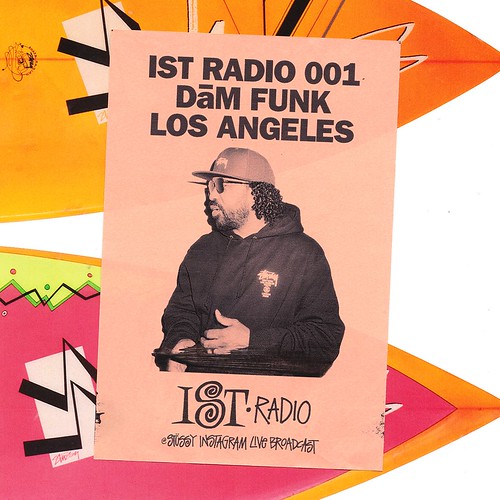
Now Stüssy has been the soundtrack breaking up a seemingly endless cycle of Zoom calls. You can find all of them here. My personal favourite is Stones Throw records stalwart DāM FUNK.
Really interesting product design. Russian designers have reached back into technological history to use vacuum tubes (valves) rather than digital or solid state (transistor) electronics that Bob Moog would have used to build his first instruments. You can find out more at APPARATUS Tube Synthesizer by Eternal Engine EMI
Interesting presentation on how behavioural science (nudge theory) is used for patient engagement. It is obvious that these techniques could be adapted across product and service design.
International Jazz Day saw an amazing array of talent performing online.
A great video about the Barbican complex that was shot in 1969.It is a London that is both familiar and alien to me. The city is now dominated by office tower blocks. The buildings for the Barbican complex of old and new building cheek by jowl. There is some beautiful B-roll shot at different times of the day across the Barbican area. That alone would make this interesting, even before it gets into the history.
Whilst you might not know the Bush TR 82, if you were from western Europe you’ll recognise its style immediately.
Post-war Britain
In the post-war era Bush Radio Limited tried to fill consumers demands for entertainment.
There were radios that would sit on a sideboard and would have the presence of a TV set. Many of these have fitted out with Bluetooth to create a better sounding sound system. It certainly sounds better than an Amazon Echo. My parents inherited one of these, a Bush VHT 61, which served them well for many years.
There was also radiograms, which is were a cross between a sideboard and a hifi system.
The secret of their warm sound was valve circuits. Before chips with millions of components, were transistors. And before transistors were delicate lightbulb-like valves.
Bush TR 82
David Ogle’s iconic design
Over time manufacturers like Bush managed to make valves small enough to make portable devices. In 1957 the Bush MB60 was launched. This was a portable valve radio designed by David Ogle of Ogle Design. The MB60 didn’t last as even minature valve radios were power hungry and delicate. But David Ogle’s case design lived on.
TR 82
Ogle’s product design was mated to a seven transistor circuit to create the TR 82.The TR 82 was big enough to have a decent sound and small enough to be portable. Alkaline batteries like Duracell were only starting to reach the market about the same same as the TR 82. So a high powered long lasting battery would be a 9 volt lantern style battery. This meant that you got months of use out of one battery, but each battery was expensive. (Similar batteries were still commonly used up until recently in the flashing lanterns used to mark road works currently in progress).
The TR 82 received long wave and medium wave so didn’t need an external aerial. VHF or FM radio wasn’t popular yet. In common with cars from the 1950s the Bush TR 82 had chrome plated brightwork. This was around the front panel around the edge of the circular reception dial. Despite this ornamentation you ended up with a very intuitive radio design, with a simplicity that Dieter Rams would appreciate. There was a large tuning wheel on the front of the radio.
On top, there were two rotating controls:
Volume
A combined tone and on / off switch
Selection between medium wave and long wave reception was done with two large buttons.
The handle ran the length of the case and swivelled at the points at which it was secured. This provided even easier access to the top controls of the radio.
The rear cover was removed by a single central screw. This could be undone with a edge of a coin. Inside the case was a battery compartment at the bottom. The rest of the radio was held on a metal subframe. This rigidity was essential for the tuning mechanism to work seamlessly and for the speaker to provide a good sound.
My personal memories of the TR 82
My own personal memories of a well-used and obsolete Bush TR 82 stem from my time on the family farm in Ireland. The radio lived in the kitchen and provided news at lunch and dinner time. It was also turned on to listen to the latest livestock market prices. This would then affect if, or when livestock and wool were sent to market. It provided live music on a Saturday evening. In essence, it filled many of the tasks that an internet enabled PC would do – if my Uncle and Grandmother had been online.
Radio was the primary media. Ireland had been an early adopter of radio, but a relative latecomer to television. So even into the early 1980s the radio had a pre-eminence in consumer behaviour that was only slowly eroded by the TV.
Television was something only broadcast from after lunch until late evening, apart from the weekends. When the second TV channel launched it only during the evening. By comparison at the time radio broadcast from before 6am in the morning until shutdown just after midnight.
TR 82 and the rise of Sony
The timing of the Bush TR 82 was a high point. The same year Tokyo Tsuskin Kogyo launched the first pocket sized transistor radio – the TR-63. It was the first ‘Sony’ product to be sold in the US. Sony was originally a product line brand for their nascent transistor radio busness. The product was so successful that the founders changed their company name to Sony Corporation. This idea of portable pocket entertainment begat personal stereos, iPods and the smartphone. (You can find more on Sony here.)
By comparison the TR 82 marked the point for Bush Radio as well. Bush Radio had been acquired by Rank in 1945. In 1962, the company was merged with Murphy Radio as Rank Bush Murphy. This was sold to Great Universal Stores in 1978. In 1986, the Bush name was sold to the Alba Group. In 2008 the former Alba Group sold the name for use outside Australasia on to Home Retail Group. Sainsburys acquired Home Retail Group in 2016.
But the iconic Bush TR 82 shape lived on, in more modern, yet poorer quality replicas. Most noticeably the Bush TR 82 DAB which had digital radio, FM, medium wave and long wave. Unfortunately the modern radio didn’t feature the same quality of speaker or internal frame. This meant that the sound suffered from lower power and a muddy sound caused by vibrations in the case. A brief feature on the Bush TR82 by the BBC and the British Museum here.