According to the AMA – Marketing is the activity, set of institutions, and processes for creating, communicating, delivering, and exchanging offerings that have value for customers, clients, partners, and society at large. This has contained a wide range of content as a section over the years including
Super Bowl advertising
Spanx
Content marketing
Fake product reviews on Amazon
Fear of finding out
Genesis the Korean luxury car brand
Guo chao – Chinese national pride
Harmony Korine’s creative work for 7-Eleven
Advertising legend Bill Bernbach
Japanese consumer insights
Chinese New Year adverts from China, Hong Kong, Malaysia and Singapore
Doughnutism
Consumer Electronics Show (CES)
Influencer promotions
A media diary
Luxe streetwear
Consumerology by marketing behaviour expert Phil Graves
Payola
Dettol’s back to work advertising campaign
Eat Your Greens edited by Wiemer Snijders
Dove #washtocare advertising campaign
The fallacy of generations such as gen-z
Cultural marketing with Stüssy
How Brands Grow Part 2 by Jenni Romaniuk and Byron Sharp
Facebook’s misleading ad metrics
The role of salience in advertising
SAS – What is truly Scandinavian? advertising campaign
Brand winter
Treasure hunt as defined by NPD is the process of consumers bargain hunting
Lovemarks
How Louis Vuitton has re-engineered its business to handle the modern luxury consumer’s needs and tastes
This week I have been listening to classic Japanese pop from the 1970s and 1980s – late Shōwa era for the win! The Shōwa era means ‘enlightened harmony’. It covers world war II and the subsequent economic miracle, right up to the bubble era of the Japanese economy. What we saw during the post-war Shōwa era was a massive outpouring of quality content in entertainment, film, music, product design, the arts and architecture.
Canadian tourism board anime
Canada’s tourism board has been running a campaign in Japan. They got the studio behind anime blockbuster ‘Your Name’ to do this 30-second spot in an anime style rather than the more traditional approach of using b-roll footage.
It’s an interesting choice, especially given the dramatic scenery available in Canada and shows how important Canada must view the Japanese market. By comparison, there doesn’t seem to be any campaign targeting the UK or Ireland at all.
The Isle of Dogs marries anime with Wes Anderson and looks amazing. The Isle of Dogs in question, is an artificial island in Tokyo Bay rather than the region of London.
Porsche have done a great piece of content marketing about conductor Herbert von Karajan’s 1970s vintage Porsche 911 RS. von Karajan was famous, even amongst non-classical music fans for being a long time conductor of the Berlin Philharmonic and his recordings on Deutsche Grammophon. This was probably helped by his recording being some of the first CDs available.
While it might be seen to be a source of inspiration for PR stunts or experiential marketing, it fits into the idea of live advertisements that agencies and brands have been experimenting with over the past few years. More at Thinkbox here.
The Equality of Opportunity Project – This introductory course, taught by Raj Chetty, shows how “big data” can be used to understand and solve some of the most important social and economic problems of our time
Will Imagination Deals Deliver MIPS to China? | EE Times – interesting discussions on the Tallwood VC / Canyon Bridge deal and possible implications for the MIPS eco-system. Interesting that China sees more potential and security in MIPS than ARM….
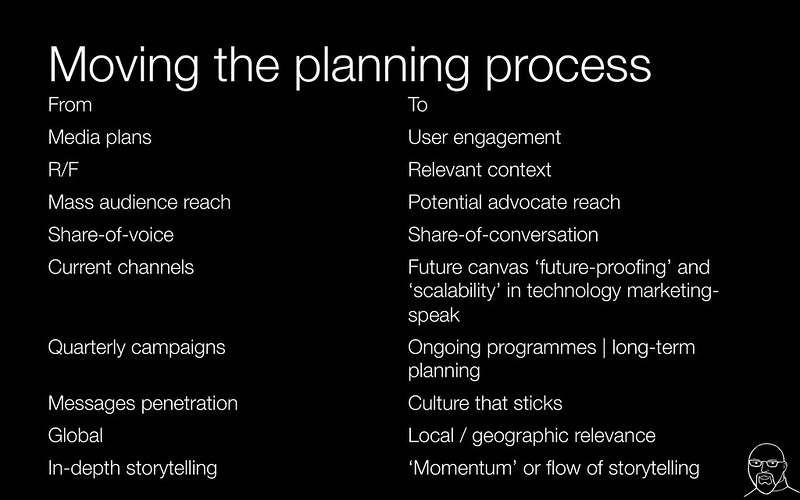
A couple of years ago I did a presentation on connection planning and much of that thinking still has value. But some of the tenets of connection planning are now challenged by changes in marketing practice and strategy in the business to consumer space.
The focus on user engagement has been affected by three things:
Social platforms have been moving their business model and interactions towards traditional brand advertising models. Social networks like Facebook and Twitter are structuring their algorithms and advertising closer towards the reach and repetition model of traditional broadcast advertising. TV advertising dollars are what social platforms are chasing, rather than going after Google
Consumer brands, particularly from publicly listed mature players are facing business pressures from the threat of private equity ownership that would look to sweat the assets at the expense of longer term brand performance. No one is immune to this, not even Nestle that was thought to be protected due to Swiss regulations. This has led to a resurgence zero-based budgeting that is locked in focus on return on investment over a shorter time period. From a communications planning perspective there are no sacred cows, no guaranteed longer campaign story arcs or brand engagements as spend has to be justified from a clean slate each year
Most marketing spend tends to be around existing products, often in mature markets. New products run a high risk of failure. New products in new categories are generally the province of start-up graveyards – we remember the few successes rather than the legion of failures. Marketing thinking for mature brands in mature sectors (so most FMCG categories and established brands). This change has been driven by research financed by FMCG companies including Coca-Cola, Mars, Kraft and Kelloggs at the Ehrensberg-Bass Institute for Marketing Science. Ehrensberg-Bass’ Byron Sharp book ‘How brands grow‘ is the talisman for these marketers and their agency side media planners
The shorter focus of consumer marketers makes it much harder to build a brand culture that sticks like Red Bull has managed to do. Flow of storytelling becomes less important than reach and stream of repetition.
Digital News Report by Oxford’s Reuters Institute for the Study of Journalism latest findings discussed by Dr. Rasmus Kleiss Nielsen. This Digital News Report is based on a survey of more than 70,000 people across 36 countries.
P&G’s Pritchard Calls for Next Generation of Digital Ads | Special: Dmexco – AdAge – I kind of agree with him from a an overall sentiment point of view, but viewability is also a function of how much of the viewable area it fills? I realise that it would be hard to measure but it would be a function of ad size, scrolling speed and display size. In the real world think about the ads on the tube escalators.
P&G Asia brand director: ‘We were clickbaiters – and a giant duck still got more likes than we did’ – “I’ve been through generations of training in how to make a good Facebook ad, which has gone around 360 degrees and come back to the simple principles of marketing. We went through lots of complications in how to get clicks – we were clickbaiters. We honestly were. And yet that duck in Hong Kong Harbour got more likes than any of pure branded messaging, and we thought that’s maybe a good thing. But it’s not and it doesn’t help brands or businesses. It’s taken us time to get to where we are and the simplicity of those core marketing principles.”
Security
On the Equifax Data Breach – Schneier on Security – Surveillance capitalism fuels the Internet, and sometimes it seems that everyone is spying on you. You’re secretly tracked on pretty much every commercial website you visit. Facebook is the largest surveillance organization mankind has created; collecting data on you is its business model. I don’t have a Facebook account, but Facebook still keeps a surprisingly complete dossier on me and my associations — just in case I ever decide to join.
I also don’t have a Gmail account, because I don’t want Google storing my e-mail. But my guess is that it has about half of my e-mail anyway, because so many people I correspond with have accounts. I can’t even avoid it by choosing not to write to gmail.com addresses, because I have no way of knowing if newperson@company.com is hosted at Gmail.
I have grown tired of a ridiculous statistic being used so frequently that it becomes marketing truth. It’s regurgitated in articles, blog posts, social media and presentations. The problem with it is that affects the way marketers view the world and conduct both planning and strategy. The picture below is a goldfish, his name is Diego. If you’ve managed to read this you aren’t Diego.
I realise that sounds a little dramatic, but check out this piece by Mark Jackson, who leads the Hong Kong and Shenzhen offices of Racepoint Global. It’s a good piece on the different elements that represent a good story (predominantly within a PR setting). And it is right that attention in a fragmented media eco-system will be contested more fiercely. But it starts with:
Over the course of the last 20 years, the average attention span has fallen to around eight seconds; a goldfish has an attention span of nine! The challenge for companies – established and new – is to figure out how to get even a small slice of that attention span when so many other companies are competing for it.
Mark’s piece is just the latest of a long line of marketing ‘thought leadership’ pieces that repeat this as gospel. The problem is this ‘truth’ is bollocks.
It fails the common sense test. Given that binge watching of shows like Game of Thrones or sports matches is commonplace, book sales are still happening, they would have to be balanced out with millisecond experiences for this 8-second value to make any sense as an average. The goldfish claim is like something out of a vintage Brass Eye episode.
To quote DJ Neil ‘Doctor’ Fox:
Now that is a scientific fact! There’s no real evidence for it; but it is scientific fact
Let’s say your common sense gets the better of your desire for a pithy soundbite and you decide to delve into the goldfish claim a bit deeper. If one took a little bit of time to Google around it would become apparent that the goldfish ‘fact’ is dubious. It originally came from research commissioned by Microsoft’s Advertising arm ‘How does digital affect Canadian attention spans?‘. The original link to the research now defaults to the home page of Microsoft Advertising. Once you start digging into it, the goldfish wasn’t actually part of the research, but was supporting desk research and thats when its provenance gets murky.
PolicyViz in a 2016 blog post The Attention Span Statistic Fallacy called it out and provided links to the research that they did into the the goldfish ‘fact’ in 2016 – go over and check their article out. The BBC did similar detective work a year later and even went and asked an expert:
“I don’t think that’s true at all,” says Dr Gemma Briggs, a psychology lecturer at the Open University.
“Simply because I don’t think that that’s something that psychologists or people interested in attention would try and measure and quantify in that way.”
She studies attention in drivers and witnesses to crime and says the idea of an “average attention span” is pretty meaningless. “It’s very much task-dependent. How much attention we apply to a task will vary depending on what the task demand is.”
There are some studies out there that look at specific tasks, like listening to a lecture.
But the idea that there’s a typical length of time for which people can pay attention to even that one task has also been debunked.
“How we apply our attention to different tasks depends very much about what the individual brings to that situation,” explains Dr Briggs.
“We’ve got a wealth of information in our heads about what normally happens in given situations, what we can expect. And those expectations and our experience directly mould what we see and how we process information in any given time.”
But don’t feel too bad, publications like Time and the Daily Telegraph were punked by this story back in 2015. The BBC use the ‘fact’ back in 2002, but don’t cite the source. Fake news doesn’t just win elections, it also makes a fool of marketers.
This whole thing feels like some marketer (or PR) did as poor a job as many journalists in terms of sourcing claims and this ‘truth’ gradually became reinforcing. Let’s start taking the goldfish out of marketing.