According to the AMA – Marketing is the activity, set of institutions, and processes for creating, communicating, delivering, and exchanging offerings that have value for customers, clients, partners, and society at large. This has contained a wide range of content as a section over the years including
Super Bowl advertising
Spanx
Content marketing
Fake product reviews on Amazon
Fear of finding out
Genesis the Korean luxury car brand
Guo chao – Chinese national pride
Harmony Korine’s creative work for 7-Eleven
Advertising legend Bill Bernbach
Japanese consumer insights
Chinese New Year adverts from China, Hong Kong, Malaysia and Singapore
Doughnutism
Consumer Electronics Show (CES)
Influencer promotions
A media diary
Luxe streetwear
Consumerology by marketing behaviour expert Phil Graves
Payola
Dettol’s back to work advertising campaign
Eat Your Greens edited by Wiemer Snijders
Dove #washtocare advertising campaign
The fallacy of generations such as gen-z
Cultural marketing with Stüssy
How Brands Grow Part 2 by Jenni Romaniuk and Byron Sharp
Facebook’s misleading ad metrics
The role of salience in advertising
SAS – What is truly Scandinavian? advertising campaign
Brand winter
Treasure hunt as defined by NPD is the process of consumers bargain hunting
Lovemarks
How Louis Vuitton has re-engineered its business to handle the modern luxury consumer’s needs and tastes
Gaming the charts has been going on for decades. Economist Tyler Cowen documented how prosecutions in the US for what was called payola started in the 1950s in his book: In Praise of Commercial Culture. Prior to this the process for ranking and gaming the charts was opaque at best. It destroyed the career of radio DJ Alan Freed, who helped pioneer the rock and roll sound. American Bandstand presenter Dick Clark almost had a similar fate. Clark sold a stake in a record company and turned snitch for the authorities.
Over time labels relied on legal promotional means to radio stations. Here’s what KLF’s The Manual had to say about them circa 1988:
Your plugger. The man responsible for getting the nation to hear your record. From now on in this man will undoubtedly be the most important person in the jigsaw. Without his faith, vision and understanding of the fastest lane in this particular rat race, you will be nowhere.
So go with the plugger that’s got the faith, vision and understanding – indefinable qualities – but you will know within five minutes of meeting them if they have it. Top grade bull is something else they should have.
The plugger will try and explain what his job is. Each of them view their role differently but all must be able to deliver the following:
1. Concrete advice on what has to be brought out on your record for him to be able to do his job.
2. Appointments with Radio One producers where he is able to get them to listen to your record under the most favourable light.
3. Advice and help in putting together a video that will be acceptable for children’s television and a lead on some of the hungry young video makers who are out there.
Money and pluggers. They will want a lot and when your record starts happening pluggers will want more. Scott [The KLF’s plugger] wanted a thousand pounds to start working the record and then all sorts of bonuses related to our record reaching certain positions on the charts. We had to pay him five grand altogether once it had made Number One. He had a lot of costs and his team worked flat out for it, but we had to give him the first thousand the day of release. We had a couple of months to pay the other four. Anybody who can do it much cheaper won’t be much good.
The KLF – The Manual – How to Have a Number One Hit the Easy Way
Plugging services also worked with club DJs to get their artists in club play charts. When I used to send returns to these charts I used to receive ‘promotional copy’ records from promo agencies. Some of them were good, some indescribably bad. One of the agencies I used to get material from was IRP; my contact there Lohan Presencer went on to become executive chairman of the Ministry of Sound Group.
With the rise of hallyu and online voting you saw early breakout artists like the Wonder Girls galvanise fans and home and abroad to get them on to the likes of Disney Radio in the US and assist in gaming the charts.
Miles Guo cover art – which makes the thing even slightly more surreal.
Now it seems political activism has merged with the art of plugging. Miles Guo, a critic of the Chinese government based in New York has provided the vocals and money behind ‘Take Down the CCP‘. It feels like the Team America soundtrack, but without the irony.
It went to number one on the iTunes download chart in three countries on the one day America, Canada and Australia (you need to make an allowance for the international date line, so Australia appears on September 11th, rather than 10th). It has all the hallmarks of a coordinated promotion. The reduced prominence of downloads versus streams obviously paid a part in their chart choice. Promotions of streams are structurally very different, with playlists along genres being much more important; so for Guo it would be much harder in terms of gaming the charts. Gaming the charts for streaming does happen; but with more conventional agendas. More music related posts here.
Minitel: The Online World France Built Before the Web – IEEE Spectrum – For a generation of French citizens, Minitel wasn’t about hardware, switches, or software. It was about the people they chatted with, the services they used, the games they played, and the advertisements for these services they saw in newspapers and on billboards. Many of the services that we associate with the Web had predecessors in Minitel. Before there was Peapod, there was 3615 TMK (Tele-Market), a service that enabled Parisians to order groceries for same-day delivery. Before there was Cortana or Siri, there were Claire and Sophie, services that provided personalized information using natural-language interfaces. Before there was Ticketmaster, there was Billetel. And before there was telebanking, there was Minitel banking
Brand Equity May Be Auto Industry’s Biggest AI Risk | CLS Strategies – The AI Risk Index reflects a substantial gap between what is intended and what is perceived by critical stakeholders. The results are stark—especially in the context of substantial investment and many more years of public scrutiny as AI is improved—and reveal a growing crisis of trust. Though an average of 62% of Americans are familiar with companies in the transportation industry, only 35% have a positive opinion of them (compared to 43% for non-automotive manufacturing and 41% for retail companies) and only 37% trust them (compared to 44% for manufacturing and retail companies). Even more concerning is that the transportation companies most heavily involved in AI technology drive this sense of distrust, more so than traditional carmakers. That may explain why only three out of eight transportation companies analyzed during the third quarter of 2018 mentioned advancements in AI at all—indicating that auto companies are either communicating poorly or not communicating at all.
The Lebanese armed forces were celebrating their 75th birthday and wanted to celebrate the contribution that they make to society. So they worked with a marketing agency to come up with PEACECAMO. PEACECAMO is based on photographs taken of different humanitarian incidents over the years that were then rendered into camouflage. These uniforms will be worn when concealment isn’t necessary. For instance parades or humanitarian work. Its a lovely idea, unfortunately this happened before the Beruit port explosion, which has fractured the government from the Lebanese people. More information here. More design related posts here.
https://youtu.be/m2IGeqRFj1Q
PEACECAMO video
Marketing Week columnist and academic Mark Ritson at the Amplify marketing festival. In this presentation Ritson talks about balancing short term and long term needs in marketing. If that sounds familiar, well that’s because Ritson was inspired by this article by Tom Roach here.
Larry Shiller’s car collection and garage is a site to behold in terms of its scale. Although I wouldn’t be choosing any of these cars for myself I like the way he collects based on a narrow time period of design. You can see the jet age aesthetic coming through in the fins and tail lights.
I like the way he is pretty much self-sufficient from a parts perspective. With enough time, he can handle most of the repairs himself. This wouldn’t be possible now with the rapid evolution in technology. It was simpler times; chip design and software are essential to most modern cars.
Photographer Trey Ratcliff has been putting out these videos that would be beloved of VJs playing a rave in the early 1990s. Pull out your old Goa trance CDs and watch with this playlist for full effect.
Internet Observatory – New White Paper on China’s Full Spectrum Information Operations – China’s influence strategy on COVID-19 has involved a full spectrum of overt and covert tactics, which has included domestic censorship, English-language state media messaging bolstered by Facebook ads, and the use of fake accounts to influence conversations on Western social media platforms. English-language state media Facebook Pages and Twitter accounts, as well as Chinese diplomats and embassies, took part in an overt messaging effort to amplify the CCP’s preferred narratives on COVID-19. Covert state-sponsored activity leveraging fake Twitter accounts paralleled these efforts, praising the CCP’s pandemic response and criticizing the responses of other actors, such as the United States, Hong Kong and Taiwan. See also: Special Report: Australia faces down China in high-stakes strategy – Reuters
Row over withdrawal treaty triggered law chief’s resignation | Financial Times – “Number 10 are doing this deliberately to pick a fight with the judiciary. They want to put the judges and Supreme Court on [the] wrong side of popular opinion. It’s a mistake to assume this is all about Brexit.” – reminds me of how Hong Kong is now being criticised for a defacto lack of separation in legislative and judicial powers brought in by China. It also affects the UK’s ‘gold standard’ contract law benefits
Mediatel: Mediatel News: An age-old issue – Finally, note the profusion of industry 30 Under 30 awards (just Google it). Even actuaries have one. But don’t kill them. They’re vital. No, let’s have the 50 Over 50 awards, and 60 Over 60 (assuming you can find that many), or OAP Heroes of WPP
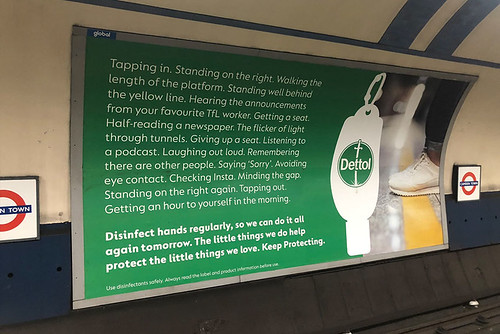
At the beginning of the month, Dettol launched a ‘back to work’ poster campaign appeared on the tube as part of McCann London’s Keep Protecting series of adverts for Reckitt Benckiser.
The ad campaign had been launched in July with out of home posters like this one celebrating a return to school and video spots.
McCann London for Reckitt Benckiser
Here’s what Ads of the World had as an explanation of the ad’s rationale:
Lockdown has taught us all to appreciate the little things in life we previously took for granted. As we move out of the lockdown phase, we are all at risk of forgetting the importance and impact of the other little things we have been doing to keep ourselves, our families and our community safe. To remind us of these, Dettol has launched a fully integrated behaviour change campaign ‘Keep Protecting,’ comprising TV, VOD, digital and OOH.
Online conversations featuring Dettol went up 2245%*. In terms of sentiment**:
22% of posts were assessed to be negative in nature
11% of posts were assessed to be positive in nature
67% of posts were assessed to be neutral in nature
Was the Dettol campaign successful?
Was the campaign successful? It depends. At the moment we don’t know how Reckitt Benckiser were assessing the campaign, or what they wanted to achieve.
Reasons for thinking that it was:
Dettol would have been top of mind with regards to hygiene thanks to the increased talkability
The posters achieved reach far beyond tube travellers; which meant that the ads could be considered to be good value for money. I would presume that they already bought the posters at a considerable discount due to the overall surplus of inventory available in out of home advertising and diminished footfall
Any negative impact is likely to be short lived. Discussion peaked on September 3rd, with 3,286 mentions, declined to 414 on September 4th and 96 the following day. Whilst PR experts claimed that Dettol would have a hard time cleaning up after this mess – the quantitative online data tends to suggest otherwise
The (small) association of the Dettol ad with the government back to work campaign has potentially alligned Dettol’s personal care and household products to align more closely with the more socially conservative majority outside the big cities. And yet doesn’t seem to have impacted the appeal of the brand abroad in markets like India and Thailand
Prior to the ‘back to work’ themed poster, the campaign didn’t seem to have spurred a significant increase in online social discussions at all. Despite the investment in out of home advertising and video. No increased discussion about product usage, or preparing for back to school. The Back To Work poster gave Dettol a brief burst of cultural relevance.
Data* from Meltwater Social.The mini-peak that occurred on August 24th is unrelated to Dettol marketing efforts ***
Reasons for thinking that it wasn’t:
Dettol is already a by-word in the UK when it comes to antiseptic and disinfecting. It is already ‘verbing’ (as Faris Yakob would say) in UK culture. So there would be marginal gains
As much as the posters drove talkability, they didn’t seem to drive content on Instagram. So for youth-obsessed brand marketers after millennial Mums and gen-y office workers, it was a bit of a wash out.
Awareness and recall probably took a bit of a knock when 203 posts commented about how they thought the Dettol ad (with its prominent logo placement) was part of the UK government’s (currently postponed) back to work ad campaign. This connection has driven some of the media coverage that followed
Dettol is likely to remain top of mind for only a short time. Discussion peaked on September 3rd, with 3,286 mentions, declined to 414 on September 4th and 96 the following day. TfL claim that the footfall at the tube is running at less than 30% of usual capacity at the moment
The advert spawned memes that were negative to the brand and arguably more culturally relevant
The media is likely to have a longer memory than the general public about the Dettol advert. It has placed the brand as a potential football in wider culture wars currently going on. Whilst the brand marketers and advertising agency won’t care, the communications team will likely to have clean up any mess coming to Reckitt Benckiser.
The relative furore around the brand, looks bad compared to the results Dettol brand marketing teams have achieved across Asia. For instance Dettol India’s #HandWashChallenge got an astonishing amount of visibility on TikTok. It has achieved over 125.1 billion views across Asia****. More on that campaign here. And the Asian campaigns didn’t cause discord.
Only 67 of the 3,870+ mentions associated the Dettol brand with hand sanitiser. Yet a key part of the ad artwork was a silhouette of their personal hand sanitiser bottle
Dettol ad in question at Camden Town tube station
The copy:
Hearing an alarm. Putting on a tie.
Carrying a handbag. Receptionists.
Caffeine-filled air. Taking a lift.
Seeing your second family. Watercooler
conversations. Proper bants. The boss’s
jokes. Plastic plants. Office gossip. Those
weird carpets. Face-to-face meetings.
Not having to make lunch. CCing.
BCCing. Accidentally replying-all.
Hearing buzzwords. Leaving early for
a cheeky afternoon in the sun.
Disinfect surfaces we use throughout the
day, so we can do it all again tomorrow.
The little things we do help protect the
little things we love. Keep Protecting.
McCann London for Rickett Benckiser
What about the craft?
My issues with the campaign are more craft-related. The call to action at the bottom made perfect sense when associated with the ‘back to school’ creative iteration of the poster. It makes less sense in the ‘back to work’ and ‘back to commute’ posters, where it has been used unchanged.
The language used in the ‘back to school’ poster would bring back emotive memories of school. The back to work poster evoked the ennui, awkwardness and embarrassing moments that Ricky Gervais skewered quite eloquently in the comedy TV show The Office.
There was also a clear comparison to Renton’s ‘Choose Life’ speech in Trainspotting 1 & 2
Original version from Trainspotting
Updated Trainspotting 2 version
This could have been done so much better. It would still have been controversial – instead much of the abuse has come at the expense of its mediocrity. I suspect that the ad was an unintentional troll.
I am confident that this wasn’t a Dominic Cummings-type of deliberate trolling. It wasn’t designed to stir up brand relevance amongst the general public at the expense of the work-from-home metropolitan elites.
What next for Dettol?
The account planning team and client service staff members at McCann London will be wrapping together much of the reasons and data I’ve suggested above into a positive narrative for the client. If they manage to pull that off; they may even try to use it for award entries next year.
Dettol is a well-loved brand in a relatively low-passion category. Everyone I know has a bottle in the cupboard under the kitchen sink with the cleaning supplies or in the first aid kit. It deserved so much more from the marketers at Reckitt Benckiser (UK) and copywriters at McCann London.
^ VOD means video on demand like Netflix, Hulu in the US, NowTV in Hong Kong or ITV Player in the UK. OOH means out of home. Poster adverts that could be on billboards, electronic Jumbotron type signage, trains, buses or taxis. They can be inside like the London underground (mass transit) posters or out on the street.
*All data quoted from Meltwater Social. I looked at data only in English from the UK. The sources for mentions that I selected were: Twitter, forums, blogs, comments, Facebook, Instagram, Reddit and YouTube.
** Machine derived sentiment, so assume that it is only 65-85% accurate
*** The mini-peak on August 24th was Twitter users sharing a meme about childhood in 1970s Britain. It associated Dettol with a simpler, if more deprived Britain. The original tweet that got things going said:
I was moulded in the 70’s…when ya school jumper was knitted by an intoxicated grandma…when ya bath had Dettol not bubbles…ya phone was a pissy smelling red box..you was tucked in & couldn’t move….fish finger sandwiches & lard fried chips & I’d go back in a heartbeat ❤️
**** TikTok like other social platforms have issues with regards engagement metrics.
UPDATE: September 15, 2020 – YouGov surveyed the British public on each of the concepts in the copy and you can understand from the results why it went over so badly. TL;DR – People really don’t like their alarm, they don’t miss the smell of the office or even eating out for lunch and your work colleagues definitely aren’t your second family (PDF)