Category: online | 線上 | 온라인으로 | オンライン

The online field has been one of the mainstays since I started writing online in 2003. My act of writing online was partly to understand online as a medium.

Online has changed in nature. It was first a destination and plane of travel. Early netizens saw it as virgin frontier territory, rather like the early American pioneers viewed the open vistas of the western United States. Or later travellers moving west into the newly developing cities and towns from San Francisco to Los Angeles.

America might now be fenced in and the land claimed, but there was a new boundless electronic frontier out there. As the frontier grew more people dialled up to log into it. Then there was the metaphor of web surfing. Surfing the internet as a phrase was popularised by computer programmer Mark McCahill. He saw it as a clear analogue to ‘channel surfing’ changing from station to station on a television set because nothing grabs your attention.

Web surfing tapped into the line of travel and 1990s cool. Surfing like all extreme sport at the time was cool. And the internet grabbed your attention.

Broadband access, wi-fi and mobile data changed the nature of things. It altered what was consumed and where it was consumed. The sitting room TV was connected to the internet to receive content from download and streaming services. Online radio, podcasts and playlists supplanted the transistor radio in the kitchen.

Multi-screening became a thing, tweeting along real time opinions to reality TV and live current affairs programmes. Online became a wrapper that at its worst envelopes us in a media miasma of shrill voices, vacuous content and disinformation.

  • Time lapse & things this week

    I don’t know what it was about this week, but I ended up looking at a whole pile of time lapse videos. These videos have become much more accessible. Modern smartphones have it as a standard feature, it has become easier to do time lapse video with professional photography equipment. Cheap time lapse timers are now available and there is software to easily stitch it all together.

    First up beautifully assembled footage of summertime in New York, this doesn’t give you a real feel of the humidity in New York. It is mesmerising though.

    Next a time lapse video that zooms pans and warps time in Pyongyang, North Korea. It is all the more remarkable given the careful curation of content that comes out about North Korea.

    Pirate Jams put together a mix of late 1980s to early 1990s tracks and their own recordings that sampled many others for i-D magazine and came up with this joyful mix. It is as at home on your car stereo as it is in your Zumba class. It fits into a wider nostalgia in dance music exemplified by nu-disco and mash-up culture.

    The Vinyl Factory put together 20 tracks as an introduction to the early balearic sound for generation-z. Balearic was a minority interest when it was originally out. The eclectic mix of music that people now listen to and genres from tropical house to nu-disco make Balearic sound as relevant today as it did in the mid-1980s.

    Burberry put together a great video showcase that shows how they use the Tencent WeChat / Weixin platform or as they put it Burberry and WeChat have created a series of creative collaborations and platform firsts that leverage WeChat’s unique functionality and responsive content capabilities. – This is very much in keeping with Burberry’s long push into exploring what digital retail would mean in a luxury environment?More related content here. Note: The original video seems to have been taken down as the licence on the music by Ed Harcourt had likely ran out.
  • Nine years span + more news

    Nine years span platform deal

    Reckitt Benckiser and Facebook announce partnership to get digitally closer to consumer – partnership over nine years. In the space of nine years Geocities went from vibrant community to graveyard. Over nine years MySpace relaunched twice – this agreement between RB and Facebook is a bet against disruptive innovation. That implies a whole range of issues regarding antitrust considerations. More FMCG related content here.

    Branding

    Oakley Disruptive by Design | Designboom – interesting how Oakley is trying to now associate itself with design goodness, rather than being disruptive designers themselves now

    TD Bank Boost Customer Advocacy via ATMs | VisibleBanking.com – nice iteration on the Coca-Cola campaigns of recent years

    JWT Launches ‘Forever Faster’ for Puma | MediaBistro – we were watching this advert in the office this morning and didn’t make any sense beyond being mildly entertaining

    Business

    Why Ebay Tells Manufacturers in China What You’re Searching For – The Atlantic – interesting thoughts around authenticity and nostalgia

    Here’s The Difference Between Working At Facebook, Google, And Microsoft — According To Someone Who Has Worked At All Three – some cultural insights at different companies. Interesting how stack ranking doesn’t seem to have turned Microsoft into a pressure cooker

    Guest post: has doing business in China just got too risky? | FT – don’t overreact (paywall)

    The Most Fascinating Profile You’ll Ever Read About a Guy and His Boring Startup | Business | WIRED – great interview with Stewart Brand

    An Insider’s Account of the Yahoo-Alibaba Deal – Harvard Business Review – interesting view of the deal from Sue Decker

    Chilling policy announced for China’s instant messaging services | WantChinaTimes – not really surprising, China has already tried to implement real name policy for cell phone SIMs and Weibo accounts. We’ll see how successful it actually is

    20 of 21 provinces probed engaged in property-related corruption | WantChinaTimes – openness by the Chinese government

    Online

    Forget :) Baidu’s Simeji App Captures Teenage Hearts in Japan – Bloomberg – interesting how traditional media is still a major driver of memes and trends

    Survey: YouTube Stars More Popular Than Mainstream Celebs Among U.S. Teens | Variety – self-serving data points

    15 specialist social network apps in China | Techinasia – interesting set of applications

    Meme

    Weibo user solicits pics for ‘most beautiful bosom’ contest|WantChinaTimes.com – could you get away with this on Twitter, I doubt it

    Security

    Hacker’s own guide to the exploit | Pastebin – I found it really interesting that Google was do important in the process

    Technology

    China Online Shopper Spent $12.5 Billion Buying from Oversea E-tailers | ChinaInternetWatch – which is especially interesting given the ubiquity of UnionPay within China

    New Strategy as Tech Giants Transform Into Conglomerates | NYTimes – I would have thought that Microsoft and Cisco where already at conglomerate status?

    Wireless

    Huawei to slash low-end mobile phone models: executive | WantChinaTimes – interesting move, probably struggling to compete against other Shenzhen businesses living on razor thin margins

  • Post 90s generation & things this week

    China’s post 90s generation

    Some nicely presented data insights on China’s post 90s generation, who are the most likely people to drive China’s next stage of economic growth through domestic consumption. The post 90s generation don’t have the same strong affinity for western brands that their older peers have. The post 90s generation have grown up as China has got better and better with sustained economic growth, infrastructure and power.

    It isn’t often that you see an interesting accessible presentation on online analytics, which is the reason why I thought I would share this one

    An interesting documentary on the relationship between ‘young people’ and brand interactions on social media. In many respects it reminds me of the way that I used brands as a teenager all be it in a real-world setting through consumerism. The power of brands as ‘social’ totem for identity. More related content here.

    A great drone-eye view of Hong Kong, though the Apple TV screensaver with an aerial view of Hong Kong is even better.

    The soundtrack of my week was a mix by Graham Park that he remastered and published online. He played the set at The Hacienda on February 1, 1992. It is a great snapshot of The Hacienda before a myriad of troubles finally closed the venue down. The set marks a time of eclecticism; with deep house, proto-progressive tracks and breaks all being played in the same mix; which would be largely unheard of in a club for the best part of 20 years.

  • A content desert?

    I started thinking about the idea of a content desert for a few reasons:

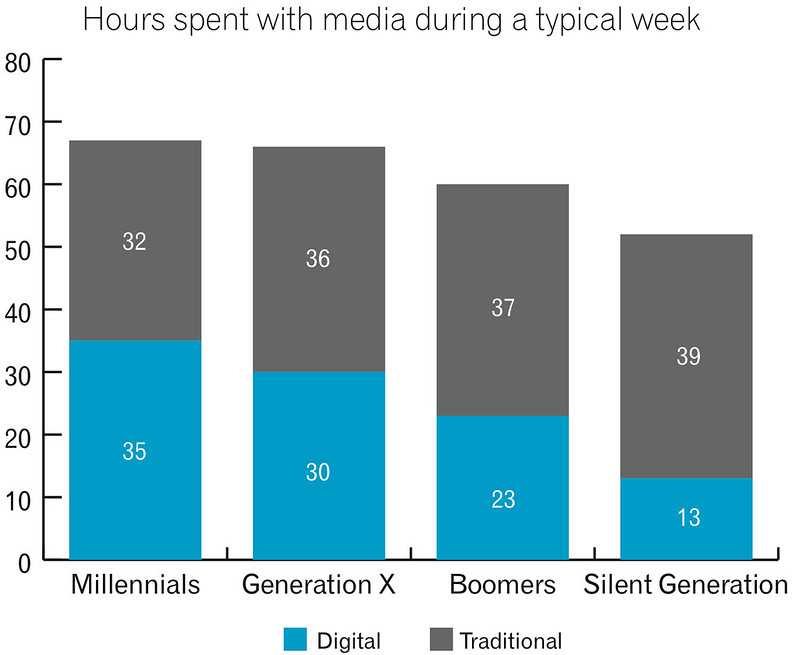
    Experian Marketing Services put out a really nice whitepaper out in June as part of their ConsumerSpeak series called Millennials come of age. One graph stood out to me; the split across generations between traditional and digital media consumption.
    media diet
    On the face of it, two things struck me, consumption of online media increased between millenials and generation X – but not in a way that makes them radically different – . There was also a marginal increase in overall consumption between generation Y and generation X. Is this due to media literacy, less commitments or they were having to work harder to get a similar amount of value from their media consumption?

    We had a focus group in the office looking at the personal media consumption habits of 18 – 24 year olds with an interest in sport. One of the things that came out of this was that they would only buy a magazine about their favourite sport if they were getting on a long plane journey. They thought it was ‘too expensive’ to spend £4 on a magazine. A colleague who sits near me loves the magazine and gets a lot out of the long form articles published in it. He uses these articles as social currency, in the office and with friends. However the panelists that we met felt that they could get everything they needed from sources that they perceived to be of equal quality via free online media.

    This stuck with me for a few days, then I realised why I kept churning it around in my mind. It reminded me of the kind of dialogue and decision-making process that was made by poorer people around food and nutrition. A mix of skewed value systems and economics brought a food desert into these areas.

    I wonder if we aren’t seeing the same thing in the media industry, whilst we know that Buzzfeed and their ilk provide easily-consumed low-quality content usually about first world problems or childhood nostalgia – are generation Y merely getting the media that they deserve? Will there be a content desert? How would a content desert impact brands and perceptions of value?

    A few things give me hope that there may not be; Vice Media is building the global news network that is defining the 2010s in the same way that Aljazeera defined the post-9/11 world and CNN defined the end of the cold war. Although you could argue that with Vice the bill is paid by branded entertainment on behalf of sponsors like Nike and Intel.

    Television has entered a new golden era in dramas; will media companies take the opportunity to reinvigorate factual programming? More related content here.

  • Modified android phones & other news

    Google Under Pressure as Modified Android Phones Take Off | TheNextWeb – 20 per cent sounds on the low side to me for modified Android phones. Why would you need modified Android variants?  You have modified Android phones because Google services are basically unuseable in China and North Korea. Amazon’s Fire phone and tablets are essentially modified Android variants. Finally the Yandex app store in Russia which I suspect is part of a wider fork of Android there, with yet more modified Android variants using it. More  content that is similar to this story here.

    Social Media, Indonesia’s election, and the growth of e-commerce | CampaignAsia – E-commerce has taken off in Indonesia. This has been a mix of traditional e-commerce and services like taxi rides and food delivery. Indonesia has managed to build up its own national champions in these fields. Social media has been used to fight a ferocious election campaign (paywall)

    Service activity at worst level in nearly years, HSBC says | Shanghai Daily – HSBC’s PMI index skews towards medium sized businesses and includes no state owned enterprises. But the data is probably more honest and has less harmonisation going on than official Chinese government data

    Apple Hires Former Social Media Director Of Nike And Burberry | Fast Company – but his job title is digital marketing director of Apple Retail. It will be interesting to see how this story develops over time.

    Procter and Gamble to Divest 100 Brands – Analyst Insight from Euromonitor International – interesting analysis. I was a bit surprised. Procter & Gamble hasn’t treated its brands as a portfolio in the same that Unilever has historically and has been known to market products alongside each other in ads to build up to a P&G story.

    McDonald’s hit by social media disaster on Instagram | Marketing Interactive – live and learn I guess, though disaster is a bit strong

    Why Coke’s experiment with vitaminwater turned sour | Quartz – interesting to see Coke acknowledging the change on its blog