Category: software | 軟件 | 소프트웨어 | ソフトウェア

Soon after I started writing this blog, web services came up as a serious challenger to software. The thing that swung the tide in software’s favour was the rise of the mobile app ecosystems.

Originally mobile apps solved a gnarly problem for smartphone companies. Web services took time to download and were awkward compared to native software.

Now we tend to have a hybrid model where the web holds authentication functionality and the underlying database for many applications to work. If you pick up a Nokia N900 today, while you can appreciate its beautiful design, the device is little more than a glowing brick. Such is the current symbiosis between between software apps and the web services that support them.

That symbiosis is very important, while on the one hand it makes my Yahoo! Finance and Accuweather apps very useful, it also presents security risks. Some of the trouble that dating app Grindr had with regards security was down to the programmers building on third party APIs and not understanding every part of the functionality.

This means that sometimes things that I have categorised as online services might fall into software and vice versa. In that respect what I put in this category takes on a largely arbitrary view of what is software.

The second thing about software is the individual choices as a decision making user, say a lot about us. I love to use Newsblur as an RSS reader as it fits my personal workflow. I know a lot of other people who prefer other readers that do largely the same job in a different way.

  • Facial recognition – ethics

    Former CEO Eric Schmidt made a big deal of facial recognition databases being the one technology that Google wouldn’t deploying as it is an ethical and privacy set too far. Face recognition is currently used in law enforcement situations from policing football matches to anti-terrorism detection and surveillance amongst crowds. Google does use a certain amount of face recognition technology in its Picasa photo-sharing application and has some patents on using facial recognition in a social network.

    Developments in face recognition technology are apparently taking place at a rapidly increasing pace according Schmidt, which means that even if Google doesn’t roll something out, others will, Facebook being the likely favourite.

    With geotagged images and video taken by smartphones, turning the world into a constantly surveiled system. There would be no privacy and few hiding places left. The idea of moving to a new town or city and reinventing yourself which young people do when they go to college or go and get their first job would fall at the first hurdle as your old life would be seamlessly sewn together to your new one online.

    The risk goes up considerably when you have battered spouses who have ran away or are looking escape a stalker.

    Google’s disinterest in face recognition could be seen as being more about dodging anti-trust regulations, particularly if this technology was merged with search. However once someone does it, Google will to be a reluctant but fast follower if it is to continue to compete in the online space, which probably explains why they bought PittPatt the other day and recently patented the use of facial recognition technology to pick famous people out of pictures (presumably to improve image search relevance). More related content can be found here.

    More information online

    One Counter To Schmidt’s Facial Recognition Claim | Stowe Boyd

    Google Acquires Facial Recognition Software Company PittPatt | Techcrunch

    Google warns against facial recognition database | The Telegraph

    Google Thinks Facial Recognition Is Very, Very Bad. Except Maybe For Famous People | Gizmodo

    Google debates face recognition technology | FT.com

  • Pepsi cola + more news

    Pepsi cola

    PepsiCo Gives Pepsi-Cola a Renewed Marketing Push – WSJ.comYou just can’t go dark on brands and expect them to hold their value (paywall). At a corporate level PepsiCo had tried to focus more on functional / healthy foods and so had under invested in Pepsi cola as a brand. Market share depends on market penetration and relative share of voice so keeping a steady investment in Pepsi cola would have made more sense, even if the ‘social good’ points aren’t earned. By comparison, Pepsi cola main competitor

    Ideas

    Phys Ed: The Science of Toning Shoes – NYTimes.com – is it about whether they work, or encourage people to exercise?

    Innovation

    Did Microsoft steal the Kinect? – Hack a Day – or is it like the light bulb which had about 8 inventors at the same time

    Nice try, Amazon: ‘One-click’ payment too obvious to patent • The Register

    TECHNOLOGY REPORT » Artificial Intelligence Pioneer Marvin Minsky on the current state of AI Research – a high tech research version of the ‘if you have a hammer, every problem looks like a nail’

    Japan

    Japan’s attention to detail is all in the delivery | The Japan Times Online – since security is no longer guaranteed, fun is a key decider in roles

    London

    Afternoon Tea – Japanese tourists love it apparently

    Luxury

    Prada Woos Young Chinese With Sister-Brand Miu Miu – WSJ

    Only In China: Paper Gucci Insert Causes Vogue China Buying Frenzy « Jing Daily – shows the power of the brand, however does this dilute the brand for purchasers?

    Watches Are Rediscovered by the Cellphone Generation – NYTimes.com – an interesting article. Watches aren’t only about what information they convey to the wearer, but also what they say to other people. I remember reading an article about stainless steel Seiko analogue watches being popular with Japanese job hunters who wanted to convey that they were punctual

    Security

    Microsoft admits Patriot Act can access EU-based cloud data | ZDNetCan Microsoft guarantee that EU-stored data, held in EU based datacenters, will not leave the European Economic Area under any circumstances — even under a request by the Patriot Act? – This screws US technology sales in a number of areas

    Software

    Why Microsoft’s ‘single ecosystem’ for PCs and tablets carries huge risks | guardian.co.uk – unified user experience just isn’t going to cut it across the different user contexts

    Judge finds HTC guilty of infringing two Apple patents; could mean trouble for Android

    Amazon’s Appstore problems run deep: a developer speaks out | ExtremeTech – interesting that Amazon has had problems

    Telecoms

    I, Cringely » The enemy of my enemy – Bob Cringely on Google’s next likely move after losing the Nortel patent portfolio to an alliance of its enemies – RIM and Ericsson together put up $1.1 billion with Ericsson getting a fully paid-up license to the portfolio while RIM, as a Canadian company like Nortel, gets a paid-up license plus possibly some carry forward operating losses from Nortel, which has plenty of such losses to spare. For RIM the deal might actually have a net zero cost after tax savings, which the Canadian business press hasn’t yet figured out. Microsoft and Sony put up another $1 billion. There is a reportedly a side deal for about $400 million with EMC that has the storage company walking with sole ownership of an unspecified subset of the Nortel patents. Finally Apple put up $2 billion for outright ownership of Nortel’s Long Term Evolution (4G) patents as well as another package of patents supposedly intended to hobble Android.

  • Invisible birdcage + more news

    Invisible birdcage

    China’s Internet: The Invisible Birdcage | Sinocism – interesting article on the business factors driving the Chinese internet. Linguistic and cultural difference has created a vibrant domestic internet scene. The invisible birdcage in question is the Chinese eco-system of sites and services that mean China’s netizens need not stray far. Inside the invisible birdcage we see an active, lively online environment full of the kind of social activities one would expect on western platforms. The invisible birdcage confounds expectations of a censored internet experience.

    Feds to Launch Probe of Google – WSJ.com – but is this good for consumers, or just companies like Microsoft who have consistently been lobbying Washington and Brussels? The ironic aspect of this is that social search could finally shake things up

    High-tech venture capitalists to Congress: The PROTECT IP Act is bad for America – Boing Boing – which is why Silicon Roundabout turning to Silicon Britain is a pipe dream

    Luxury

    Chinese Media Giants In War Of Words Over Luxury Consumption « Jing Daily – interesting that this is on CCTV around about the same time as discussions on reducing luxury goods tax. Rui Chenggang is the Cheryl Cole of Chinese newsreaders

    FT.com – No longer a Cinderfella – fashion as a real-world attention economy. Luxury brands having to step up and provide decent men’s products

    From Alley To Airport: Beijing Urban Brand NLGX « Jing Daily

    Boutique Supermarkets Flourishing In China, But Is The Demand There? « Jing Daily

    Breaking Down China’s Booming Luxury Watch Market « Jing Daily

    In China, Women Begin Splurging on Luxury Items – WSJ.com – interesting change in purchasing power, much more egalitarian than North America or Europe

    Business of Luxury summit: Amex discovers a new luxury consumer | FT.com – gen-x new fashion buyers: electronics, home furnishings, holidays

    Media

    “Brands are over-obsessed with fans,” says Facebook adsales chief | FT.com

    Online

    Geosocial networking: The secret sexism of social media | The Economist – this feels a bit lazy. Whilst I agree that security and competition plays a role; its also probably because this stuff is early adopter in nature and that tends to skew male anyway

    Underpinnings of the Internet Shift – NYTimes.com – interesting the way governments are subverting the freedoms of citizens in developed countries. This is probably the most lasting legacy of Wikipedia, the wisdom of mobs and the lobbyists of the media industries who see UGC as akin to communism

    Retailing

    Jack Ma: we’ve got this covered | FT.com – interesting how the Baby Taobaos are specialising to combat competition, if Steve Ballmer had done this with Microsoft; they’d have been dangerous

    Security

    Hackers publish claimed Tony Blair contacts | FT.com

    Danish police proposal: Ban anonymous Internet use – Boing Boing

    Software

    Nokia’s Stephen Elop is still over MeeGo, even if the N9 is a hit – Engadget – this isn’t strategy its dogma

    Technology

    Gartner follows IDC’s PC sales cut forecast for 2011 and sees change ahead | guardian.co.uk

  • IBM fellows + more news

    IBM fellows

    New IBM Fellows push computing frontiers – IBM fellows are the company’s most prolific innovators. This batch of IBM fellows is interesting because it is a good indication of technology areas which will be hot: question-and-answer systems, a holistic approach to hardware and software design (like Apple), mathematical modelling for environmental risk management, stream computing, network optimised computer operating systems, cloud services, virtualised data centres and semiconductor design verification tools / processes (presumably to deal with increasing complexity and parallel processing at the silicon level)

    Business

    Helen Wang On China’s Opportunities. She’s Not Dreaming. : China Law Blog – luxury, healthcare, education and green tech are foreign companies opportunities. Basically most of the west is screwed

    Design

    Warm Respect for a Scottish Ruin – NYTimes.com – I love the way you have a house within a house on this design, could think of a few places in Ireland where this would work a treat

    Economics

    Revenge of the Invisible Hand – By Bruce Everett | Foreign Policy – this of course also means that much of the FTSE-related portfolios depending on Shell and BP for its value is screwed

    Big Oil In Turnaround – By Edward C. Chow | Foreign Policy – good write-up on the current state of what were the 7 Sisters of the oil industry. I’d be more worried about energy security than the environment now

    What exactly is made in China? | FT.com – rising wages encouraging clothing to move elsewhere in Southeast Asia

    Luxury

    Chanel’s cruise control | Material World | Vanessa Friedman blogs on the fashion and luxury industry for the Financial Times – FT.com

    Media

    U.S. Bill To Criminalize Illicit Movie / Music Streaming | TorrentFreak

    Leaked “ACTA” Lobby Letter Reveals Hollywood Pressure On EU | TorrentFreak – what is of interest is that they want to bypass the judiciary and push this into law

    Online

    Study Says Spam Can Be Cut by Blocking Card Transactions – NYTimes.com – interesting that law enforcement hasn’t been looking at this

    Security

    Why you can’t really anonymize your data – O’Reilly Radar – the ethics of big data need to be thought out and you have to ask questions about the ethics of how healthcare research is executed in the future

    Software

    Android vaults to smartphone lead as Nokia faces ‘ugly’ future | guardian.co.uk

    Did Microsoft pay for the wrong Skype? | asymco – interesting analysis

    Technology

    Zennstrom: private investors take the profits | FT.com – interesting ethical questions brought up

  • Palm Vx

    When I started agency life I still had a trusty Filofax that had my contacts I had built up from DJing, working in the oil industry and being in college written in barely legible text on address sheets or plastic sheets stuffed with business cards. It had a reassuring heft to it like it contained both the old and new testaments of the bible. In my first 12 months working at the agency, my contacts were further swelled by journalists, suppliers, clients and colleagues stuffed into two Rolodex frames and 99 numbers on the SIM of my then new Ericsson PF 768 mobile phone.In addition to all this, I also had built up a database of over 200  industry contacts on ClarisWorks running on my by now ancient Apple PowerBook. This presented me with the kind of problems that businesses sorted with CRM software. A second problem that I had was making all this data portable. The solution to all this was the Palm Vx.
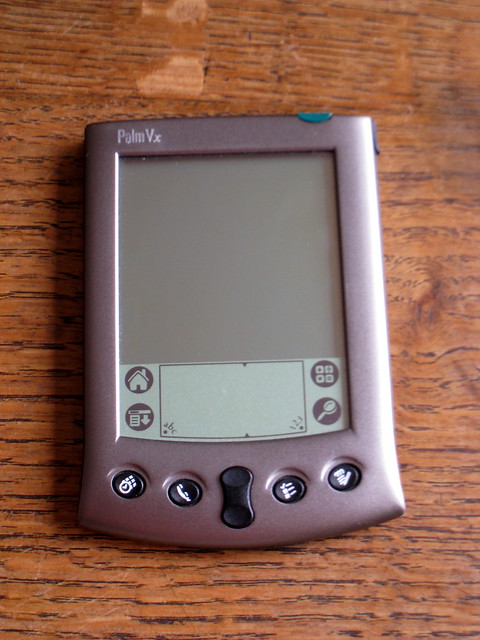
    Palm Vx
    The only device that was compatiable with my Mac was the Palm series of devices and flush with cash from my first year’s bonus. I got myself a Palm Vx from Expansys. In many respects despite its lack of an always-on wireless connection, the Palm Vx was the benchmark I have in mind when I look at smartphones.

    At its core the smartphone lives or dies by its personal information manager and its ability to sync with your computer for your contacts and calendar. When I used a Palm Vx, I never had the machine brick when I loaded too many contacts on to it, it never endlessly duplicated or corrupted contacts and it didn’t freak out when you scheduled events more than three months ahead.

    Unfortunately the same can’t be said for subsequent devices I owned including Palm’s Treo 600 and 650 phones, or the succession of Nokia devices I owned up until my E90 communicator gave up the ghost and went to the great Carphone Warehouse in the sky.

    The Vx was primitive, which was one of its main strengths:

    • Its screen which showed 16 types of grey was easy to view in direct sunlight
    • It’s electroluminescent backlight allowed you to view it in a darkened room and still have enough battery left to last you a week
    • It didn’t have an app store, but then there wasn’t any productivity sucking software and you could find new applications with your search engine of choice
    • It had to use a stylus for all but the most basic items on the resistive touchscreen, but Palm’s original single stroke handwriting called Graffiti once you got the hang of it is faster to use than the soft keyboard on my iPhone. Unfortunately a long-running patent dispute that went on until 2004 meant that Palm had to move to the inferior Graffiti 2 based on a product called Jot
    • It did allow you to sync your desktop PC’s inbox with your device so you could go through your email on the commute home, but you wouldn’t be bothered by the always connected aspects of push email. Push technology was a big thing then so if you got tired of clearing out your inbox you could read highlights from Wired.com or CNBC via the AvantGo service which sucked in content via your PC that you could then browse through offline at your leisure; in many respects an RSS reader before RSS became well-known
    • Location-based software before GPS was a subscription service called Vindigo that provided recommendations on restaurants, clubs and bars, and shopping. It also had maps that provided turn-by-turn instructions from a look-up table of  directions and was updated by syncing via serial port or USB connected cradle
    • Wireless connectivity was an IrDA infra-red port which was pathetic. I once tried to use it in conjunction with my Ericsson phone to surf the web but it was too much effort to keep both of them lined up. It was perfectly fine though for exchanging business cards electronically. I remember being at a Red Herring conference during the summer of 2000, demoing Palm devices and spent half the time beaming business cards with consultants and lawyers. It involved a curious ritual akin to an animal courtship display where two people would hold their devices in front of each other and move them closer or apart until their contact details had been exchanged. But it seemed to work better than any solution since. Moo cards are now my common currency of information exchange instead

    It was the industrial design of the Palm V and Vx that feels the most prescient parts of the product in many respects. Some of the decisions in this were forced on the designers by the hardware specifications. Palm used to use AAA batteries in their earlier devices and held the OS and resident apps in ROM. ROM was expensive at the time so the V and the Vx had everything in RAM which meant that there always needed to be a power supply which meant they had to use a lithium-ion battery. Since the battery wasn’t designed to be user serviceable the case was hot-glued together. This allowed the industrial designers to make the device much thinner so that it could be slipped into a set of jeans or a shirt pocket and weighed in at a paltry 114g, some 20g lighter than my iPhone without its case.

    The need for a ‘picture frame’ around the screen provided the designers with a way of making the device feel nicer in the hand by making it have rounded edges. It wasn’t that far off the iPhone in terms of size, but felt nicer to hold. When I first got my iPhone 3GS the device felt too wide in my hand. The product design encouraged premium brands like Burberry and Jean Paul Gaultier to make Palm V cases (which is a bit nicer than the silicone rubber jacket most people have on their iPhone. I used to have a slider case by a company called Rhinoskin made out of laser cut titanium plate that was indestructable.

    At the bottom of the Palm V and Vx was a connector that Palm continued to use on the M500-series devices. This connector meant that lots of companies made great accessories. A company called OmniSky sold a GSM modem that the PDA slotted into, ThinkOutside made the best folding keyboard I have ever used, again using the connector at the bottom to connect with the PDA. I once wrote a by-lined article on the train back from London to Liverpool without any at seat power and with both the keyboard and the Palm Vx slipping into my jacket pocket when I reached Liverpool Lime Street. Something I just couldn’t do with the iPhone due to its greedy battery life and the bulky keyboard accessories currently available.

    Looking back on it, the Palm Vx was the high point of of Palm the company. Missed technological opportunities, numerous management issues, poor quality product and software engineering together with wider market technological progress meant that the company and the PalmOS developer eco-system was a shadow of its former self by the the time the company was sold to HP.