Category: technology | 技術 | 기술 | テクノロジー

It’s hard to explain to someone who didn’t live through it how transformation technology has been. When I was a child a computer was something mysterious. My Dad has managed to work his way up from the shop floor of the shipyard where he worked and into the planning office.

One evening he broad home some computer paper. I was fascinated by the the way the paper hinged on perforations and had tear off side edges that allowed it to be pulled through the printer with plastic sprockets connecting through holes in the paper.

My Dad used to compile and print off work orders using an ICL mainframe computer that was timeshared by all the shipyards that were part of British Shipbuilders.

I used the paper for years for notes and my childhood drawings. It didn’t make me a computer whiz. I never had a computer when I was at school. My school didn’t have a computer lab. I got to use Windows machines a few times in a regional computer labs. I still use what I learned in Excel spreadsheets now.

My experience with computers started with work and eventually bought my own secondhand Mac. Cut and paste completely changed the way I wrote. I got to use internal email working for Corning and internet connectivity when I went to university. One of my friends had a CompuServe account and I was there when he first met his Mexican wife on an online chatroom, years before Tinder.

Leaving college I set up a Yahoo! email address. I only needed to check my email address once a week, which was fortunate as internet access was expensive. I used to go to Liverpool’s cyber cafe with a friend every Saturday and showed him how to use the internet. I would bring any messages that I needed to send pre-written on a floppy disk that also held my CV.

That is a world away from the technology we enjoy now, where we are enveloped by smartphones and constant connectivity. In some ways the rate of change feels as if it has slowed down compared to the last few decades.

  • Advertising isn’t the problem, telecoms are

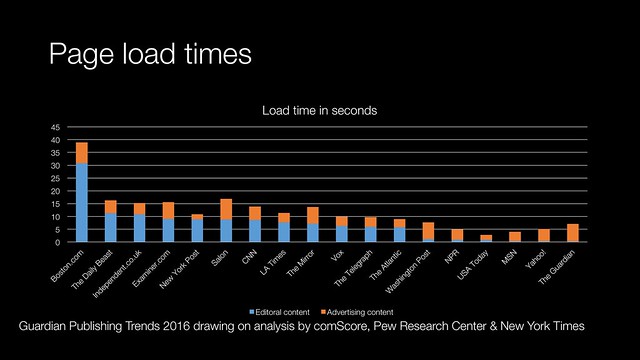
    Advertising isn’t the problem with ad blockers, at least not the sole problem. A few days ago I explained why I thought that tracking was the problem that ad blockers are designed to deal with. From a consumer point-of-view the time it takes to load a page is unacceptable for a significant minority of internet users.

    This comes at a time when mobile telecommunications services have become commoditised. For £29/month I get unlimited data, unlimited SMS texts, unlimited voice, free roaming across a number of countries around the world and 8GB of data when my phone is used as a modem for a laptop.

    So how could a mobile carrier upsell me? The answer lies in going back to the late 1990s. In the UK, there used to be a mobile carrier called one2one. The service provider had a poor network, but needed to engage with business users and tech forward consumers. They did this with series of tariffs under the Precept brand. These tariffs had a couple of differentiated services in common:

    • A shorter gap between replacement handsets
    • A priority and normal number, so that you could prioritise callers
    • Improved voice quality using a better Codec called Enhanced Full Rate or EFR

    Move forward the best part of two decades – handsets are now affordable to be purchased upfront for tech forward consumers, though Apple and Samsung looking to duplicate the car leasing model in the US. They are likely to roll it out internationally at some point.

    The equivalent of priority numbers is multiple identities or accounts, differentiation that steps out of the mobile provider remit and into services provided via applications, for instance multiple email addresses.

    Voice calls are becoming increasingly disinter-mediated through OTT messaging services.  But ad-blocking on the network level offer a clear analog to the deployment of EFR, providing faster page load times for web content.

    There are also benefits in terms of network utilisation and bandwidth capacity. This is especially important in countries like the UK where it is nigh on impossible to get planning permission for mobile masts due to consumer protests. But the most attractive part of ad blocking at the network is the product differentiation it affords mobile providers.

    More information

    Advertising isn’t the problem with ad-blockers | renaissance chambara
    UK Gov’t Launches Anti-Adblocking Initiative, Compares It To Piracy | Slashdot
    Three Group to tackle excessive and irrelevant mobile ads | Three UK media centre
    One 2 One offers free daytime calls and souped-up GSM | V3
    The UK’s £150m Mobile Infrastructure Project “not as successful as envisaged” | TelecomTV

  • Ad blockers

    If you work in the advertising or media sectors, the elephant in the room will be the problem ad blockers. Specially developed software designed to stop ad tracking and ad vending online.
    ad blocker
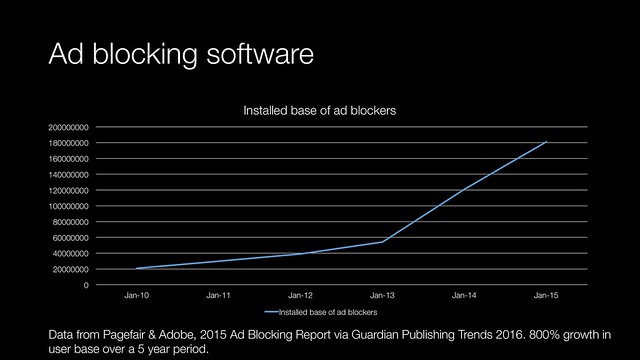
    Over five years from 2010 to 2015 the installed base of ad blockers has increased eight-fold. The root problem is a that of a poor web experience. It is a well known heuristic since the late 1990s that page load time and the likelihood of a consumer to click away to another page have inverse relationship with each other.
    page load times

    Can it be the ads themselves?

    Display ads have been around almost as long as the commercial web.

    Secondly, Google research found that 56.1 per cent of display ads vended in a trial were not viewable by the audience.

    But that number is a problem for advertising customers as they want to get greater efficiency and effectiveness in their marketing campaigns.

    Unilever’s CMO Keith Weed went on record last year demanding 100% viewability for digital advertising. In order to support this, there needs to be tracking technology deployed to monitor the advertising experience.

    This is on top of tracking technology that is used to conduct retargeting and aid programmatic selling of advertising. All of this slows page load times as information is conveyed to a plethora tracking servers, which then controls which ads are served.

    Retargeting is a tool that is particularly crudely used, audiences aren’t that impressed by brands stalking them throughout their online journey. More media related content can be found here.

    More information

    IAB: 100% Viewability of Digital Ads Is ‘Not Yet Possible’ | Advertising Age
    5 Factors of Display Visibility | Think With Google (US)
    The Future of Viewability | 360i
    CPM is dead: a guide to viewability in online advertising | Econsultancy GooglePlus account
    Measuring Ad Viewability | Think With Google
    Why viewability will become one of the key issues in digital advertising in 2016 | The Drum
    State of Viewability Transaction 2015 | iab
    Unilever’s Keith Weed: ‘Digital ads must be 100% viewable’ | Marketing Week
    Ad Blockers and the Next Chapter of the Internet | HBR – retargeting blamed (hat tip Daniel Appelquist)

  • AirBNB + more news

    Build them and they will come | The Economist – or how AirBnB doesn’t make much of a difference in London due to structural issues

    IBM’s Supercomputer is Controlling a Massive Virtual Reality Game, and They Need Beta Testers – In Brief This virtual reality game will be powered by cognitive computing and cloud technology. And they are seeking beta testers.

    Porn Industry Uses Airbnb, Rental Houses for Filming | NBC Southern California – Nearly four years after Los Angeles County passed new requirements for pornographic performers, the porn industry has spread to nearby counties like Ventura County and much of the filming is done via AirBnB. The irony of the gig economy supporting another gig economy business isn’t lost on me. More adult entertainment industry related posts here. I wouldn’t be surprised if film and TV didn’t follow suit for non-studio shoots

    WhatsApp to end support for BlackBerry, Nokia, and other older operating systems by the end of 2016 | VentureBeat | Mobile | by Paul Sawers – WhatsApp is to cease support for a number of operating systems by the end of 2016, the company announced yesterday. This is the point at which the old mobile eco-system finally handed over to Android and iOS

    Disney World and Disneyland Introduce Demand-Based Pricing | TIME – there is only so far that you can go with sophisticated queue engineering and Disney’s moves indicated that it has tapped out service design innovation

    Norway Becomes First NATO Country To Accuse China of Stealing Military Secrets – what’s interesting is why they’ve gone there.

    The art of wellbeing at work | McKinsey – modern technology apparently leaves us exhausted, eerily prescient when one things about Zoom and similar app adoption (PDF)

    Music’s Role In Digital Content Is Small And Shrinking | Music Industry Blog – and the music industry’s major labels only has itself to blame

  • MWC 2016 as a case study on talkability, brand mentions and brand performance

    Mobile World Congress (or in industry parlance MWC 2016) is where the telecoms industry goes to set out its stand. It has gradually changed from being a conference where the big issues of the day are hashed out, to more of a trade show a la CES or CeBIT.

    From a brand point of view, it was of interest to me for two reasons:

    • It offers largely culture neutral brand discussions, many of which occur online
    • I have an interest, having worked on a few mobile brands during my agency career (Palm, Ericsson, Verizon Wireless, Samsung, Qualcomm, Telenor Myanmar and Huawei)

    I pulled this slide ware together for a talk I am giving at an internal event at an agency.

    The first data that I have put together is looking at the amount of mentions that occurred regardless of the channel. It is a relatively easy data point to pull out of monitoring systems very quickly.

    Obviously the value of mentions will depend on how many people view them, what is the context that the mention appears in. What was the content around it? Who said it, are they expert or trustworthy? So looking purely at the number of mentions would be crude, offering little value apart from nice PowerPoint slides.

    Breaking the mentions down by platform gives an idea of relative marketing communications competencies of brands. So looking at Huawei and Xiaomi shows contrasting approach to building talkability and conversations. Huawei focuses on traditional media channels where as Xiaomi focuses on social.

    By comparison LG and Samsung seem to have a more holistic approach.

    I then moved on beyond the mention data to try and look at relative authority of whoever mentioned the brand and looking at the relative distribution by brand and channel.

    I had done some initial analysis on the event in general here. These numbers showed how well brands had built high authority communities and the discussions around them.

    What was quite surprising was the polarised authority of mainstream media sources. Newswire syndication had destroyed authority of many online traditional media channels. A second cross brand observation was the relatively low authority of the blogosphere.

    These slides only start to delve into understanding talkability and are time consuming to create in comparison to looking at raw mention numbers, but offer superior strategic insight for both earned and paid media approaches for future launches.

    I did some broad profiling of online conversations around MWC here.

  • Come to Singapore + more

    Come to Singapore

    Come to Singapore! The Sights (And Branding) Are Lovely | WIRED – it feels very Monocle-esque in terms of editorial style. Come to Singpore! is very different to the Conde Naste Traveller type editorial. Singapore is aiming at developing a start-up culture so targetingWired (US) readers make a good deal of sense. More Singapore related posts here.

    Decline of cyberspace

    William Gibson on the decline of cyberspace. It is fascinating in terms of how Gibson’s inspiration has evolved over time. He was reacting against genres that he didn’t want to write as much as ideas he wanted to convey. The ability to say no, is a very interesting creative process and it reminds me of an interview I saw with an Apple executive talking about why the iPod didn’t have an FM radio.

    Renault Alpine Vision

    Interesting to see Renault going back to Alpine’s sports roots with the Vision sports coupe. It is made to a similar formula to the original 1960s cars that made Alpine famous. A light, small car, a rear-mid engine placement with a highly tuned small capacity engine. Performance is viewed by the Alpine team in much more holistically with an equal focus on handling and breaking.

    Tesla Model X

    I am a sucker for well done manufacturing and process films. The first one up is from Tesla, highlighting robots working in a manufacturing cell on their X model vehicle. Tesla has had problems around areas like panel fit. I am not sure if they have resolved those quality issues, but robots should provide them with a very consistent process and higher throughput.