Category: wireless | 無線 |무선 네트워크 | 無線

This blog came out of the crater of the dot com bust and wireless growth. Wi-Fi was transforming the way we used the internet at home. I used to have my Mac next to my router on top of a cupboard that contained the house fuse panel and the telephone line. Many people had an internet room and used a desktop computer like a Mac Mini or an all-in-one computer like an iMac. Often this would be in the ‘den’ or the ‘man cave’. Going on the internet to email, send instant messages or surf the internet was something you did with intent.

Wi-Fi arrived alongside broadband connections and the dot com boom. Wi-Fi capable computers came in at a relatively low price point with the first Apple iBook. I had the second generation design at the end of 2001 and using the internet changed. Free Wi-Fi became a way to attract people to use a coffee shop, as a freelancer it affected where I did meetings and how I worked.

I was travelling more for work at the time. While I preferred the reliability of an ethernet connection, Wi-Fi would meet my needs just as well. UMTS or 3G wireless data plans were still relatively expensive and slow. I would eventually send low resolution pictures to Flickr and even write a blog post or two. But most of the time I used it to clear my email box, or use Google Maps if I was desperate.

4G wireless services, started to make mobile data a bit more useful, even if the telephony wasn’t great


  • Living with the iPhone 12 Pro Max

    iPhone 12 Pro Max transition

    I moved to an Apple iPhone 12 Pro Max from an Apple iPhone 11 Pro Max. That’s an important  factor to bear in mind when one sees phone comparisons. Secondly, I don’t earn my living doing phone reviews, so my reactions are likely to be less dramatic than a professional phone reviewer. Instead, I am trying to reflect a view of what its like to live with the device. 

    Smartphones overall

    You would have to look pretty hard to find a dreadful premium or mid-range smartphone nowadays. Some of the lower end Motorolas are sluggish performers, have the build quality of an early Samsung Galaxy and a mic that cuts in and out. But for the average iPhone user, a phone that is five years old is still a cracking phone, that could go another few years with a replacement battery. 

    The cameras are more than adequate for snapshots or document scanning, but no amount of software will make up for the quality of the lens in a smartphone versus a semi-professional photographers camera. And for most people, that’s enough. Performance has reduced to incremental improvements in real world performance. And in this respect smartphones mirror personal computers; as the huge perceived performance gains of the early computers flattened out. 

    I no longer need a Mophie Juice Pack case to make the iPhone last through a work day like I did with the iPhone 3GS. Although for long trips away from my desk, I still a power pack and a cable in my bag. This is as much about having the reassurance of knowing that I can run down my battery with lots of Maps usage if I have to, rather than a real need. Increased battery life is partly a function of screen size. The larger the screen, the larger the battery. Device screen sizes have grown over the years. Secondly, chip design and system software have focused on power consumption as part of a decade plus long focus on computing power per watt. 

    I still miss the keyboard and form-factor of my old Nokia E90; despite its flaky Symbian software. But I no longer miss its superior battery life, or the ability to remove the battery and replace it with fully charged spare. 

    Out of the box

    All of the iPhone 12 models come in smaller packaging than previous devices. The primary reason for this is Apple no longer supplies a USB charger. The excuse that Apple provided was that it was environmentally friendly. The problem with this is there are some awfully unsafe USB chargers available online as an alternative. The second thing that was missing from the box was a set of Apple wired earbuds. Again this was put down to being environmentally friendly by Apple. Though you could also come to two less flattering conclusions:

    • Apple is converting an insignificant amount of Android users, but only converting existing Apple iPhone customers. So headphones with a Lightning connector wasn’t needed and Apple could save on costs
    • It was a cynical ploy by Apple to drive AirPod wireless headphone sales even higher

    I can understand why Chinese netizens considered both moves to Apple shortchanging customers. I agree with them.

    China

    It is also interesting to note that all the main live-streaming platforms in China simultaneously decided to cancel live-streaming of the iPhone 12 series launch.

    Of course the Chinese government / Communist Party of China had nothing to do in coordinating this – honest….

    Handset design

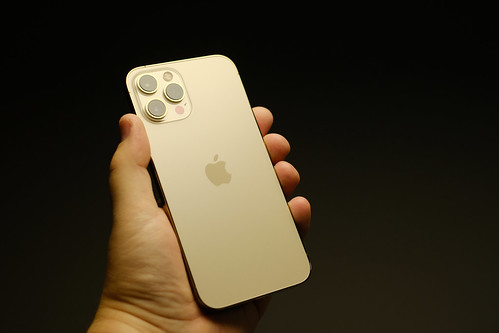
    When you take the iPhone 12 Pro Max handset out of the box, you immediately notice its size and weight.  It has steep stainless steel sides like an iPhone 4 on steroids. 

    Apple iPhone 12 Pro Max
    iPhone 12 Pro Max view from the back of the phone

    Usually the heft of a premium phone feels reassuring. But at first, holding the phone was a dissonant experience. There were a few reasons for this:

    The change in design language from smooth round edges on handsets from the iPhone 6 onwards, to a flat edge of the iPhone 4 and 5.

    It was the first time that an iPhone model has become thicker than the previous generation of iPhone.

    The change in design with its thicker flat sides has little difference in putting on a protective case, but removing the case is noticeably harder.

    After three days or so usage, the iPhone 12 felt perfectly normal as I got used to it.

    Camera

    As I said at the outset to this post, this like other modern premium smartphones, are good at taking snapshots. The main difference between my iPhone 11 Max Pro and iPhone 12 Max Pro was a slight increase in optical magnification. The rest of the mild photographic improvements were available in the iOS 14 software for both new and older iPhones.

    Networking

    The big selling point for Apple on the iPhone 12 Pro Max is its ability use 5G networks. The problem is that for consumers 5G doesn’t have a compelling killer application at the moment.

    In that respect, it reminds me a lot of my time working with Cap Gemini as a client when video calling and Quibi like sports and entertainment clips were thought to be the killer app for 3G.

    The reality is that it took wi-fi and 4G made video to make calls work, even then the product isn’t perfect. Shorter sellable video content is still looking for a market. 5G does have industrial niche market opportunities.  Secondly, 5G network rollout means that there will be probably three generations of future iPhones before the 5G wireless function becomes useful. I still live in a neighbourhood in central London where I often lose 4G coverage. 5G will require many more cell sites to provide the same level of coverage. 

    Cellphone reception seems to be better; I don’t know if this is down to the handset or my carrier building out their infrastructure further during the lockdown.

    My house has never had great cellphone reception during my time living here. It backs on to a railway line with overhead electrification and only had windows the side facing away from the railway. Yet I am now seeing two bars of signal in parts of the house where I previously would only have had Wi-Fi or a single bar of 3G. 

    Conclusion

    Unsurprisingly, the iPhone 12 Pro Max is an accomplished handset. It offers good battery life, responsive performance, a great screen, a good camera and is well made. But there is insufficient reason to upgrade if you have an iPhone made in the last three years. You already have a good well made phone. It has a good camera and will run the latest version of iOS.

    If your battery no longer holds the charge, the way it once did, Apple offers a service to replace the battery at a very reasonable cost.

    More design related posts here.

    More information and selected reviews

    iPhone 12 launching without earbuds or wall chargers is compared to eating without chopsticks in China | South China Morning Post 

    Shenzhen/Huawei: the other Bay Area | Financial TimesThe impression of military manoeuvres by alternative means was reinforced by Tencent, another Shenzhen resident. It was among big Chinese social and video platforms including iQiyi and Weibo, that simultaneously cancelled the livecast of Apple’s iPhone 12 launch

    Kibbles & Bytes #1122: Apple Releases Four iPhone 12 Models and the HomePod mini – Don nails the assessment of 5G in the latest edition of his newsletter.

    Daring Fireball: The iPhone 12 and iPhone 12 Pro – interesting thoughts on the iPhone 12s. What Gruber doesn’t touch on is the radio improvements, particularly in 4G

  • Private sector control + more things

    China’s Xi Ramps Up Control of Private Sector. ‘We Have No Choice but to Follow the Party.’ – WSJIn some cases, it is taking charge entirely of companies it regards as undisciplined, absorbing them into state-owned enterprises. – Push driven by a concern over the private sector business owners being unpredictable and not trusted. They think a centrally planned complex economy is the way forward; with the private sector playing a subservient role at best. This view has been strengthened by the state engineered swift recovery from COVID-19. I presume that they consider that China’s place in global supply chains, big data and machine learning will solve a lot of the problems that bedevilled previous centralised economic planning systems like what happened in the Soviet Union. More economics related content here.

    Party Committees See Rising Prevalence in Private Sector | Marco Polo – China clamping down on private sector

    Google AMP gets a shock to its system as advisor quits, lawsuit claims foul play • The Register 

    Quick Thoughts on the Russia Hack – Lawfare  – interesting post on the SolarWind hack based attacks

    North American Semiconductor Equipment Industry Posts November 2020 Billings – Semiconductor Digest – this looks good in terms of world economic growth

    China-Europe Trade Forum Canceled After China Sought to Bar Critics – WSJOfficials familiar with the exchange say the two people Beijing wanted to exclude from this year’s virtual event were Reinhard Bütikofer, the European Parliament’s chairman of the EU-China caucus who has publicly criticized Beijing over Hong Kong and its treatment of the Uighur minority; and Mikko Huotari, the head of Merics, a German think tank critical of the Chinese Communist Party. – China is depriving itself of unvarnished information about how it is viewed. A recipe for miscalculation in policymaking. Mainland Chinese contacts fail to understand why they don’t seem to have friendly relations with other nations anymore, despite Chinese achievements

    Huawei, 5G, and the Man Who Conquered Noise | WIRED – Steven Levy explains Erdal Arikan’s breakthrough in information theory well. What’s interesting is how the west has abandoned long term research projects. Arikan took 20 years for his breakthrough. In an American university you wouldn’t get, or maintain tenure doing that

    ‘Made in Hong Kong’ prestige provides springboard for retailers Watsons, Sa Sa to find success in Greater Bay Area | South China Morning Post‘Made in Hong Kong’ prestige provides springboard for retailers Watsons, Sa Sa to find success in Greater Bay Area. Well-known Hong Kong retailers are aggressively expanding in the bay area, where the prestige of their brands makes them a hit with mainland consumers. The city’s retail sector has been devastated by the coronavirus keeping deep-pocketed mainland tourists away – if true, I don’t seeing it being a defensible differentiation in the medium to long term

    MindGeek: the secretive owner of Pornhub and RedTube | Financial TimesPorn pioneered elements of the global online advertising industry such as targeted advertising, pay-per-click and email marketing and is today a substantial part of the internet economy

    Gen Z: the rising power in Chinese market and their 7 digital lifestyles – ChoZan – not the greatest guide to life stage trends in China

  • Hydrogen fuel cells + more news

    Hydrogen fuel cells

    Hyundai and Ineos team up to develop hydrogen future | CAR Magazine  BMW details fuel cell plans | EE News – I think that this move to hydrogen fuel cells makes more sense than lithium ion batteries. Hydrogen fuel cells are well understood, having been used by NASA during the Apollo space mission, the main challenge as been the cost of the cell. Hydrogen fuel cells don’t induce range anxiety and don’t have the environmental problems that you get recycling lithium ion batteries.

    Panasonic finally looks at European battery gigafactory – but this is happening with hydrogen fuel cells being in a more effective decision. Elon Musk is down on hydrogen fuel cells, but ignores the issues with lithium ion batteries compared to hydrogen fuel cells. Lithium ion batteries have their own dangers. Hydrogen fuel cells don’t have the same recycling issues that spent lithium ion batteries have. Given the strategic hold over lithium mining by China; hydrogen fuel cells offer a better option to reduce dependence. The hydrogen lobby does a better job to combat the Tesla showmanship.

    China

    EU braces for battle despite new faces in White House | Financial Times“ There will be a number of easy wins and enhanced co-operation on climate, the pandemic and remedying some of the offences of the past four years,” said Kristine Berzina, a senior fellow at the German Marshall Fund of the United States. “But there are real dangers that disagreements on issues like data privacy and digital taxation will make it more difficult to get agreements on other issues that are very important for both the US and Europe — particularly China

    Germany frets over its corporate dependency on China | Financial TimesRobust Chinese demand has helped Germany’s auto manufacturers and their suppliers to offset weaker European and US markets still afflicted by the pandemic. But it has also revived concerns that German industry is too dependent on China. And it has raised questions about whether Berlin will be willing to respond to growing pressure in the EU for a stronger line towards Beijing and to embrace a new transatlantic partnership on China under a Biden administration. – you can see this in the split between Merkel and her party over China engagement – Daimler, which has two large Chinese shareholders, sells nearly 30 per cent of its Mercedes cars in China. It accounts for about 11 per cent of group revenues. For several companies in the Dax 30 index, China represents at least a fifth of sales including BMW, chipmaker Infineon and plastics manufacturer Covestro. Likewise, Volkswagen is estimated to generate a similar proportion of its sales in the country last year, selling nearly 40 per cent of its vehicles there. All of this leaves you vulnerable to the Australian situation: China sends a message with Australian crackdown | Financial TimesThe message is clear. If your media is overly critical, if your think-tanks produce negative reports, if your MPs persist in criticism, if you probe Communist party influence in your community and politics and if you don’t allow Chinese state and private companies into your market, and so on, you will be vulnerable to Beijing’s retribution as well

    Red Convergence | China Media Project – media policy in China – with implications domestically and internationally. It outlines how the Chinese Communist Party intends to leverage transformations in global communication, both at home and abroad (though the latter is more implied), to sustain the regime and increase its influence internationally.

    Lessons from China’s decision to halt Ant Group’s giant IPO | Financial Times – interesting points from WeBank about a sweet spot from Rmb 8,000 – 200,000 were debtors do not have an incentive to run away or speculate. SMEs are focused on having a good credit record

    Q&A: Gareth Richardson – Western Brands No Longer Have an Easy Ride in Asia | Branding in Asia MagazineIn China, there’s no access to Google and Facebook but consumers are immersed in WeChat. This is a playground where western brands have no inherent advantage. In fact, many Chinese consumers don’t know or much care about where the brand originated (save for a few specific categories such as Infant Milk Powder). In western culture individuals are heroes and this is reflected in the approach to brand storytelling. However, in Asia, the culture is more collectivist and storytelling celebrates multiple heroes. Asian brands should celebrate their cultural values. Examples include brands built on traditional values of Asian hospitality, such as Mandarin Oriental. There’s a paradox though. Asian culture is collectivist and yet Asian businesses are very hierarchical. There’s often a significant power gap between the C-suite and the frontline staff. This makes branding more challenging to implement even when its value is properly understood by the leadership – this also happens within agencies. True story: I was asked to go and present to the Chinese subsidiary of a US multinational. The global digital lead had gone in there previously with the global client ambassador and made a mess that couldn’t be cleared up. Firstly, they hadn’t recognised the great firewall. Twitter doesn’t matter in China. Secondly, they thought that democratic political campaigning experience was an example of great marketing. At the time, the person who was the global data lead had also worked on the first Obama presidential campaign. All of them had come from a political background and were clueless about brand marketing. Finally, they’d unintentionally priced a measurement solution ludicrously low. It was a shit show. We had lost the client already, but the client lead had held out hope that hanging on in there churning out a monthly report with no actionable insight would somehow provide a way back in. But at least I got to Guangzhou for the first time.

    Consumer behaviour

    Right-wing populism with Chinese characteristics? Identity, otherness and global imaginaries in debating world politics online – Chenchen Zhang, 2020The past few years have seen an emerging discourse on Chinese social media that combines the claims, vocabulary and style of right-wing populisms in Europe and North America with previous forms of nationalism and racism in Chinese cyberspace. In other words, it provokes a similar hostility towards immigrants, Muslims, feminism, the so-called ‘liberal elites’ and progressive values in general. This article examines how, in debating global political events such as the European refugee crisis and the American presidential election, well-educated and well-informed Chinese Internet users appropriate the rhetoric of ‘Western-style’ right-wing populism to paradoxically criticise Western hegemony and discursively construct China’s ethno-racial and political identities. Through qualitative analysis of 1038 postings retrieved from a popular social media website, this research shows that by criticising Western ‘liberal elites’, the discourse constructs China’s ethno-racial identity against the ‘inferior’ non-Western other, exemplified by non-white immigrants and Muslims, with racial nationalism on the one hand; and formulates China’s political identity against the ‘declining’ Western other with realist authoritarianism on the other. The popular narratives of global order protest against Western hegemony while reinforcing a state-centric and hierarchical imaginary of global racial and civilisational order. We conclude by suggesting that the discourse embodies the logics of anti-Western Eurocentrism and anti-hegemonic hegemonies. – This is interesting especially when the Communist Party of China is adopting a more Han nationalist stance (and in some respects reaching back into historic integration of Mongol and Manchu rulers). Secondly, Communist Party academics and legal academics from Beijing University have been drawing heavily on the work of Carl Schmitt. As have far right organisations and Russian nationalists. Schmitt was Nazi Germany’s leading legal theorist. He was known to be hostile to parliamentary democracy and supported the power of an authoritarian leader to decide the law. Schmitt’s rejection of attempts to take politics out of the operation of the law or economic policy implementation – have appeals to diverse audiences.

    Design

    Top 3 reasons why Nokia N97 failed: The “iPhone killer” that actually killed Nokia – Gizchina.comNokia N97 has a slide-out design with a three-line QWERTY keyboard displayed below the display. That was an advantage at the time, but it was just another manifestation of Nokia’s outdated ideas. With the improvement of input methods, touch screen keyboards have become more accurate and soon eclipsed physical keyboards. – the keyboard was very poor compared to the Nokia E90 Communicator that I used to use. I also remember that the address book feature used to crash the phone if you loaded more than 999 contacts into it. Even their ‘E’ series business handsets like my E90 Communicator and the later E71 devices. I moved to the iPhone because I wanted an address book that worked. If the iPhone ever came in a Nokia Communicator type format, I would be ecstatic. More gadget related content here.

    Ideas

    I have been watching more David Hoffman films recently, looking back to the past to try and understand the present. What becomes apparent was that there was a schism of values in the late 1960s America. What’s less apparent was how, or even if; that schism was eventually healed.

    Online

    China tightens grip on booming livestreaming sector | Financial Times – this needs to be viewed in the wider aspect of reining in internet companies

    Style

    Good Collaborations Are Art, Great Ones Are Kitsch | Highsnobiety“You know it’s art when the check clears,” said Andy Warhol. With Roy Lichtenstein and Robert Indiana, Warhol made his way into museums by turning the mundane world into works of art by enriching it with pop references, connotations and associations. Warhol’s art is commercial and his commercials are art (a Warhol ad launched Absolut vodka in 1986)

    Technology

    A little automation goes a long way in distracting drivers | INPUT – technology creating more problems than it solves in the car driving experience.

  • M1 processor + more things

    Apple’s M1 ARM Pivot: A Step Into the Reality Distortion Field | Chips | TechNewsWorld – pretty much many of the points that I was thinking about. More here on the M1 Apple M1 Processor, Passing on the Chiplets | EE Times 

    BMW Unveils Anime-Like Electric Scooter Concept – Core77 – nice but I would still want Kenada’s bike

    The Biden team’s tug of war over Facebook – POLITICO – Facebook is the new Goldman Sachs….

    5G has been heralded as a tech game changer but consumers in China are underwhelmed by spotty coverage and hard sell | South China Morning Post 

    How to appeal to Gen Z in Asia | Vogue Business“Chinese luxury consumers’ offline and online lives are becoming increasingly intertwined,” says Mark Morris, Burberry’s senior vice president of digital commerce. “They are demanding a more seamless blend of content and capabilities across their two worlds.”  Working with local experts like Mr Bags and relatively lower-tier influencers (Ching has 6.6 million fans on Weibo, which is mid-range for a Chinese KOL) helped reach this level of engagement. “Gen Z wants to be approached in a narrow and deep, insightful way instead of using a mass approach with a big talent [and] hashtag ads,” says Rie Tanaka, senior business strategist and senior researcher at Japanese PR firm Dentsu

    Europe is ready for Biden to start, says E.U. foreign affairs chief Josep Borrell – The Washington PostWestern governments may have been “a bit naive” about Beijing’s manipulation of global trade rules – strategic reset inbound

    Five-Year Plan, 15-Year Vision by Geoff Yu, Bank of New York Mellonat the outset a new long-term objective for 2035 was established: China is expected to “largely realize socialist modernization” by that year. Specifically, this means achieving GDP per capita of a “moderately (or mid-level, depending on the translation) developed country”. Again, we underscore that the FYP itself does not contain a corresponding numerical target, but during his remarks at the plan’s launch, President Xi Jinping remarked that “it is fully possible for China to realize a doubling of the size of the national economy by 2035”. Assuming the doubling happens in real terms, this comes to around 4.7%y/y p.a. real GDP growth over the next 15 years (PDF)

    Micron Leapfrogs to 176-Layer 3D NAND Flash Memory | EE Times – everyone else is on 128 layers

    Japan gov’t may turn to YouTubers to promote ‘My Number’ ID cards – The MainichiTo publicize the system, the government has inserted advertisements in newspapers and used digital signage to stream commercials at stations and in the streets, among other methods. However, it has not received as many applications as anticipated, and now places a big hope on the YouTubers’ power to transmit information. The choice is also apparently because labor costs are not as high as appointing nationally popular actors, celebrities and other public figures. Moreover, the Japanese government, by eradicating its image of stubborn bureaucracy and having people watch videos on YouTube without reserve, aspires to remove anxiety and concerns about possible personal information leaks that accompany the My Number system – surprised that Japanese influencers would be that cheap relative to their reach. More on marketing here

    Resharing this as many people still don’t know about this old paper from Ogilvy on Facebook organic reach

  • Internet of Bodies

    Internet of bodies or IoB is a term that I first heard as The Internet of Bodies – a RAND Corporation report into internet connected devices that

    …monitor the human body and transmit the data collected via the internet. This development, which some have called the Internet of Bodies (IoB), includes an expanding array of devices that combine software, hardware, and communication capabilities to track personal health data, provide vital medical treatment, or enhance bodily comfort, function, health, or well-being.

    RAND Corporation
    The Internet of Bodies

    RAND Corporation were interested in the internet of bodies because of the complexity of the area. There are benefits which are well documented by others. However there are also ethical considerations around:

    • Data use by commercial organisations (advertising, health insurance, pharmaceutical industry)
    • Misleading product claims around product efficacy
    • Privacy risks
    • Data security risks
    • Underdeveloped and complex regulatory environment

    What the Internet of Bodies covers includes:

    • Fitness trackers
    • Fitness software running on smartwatches or smartphones and device sensors
    • Connected health devices: insulin pumps, pacemakers
    • Patient adherence apps on smartphones
    • Patient diaries about their condition

    The report came to a number of conclusions including:

    • As 5G, Wi-Fi 6, and satellite internet standards are rolled out, the US government conduct research projects to better understand any potential issues that might emerge
      There is a challenge that needs to be addressed to replace earlier generation devices and services with poor information security practices. The issue of cybersecurity needs to have more attention paid to it, right from the beginning of IoB product development
    • Device makers should test products and services for vulnerabilities often, and devise methods for users to patch software.
    • Data transparency and protection regulations need to be revisited to take account of materials received from the IoB
    • As with any new sector, a tighter regulation is required to prevent false or misleading product claims

    More jargon related posts here.