Month: April 2018

  • Erooms Law – jargon watch

    Erooms Law is a metaphor that compares other business processes to the virtuous circle of Moore’s Law. It is literally Moore’s Law in reverse. Industries have developed processes that are getting ever more expensive.  Once could consider that is inversely proportional to the way semiconductor manufacture  reduced the relative cost of computing power over time.

    Some see this as a potential opportunity for the use of computing in a sector to reduce costs. As with most circumstances, what seems like a great idea inside an Excel spreadsheet doesn’t work out in the real world. But that doesn’t stop the management consultants, investment bankers or venture capitalists from trying.

    Eroom’s Law and the pharmaceutical industry

    The poster child for Erooms Law cited would be the biotechnology and pharmaceutical industry developing new drugs.

    Here’s how Nature Reviews Drug Discovery put it:

    Eroom’s Law indicates that powerful forces have outweighed scientific, technical and managerial improvements over the past 60 years, and/or that some of the improvements have been less ‘improving’ than commonly thought. The more positive anyone is about the past several decades of progress, the more negative they should be about the strength of countervailing forces. If someone is optimistic about the prospects for R&D today, they presumably believe the countervailing forces — whatever they are — are starting to abate, or that there has been a sudden and unprecedented acceleration in scientific, technological or managerial progress that will soon become visible in new drug approvals.

    You could argue that the defence industry would also fall into this, despite the benefits of technology. (The origins of the semiconductor industry lie in the development of missiles during the cold war. Integrated circuit technology is more robust and lighter than discrete transistors or vacuum tube based systems).

    Other areas were Erooms Law is prevalent include fintech or financial technology and the automotive sector, where massive assumptions are made about the rate of innovation in battery technology based on Moore’s Law rather than the rather prosaic improvements in materials science that underpin existing battery chemistry.

    More information

    Diagnosing the decline in pharmaceutical R&D efficiency | Nature Reviews Drug Discovery (paywall)
    Eroom’s Law | In the Pipeline | Science magazine
    EROOM’s Law of Pharma R & D | buildingpharmabrands
    More posts on the pharmaceutical industry on this blog.

  • Discussion on voice interfaces and services

    Interesting discussion on the use of voice interfaces and services. There is a certain amount of cheerleading involved in the talk; but that is to be expected with vendors in the room. If found it interesting that one of the panelists; Sam Liang of AISense moved out of where2.0 services and into voice. because location is a great gateway to lots of rich contextual information and voice is desperately in need of context and by extension user intent.

    It is interesting to get a perspective on the organisations involved in the discussion on voice interfaces:

    • SRI International
    • Amazon
    • Microsoft
    • AISense

    All of them seem to be well behind where the telecoms voice services managed to get to like Orange’s Wildfire.

    Key takeouts from this:

    • 50,000,000 voice devices to ship this year (2018). A total installed user base of 100,000,000 (presumably excluding voice interfaces on smartphones)
    • AISense is looking to build in voice biometrics that would prompt you about who a person is. Privacy implications are profound
    • The panel struggled to articulate an answer to privacy concerns beyond ‘services need to build trust’ and transparency
    • Information security and hacking wasn’t a point of discussion; which surprised me a lot
    • Context still seems to be a huge issue, I think that this is a bigger issue than the panelists acknowledge. Google still struggles on user intent, without adding the additional layer of understanding voice. The biggest moves seem to be ‘social engineering’ hacks, rather than improvements in technology
    • Amazon and Microsoft don’t have plans for advertising services on voice (at the moment)
    • We’re very far away from general purpose voice services
    • Work has only started on trying to understand emotion
    More information
    • Orange’s Wildfire and The Register on its shutdown. Wildfire’s problem seemed to be a failure of marketing more than anything else. We haven’t seen anything else like it. Even Siri is only scraping over the ashes of the work done on Wildfire 15 years ago
    • Google’s published research on speech processing. What becomes apparent from looking at the list of research is how basic the current state-of-the-art currently is
    • Stuff that I have written that touch on context dependent services
  • Global Web Index + more news

    Global Web Index data on privacy

    1 in 4 Deeply Concerned About Online Privacy – GlobalWebIndex Blog – ok its Global Web Index so you have to take the data with a pinch of salt. Global Web Index is based on people completing online surveys. That means that the technique Global Web Index uses needs to be considered alongside the data. It isn’t observed behaviour, but reported behaviour. One might do one thing and say another. The extremely high rate of concern in Latin America in the Global Web Index survey could be a sampling error on the survey or it could be quite profound given that it would be a growth market for social media networks like Facebook

    Business

    WPP Appoints Independent Counsel to Investigate Allegations of ‘Personal Misconduct’ Against CEO Martin Sorrell – Adweek – by the sounds of it the share price drop was disproportionate to the size of misuse involved

    Marketing

    ANA finds only 36% of marketers say their influencer marketing is effective | The Drum – research says what people know but won’t talk about

    Not a simple process’: Marketers struggle to recruit in-house media talent – Digiday – what’s depressing about this is not the media side of things but is how screwed brand is with in-house marketers

    Media

    YouTube will now monetize on skipped ads | Digital | Campaign Asia – interesting how a brand marketing metric (CPM) is recharacterised as a ‘vanity measure’

    Online

    The death of the newsfeed — Benedict Evans – or why western social platforms may learn from WeChat’s user experience

    OPPO Digital – giving up making hi-fi and high end Blu-Ray players – a bit sad as OPPO made high-end headphones and arguably the best multi-region Blu-Ray players that money could buy

    Security

    Privacy fears over police spy tools that can break into mobile phones | News | The Times – The technology was first introduced by the Metropolitan Police for the London Olympics in 2012 and has been quietly rolled out. Privacy International’s report says police are operating without any clear legal framework and often break into phones belonging to people who have not been convicted of any crime, including witnesses and victims

    Technology

    Let’s take a moment to appreciate all the lies in Zuckerberg’s truths about Tim Cook and Apple – BGR – interesting tonality in this article which gives you an idea of the temperament vintage Microsoft enjoyed in the technology media. Expect Facebook to start emphasising their innovative nature soon…

    We put Huawei’s P20 triple-lens snapper through its paces • The Register – basically keep your old phone and download VSCO. Interesting a wider phone review wasn’t done. Says a lot about market saturation and performance differences per handset generation. More related content here.

  • Family & other things that made my day this week

    Untitled

    I spent a good deal of the week seeing the family. It was great to have homemade soda bread and finish off my Mum’s Christmas cake. Yes, you haven’t read that wrong, my Mum specialises in making rich fruit cakes for Christmas. They keep for a good few months afterwards.

    A good deal of that was spent watching Homeland and assorted  films with my Dad. This included Accident Man – a pretty accurate remake of the Toxic! comic book character from the early 1990s by Pat Mills (of 2000AD fame) and Tony Skinner. We didn’t watch them as a family for reasons that will become apparent.

    For a brief period from March to October 1991; the UK comic scene had a darker, more anarchic publication than had been previously seen. Toxic! was originally designed to address failings in 2000AD magazine.

    The film is so anachronistic in its nature that its audience will be niche. That doesn’t reflect on the quality of the action in the film. It features Ray Stevenson, Scott Adkins (you’d recognise hime host of Hong Kong and Hollywood movies) and Ray Park (who played Darth Maul). Adkins is a bit lean to play the titular character Mick Fallon, which is a surprise given his Boyka role in the Undisputed franchise. Adkins to his credit manages to make it all work.

    Both the director and the script writer managed to skilfully blend the unreconstructed misogyny of 1991 with with the great ‘unawoke’ attitudes of a post-Brexit Britain.

    Watching Wanted: Dead or Alive with Rutger Hauer shows how much the media portrayal of Islamic terrorism has changed over the past 30 years. The plot itself is a bit odd. Sex tape star Gene Simmons plays an Islamic terrorist looking to cause a Bhopal-type disaster as an act of revenge on the United States – where do you even start with that plot?

    Hauer’s car has an early generation cellular phone and what seems like some sort of satellite navigation equipment with a monochrome CRT display.

    Dated films weren’t the only things that I saw. The family car is still a Polo diesel that I helped them buy. Whilst I heard of a few people who had a Nissan Leaf; Merseyside is still firmly in the petroleum age. Most of the cars were a decade old on average and I didn’t see any obvious charging stations. Importation of secondhand cars from Japan is still a thing. Both J60 and J80 series Toyota Land Cruisers seem to have a loyal following.

    For something more recent and music-related, I can recommend this from Resident Advisor: How did UK garage become dubstep?

    I think that we must be pretty close to peak-vape. I was in a Wilkinsons store and wandered past the cough and cold medicine section. Wilkinsons is a discount retailer that does a mix of food cupboard staple grocers, household cleaning products and over the counter pharmacy products. A good analogue for Hong Kong readers would be 759 Store.

    On the top shelf of the unit above cough and cold remedies was vape fluid and e-cigarettes.

    Douglas Rushkoff | Present Shock Economies – great YouTube video which explains why Amazon is likely to be more trouble over time than Facebook ever will be. Well worth listening to during a lunch hour.

    Finally Asian Boss had some great vox pop interviews with Beijingers about what they thought of Sesame Credit which is a financial and behavioural credit system being rolled out in China.

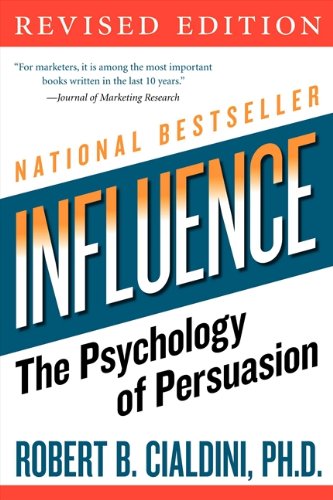
  • Influence – The Psychology of Persuasion by Robert M Cialdini

    Cialdini’s Influence is now over ten years old and still stands up. It is a good guide on the psychology of why people say “yes”. The accessible style of Influence reminded of Douglas Rushcoff, or Malcolm Gladwell. Ok Malcolm Gladwell is a poor analogy, Cialdini’s work isn’t candy floss for the mind. This is deceptive as there is usually an inverse relationship between value and accessibility. Exceptions to this heuristic would be the likes of Sun Tzu – The Art of War.

    Influence by Cialdini

    Cialdini hasn’t been researched within an inch of its life in the same way Byron Sharp’s books have been.

    Cialdini provides planners and strategists with starting points for customer experiences. The book isn’t a how to guide for digital journeys but provides first principles. Psychology is not channel-specific.

    The Journal of Marketing Research described it as

    …among the most important books written in the last 10 years.

    The book’s style allowed me to pick it up and put it down, to fit in with my holiday schedule of train travel and family time.

    Why should you have Cialdini’s Influence?

    • If your work includes marketing planning or strategy, your bookshelf should have this book. If you are thinking about customer interactions, this book outlines the first principles that you need
    • If you’re a consumer and want to know how you’re being sold to; read this book
    • If you want to get on better with people ( your kids or co-workers); buy this book

    My copy is well-thumbed and stuffed with post-it notes around the edges as I go back and forth into it on a regular basis. More marketing related content here.

    SaveSaveSaveSave

    SaveSave