My interest in business or commercial activity first started when a work friend of my Mum visited our family. She brought a book on commerce which is what business studies would have been called decades earlier. I read the book and that piqued my interest.
At the end of your third year in secondary school you are allowed to pick optional classes that you will take exams in. this is supposed to be something that you’re free to chose.
I was interested in business studies (partly because my friend Joe was doing it). But the school decided that they wanted me to do physics and chemistry instead and they did the same for my advanced level exams because I had done well in the normal level ones. School had a lot to answer for, but fortunately I managed to get back on track with college.
Eventually I finally managed to do pass a foundational course at night school whilst working in industry. I used that to then help me go and study for a degree in marketing.
I work in advertising now. And had previously worked in petrochemicals, plastics and optical fibre manfacture. All of which revolve around business. That’s why you find a business section here on my blog.
Business tends to cover a wide range of sectors that catch my eye over time. Business usually covers sectors that I don’t write about that much, but that have an outside impact on wider economics. So real estate would have been on my radar during the 2008 recession.
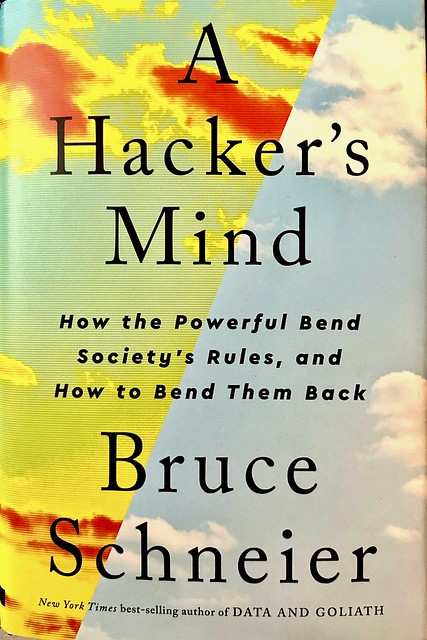
I eagerly anticipated reading A Hackers Mind, being a long-time follower of Bruce Schneier’s blog. A Hackers Mind caters to the well-informed individual. Schneier commences by defining what constitutes a hacker, delving into the essence of hacking and its widespread prevalence.
Subsequently, Schneier takes us on a journey into a hackers mind, guiding us through fundamental hacks targeting:
ATMs (automatic teller machines or cash machines)
Casinos
Airline frequent flier miles
Sports systems
Financial networks
The legal realm
Politics
Through these examples, Schneier aims to illustrate the parasitic nature of hacks on the systems they target, offering various techniques to impede or render them unfeasible. In doing so, he makes a broader socio-political statement about how the very foundation of the economy and society is continuously ‘hacked’.
The implication is that power lies in a hacker’s mind being applied to the systems that govern our lives. And that with the right mindset and ‘hack’ the ordinary person can turn the tables on those in power.
When this happens it makes great film or television. (A classic example of this would be ITV’s People vs. Post Office which told the story of postmasters combating wrongful prosecutions due to software defects. The reality was that in that particular case, it actually took the media coverage around the TV drama being shown to actually start moving the needle.)
Schneier in his book recognises that over time societies have evolved to become more equitable over time. He also attributes late stage capitalism to the hackers mindset, mixed with resources and technical capability in law or finance. The book is designed to wake the public up with a view to them also developing a A Hackers Mind and hacking the system back to equilibrium.
It’s an interesting light read, but I think VR pioneer and author Jaron Lanier writes better books focusing on the inequities inherent in the intersection of technology, culture and society. A great example of this is his book Who Owns The Future?
I don’t think Schneier gets close to inspiring his desired outcome with A Hacker’s Mind, but if you want something above the usual airport reading then it gets a thumps up from me, but it won’t be staying on my book shelf for me to re-read it at a later date. For more book reviews and recommendations go here. For recommendations of non-fiction books in particular go here.
Early last year, fashion started to pillage the late 1990s and early 2000s for fashion inspiration, which became a Y2K trend on social platforms and in the fashion media. But this divorced Y2K from its original meaning. Y2K was technologist short hand for a calendar problem in a lot of legacy systems that were designed around a two digit date for years.
The rise of micro-processors had meant that the world had more computers, but also more computer control of processes from manufacturing to building air conditioning systems.
The HBO documentary Time Bomb Y2K leaned into the American experience of Y2K in an Adam Curtis type archival view, but without his narrative.
Millennium layers
There was so much to unspin from the documentary, beyond the Y2K bug, including the largely alarmist commentary. The run-up to the millennium had so many layers that had nothing to do with Y2K, but were still deeply entwined with anxiety around what might happen with Y2K.
This included:
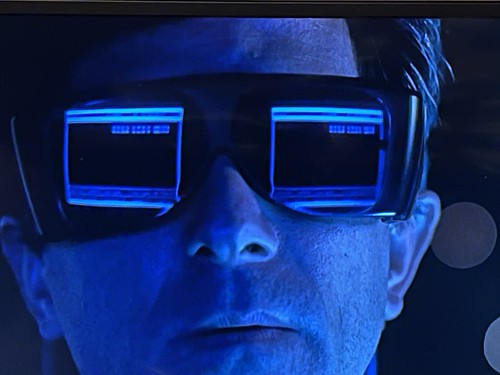
Internet adoption and more importantly the idea of internet connectedness on culture through the lens of cyberpunk – which in turn influenced the spangliness of fashion around this time and the preference for Oakley mirror shades that looked as if they were part of the wearer. The internet was as much a cultural construct and social object as it was a communications technology. It memed AND then got people online.
Telecommunications deregulation. In the United States the Telecommunications Act of 1996, saw a levelling playing field be set out and allow for new entrants across telecoms networks to television. They also defined ‘information services’ which internet platforms and apps fitted into giving them many freedoms and relatively few responsibilities. You had similar efforts at telecoms deregulation across what was then the EEC. This saw a rise in alternative carriers who then drove telecoms and data commuunications equipment sales, together with a flurry of fibre-optic cables being laid. There was a corresponding construction of data centres and ‘internet hotels‘ to provide data services. With these services came an expectation that the future was being made ‘real’. Which in turn fed into the internet itself as cultural phenomenon. The provision of new data centres, opportunities for computer-to-computer electronic data interchange (EDI) and services that can be delivered using a browser as interface also drove a massive change in business computing.
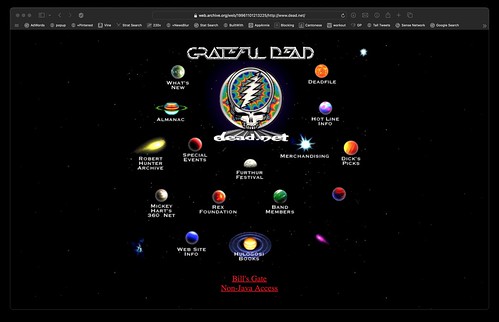
An echo boom of the hippy back to the land movement, many of the people involved in that movement were early netizens. Hippy favourites The Grateful Dead had been online since at least 1996 and were pioneers in the field of e-commerce. The Whole Earth ‘Lectronic Link (or The WeLL) had founders from hippy bible The Whole Earth Catalog. There was also a strong connection through Stewart Brand to Wired magazine. Long time ‘Dead lyricist Jon Perry Barlow created a Declaration of the Independence of Cyberspace – a libertarian totem for netizens up to the rise of social media platforms like Facebook.
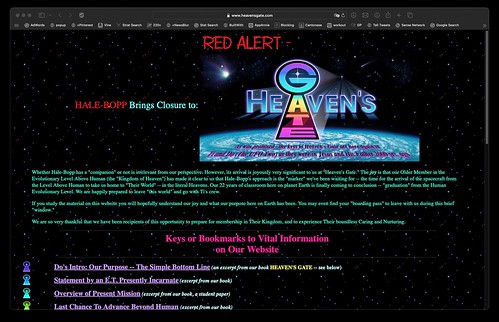
Millennial religious fervour. The Heaven’s Gate cult committed ritual suicide in 1997, and even posted about it on their website. The disastrous FBI showdown with the Branch Davidian cult in Waco, Texas had happened four years earlier and even today is a point of discussion amongst right-leaning Americans.
The confluence of noise around Y2K drove some anxiety and a lot of media chatter.
Advertisers did their bit to fuel insecurities as well.
However by October 1999, American consumers who responded to a poll by the Gallup Organisation were pretty confident that glitches would be unlikely
55% considered it unlikely ATMs would fail.
59% believed direct deposit processing wouldn’t be a problem.
60% said they felt that temporary loss of access to cash was unlikely.
60% believed credit-card systems were unlikely to fail.
66% felt that problems with check processing were unlikely.
70% had received Y2K-readiness information from their banks.
90% were confident their bank was ready for Y2K.
39% said they would definitely or probably keep extra cash on hand.
Y2K: More Signs of the Time | Computerworld (January 10, 2000)
Experts had felt that the Y2K challenge had largely been beat, but some prudent advice was given. I worked for a number of technology clients at the time including telecoms provider Ericsson and enterprise software company SSA Global Technologies. I had to keep my cellphone with me in case anything went wrong and we would have to go into crisis mode for our clients. Needless to say, I wasn’t disturbed during my night out at Cream by THAT call.
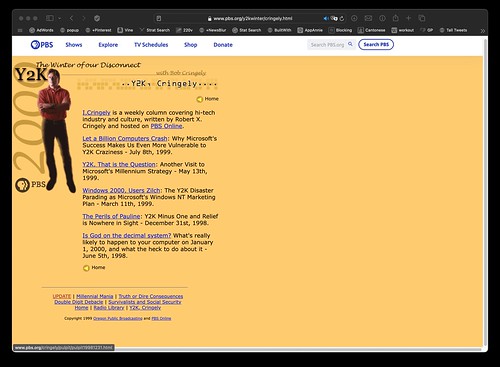
Technology experts like Robert X. Cringely were rolled out to advise consumers on prudent precautions. Have a bit of cash in your wallet in the unlikely event that card merchant services don’t work at your local shop. Have some provisions in that dont need refrigeration in case there is a power cut. And a battery or solar powered radio just in case.
All of these are still eminently sensible precautions for modern-day living.
Why were we ok?
The warning
There were several people who voiced warnings during the 1990s. Some of the most prominent were Ed Yourdon and Peter de Jager.
Risk management
During the 1990s company auditors were informing boards that they had to address Y2K. Failure to follow this would affect their ability to trade. Their public accounts wouldn’t be signed off and there would be implications for the validity the insurance policies need to run a business.
Approaches
IT professionals took Y2K very seriously, which meant that there was little to no impact. Some academics such as UCL’s Anthony Finkelstein posited that the problem was taken too seriously, though it is easier to say that in retrospect. There were a number of approaches taken to combat the risk of failure due to Y2K. In order of least to most ambitious they were:
Systems testing
Rip and replace
Recode
Systems testing
The Russian military had tested their systems for vulnerability to the millennium bug and announced this in the last quarter of 1999. Meanwhile businesses were often passing the testing out to contractors like Accenture with teams based in India, the former Soviet Union or the Philippines. There was a thriving market for auditing software to check if applications used two-digit dates or not. One of these was Peregrine Systems ServiceCenter 2000 Y2K Crisis Management software.
Testing highlighted problems at Oak Ridge Laboratories who process American nuclear weapons, the alarm systems at Japanese nuclear power stations and some kidney dialysis machines.
Problems would then be addressed by ripping and replacing the systems or recoding the software.
Rip and replace
Apple used Y2K as a sales tool to get Macs into businesses, including this campaign from early 1999 where the HAL computer from 2001: A Space Odyssey featured in Apple’s Super Bowl advert.
Two years earlier IBM CEO had the company re-orientate an offering that he called e-business. There was snazzy advertising campaigns ran over an eight year period.
Mainframes and high powered UNIX workstations became internet servers running multiple instances of Linux. IBM Consulting learned as they went building the likes of internet retailer Boxman (which would go bust due to IBM’s cack-handed software and the rise of Amazon).
Timely replacement of business systems with e-business systems, paired with new personal computers like the latest Apple Mac allowed the firm to avoid Y2K and make speedier approaches in digitising their businesses.
German enterprise software company SAP launched SAP Business Connector in association with webMethods in 1999, this provided an integration and migration layer for SAP and other business software applications. It also allowed the business software to be accessed using a web browser and for it to trigger business processes like email updates.
Articles (like Robertson & Powell) highlighted the wider business process benefits that could be generated as part of a move to rip-and-replace existing systems with ones that are Y2K compliant. Reducing the amount of systems in place through rationalisation as part of Y2K preparation would then provide benefits in terms of training and expertise required.
Recode
Where rip and replace wasn’t an option due to cost, complexity or mission criticality recoding was looked at as an approach. For PC networks there were a few off the shelf packages to deal with low level BIOS issues
IntelliFIX 2000 by Intelliquis International, Inc. Their product would check hardware, DOS operating system, and software. This version was free and ran a pass/fail test. The full version, which could be purchased for $79, would report the issues and permanently correct date problems with the BIOS and the CMOS real-time clock. In 1999, Stewart Cheifet of the Computer Chronicles rated the product as a very good all-in-one solution for hardware and software.
National Museum of American History: Y2K collection
Products similar to IntelliFIX included Catch/21 by TSR Inc.
Longtime software makers like Computer Associates and IBM provided large companies with tools to audit their existing code base and repair them. IBM’s software charged $1.25 per line inspected. OpenText estimate that there 800 billion lines of COBOL language code out there. So having one of these tools could be very lucrative at the time.
You might have mainframe code on a system that might not have been altered since the 1970s or earlier. Programmers in the developed world who had skills in legacy languages were looking at the end of their career as more of this work had been outsourced to Indian software factories saw Y2K as a last hurrah.
COBOL is still very robust and runs business processes very fast, so is maintained around the world today.
Y2K impact
Professor Martyn Thomas in a keynote speech given in 2017 documented a number of errors that occurred. From credit card reading failures and process shut downs to of false positive medical test results across the world. But by and large the world carried on as normal.
Academic research (Anderson, Banker et al) suggests that the most entrepreneurially competitive companies leaned hard into the Y2K focus on IT and used the resources spent to transform their IT infrastructure and software. Garcia and Wingender showed that these competitive returns were shown to provide a benefit to publicly listed company stock prices at the time.
There were also some allegations that software companies and consultants over-egged the risks. Hindsight provides 20:20 vision.
IT spending dropped dramatically during 2001 and 2002, and by the middle of 2003 technology started to see replacement of software and equipment bought to address Y2K. But the US department of commerce claimed that was no more than a transient effect on economic growth. This was supported by the Kliesen paper in 2003, which posited that the boom and subsequent economic bust was not as a result of Y2K preparation.
The train of thought to this post about Hong Kong measurements started with a friend’s class learning do-it-yourself skills. I had rented an apartment when I lived in the city and had no need to do home repairs myself. I wondered past hardware stores, saw metric drill bits and rules.
Metric
My supermarket-bought groceries had their measurements on in metric. Hong Kong measurements go back to history and culture. I knew more about traditional measurements from traditional Chinese medicine shops and period Hong Kong cinema than the local ‘wet’ markets.
I didn’t drive, but the speed limits were all in Km/H like Ireland. Pedestrian signs for the most part didn’t need distances because everything is so compact and the public transport so good.
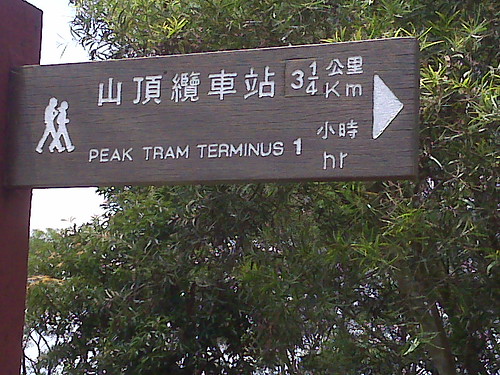
If I had driven, I would have seen distances in kilometres on the expressway. In fact, the only time I can remember using distances on pedestrian signs were on hikes like this one below, with distances in kilometres and approximate time that the walk should take.
What became apparent in my discussion that that Hong Kong measurements are more complex than would appear at a cursory glance.
Inches and pints
The method of instruction in the do-it-yourself was predominantly imperial measures with a metric equivalent being secondary. Timber could still be provided in 2×4 inch planks. Both imperial and metric drill bits were available to buy.
You could order a pint, though like many other countries, you will be served a 1/2 litre glass in most bars.
The laws governing weights and measures in trade is covered by the Weights and Measures Ordinance. This was drafted in 1988, came into force in 1989 and has been amended for formatting since. The related Weights and Measures Order of 2021 added US units were different alongside imperial measures, metric and traditional Chinese measurements. Though this seemed to be for reference, rather than encouraging the active use of American measures in Hong Kong. American products usually come with the equivalent metric sizing for items like drinks cans volume.
Taels and Cattis
Hong Kong uses Chinese traditional measures alongside more standard measures in certain markets – from fresh produce bought in the ‘wet’ markets to sales of gold and silver.
Before I had got to Hong Kong I had hear of taels and cattis. Taels is the traditional unit by which gold (and silver) had been sold amongst the wider Chinese community from Liverpool to Shanghai. If you’ve sat through enough old kung fu movies, you will have heard of a bounty or reward to be paid in taels.
However like other pre-Metric weights like hundredweights and tons; taels and cattis now mean different dimensions in different markets.
Hong Kong hews to the traditional weights and measures for this. Taiwan’s taels and cattis are more related to the measures of the Imperial Japanese empire. Taiwan may even refer to taels and cattis using different words. Mainland China went through a period of simplification during communist rule from Chinese characters to measures. Their taels and cattis are more aligned to metric measures.
Singapore struck much more closely to the metric system which it has adopted from 1968 – 1970. While traditional measures are included in the statutes for reference and fabric discussions still happen in terms of square yards, you will be charged for the metric measure. This was because post-independence Singapore had to make its own way in the world without the mother country of empire. China was closed off at the time and the city state had to think of its place in terms of global scale.
So why is this all important?
Measurements are essential to our points of reference in everyday life. The variance of points of reference can affect perceptions around attributes like value for money, or whether something is big or small. It affects how we think about tasks to be done or distances to be walked and things to be carried.
It can be a ‘grain of sand’ in the shoe level of dissonance, familiar, yet different. Rather like the average European pondering the American distance definition of ‘a block’. Our cities aren’t built on grid systems for the most part, so we don’t have the same feel for the measure. Speaking to a New Yorker friend; a block was considered by them to about a tenth of a mile. BUT, different cities have different sized blocks and it isn’t a formal definition. It’s a quintessential American cultural artifact and yet very inexact.
For a business there are additional factors to consider
Complexity of regulations.
Additional complexity in terms of product instructions.
Descriptive copywriting and advertising claims.
Pricing strategies and arbitrage opportunities. For instance, while Hong Kong gold might be duty free – does the differing weight from one’s home affect price considerations?
While Hong Kong is being reintegrated back into mainland China, even apparently small issues like measurement units could become political in nature.
As they are product of a unique history and emergent culture not shared with the mainland, rather like modern Hong Kong Cantonese. The Cantonese language evolved from being similar to that spoke in Guangdong province in the early 1960s to develop its own Hong Kong-specific idioms, lone words (from English, Japanese and South Asian languages spoken in the territory by minorities). Now with the increasing influx of mainland immigrants there is use of mandarin code switching added into the mix.
The use of multiple measures allows Hong Kongers and their businesses to be commercial ‘citizens of the world’ in their transactions. Hong Kongers have also taken these measures abroad. Going to a China town jeweller or pawn shop will allow you to buy gold taels, even though the weight on your receipt might be in troy ounces or grams.
Alongside Hong Kong-specific cuisine, the unique mix of measurement units may be its unique informal contribution to the world alongside archive films, long after the city becomes just another city in China.
Technonationalism as a term has started to spring up in Chinese policy discussions regarding technology trade with the US and China.
Technonationalism origins
Technonationalism is a term used by economist Robert Reich in 1987 to describe the relationship between technology and national security. Reich used the term in an article that he wrote for The Atlantic. It originally referred to the intervention of the Reagan administration in the United States to prevent the acquisition of Fairchild Semiconductor by Japan’s Fujitsu. Reich felt that the Reagan administration mis-understood the the technology problems faced by the US and blocking the Fujitsu-Fairchild deal was the wrong thing to do.
Elkor Labs photo of Fairchild Semiconductor exhibition stand.
The China effect
In English language usage, it started to be mentioned in publications as far back as 1969 and seems to have had two distinct peaks. The first was from the Brezhnev-era Soviet Union through to 1990. The second peak coincides with China’s rise.
From a Chinese perspective, strategic conflicts between major powers have revitalised the concept in the international political arena. Of course, this ignores China’s own actions and their perceptions by other countries:
Chinese government policies to promote economic independence and induce strategic dependence of other states across all infrastructure technologies – or as the FT calls it ‘Fortress China‘
Today, the competition between China and western democracies is focused on critical materials like pharmaceuticals and a range of strategically important advanced technologies.
These sectors include:
Electric vehicles (or as they are called in China new energy vehicles)
Drones, virtual reality,
Various type of machine learning ‘artificial intelligence’
Big data and data mining
Robotics and automation
5G networks
The Internet of Things (IoT),
Synthetic biology
This conflict is considered more severe than the US – Japanese semiconductor trade friction of the 1980s. But Japan and the US were largely aligned from a political, defence and economic perspectives during this time.
The technology related to disputed sectors are seen as key to the next generation of defense systems, industrial capabilities and information power China and western democracies.
Neo-liberalism & technonationalism
This implies that economics is an extension of defence rather than completely separate, as implied by the western neo-liberal laissez-faire approach to globalisation. This places company leadership dead set against the wider interest of their own western countries. During the cold war with the Soviet bloc western companies were much better aligned with their country’s interests.
Palmer Luckey’s Anduril represents a notable exception in Silicon Valley and its attitude is remarkably different to the likes of Apple or Microsoft.
Post-war Asian miracle model
While technonationalism as a term was given voice in the mid-1980s, one could consider the directed economy efforts by the likes of MITI in Japan and its counterparts in Taiwan and South Korea as being technonationalist in nature.
From this perspective, technonationalism played a crucial role in post-World War II economic and industrial policies, fostering domestic industries, promoting scientific and technological innovation. These polices propelled Japan to become a global technological power. Korea took a similar tack with Park Chung Hee’s compact with the chaebols and the Taiwan government was crucial in the roots of Taiwan’s dominance in semiconductors.
Back to the present
The current increase in technonationalism by China and western democracies means that international trade in many fields will continue to change due to national security concerns evolve. This is often masked in language such as de-risking, de-coupling and de-globalisation.
The racket sport padel seems to have got the zeitgeist, if not the player numbers yet. We haven’t really seen a surge in sports fads since the 1980s. During that time skateboarding rose from a peak in the late 1970s, to a more stable underground sport that we have today. The closure of a squash racquet factory in Cambridge, saw the sport globalise manufacture and playing. In a few short years rackets went from gut strings and ash wood frames to synthetic strings and carbon fibre composite rackets. It was as much a symbol of the striving business man as the Filofax or the golf bag. Interest was attracted by a large amount of courts and racket technology that greatly improved the game.
Squash had its origins in the late 19th century and took the best part of a century to reach its acme in the cultural zeitgeist. Skateboarding started in the late 1940s and took a mere 30 years to breakout. Padel falls somewhere between the two. Padel was invented in 1969. But it took COVID-19 to drive its popularity in Europe and North America.
There is a new world professional competition circuit for 2024. And it has attracted the interest of court developers looking to cater to what they believe is latent consumer demand.
Finally, you can get three padel courts in the space for one tennis court. More on the padel gold rush from the FT.
The challenge is if padel is just a fad, or has it longevity? Skateboarding is popular, but many councils didn’t see the benefit of supporting skate parks built in the 1970s around the country. Squash still has its fans but doesn’t have the same popularity that it enjoyed in the 1980s.
What’s it like being a Disney adult? – The Face – this is much more common in Hong Kong, but then people had annual passes to go there. I found it interesting that The Face othered it as a sub-culture
Vittles Reviews: There Is Always Another Province – Province-chasing isn’t just a Western phenomenon; China is still so vast that when the barbecued food of Xinjiang, one of China’s border provinces, showed up in a former sausage shop on Walworth Road at Lao Dao, it didn’t need to open to the general public for months, choosing only to take bookings via Chinese social media. The paradox is that the success of regional Chinese restaurants has created a Western audience which wants more, but that same success has allowed these restaurants to bypass those customers altogether
Culture
Television: one of the most audacious pranks in history was hidden in a hit TV show for years. – Watch enough episodes of Melrose Place and you’ll notice other very odd props and set design all over the show. A pool float in the shape of a sperm about to fertilize an egg. A golf trophy that appears to have testicles. Furniture designed to look like an endangered spotted owl. It turns out all of these objects, and more than 100 others, were designed by an artist collective called the GALA Committee. For three years, as the denizens of the Melrose Place apartment complex loved, lost, and betrayed one another, the GALA Committee smuggled subversive leftist art onto the set, experimenting with the relationship between art, artist, and spectator. The collective hid its work in plain sight and operated in secrecy. Outside of a select few insiders, no one—including Aaron Spelling, Melrose’s legendary executive producer—knew what it was doing. The project was called In the Name of the Place. It ended in 1997. Or, perhaps, since the episodes are streamable, it never ended
Rode acquire Mackie | Sound On Sound – this is big for podcasters, but also for artists that record in their own studios. Mackie mixers have powered the home grown set-ups of artists like The Prodigy, The Crystal Method, Brian Eno, Daft Punk and Orbital.
Health
China e-cigarette titan behind ‘Elf Bar’ floods the US with illegal vapes | Reuters – In the United States, the firm simply ignored regulations on new products and capitalized on poor enforcement. It has flooded the U.S. market with flavored vapes that have been among the best-selling U.S. brands, including Elf Bar, EBDesign and Lost Mary. In the United Kingdom, by contrast, Zhang has complied with regulations requiring lower nicotine levels and government registration while building an unmatched distribution network — and driving a surge in youth vaping
Hong Kong’s first ‘patriots-only’ district council poll reflects political tale of two cities, as some eagerly rush to vote and others shy away | South China Morning Post – Hong Kong on election day splits into two camps, with one eager to vote out of civic duty and others giving polling stations wide berth over lack of political diversity. ‘I thought more people would come and vote because there has been more publicity,’ one elector says after discovering sleepy atmosphere at local polling station – the question is will Beijing take anything from this voter turn out? Does it signal suppressed but indignant separatists, or Hong Kongers who are more focused on prosperity and weekend Netflix? If they suspect the former then the security situation is likely to get more dire
Inside Louis Vuitton’s Hong Kong spectacle | Vogue Business – While Hong Kong is gradually recovering from the pandemic lockdowns, growth in Mainland China is slowing. According to HSBC estimates, luxury sales there are expected to grow 5 per cent in 2024, a sharp deceleration compared with 2023’s projected 18 per cent.