Category: china | 中國 | 중국 | 中華

Ni hao – this category features any blog posts that relate to the People’s Republic of China, the Chinese communist party, Chinese citizens, consumer behaviour, business, and Chinese business abroad.

It is likely the post will also in other categories too.  For example a post about Tong Ren Tang might end up in the business section as well. Inevitably everything is inherently political in nature. At the moment, I don’t take suggestions for subject areas or comments on content for this category, it just isn’t worth the hassle.

Why have posts on China? I have been involved in projects there and had Chinese clients. China has some interesting things happening in art, advertising, architecture, design and manufacturing. I have managed to experience some great and not so great aspects of the country and its businesses.

Opinions have been managed by the omnipresent party and this has affected consumer behaviour. Lotte was boycotted and harassed out of the country. Toyota and Honda cars occasionally go through damage by consumer action during particularly high tensions with Japan.

I put stuff here to allow readers to make up their own  minds about the PRC. The size of the place makes things complicated and the only constants are change, death, taxes and the party. Things get even more complicated on the global stage.

The unique nature of the Chinese internet and sheltered business sectors means that interesting Galapagos syndrome type things happen.

I have separate sections for Taiwan and Hong Kong, for posts that are specific to them.

  • Dieter Rams handbag + more things

    Buy it now: the Dieter Rams handbag – DisneyRollerGirl – the Dieter Rams handbag reminds me of the kind of thing that would appeal to Chinese millennial luxury buyers. They’ve increased their luxury consumption sophistication in leaps and bounds

    Perspectives on Encryption and Surveillance – Lawfare – great set of essays on the interface of cryptography, privacy and the law

    Autonomous Vehicle Navigation in Rural Environments without Detailed Prior Maps by Ort, Paul and Rus – interesting work being done by MIT and Toyota

    Starwood Reservation Database Security Incident – name, mailing address, phone number, email address, passport number, Starwood Preferred Guest (“SPG”) account information, date of birth, gender, arrival and departure information, reservation date, and communication preferences. For some, the information also includes payment card numbers and payment card expiration dates, but the payment card numbers were encrypted using Advanced Encryption Standard encryption (AES-128). There are two components needed to decrypt the payment card numbers, and at this point, Marriott has not been able to rule out the possibility that both were taken – oh Lordy!

    Time to step away from the ‘bright, shiny things’? Towards a sustainable model of journalism innovation in an era of perpetual change | Reuters Institute for the Study of Journalism – to be fair the same is true across marketing and advertising and client boards that have been seduced by the same management consultancy bullshit about disruption for far too long

    China unveils first satellite that offers free Wi-Fi to entire world | Video | SupChina – Oh really?

    South Korea Charges 11 With Selling Samsung Technology to China – Bloomberg – Samsung spent about 150 billion won over a period of six years to develop the OLED technology that is now considered highly-classified national knowledge (paywall) – US is the least of Chinese worries if they can get other countries China has been stealing stuff from to take action like Germany, France, Italy, Japan and South Korea

    Why is Huawei Out in the Cold? | China Media Project – ignore the mock surprise at Jack Ma being a communist party member and reflect on the  interesting analysis of the Chinese Communist Party’s reform and opening 40th anniversary celebration

    How Amazon Now Shapes What Our Stuff Looks Like | Gizmodo – how e-tailing is affecting FMCG packaging design

    The Next Great (Digital) Extinction | WIRED – how counterculture met digital and failed to meet its full potential

    Jane Wong explains why she uncovers hidden app features that tech giants like Facebook want to keep secret | South China Morning Post – great read, particularly her comments on WeChat

    How Cheap Labor Drives China’s A.I. Ambitions – The New York Times – manually writing rules is more like prior efforts at AI than the kind of machine learning advocated at the moment, but that doesn’t mean that the Chinese won’t have their successes

    Luxury goods group Kering steps up digital strategy with new Apple deals – Reuters – interesting apparent role for Apple in this

    In China’s hinterland, car market growth engine sputters – Reuters – a mix of consumer credit squeeze, move out of legacy industries, healthcare costs and inflation affecting car buyers in lower tier cities
  • Naomi Wu & things from last week

    Naomi Wu on the nascent open source culture developing in China. It isn’t just about China taking anymore but contributing. Ironically, China’s large corporates have now tried to start building intellectual property as a weapon cough, cough Huawei.

    Huawei historically leached off the open source community for software and spent a good deal of time justifying why they didn’t contribute to the open source software projects that they so heavily used. It also had a reputation of intellectual property theft, that was allowed to happen unchecked. Naomi Wu, based in Shenzhen, has been doing a lot of work to educate her peers on open source. More related content here.

    Ari Saal Forman’s Menthol 10s took a swipe at corporate culture and big tobacco. Some background for you. Menthol cigarettes were the only flavoured tobacco products allowed in the US. The government banned other flavours. Menthol cigarettes were disproportionately popular with American people of colour.

    Nike didn’t see the social purpose in the message behind the design. In this interview with Vice, Ari Saal Forman tells

    The ambiguous nature of the male host business in Japan is highlighted in this interview. Hosts can be extremely well paid and the roles are very competitive.

    The needs of their clients are surprisingly modest. The client interview section is insane, an 18 year old having $100,000 to spend on drinks in a nightclub – for some people the bubble economy years of late 1980s Japan has never gone away.

    A people’s history of computing in the US. The presenter talks about the early experiences of personal computing and programming languages like BASIC. It is interesting hearing a programmer talk about their ambiguous relationship with BASIC when they went into a professional career of programming.

    It’s the time of the year when 2019 consumer trends are trotted out.  JWT(WundermanThompson) have 100 trends. Trendwatching thankfully have just five.

  • 2018 Chinese consumers insights + more

    Who is winning more 2018 Chinese Consumers? – Global site – Kantar Worldpanel – top line is that western FMCG brands are growing 2018 China consumers market share at a slower rate than their local competitors. Any of them that banging on about 2018 Chinese consumers as a strategic market long term have another think coming. Expect these Chinese brands to go after emerging markets in Southeast Asia and Africa later on. More on consumer behaviour here.

    Facebook, Google, Amazon, and the Collapse of the Tech Mythology – The Atlantic – opportunity for public affairs and public relations industries

    Chart: Is TV’s Reign Nearing Its End? | Statista – the conclusion on this is a bit off base. What is TV? Is it the TV set, is it broadcast infrastructure or is it passive content consumption. IPTV is an extension of TV rather than something new. Is there really that much difference between Amazon Prime and cable TV or nowTV. Is Netflix that much different to HBO? Broadcast networks (terrestrial and satellite) cover more of the population in most western countries than mobile networks, or wired broadband. The technology moves a lot slower which makes have a TV that will last a decade or more an attractive proposition. By comparison my parents have an iPad that is six years old and Apple no longer supports

    Cognitive Training Does Not Enhance General Cognition: Trends in Cognitive Sciences – bang goes a parents excuse for more gaming

    Two great articles on the Dolce & Gabbana Chinese adverts and how it all blew up

    LinkedIn cuts off email address exports with new privacy setting | TechCrunch – interesting move. Especially given that LinkedIn had complained about Facebook doing a similar tactic. Web 2.0 data portability is dead and buried according to LinkedIn. The fit with Microsoft becomes apparent.

  • Walter Cronkite & things from last week

    US newsreader Walter Cronkite narrates a 1967 programme on what the future held in the 21st century. The soothing voice of Walter Cronkite makes the future look less scary

    An Unknown Enemy is a Mexican series on Amazon Prime that follows the rise of Fernando Barrientos, Head of the National Security Directorate, Mexico’s Secret Police in the late 1960s

    Panasonic helps workers create their own head space with new crowdfunded device | The Japan Times – the design looks hokey, but it mirrors the transformation of offices with hot desking and always on headphone culture to try and provide distance. More design related content here.

    The People’s Republic of Desire documents China’s online streaming culture that has developed over the past few years. The film financed by the Ford Foundation provides an inside view of the direction interaction between personalities and their audience. Young girls become online personalities funded directly by besotted fans. More interaction happens online than in real life. Of course, all this happens under the ever-seeing eye of the Chinese government.

    https://youtu.be/auHtqCJV4Rw

    Super-excited by an album of Smith & Mighty’s unreleased back catalogue from 1988 – 1994 being released this week. It is available via digital channels, double vinyl album and on compact disc. While the tracks were unreleased, there is no filler tracks in the collection, the quality is all top notch. Here is a taster.

    Have a great weekend.

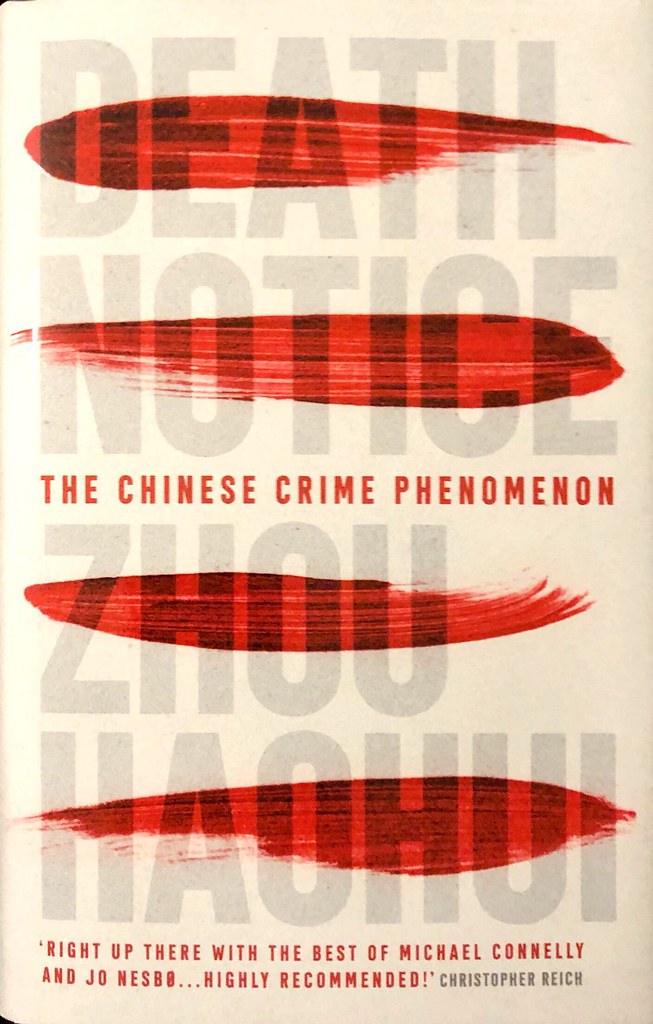
  • Death Notice by Zhou Haohui

    China has had a run in English literature at the moment. Cixin Liu has overturned the world of science fiction with his Three Body Problem trilogy of books. Zhou Haohui’s Death Notice promises a similar shake up in crime fiction.

    Death Notice

    Death Notice takes place in 2002, the internet was changing Chinese society and the government hadn’t yet rolled out a consistent approach to online services and content. You had the first generation of Chinese internet giants, Google was available to trawl content worldwide. The world was your oyster if you were curious enough and had sufficient English skills. Forums were transformative, attracting participants who shared a passion to connect in ways previously impossible within China.

    It was also a more open time in terms of the government’s attitude to public freedom and discourse. The book is set before the implementation of Golden Shield project, which started to censor Chinese access to the web. The Golden Shield project also helps shape online consumer opinion through content deletion on social platforms and gaming trending items. Which is why it is the ideal time to set a complex serial killer that relies on the internet. It is also a China that longer exists. I was surprised that the book has been published and lauded in China as it begs comparison with the less open Xi regime.

    The death notice of the title refers to a crowdsourced list of wrongdoers who escaped justice and end up being dispatched in creative ways. I don’t want to say any more that would give away more of the plot.

    Death Notice leads you on a twisted exploration of who the killer could be, dragging in to suspicion even members of the investigative team. And this is apparently the first in a series of books. If you enjoy Scandinavian fiction like Jo Nesbo and Stieg Larsson, then Zhou Haohui offers something that provides a similar sense of innovation in crime literature. More books reviewed here.