Category: design | 設計 | 예술과 디자인 | デザイン

Design was something that was important to me from the start of this blog, over different incarnations of the blog, I featured interesting design related news. Design is defined as a plan or drawing produced to show the look and function or workings of a building, garment, interfaces or other object before it is made.

But none of the definition really talks about what design really is in the way that Dieter Rams principles of good design do. His principles are:

  1. It is innovative
  2. It makes a product useful
  3. It is aesthetic
  4. It makes a product understandable
  5. It is unobtrusive
  6. It is honest
  7. It is long-lasting
  8. It is thorough down to the last detail
  9. It is environmentally-friendly – it can and must maintain its contribution towards protecting and sustaining the environment.
  10. It is as little design as possible

Bitcoin isn’t long lasting as a network, which is why people found the need to fork the blockchain and build other cryptocurrencies.

Bitcoin uses 91 terawatts of energy annually or about the entire energy consumption of Finland.

The Bitcoin network relies on thousands of miners running energy intensive machines 24/7 to verify and add transactions to the blockchain. This system is known as “proof-of-work.” Bitcoin’s energy usage depends on how many miners are operating on its network at any given time. – So Bitcoin is environmentally unfriendly by design.

On the other hand, Apple products, which are often claimed to be also influenced by Dieter Rams also fail his principles. They aren’t necessarily environmentally friendly as some like AirPods are impossible to repair or recycle.

  • Bush TR 82 – throwback gadget

    Whilst you might not know the Bush TR 82, if you were from western Europe you’ll recognise its style immediately.

    Post-war Britain

    In the post-war era Bush Radio Limited tried to fill consumers demands for entertainment.

    There were radios that would sit on a sideboard and would have the presence of a TV set. Many of these have fitted out with Bluetooth to create a better sounding sound system. It certainly sounds better than an Amazon Echo. My parents inherited one of these, a Bush VHT 61, which served them well for many years.

    There was also radiograms, which is were a cross between a sideboard and a hifi system.

    The secret of their warm sound was valve circuits. Before chips with millions of components, were transistors. And before transistors were delicate lightbulb-like valves.
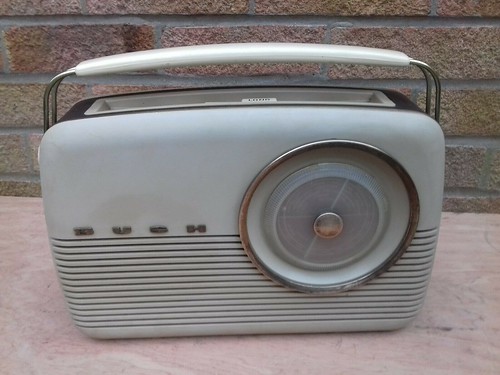
    Bush TR 82
    Bush TR 82

    David Ogle’s iconic design

    Over time manufacturers like Bush managed to make valves small enough to make portable devices. In 1957 the Bush MB60 was launched. This was a portable valve radio designed by David Ogle of Ogle Design. The MB60 didn’t last as even minature valve radios were power hungry and delicate. But David Ogle’s case design lived on.

    TR 82

    Ogle’s product design was mated to a seven transistor circuit to create the TR 82.The TR 82 was big enough to have a decent sound and small enough to be portable. Alkaline batteries like Duracell were only starting to reach the market about the same same as the TR 82. So a high powered long lasting battery would be a 9 volt lantern style battery. This meant that you got months of use out of one battery, but each battery was expensive. (Similar batteries were still commonly used up until recently in the flashing lanterns used to mark road works currently in progress).

    The TR 82 received long wave and medium wave so didn’t need an external aerial. VHF or FM radio wasn’t popular yet. In common with cars from the 1950s the Bush TR 82 had chrome plated brightwork. This was around the front panel around the edge of the circular reception dial. Despite this ornamentation you ended up with a very intuitive radio design, with a simplicity that Dieter Rams would appreciate. There was a large tuning wheel on the front of the radio.

    On top, there were two rotating controls:

    • Volume
    • A combined tone and on / off switch

    Selection between medium wave and long wave reception was done with two large buttons.

    The handle ran the length of the case and swivelled at the points at which it was secured. This provided even easier access to the top controls of the radio.

    The rear cover was removed by a single central screw. This could be undone with a edge of a coin. Inside the case was a battery compartment at the bottom. The rest of the radio was held on a metal subframe. This rigidity was essential for the tuning mechanism to work seamlessly and for the speaker to provide a good sound.

    My personal memories of the TR 82

    My own personal memories of a well-used and obsolete Bush TR 82 stem from my time on the family farm in Ireland. The radio lived in the kitchen and provided news at lunch and dinner time. It was also turned on to listen to the latest livestock market prices. This would then affect if, or when livestock and wool were sent to market. It provided live music on a Saturday evening. In essence, it filled many of the tasks that an internet enabled PC would do – if my Uncle and Grandmother had been online.

    Radio was the primary media. Ireland had been an early adopter of radio, but a relative latecomer to television. So even into the early 1980s the radio had a pre-eminence in consumer behaviour that was only slowly eroded by the TV.

    Television was something only broadcast from after lunch until late evening, apart from the weekends. When the second TV channel launched it only during the evening. By comparison at the time radio broadcast from before 6am in the morning until shutdown just after midnight.

    TR 82 and the rise of Sony

    The timing of the Bush TR 82 was a high point. The same year Tokyo Tsuskin Kogyo launched the first pocket sized transistor radio – the TR-63. It was the first ‘Sony’ product to be sold in the US. Sony was originally a product line brand for their nascent transistor radio busness. The product was so successful that the founders changed their company name to Sony Corporation. This idea of portable pocket entertainment begat personal stereos, iPods and the smartphone. (You can find more on Sony here.)

    By comparison the TR 82 marked the point for Bush Radio as well. Bush Radio had been acquired by Rank in 1945. In 1962, the company was merged with Murphy Radio as Rank Bush Murphy. This was sold to Great Universal Stores in 1978. In 1986, the Bush name was sold to the Alba Group. In 2008 the former Alba Group sold the name for use outside Australasia on to Home Retail Group. Sainsburys acquired Home Retail Group in 2016.

    But the iconic Bush TR 82 shape lived on, in more modern, yet poorer quality replicas. Most noticeably the Bush TR 82 DAB which had digital radio, FM, medium wave and long wave. Unfortunately the modern radio didn’t feature the same quality of speaker or internal frame. This meant that the sound suffered from lower power and a muddy sound caused by vibrations in the case. A brief feature on the Bush TR82 by the BBC and the British Museum here.

  • Economics of YouTube + more

    lifeintaiwan have gone into the economics of YouTube by looking at their own channel in this video. It makes fascinating viewing and provides more questions than answers about the value of ‘influencer’ fees being paid in travel, beauty and FMCG sectors. It will provide additional grist on the economics of YouTube moving forwards

    Photochromeleon: Creating Color-Changing Objects – YouTube – I thought that this was projection mapping but it seems to be just variable light wavelengths. Really interesting applications from activations to packaging design

    The nth room sex scandal is a mix of dark web fears played out within a private Telegram channel. Some great explanations and vox pops interviews in Korea by Asian Boss. This scandal falls on the back of other sexual exploitation scandals in the Korean media, notably around the Burning Sun club in Seoul. It is also interesting how Telegram had been perceived as a super-safe channel for delivery of services, rather than building a dark web site. More Korea related posts here.

    Asian Boss vox pop interviews with the Korean public on the nth room sex abuse scandal

    Mark Ritson talks about marketing in the midst of a recession. If you do nothing else this week, get a CMO you know to watch it. The big thing to take away is the concept of eSOV. Although Ritson doesn’t mention this explicitly, this is the foundation of Proctor & Gamble’s success during the Great Depression.

    The history of Marriott carpet camouflage. Uniform History do some interesting design story videos and their April’s Fools videos tap into odd but true stories. Apparently this camouflage was for cosplay conventions in the US. The video then goes into a tangled mess of intellectual property, fair use, parody and cultural appropriation of a carpet. The thing has taken a life of its own. When Marriott refreshed its carpet choice the old ones were dumpster dived or bought up by cosplayers so that they could continue the convention tradition that had build up over a few years.

  • Tokyo Metro + more things

    Upcycling a Tokyo Metro train into a coffee vending machine. Suntory Coffee collaborated with Tokyo Metro on a one-off vending machine based on parts of a decommissioned train. The level of detail that they put in is amazing. Trains have a big part of modern Japanese city life. Japan has more railways and more train travel than most other countries. It was part of a concerted post war strategy that saw the creation of the bullet train and a wide range of commuter railway lines. It stands in stark contrast to a post-Beecham report train system in the UK. More Japan-related posts here.

    via Sora News 24
    Chipotle
    Chipotle by Mike Mozart

    Chipotle hosts virtual lunch hangouts amid pandemic | Contagious – Chipotle tapped into the widespread use of Zoom to develop virtual lunches. They might do food but they also realise that work lunch has social aspects. As far as I know this was the first consumer marketing campaign on Zoom and shows what an agile marketing team can do. It would be interesting to see if there is any marketing effectiveness data around the campaign in the future.

    Adidas GMR tech combines sport and gaming | Contagious – interesting combination of wearable, gaming and locative technologies. It also shows the potential of what Nike Plus could achieve with this arguably wider existing customer base.

    Lil Mariko’s ‘Where’s my Juul?’ blew up for a second time. The first time was due to the anxiety of jonesing for that nicotine fix. The second time is because it perfectly expresses cabin fever. Mariko Zhang is the full package in this video. The song slips somewhere between EDM and BabyMetal.

    Channeling cabin fever

    The guys over at Zak have launched a new video series of interviews and episode one covers young people around the world coping with lockdown.

  • My analogue journey & more things

    I’ve been listening to My Analogue Journey which has got an amazing selection of Japanese music as part of his videos. Check this out. My Analogue Journey pulls together some buttery smooth records; like a high class version of smooth radio.

    Streaming Up From Boston – Info on how to watch here | Dropkick Murphys – what really surprised me is that enterprise software company Pegasystems stepped up to financially support this. Its an amazing concert by the Dropkick Murphys.

    I am a big fan of SIGGRAPH demo videos. They are are an amazing amalgam. Reality and Daliesque surrealism. This video is very much in that SIGGRAPH vein. The physics of this video is amazing, but has a distinct otherworldly quality.

    Huggies candid campaign takes on parent-shaming | Canvas8 – Procter & Gamble have built a stable of expertise in mixing ads with social purpose. Some of these ads have been more effective than others, for instance the Gillette ads have fallen flat with male customers. This reminded me a bit of Brooklyn Brothers work for Water Wipes which hinged around authenticity around the parenting experience. More posts related to Procter & Gamble here.

    ICYMI: Vanilla Ice apologises for crimes against music in this campaign from Virgin to ‘Right Music… | Creative Moment  – using celebrities and getting the balance right is always a tough one. In this particular case Virgin seems to have done a better job rebuilding up the brand of Vanilla Ice than its own brand. It was an interesting insight that consumers no longer know about Virgin’s musical heritage that gave it its original cool factor. I guess its time for Mike Oldfield to release another follow on to Tubular Bells and remind gen Z of Virgin’s relevance. I do wonder if Vodafone had a similar but less extreme issue with its ads that revolved around Martin Freeman.

  • Ever more digital media + more

    Whilst the world is becoming ever more digital, the book publishing industry has remained print focused due to customer demand. This is a great segment from CNBC that goes into it in more depth.

    Dina Amin’s stop-motion assembly and disassembly video of everyday objects caught my eye. I would be surprised if this doesn’t show up in future ad agency work concepts.

    What’s inside by Dina Amin.

    Even my lack of expertise in gaming means that I have heard of Crash Bandicoot. What’s interesting in this video is how the development of Crash Bandicoot for the original PlayStation is similar to getting software to work on early PCs. Crash Bandicoot was one of a handful of titles that drove PlayStation popularity.

    How Crash Bandicoot hacked the original PlayStation from Ars Technical’s

    I did some initial work on dental health campaigns in APAC. It fell apart due to politics within my own agency, making us unable to collaborate with our colleagues at Red Fuse. Our agency was appointed for social media marketing work; but we couldn’t get anything out the door. During that time I came across some really smart people working in this space. This is why work like this: Colgate Ice Cream and Candy – The Inspiration Room made me smile. Great insight, simple execution in collaboration with confectionery companies ensuring a win-win outcome.

    Greg Girard’s street photography from Tokyo in the 1970s feels like postcards from the future – check out these previews from a forthcoming book of his work: Rare 1970s Street Photography from Tokyo Published in New Photo Book. You can see more Japan related posts here.  

    I’ll be working from home for the foreseeable future, but will be working hard to try and keep this blog as free of coronavirus-related content as I can.

    I am not a virologist, so my expertise doesn’t matter. I do know about the media and social platforms. You will see contradictory information, confusion and uncertainty. A classic example is the way hoarding toilet paper became a self-perpetuating meme.

    While I am working from home, I don’t imagine that it will be too much of a trial as the office environment itself has become ever more digital. I am going to use the time that I’d have spent commuting to improve my reading. I have a stack of unread books that won’t read themselves. I may even explore the ideas from them here with you my reader(s).