Finance is a really odd section for me to have. I don’t come from a finance background, I have no interest in fin-tech. Yet it makes its appearance here on this blog.
When thinking about this category, I decided to reflect on why its here. It’s usually where curated content sits, rather than my own ideas.
The reality of life in the west is that everything has become financialised. As I write this as people think about web 3.0, they are thinking about payment systems first and working about utility later. This implies that the open web we know won’t be part of the metaverse in terms of ideas or ethos.
Instead of economic growth consumer spending depends on different ways of creating credit. Its no accident that delayed payments finance company Klarna is the biggest thing in European e-commerce at the time of writing this page.
Back when I started writing we were heading into the financial crisis of 2008, the knock on effects of that could still be felt a dozen years later and was a contributing factor to Brexit and Trump victories. The ‘occupy’ movement was catalysed by the financial crisis and then turned into something else. For instance it became a pro-democracy movement in Hong Kong.
We had the implosion of financial brands like Lehman Brothers and the Royal Bank of Scotland. This created a lack of trust in business, the media and the government. We are still seeing that play out today, from cryptocurrency to conspiracy theories and a lack of trust by the public in experts.
Paidy considers listing as ‘buy now, pay later’ catches on in Japan | Financial Times – Japan is a microcosm of what’s happening in terms of buy now, pay later on the web. Japan is notable, because like Germany, historically it has been a heavy cash focused consumer payments market. Mobile payments were mainly used for daily expenses like commuter travel or shopping at the combini. Many consumer e-commerce sites now have Klarna involved. Even Amazon is getting in on the buy now, pay later theme:Amazon Enters the ‘Buy Now, Pay Later’ Space Through Affirm – All of this looks like a consumer credit iceberg that might catch bankers et al by surprise. The buy now, pay later model itself isn’t new. Its payment by instalments model was used by catalogue businesses to furniture stores. It is lay away for more impulsive times.
Cantopop star Denise Ho flagged by law enforcement agencies: Sing Tao | The Standard – a few things are interesting which are further evidence of the maximalist interpretation of the Hong Kong National Security Law. Going after Ho is an indication that none of the pro-democracy movement will be tolerated, even as a Potemkin village type construct.
Chinese Official Dismisses Wave of Emigration From Hong Kong — Radio Free Asia – “Neither Beijing nor Hong Kong officials are willing to admit that there is a crisis in Hong Kong,” Cheng said. “Hong Kong residents lack confidence in the future and can’t tolerate the current situation, so a considerable number of people are choosing to emigrate.”
“I think the central government must care about that, because it will affect how its policies in Hong Kong are perceived in the international community,” he said. Cheng, who has himself recently emigrated, said the feelings of the people of Hong Kong are no longer being taken into account by Beijing. – I honestly think the Xi administration doesn’t care
ESG can be considered to be a form of ethical investing. Ethical investing of one form or another has been around for a while. In the US by the middle of the last century union pension funds were looking to invest in areas like affordable housing. There used to be funds and banks that wouldn’t invest in certain industries, such as tobacco or arms manufacturers. The Cooperative Bank in the UK screens business banking clients looking at issues such as animal welfare and supplying arms to oppressive regimes.
ESG or environmental & social governance can be seen as a way of standardising ethical investing and has been adopted by the US financial services sector. Environmental factors have been raised in importance due to concern about climate change. ESG as we now know it came out of the UN Principles for Responsible Investment which financial institutions signed up to. This happened in 2005 and by 2016 it became a ‘hygiene factor for asset managers as requests for proposals required being a UN PRI signatory.
The growth of interest in ESG can be seen by the amount of funds under management over time complying with PRI framework
The PRI is based around six principles
Incorporation of ESG issues into investment analysis and decision-making processes – this makes sense to a point. What are the best decisions from an environmental and social governance point of view is a matter of perspective as every decision requires trade-offs. The same kind of ‘religious’ disputes that caused Greenpeace to be formed by ex-Sierra Club members now drive ESG decisions. Here’s a hypothetical example. Internal combustion engine cars have a lower carbon footprint of manufacture than their electric counterparts. 70 percent of a vehicles carbon footprint is in its manufacture. Therefore I could argue investing in a secondhand vehicle supermarket a la AutoTrader or BringATrailer would be better than Tesla Motors. The reality is that Tesla tells a great story and the optics my valid rational argument for an investment decision would go down badly with the media and many investors.
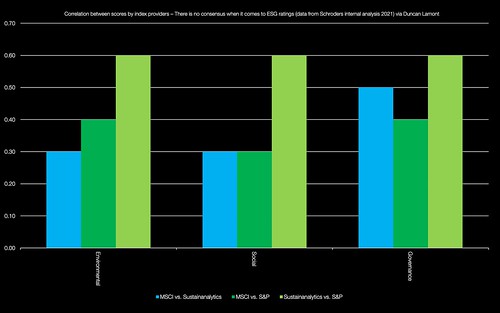
Correlation data on ESG ratings via Schroders analysis 2021
Being active owners and incorporate ESG issues into our ownership policies and practices. So should investors be looking to get companies to divest oil production? Or should they be running down their oil fields in a responsible manner? If they divest their oil production, it could be going to custodian that would have less moral and social scruples. Again the optics on these decisions may drive a move that on balance would be worse for the environment.
Seeking appropriate disclosure on ESG issues by the entities in which we invest.
Promoting acceptance and implementation of the Principles to their peers within the investment industry. Which is why Larry Fink is doing these kind of interviews on business media.
Work together to enhance effectiveness in implementing the Principles.
Reporting on activities and progress towards implementing the Principles. If you dig into back and investment fund websites you will be able to find these reports for listed companies, financial institutions and even the likes of Harvard University
Why do investors use ESG?
ESG investing is considered to be a form of risk management
The rationale being that ESG aligns with companies there that are prepared for risks that other companies miss. However it is based on a fallacy that other people are stupid, rather than the risks not matching their client’s investment horizons.
Companies that have embraced sustainability are doing better
This is based on a perception that ‘virtuous investments’ as a strategy tend perform better than sinful ones. Yes there are a number of businesses in this category. Sinful companies can do well as well, and ESG investment funds don’t necessarily outperform their rivals.
An altruistic desire to drive down the cost of capital for green businesses versus their incumbent competitors in the carbon economy
Going down this route requires an admission that this might not outperform as an investment and won’t be a substitute for political, legal and regulatory action to spur economic greening.
ESG Earthquake
On August 2, 2021, Tariq Fancy dropped a proverbial bomb on the ESG sector. He didn’t say anything that hadn’t been said before. But the way he put it together into a cohesive story and the authority he had to talk about ESG made an impact.
Fancy comes from a background in investment banking, private equity and fund management. Most notably he formerly worked for BlackRock as their global chief investment officer for sustainable investing. In other words, he knew the ESG investment business inside-and-out.
What I considered to be his most relevant points were:
The tension between ESG lowers the cost of capital to green businesses, lowering investor returns. But are promoted as good performers by funds
ESG investments have long term time horizons that don’t match the requirements of investors. This creates a misalignment between profit and purpose. A secondary aspect of ESG investment being weak means that there will never be a critical mass of capital to make it work
People thinking that their retirement plan is going to help the world; stops them taking actions in their own lives that might help changing the world. (It’s the investment equivalent of liking or sharing the Kony 2012 video and expecting real political change in Sierra Leone)
Can you trust people on Wall Street or in the Square Mile to decide what is good for society?
I couldn’t avoid doing a post on Afghanistan given what had been going on this week. The Afghanistan conflict posed a number of interesting questions about:
What privacy and security means for the people left behind in Afghanistan in the digital age
Why strategy is seldom a teacher and several countries have made the same mistake in Afghanistan – (Britain did so twice!)
The failure of intelligence in Afghanistan reminded me of the failure of intelligence agencies to realise that the fall of the Berlin Wall would happen. There was also a failure to underhand who the players were and their motivations in Afghanistan
What will Afghanistan mean for Pakistan moving forwards? Once out, the west has the perfect opportunity to shun Pakistan; which will leave the country vulnerable to Chinese predatory practices
The US Is Removing Records of Its War in Afghanistan From the Internet – Lives are on the line here, but helping them may mean destroying—even if temporarily—the memory of the war and all that happened. It’s a horrible problem to face. One potential solution would be for the U.S. and its allies to take as many Afghan refugees as want to flee the country. – it assumes that the Taliban and supporters like the Pakistani ISI intelligence agency haven’t been caching this material themselves over the years. Things got rolled up so fast, they probably have hold of records from Afghanistan government payroll ledgers to intelligence reports
Germany Flew 65,000 Beer Cans Out of Afghanistan, but Just 7 People on an Evacuation Flight – “There was transport capacity for alcohol, but not for the local staff in Afghanistan,” read a piece in Germany’s Bild newspaper, referring to the fact that the German military had earlier flown home 65,000 cans of beer and 340 bottles of wine before it withdrew from its bases in Mazar-e Sharif and Kabul at the end of June. – surely they could have blown up the alcohol and put people on the flights? – this is the kind of thing that fuels future grudges that morph into terrorist attacks. But it also shows the colossal failure in intelligence in a microcosm
SIGAR | Lessons Learned. The Ides of August – a couple of good post-mortem reads on Afghanistan. A few things struck me. Mission creep had been baked in, although much of that was down to the allies partnering with the Northern Alliance and liberal values. The dual nature of Pakistan, which I suspect Pakistan will get punished for in the longer term. The lack of intelligence on the main players involved such as former president of Afghanistan Hamid Karzai
Beauty
Skincare Preferences by Generation | NPD Group – Despite the generational differences in skincare preferences, there are also commonalities. At the end of the day, it seems we’re not so different, after all. Whether they are more like my mother or my cousin, we see from consumers across-the-board that they are open to trying new things, are looking for clean ingredients, and simply want skincare that produces results from a brand they can trust. Regardless of the trends driving the category, the demand for efficacy and transparency is here to stay
Business
Wolfsburg, we have a problem: How Volkswagen stalled in China | Reuters – Last month, though, he said Volkswagen had fixed the problems revealed by the test, that the ructions of the episode had subsided and the carmaker’s Chinese business was recovering. “We have once again clearly one of the safest cars on the market in this segment,” Woellenstein told reporters in July. “We will once again take up the old leadership of the Passat.”But there is quite some ground to regain in the large family car segment. A total of 47,480 Passats were sold in the first six months of this year in China, some way behind the 91,110 Toyota Camrys (7203.T) and 89,157 Honda Accords (7267.T), according to LMC. The figures from the same period of 2019, before the pandemic struck, show how steeply the Volkswagen model has fallen away of late: 91,400 Passats were sold versus 111,968 Accords and 85,396 Camrys. – I am surprised by this, given Volkswagen’s obsession with common platforms
Tata’s rise mirrors the sweep of India’s history | Financial Times – Tata is no longer at India’s entrepreneurial vanguard. The likes of Mukesh Ambani’s Reliance Industries and Gautam Adani’s eponymous group, with their investments in telecoms and renewable energy, hold stronger claim to be the “nation builders” of today. These tycoons represent a different way of doing business, one that has prompted much consternation. They lack Tata’s ambivalence about the state, aligning themselves unabashedly with Narendra Modi, and share few of the conservative Tatas’ qualms about “wealth creation for its own sake”.
Biden is sandbagging on immigration – by Noah Smith – Noahpinion – the new American support for throwing open the country’s gates is more broad than it is deep. There’s a real desire to cleanse the stain of Trump’s human rights abuses and flirtation with white-nationalism — to at least be able to say that America is still the Nation of Immigrants, that we still have compassion for the people of the poor countries of the world. But beyond that idealistic impulse, I’m not so sure that most liberals have a strong, enduring commitment to welcoming in as many refugees, asylum-seekers, and economic migrants as possible.
One reason is that the Democratic party is increasingly the party of the educated, and to most educated Americans, people like refugees and asylum seekers live in a different world. There’s little natural class solidarity or empathy there. And when it comes to skilled immigrants — the people waiting desperately for that backlog of 100,000 green cards to be processed — well, to most educated Americans, that’s the competition. Both for themselves and for their kids in schools.
Beijing’s American Hustle | Foreign Affairs – U.S. institutions, especially in finance and technology, cling to self-destructive habits acquired through decades of “engagement,” an approach to China that led Washington to prioritize economic cooperation and trade above all else.
If U.S. policymakers and legislators find the will, however, there is a way to pull Wall Street and Silicon Valley back onside, convert the United States’ vulnerabilities into strengths, and mitigate the harmful effects of Beijing’s political warfare. That must begin with bolder steps to stem the flow of U.S. capital into China’s so-called military-civil fusion enterprises and to frustrate Beijing’s aspiration for leadership in, and even monopoly control of, high-tech industries—starting with semiconductor manufacturing
How Chinese pressure on covid origins probe shocked WHO — and led Tedros to push back – The Washington Post – When a WHO scientist on a coronavirus origins probe announced in February that the idea that the virus leaked from a lab was “extremely unlikely” and unworthy of further investigation, senior WHO staff in Geneva were shocked. “We fell off our chairs,” one member told the authors. The team in Wuhan appeared to have given in to Chinese pressure to dismiss the idea without a real investigation. Later, when the WHO-China team released a report that again dismissed that scenario, Tedros pushed back, saying that the research was not “extensive enough” and that there had not been “timely and comprehensive data-sharing.” Since then, relations between the WHO and China have nosedived. Chinese officials said in July that they would not accept any further investigation into the origin of the coronavirus in China and accused the United States of pressuring scientists. The WHO last week released a statement that resisted the idea that “the origins study has been politicized, or that WHO has acted due to political pressure.”
China, the WHO and the power grab that fuelled a pandemic | News | The Sunday Times – In 2017 Chan crowned her final year in office by welcoming Xi to Geneva. While he was there, she signed an agreement that committed the WHO to working alongside China on health as part of the country’s Belt and Road initiative. It was the first time any UN agency had signed up to the initiative, which seeks to extend Chinese influence and trade in more than 70 developing countries by financing infrastructure projects. The initiative is highly controversial because its critics argue that China uses it to shackle countries, particularly in Africa, to “unsustainable debt” as a way of gaining access to the continent’s raw materials and buying political favours. “I think health is too special to get into the really seedy politics that Belt and Road is part of, and I wouldn’t want the WHO to be associated with it,” Gostin argues. “The cost in terms of human rights and debt, and other adverse events for Africa, was a bridge too far.”
Hong Kong’s Leader Killed Her City – The Atlantic – Regina Ip, a pro-Beijing lawmaker and member of Lam’s cabinet, told me that simply having the laws on the books would provide a “deterrent effect” to protesters, and that the fears of journalists and activists over the curtailing of freedoms were not “completely misguided.”
How the daigou can help new brands | Vogue Business – The classic image of the daigou is of an entrepreneurial and well-connected individual who buys global luxury brands on behalf of Chinese clients abroad, where prices are lower and hard-to-find products are more accessible. But the new model daigou is also working closer to home, and mixing emerging Chinese designers with foreign brands. The motivation for the evolution of the daigou’s role comes from a wave of young Gen Z Chinese consumers who are seeking more interesting and affordable fashion and don’t care as much about the name on the label. This is good news for new brands in China – and elsewhere. In a fiercely competitive market, any well-designed brand has the potential to catch consumers’ eyes. What’s needed in the early days of a new brand’s development is an effective sales channel. – Building a similar relationship with daigou, that brands currently have with fashion stylists
[Report] Bad News, By Joseph Bernstein | Harper’s Magazine – In the beginning, there were ABC, NBC, and CBS, and they were good. Midcentury American man could come home after eight hours of work and turn on his television and know where he stood in relation to his wife, and his children, and his neighbors, and his town, and his country, and his world. And that was good. Or he could open the local paper in the morning in the ritual fashion, taking his civic communion with his coffee, and know that identical scenes were unfolding in households across the country. Over frequencies our American never tuned in to, red-baiting, ultra-right-wing radio preachers hyperventilated to millions. In magazines and books he didn’t read, elites fretted at great length about the dislocating effects of television. And for people who didn’t look like him, the media had hardly anything to say at all – give this a read
COVID slows Apple and Google production shift away from China – Nikkei Asia – AirPods — both entry-level and high-end models — were among the earliest products that Apple began making in significant amounts in Vietnam, having moved production there around two years ago during the height of U.S.-China trade tensions. Apple’s plan to bring some MacBook and iPad production to Vietnam has also been put on hold due to a lack of engineering resources, an incomplete notebook computer supply chain and the dynamic COVID situation, one of the people said. Production of smart doorbells, security cameras and smart speakers for Amazon, which recently moved to Vietnam, has also faced delays since May as assembly lines in the northern part of the country coped with a surge in local cases and tougher COVID prevention measures
Opinion | We built a system like Apple’s to flag child sexual abuse material — and concluded the tech was dangerous – The Washington Post – Our research project began two years ago, as an experimental system to identify CSAM in end-to-end-encrypted online services. As security researchers, we know the value of end-to-end encryption, which protects data from third-party access. But we’re also horrified that CSAM is proliferating on encrypted platforms. And we worry online services are reluctant to use encryption without additional tools to combat CSAM. We sought to explore a possible middle ground, where online services could identify harmful content while otherwise preserving end-to-end encryption. The concept was straightforward: If someone shared material that matched a database of known harmful content, the service would be alerted. If a person shared innocent content, the service would learn nothing. People couldn’t read the database or learn whether content matched, since that information could reveal law enforcement methods and help criminals evade detection. Knowledgeable observers argued a system like ours was far from feasible. After many false starts, we built a working prototype. But we encountered a glaring problem.
Our system could be easily repurposed for surveillance and censorship. The design wasn’t restricted to a specific category of content; a service could simply swap in any content-matching database, and the person using that service would be none the wiser. A foreign government could, for example, compel a service to out people sharing disfavored political speech. That’s no hypothetical: WeChat, the popular Chinese messaging app, already uses content matching to identify dissident material. India enacted rules this year that could require pre-screening content critical of government policy. Russia recently fined Google, Facebook and Twitter for not removing pro-democracy protest materials. We spotted other shortcomings. The content-matching process could have false positives, and malicious users could game the system to subject innocent users to scrutiny. – Emphasis in bold is mine
Technology
Laptops Shortage Is Easing as Pandemic Demand Wanes – Bloomberg – The waning demand for PCs will likely last for at least several more quarters. Memory prices are dropping precipitously on fears the chip cycle is over. But it’s good news for anyone looking to buy a laptop, printer, webcam or router. Expect them to be much easier to find in stores this fall. – I am hoping that the price of SSDs will fall again
Intel with an old take on big.little for Alder Lake | EE News Europe – Intel’s next-generation desktop chip, code-named Alder Lake, is the company’s first hybrid architecture to integrate two core types – the Performance-core and Efficient-core. This is similar to ARM’s big.little approach which used a small core optimised for low power consumption with lower performance alongside a larger, higher performance core. Both cores could run the same code depending on the context, avoiding the problems of having a scheduler to allocate tasks to multiple cores. This has traditionally been a limiting factor for the system-level performance of multicore chip designs
Epic’s Fortnite lawsuit has become a nightmare for Google – Protocol – Google ‘estimated in 2019 that it risked losing as much as $6 billion per year if app makers and app store operators banded together with Epic and began creating alternative distribution channels. So instead of offering a superior product, the company muscled its way to a market position now being viewed by U.S. regulators as potentially anticompetitive’ – this might feed into a wider FTC case later on given the focus on revenue. More related content here.
Fear of finding out was how Paul Holmes characterised marketing as a discipline and its approach to return on investment. This was an article that was originally published in 2019, but was going around in circles that I keep an eye on online recently.
The article characterised marketing in this way:
Marketing and public relations continue to focus on reach and awareness. Is that because they’re afraid of finding out whether they really make a difference?
The PR Industry’s FOFO Problem | Provoke Media
What do marketers actually focus on?
According to Nielsen:
Please rank each of the following marketing objectives for your business from most important to least important. Chart shows the percentage of respondents who picked that objective as their No. 1 priority. Source: 2021 Nielsen Marketing Report: Era of Adaptation.
Looking at those marketing objectives ROI and business impact are a key consideration embodied in both customer acquisition and brand awareness.
Long and short term goals
In order to understand marketing one has to understand that marketing provides short term benefits and long term benefits. Certain techniques skew towards a short term delivery and others deliver over the long term. The approach mentioned in Fear of Finding Out was very skewed to short term techniques.
That means that the return on investment timeframes could be very different. The longer the time frame that you are measuring the full return on investment, the harder it is prove it.
But surely you want things to work fast? True. But what if there are marketing techniques that keep on giving? Think about advertising jingles that stick in your head. They have mental availability decades after you’ve heard them.
In How Brands Grow by Byron Sharp, he distills down the findings from decades of empirical research into marketing. Two of the most important factors are mental availability and brand salience.
Mental availability is the probability that a buyer will notice, recognize and/or think of a brand in buying situations. It depends on the quality and quantity of memory structures related to the brand.
It is different from brand awareness or brand recall because it is situational in nature and thus hard to measure, a notable exception would be through observational research in retail environments. Brand awareness and consideration are two relatively indicative proxy measures for mental availability.
Here’s what research firm Nielsen had to say about those proxy measures:
Nielsen research shows that a 1-point gain in brand metrics (e.g., awareness and consideration) drives a 1% increase in sales. Importantly, upper-funnel efforts also generate an array of ancillary benefits that can drive more effective sales activations—and not just for consumables. For example, Nielsen recently measured how effective a financial services company’s marketing efforts were at driving sales across approximately 20 markets and found that the correlation between the upper funnel brand metrics and marketing efficiency was exceptionally strong (0.73).
Long-Term Business Vitality Should Outweigh Short-Term Sales Gains by By Cara Kantrowitz, Vice President of Solutions Consulting, Nielsen Research
A second aspect is brand salience which is how distinctive a brand is. This again helps with the memory structures that relate to a brand.
You might remember TikTok memes for a few months?
Go News India
What is the mental availability created by all but the most persistent Facebook ads? What’s the mental availability of a Google ad?
How are you measuring and driving brand salience for your company? Because that will affect sales further down the funnel.
For business to business audiences, which are covered in Byron Sharp and Jenni Romaniuk’s How Brands Grow part two – the results are very similar.
The now bias
The now bias can be seen in the finding of the research cited by Holmes. The responses (and probably the question design that elicited them) are very focused on the bottom part of the marketing funnel / sales support.
Among the other troubling findings of Proof’s research, which included more than 400 senior business leaders in 160 key Fortune 1000 C-suites:
94% reported that they had little or no reliable understanding of the quantifiable business value actually delivered by marketing;
97% said they had little or no idea how much money they should be investing in marketing and PR;
72% said that they expected that 2019 marketing budgets would be cut by 10% or more.
Says Mark Stouse, Proof founder and a veteran of marketing and communications roles at BMC Software, Honeywell, and HP: “Many of the C-suite respondents went out of their way to say that their frustration did not stem from a lack of belief in marketing’s impact, but rather the failure of their marketing teams to embrace full accountability for ROI and business value.”
This doesn’t ring true based on research I have seen from Nielsen:
Please rate the importance of each of the following metrics / measurement capabilities to your organization. Chart shows to p-2 (very important and extremely important) on a 5-point scale. Source: 2021 Nielsen Marketing Report: Era of Adaptation
Research by Ebquity suggests the marketers are focused on ROI. You can get the full research here.
Marketers also have a now bias, that’s due to astonishing levels of CMO turnover in many organisations that’s only increasing over time.
The now bias creates revenue opportunities for agencies, with a temptation to do what’s right for them rather than their clients. ‘The quantifiable business value’ are likely to be getting worse. While client budgets are stagnant, media buying agencies are taking more of the money on online advertising (7 – 10 per cent commission, compared to 3 per cent on other media channels).
So there is a natural business incentive for them to lean into ‘business transformation’ / ‘digital disruption’ narratives popular in board rooms. Digital has its place, but it might not be the panacea that you’re looking for. I say that not as a digital cynic, but as a seasoned digital focused strategist, which means doing the research and recommending the right media for the right job.
Depending how you look at media channels some are better than others.
So how is the now bias exhibited by the C-suite? In business value they don’t think about brand building. Yet businesses are quite happy to factor in brand value when thinking about the value of goodwill on the balance sheet of their accounts.
The PR Industry’s FOFO Problem – Marketing and public relations continue to focus on reach and awareness. Is that because they’re afraid of finding out whether they really make a difference?
O-RAN in uncertain future – Although Europe’s four major telecom operators – Vodafone, Orange, Deutsche Telekom, and Telefonica – had signed memorandum of understanding on the implementation of Open RAN (ORAN) based networks in Europe in early 2021, Rakuten Mobile’s ongoing operating losses have put uncertainty to ORAN’s future. Rakuten Mobile is the only major telecom operator to adopt the ORAN architecture for its 5G network, but the financial results of the company for the first quarter of 2021 showed an expansion of 265% on year in its operating losses to JPY97.2 billion (US$880 million), the largest in the past five quarters. The company’s operating margin also reached negative 141.7%, down 77.4% on year. However, Rakuten Mobile’s revenues still grew JPY19.1 billion and 38.5% from a year ago to JPY68.6 billion for the first quarter of 2021. The figures show the company has continued to see its mobile business growing, but the high costs from its operation kept the company suffering losses. – so what are the hidden costs of ORAN? What is different about this ORAN situation conceptually to the use of white boxes in complex enterprise IT systems? Would this question have pointed towards the kind of problems that ORAN has been encountering?
Men are much less likely to read books by women | Canvas8 – male readers are significantly less likely to opt for fiction books written by women. Of the top ten best-selling female authors, including Jane Austen, Margaret Atwood, and Danielle Steel, only one of five readers are male, whereas for the top male authors, including Charles Dickens and JRR Tolkien, 45% of readers are women. Meanwhile, data on Goodreads shows that enjoyment levels are not impacted by sex – on Goodreads, men give an average rating of 3.9 out of 5 to books by women while they give books by men an average of 3.8 – Sieghart’s interpretation of the data misses a key assumption that many women authors write books that don’t appeal to the majority of male readers interests, where as she assumes that they are not accorded as much authority as male ones. Those that do enjoy the kind of content that these women authors write find as much enjoyment in it. Examples of authors that cross the gender popularity gap include Gillian Rubinstein (aka Lian Hearn), Ursula Le Guinn and JK Rowling. TL;DR – sometimes its the product doesn’t float their boat rather than sexism
The young ‘lie flat’ as China’s growth model begins to fray | Financial Times – the money quote in this article for me is “The bulk of China’s population is doing worse in net terms as housing affordability continues to worsen and access to education and health becomes ore and more costly” – sounds like a lot of western developed economies. The key question is what impact this unfairness might have on the relationship between the populous and the communist party of China
Germany
Handel mit China: Braucht Deutschland eine Wende? | Frankfurther Allgemeine Zeitung – there are more important things than doing good business in China. Germany’s foremost business paper editorial swipe at Angela Merkel and selected big German enterprises (Daimler Benz, Deutsche Bank, T Systems and Volkswagen Audi Group)- short of name checking them with IG Farben I couldn’t see what else FAZ could do
UK’s Draft Online Safety Bill Raises Serious Concerns Around Freedom of Expression | Electronic Frontier Foundation – which attempts to tackle illegal and otherwise harmful content online by placing a duty of care on online platforms to protect their users from such content. The move came as no surprise: over the past several years, UK government officials have expressed concerns that online services have not been doing enough to tackle illegal content, particularly child sexual abuse material (commonly known as CSAM) and unlawful terrorist and extremist content (TVEC), as well as content the government has deemed lawful but “harmful.”
Two arrested over online calls for boycotts, threats against Hong Kong broadcaster TVB | Hong Kong Free Press HKFP – continuously and widely disseminated a large amount of messages through social media groups and pages, intending to smear the media organisation, and also to use threatening means to pressure different advertisers into stopping advertising with this media. [Their] goal is to cause reputational and financial damage,” said Superintendent Wilson Tam of the Cyber Security and Technology Crime Bureau. – sounds like what pro-Beijing politicians have done on several occasions. Angry emojis organised was seen to be criminal damage
FundFemme – I think what the site is trying to do is good. The thing I don’t like about this is the cynical approach of WundermanThompson who are trying to distract and run crisis comms on their unfair dismissal of Chas Bayfield and Dave Jenner. The domain was registered on June 30th via Squarespace
Phantom Warships Are Courting Chaos in Conflict Zones | WIRED – Bergman has found no evidence directly linking the flood of fake AIS tracks to any country, organization, or individual. But they are consistent with Russian tactics, says Todd Humphreys, director of the Radionavigation Laboratory at the University of Texas at Austin. “While I can’t say for sure who’s doing this, the data fits a pattern of disinformation that our Russian friends are wont to engage in.”