Category: germany | 德國 | 독일 |ドイツ

Willkommen – welcome to the Germany category of this blog. This is where I share anything that relates to Germany, business issues, the German people or culture. Often posts that appear in this category will appear in other categories as well. So if Berghain launched a new brand collaboration with Volkswagen. And that I thought was particularly interesting or noteworthy, that might appear in branding as well as Germany.

So far, I haven’t had too much German related content here at the moment. That’s just the way things work out sometimes.

Where I have talked about Germany much of my discussions have focused around innovation or design due to German history and reliance on its manufacturing sector. It hasn’t deindustrialised to the same extent as the UK did during the 1980s.

However it hasn’t been all good. A classic example is how German car manufacturers. They had been behind the curve on both electric and hydrogen powered vehicles compared to China, the US and Korea. While German strength is in traditional engineering areas such as software have been much more hit and miss.

I don’t tend to comment on local politics because I don’t understand it that well, but I am interested when it intersects with business. An example of this would be legal issues affecting the media sector for instance.

If there are German related subjects that you think would fit with this blog, feel free to let me know by leaving a comment in the ‘Get in touch’ section of this blog here.

  • Vietnam boomtowns + more things

    Apple’s Shifting Supply Chain Creates Boomtowns in Rural Vietnam – Bloomberg – Vietnam is becoming the new China. While China has been impacted by problems of its own making, resulting in diversification of supply chains and trade disputes. This Vietnam build-out feels very much like build out in China during the late 1990s and the early 2000s after China joined the World Trade Organisation. Vietnam is now likely to experience double-digit growth. Hopefully Vietnam will climb up the value chain in a similar way to China. Vietnam is already a great place to develop software and applications. More Vietnam related posts here.

    Apple develops alternative to Google search | Financial Times“Any reasonable search engine has to have 20bn-50bn pages in its active index,” Mr Ramaswamy said. When a user runs a query, the retrieval system must sift through vast troves of data then rank them in milliseconds. Some observers still dismiss the idea of Apple creating a complete search rival to Google. Dan Wang, associate professor of business at Columbia Business School, said it would be “extremely difficult” for Apple ever to catch up. “Google’s advantage comes from scale,” he said, as the endless user feedback helps to tune results and identify areas of improvement. “Google gets hundreds of millions of queries every minute from users all over the world — that’s an enormous advantage when it comes to data.” – Apple needs search for its app store, mapping services, media services and even on device. It doesn’t necessarily mean that Apple will do a ‘Google’

    Army of avatar robots readies to invade Japanese job market – Nikkei Asia – stocking shelves in a FamilyMart

    Apple develops alternative to Google search | Financial Times – explains Apple’s massive amount of overcapacity in their datacentre space for the past decade as they built around the world

    Chinese retailer Miniso beats Uniqlo and Muji at their game – Nikkei Asia – interesting profile of Miniso. What becomes apparent is how Luckin Coffee has poisoned the well with investors for Chinese retailing businesses

    Surveillance Startup Used Own Cameras to Harass Coworkers | Vice News – not terribly surprised that this was in their sales team. It fits right in with the sales cultures I have known

    25 Years In Speech Technology. …and I still don’t talk to my computer. | by Matthew Karas | Oct, 2020 | Medium – great essay on voice technology on computers (including smartphones)

    German spy chief Gerhard Schindler: China is poised to dominate the world | World | The TimesGerhard Schindler, who led the Federal Intelligence Service (BND) from 2011 to 2016, said Germany needed to curb its “strategic dependence” on Beijing and ban Huawei from its 5G mobile phone network. He also warned that Angela Merkel’s liberal approach to the 2015 migrant crisis had left Germany with a “large reservoir” of young Muslim men susceptible to violence and jihadist ideology, and that the true scale of the danger was only now becoming clear.

    UK risks road rage with China in Africa – POLITICOUnited States Assistant Secretary of State for African Affairs Tibor Nagy told a Congressional hearing in 2019 that Washington was “weaponizing” its African embassies “to confront China on a whole range of issues, most prominently a commercial one.” Westcott, from the Royal Africa Society, pointed out that Britain was so far aiming to maintain its own influence in Africa rather than reduce Chinese influence — but that it could take a more aggressive approach in future, for example attempting to outbid China for projects.

    How The Epoch Times Created a Giant Influence Machine – The New York TimesThe Epoch Times was a small, low-budget newspaper with an anti-China slant that was handed out free on New York street corners. But in 2016 and 2017, the paper made two changes that transformed it into one of the country’s most powerful digital publishers. The changes also paved the way for the publication, which is affiliated with the secretive and relatively obscure Chinese spiritual movement Falun Gong, to become a leading purveyor of right-wing misinformation. First, it embraced President Trump, treating him as an ally in Falun Gong’s scorched-earth fight against China’s ruling Communist Party, which banned the group two decades ago – the enemy of my enemy is my friend. I see this as a failure of liberal politicians engaging with a plurality of opinions about China.

    The Belt and Road Strategy Has Backfired on Xi | Palladium MagazineThe Belt and Road is less a geoeconomic power play than a marketing strategy. Few of the myriad projects and investment schemes labeled ‘Belt and Road’ exist because of the initiative as such. Grand strategists in Beijing did not cause the tremendous outbound flows of money, men, and material that comprise Belt and Road, and they cannot direct it either. What statesmen like Xi Jinping do have power to influence is how these flows are understood and perceived by the world

    How Did China Beat Its Covid Crisis? | by Ian Johnson | The New York Review of Books – ambiguous lessons on handling COVID-19

    WeChat ban a catch-22 for Chinese Australians – The China Storysome members of the Chinese Australian community have created parallel chat groups on WhatsApp, Letstalk, Line or Telegram in case of a local WeChat ban. But they continue to be drawn back to WeChat as their main social media platform. Why do members of the Chinese diaspora choose to self-censor when they have many other options available? The answer may lie in platform affordances available in WeChat as well as techno-material features of the app that produce ‘habits’, engender ‘necessity’ and provide users with a sense of ‘vitality’.

    Inside Out: China’s Forgotten Domestic Politics – The China Story – China digging itself into a soft power hole

    Adobe’s new AI experiment syncs your dance moves perfectly to the beat | The Next Web – I was thinking about the effect that quantisation had on music software in the early 1990s which allowed for perfect beat synching (in theory, though MIDI and USB could throw that off slightly

  • CPO

    I came across the idea of CPO in GQ magazine. I know few people that have bought anything other than the G-Shocks in their collection for retail.

    There’s a few reasons for that:

    • The watches that people like are often vintage models, it’s reverse of the hot streetwear and luxury ‘drop’ scene
    • With the exception of sought after models from the likes of Rolex; most watches suffer from a similar depreciation curve to buying a new car
    • If you’re buying a watch to wear, so I care less about the box, immaculate cardboard outer box and papers
    • A quality watch is a classic example of heirloom design. Whilst they will need to be serviced every three to five years; they can also last beyond the lifetime of the owner to be handed down in families.

    Watch resellers

    A number of watch dealers that were known by word-of-mouth have gone to the wall. For instance, Austin Kaye, which had been a regular fixture on The Strand longer than I have lived in London closed at the end of 2019.

    Online watch resellers have taken off. Crown & Caliber and WatchBox in the US; Watchmaster in Germany and Watchfinder & Co. from the UK – are some of the biggest players. Scale, brand trust and a panel of expert watchmakers have formalised the purchase process with validation that you’re not buying a fake or a ‘frankenwatch’.

    CPO

    This verification is usually called certified pre-owned or CPO in the trade. At first you used to see this in the Japanese luxury resale market provided by the likes of BRAND OFF.

    BRAND OFF is trusted by luxury shoppers across East Asia.

    It then extended to this new breed of online resellers. Luxury watch brands have bought some of the watch resellers. For instance, Richemont bought Watchfinder & Co. Other watchmakers, now have a formal process to CPO their watches.

    Previously, you would have to submit a watch in for a service to get proof that the watch was legitimate. Some brands are even reselling CPO watches including H Moser & Cie. Pre-owned items offer the luxury industry an opportunity to be more sustainable. Greater involvement in the pre-owned market also allows watch brands to get more value from their products over time.

  • iPhone 12 range launch

    Apple announced a four phone iPhone 12 range:

    • iPhone 12 Mini
    • iPhone 12
    • iPhone 12 Pro
    • iPhone 12 Pro Max

    I looked at the event using a social listening tool and the thing that really struck me was where the people commenting on it where commenting from.

    iPhone 12 event languages used in 1000s of mentions
    Languages versus 1,000s of mentions

    Thinking about key Apple markets; at least some of the buzz seems geographically misplaced. There was a distinct lack of discussions happening in Japan and mainland Europe for example. I watched it with a couple of friends based in Hong Kong; but I realise the launch itself would be at an inconvenient time in Japan.

    Where was the Japanese pre-event buzz though? Why didn’t Apple do more to build buzz in Japan? Apple has a sizeable market share in Japan and this 5G range of handsets are strategically important to retain that market share.

    As for mainland Europe, if social discussions are a proxy for a lack of interest; Apple has a serious problem on its hands. The silence hints a wider question around brand and product relevance. Yes 5G rollout is less advanced than in Asia, but there is also the improved camera and improved 4G reception that the handsets provide. Apple has arguably the best 4G antennas currently available on a handset which would benefit real world performance.

    At this time, Apple should be on the up, given that Huawei is no longer a serious contender in the market. Instead there is the silence of one hand clapping.

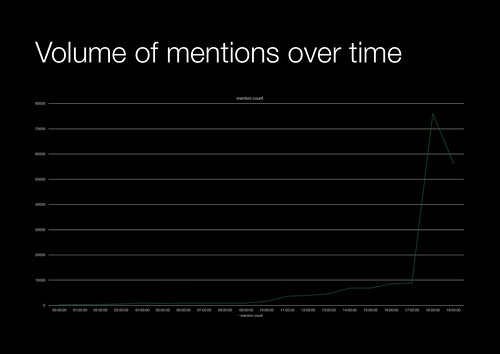
    Here’s what the social discussions looked like during the live event.

    iPhone 12 event social mentions over time
    Social mentions over time.

    As a brand marketer I would be concerned. The fan boys didn’t show, neither did the critics. Yes this launch is happening in a pandemic, but that should help due to the lack of distractions and the break from doom scrolling on social to do something else.

    More Apple related posts here and rewatch the iPhone 12 launch online.

  • Empathy delusion + more things

    Ian Murray of House 51 takes on some marketing sacred cows such as brand purpose in The Empathy Delusion. His presentation sets out to show how different marketing and agency folk are from the general public. Positive traits, like the gumption to move to London put a difference between them and the general public. This is just one aspect that Murray touches on when talking about The Empathy Delusion.

    I was recommended Economy Candy in New York. Their collection of vintage trading cards is a site to behold. The film tie-ins from Back To The Future and ET to Howard The Duck are tremendous.

    Local Hong Kong group StreetSignHK are featured on this video of the process that goes into saving Hong Kong’s neon signage. The biggest threat seems to be building regulation bureaucracy rather than technology.

    I loved the style of this 1980s vintage Mercedes sales training video, presumably for American dealerships.

    I was reminiscing about The Site. This used to run on CNBC Europe when I was in college and provided a window into the early net. Soledad O’Brien has gone on to produce documentaries. Leo Laporte who played the Dev Null* character is now better known for his technology podcasts. (Technically it should be /dev/null* for maximum geek humour.) The programme sat at a sweet spot. The web was small, but inaccessible to many of the viewers. AOL and CompuServe were just taking off. I had net access in college and used that to take a look at their online recommendations at the time.

    The Site pioneered virtual characters and offline integration of programming with its own site. Dev Null now has a kind of PlayStation 1 vibe to him. But this was all new stuff. Terminator 2 had been in the cinemas five years earlier and blow people away with its animation.

    The year after we had the virtual world of The Lawnmower man. Lawnmower Man brought to life the kind of virtual world on screen that had previously only existed in the works of authors like William Gibson and Vernor Vinge.

    Then in 1995, there was Hackers that tapped into gen-x youth culture (X-Games, Oakley T-wire glasses, the psychedelic side of rave culture) to create a connected world closer to our own now.

    This all explains the look and feel of The Site and its role in helping the general public to experience online. What I didn’t realise is that the show was run on one dial-up modem. This around about the time when I worked in my first agency with a 1MB T1 line – and that was hard enough. I am not sure how the programme researchers, broadcast production team and web producers managed on 1 dial-up line.

    More on online culture here.

  • #washtocare & things that caught my eye this week

    Dove #washtocare advert focusing on cleansing. We’re so used to seeing Dove and have a strong beauty and softness association. But it is challenged in landing a cleanliness message. At least in comparison to other bar soaps. The coronavirus offered an opportunity for them to re-emphasise the cleaning aspect of the product with #washtocare.

    https://youtu.be/ZjQM3ucVZhU

    One interesting aspect of this is that the ad doesn’t run to the 20+ seconds needed to comprehensively clean hands but a six-second format. Dove seem to have paired it with a paid influencer placement via a platform that pairs social media users with brands and gives the consumers a ‘challenge’ to complete. Unfortunately for a lot of the material, the Dove brand got lost in it, this post below was about the best one that I saw.

    https://www.instagram.com/p/CAcF1-PF9c6/?utm_source=ig_web_button_share_sheet

    I suspect so they can put the budget into landing and repeating the messaging. More FMCG related content here. #washtocare is more like a washout.

    Charlie Brooker’s Newswipe shows were only of interest to me for the Adam Curtis films that he featured in the shows. This film about the growth of paranoia in society seems to be very in tune with the current zeitgeist.

    Unlike many other magazines, Monocle does a good job of showing the ‘sausage factory’ of how their magazine is made. There is a huge amount of pride in the effort they go to get a quality product out the door. This isn’t just from a design and content point of view, but in the tactile magazine experience. I couldn’t think of any other publication that would do a feature film about why they were moving printing press, paper stock, design and content tweaks.

    Wired US would have a bit of editorial comment when they have banged it out of the park on design and typography – something that tragically hasn’t happened in years.

    All of these changes for Monocle’s print edition has happened in the midst of early coronavirus Europe. The design tweaks aren’t jarring for the experience, with just enough changes to keep things fresh.

    The change seemed to be partly driven by Brexit, but also an apparent desire to get a quality step change that they didn’t seem to think would be possible with UK printers. Tyler Brûlé’s comments on the German apprentice system, for instance, shows that taking back control won’t change the perception of relative quality in UK manufacturing versus Europe.

    Canvas8 tries to read the tea leaves on likely changes in consumer behaviour due to the coronavirus lock-in period. Tom Doctoroff was the guest speaker in this episode and wrote the great book ‘What Chinese Want‘ which I reviewed a number of years ago.