Ideas were at the at the heart of why I started this blog. One of the first posts that I wrote there being a sweet spot in the complexity of products based on the ideas of Dan Greer. I wrote about the first online election fought by Howard Dean, which now looks like a precursor to the Obama and Trump presidential bids.
I articulated a belief I still have in the benefits of USB thumb drives as the Thumb Drive Gospel. The odd rant about IT, a reflection on the power of loose social networks, thoughts on internet freedom – an idea that that I have come back to touch on numerous times over the years as the online environment has changed.
Many of the ideas that I discussed came from books like Kim and Mauborgne’s Blue Ocean Strategy.
I was able to provide an insider perspective on Brad Garlinghouse’s infamous Peanut Butter-gate debacle. It says a lot about the lack of leadership that Garlinghouse didn’t get fired for what was a power play. Garlinghouse has gone on to become CEO of Ripple.
I built on initial thoughts by Stephen Davies on the intersection between online and public relations with a particular focus on definition to try and come up with unifying ideas.
Or why thought leadership is a less useful idea than demonstrating authority of a particular subject.
I touched on various retailing ideas including the massive expansion in private label products with grades of ‘premiumness’.
I’ve also spent a good deal of time thinking about the role of technology to separate us from the hoi polloi. But this was about active choice rather than an algorithmic filter bubble.
Chinese mercenaries have been around longer than the belt and road. You can come across Chinese mercenaries protecting in the border areas of China such as the warlord regions of Myanmar. But now Chinese mercenaries are increasingly linked with the Belt and Road Initiative. China claims that it isn’t building an empire in Africa, across the former Soviet Union and Sri Lanka. Yet all of the private security companies that Chinese mercenaries work for are state owned. The Chinese mercenaries come out of the PLA, the PLAN marines and the PAP. That doesn’t mean that they are well trained or even well disciplined and they exist in a Chinese legal vacuum.
There is more connecting China to its empire with these Chinese mercenaries than there was for the army fighting under Clive of India for the East India Company a few centuries before. Task and Purpose goes into the subject of Chinese mercenaries in more depth.
Inside Missfresh’s hunt for investor cash ahead of collapse | Financial Times – probably one of the best comments on this article – Missfresh is only one of a number of Chinese domestic startups that sought US investors, as their own domestic private investors were unwilling to invest. For a Chinese investor, they always consider when and if the CCP may want a piece of the business, or worse take action against the promoters and management. for non performance. The lighter loss being financial and. the greater loss, life.
China’s Growth Sacrifice by Stephen S. Roach – Project Syndicate – Japanization of an increasingly debt-intensive, bubble-supported Chinese economy. An overly leveraged Chinese property sector fits this script, as does the debt-fueled expansion of state-owned enterprises since the 2008-09 global financial crisis. For China, this became the case for deleveraging, well worth the short-term price to avoid the longer-term stagnation of Japan-like lost decades. Finally, a major reversal in the ideological underpinnings of governance is also at play. As the revolutionary founder of a new Chinese state, Mao emphasized ideology over development. For Deng and his successors, it was the opposite: De-emphasis of ideology was viewed as necessary to boost economic growth through market-based “reform and opening up.” Then came Xi. Initially, there was hope that his so-called “Third Plenum Reforms” of 2013 would usher in a new era of strong economic performance. But the new ideological campaigns carried out under the general rubric of Xi Jinping Thought, including a regulatory clampdown on once-dynamic Internet platform companies and associated restrictions on online gaming, music, and private tutoring, as well as a zero-COVID policy that has led to never-ending lockdowns, have all but dashed those hopes – China was on a rocket ship that it couldn’t control, it is now trying wrestle back control at the expense of growth
Eurostar to axe direct trains from London to Disneyland Paris over Brexit | Eurostar | The Guardian – “We have taken the decision not to run the direct Disney service … in summer 2023,” it said. “While we continue to recover financially from the pandemic and monitor developments in the proposed EU entry-exit system, we need to focus on our core routes to ensure we can continue to provide the high level of service and experience that our customers rightly expect.” – not enough demand from the UK and too much hassle to run
In Myanmar, Vietnamese firms learn the political risks of backing the junta — Radio Free Asia – interesting that Burmese consumers are boycotting military-owned businesses including MyTel – a mobile carrier that VietTel has a major stake in. Also: Vietnamese firms have begun investing abroad, and, in particular, have sought a place in the 5G marketplace, especially in markets where there is residual fear of China’s communications giant Huawei. – Also: Vietnamese conglomerate THADICO, which has invested in Myanmar Plaza, the largest modern mall and office space in Yangon, ran afoul of the local population when the plaza’s security attacked civil disobedience protesters in November 2021. This led to a sustained boycott that hit the plaza’s 200 retail units hard, compelling the firm to publicly apologize
Over the weekend, Darya Dugina was blown up in a car bomb under the Toyota Landcruiser, her newsworthiness was down to her being the daughter of Aleksandr Dugin. News stories covering the bomb blast described Aleksandr Dugin as a political commentator close to the Putin regime. But that descriptor doesn’t really tell you that much.
Aleksandr Dugin is a political philosopher, published author and commentator. But most importantly he is the founder of the Eurasian Movement. This movement supports neo-Eurasianism. This means opposing and rolling back the Atlanticism of western nations and having Russia to rebuild its influence through annexations and alliances, underpinned by an ultranationalist and neo-fascist ideological logical world view that considers America and liberal values the scapegoat for every ill.
https://flic.kr/p/2nFvPwm
Dugin’s written work
Foundations of Geopolitics: The Geopolitical Future of Russiapublished in 1997, outlined in how Aleksandr Dugin saw the future of Russia. it would form an alliance with Iran in the middle east. Reassert control over former Soviet republics, dismantling some completely like Ukraine and Georgia.
Dugin on re-engineering the world’s borders
It would look to address what it perceived as a threat from China, encouraging China to look south to its neighbours on the South China Sea rather than north to the former Qing empire lands now full of natural resources. This would allow China to solve the Straits of Malacca problem in its favour. The constraint to its move west would be India inside the Eurasian empire.
Aleksandr Dugin wanted the UK was to be isolated, as he viewed it as an aircraft carrier of the US, (echoes of Orwell’s 1984 in that viewpoint). Europe is to remade an anti-Atlanticist Franco-German bloc, that would affect a ‘Finlandisation of Europe’. Countries like Poland, would become a vassal like state of Russia. Orthodox countries would look towards Russia as the home of their mother church and cultural lodestone. Finland would be absorbed into Russia. Eventually, due to an over-reliance on Russian commodities, Aleksandr Dugin hoped to engineer an economic shock. Germany’s dependancy on Russian gas and oil would ultimately allow Russia to pick up the pieces in Europe and create an empire stretching from Dublin to Vladivostok
Aleksandr Dugin maybe at a distance from the Putin administration, but his political ideas have influenced Vladimir Putin, Russian foreign policy and military thinking.
Uneasy Euroasian detente
One can only see Russia’s relationship with China as reminiscent of the von Ribbentrop – Stalin detente of the interwar years, based purely on timing and mutual convenience.
Demographics
Aleksandr Dugin’s ideas are challenged by demographics. In the Middle East, Iran and Shai Muslim community are outnumbered by their Sunni counterparts. Russia’s own population growth is in terminal decline and not a match for China should it decide to go north. Which probably explains why Dugin tries to shoehorn India into part of the Eurasian empire.
The current war in Ukraine is as much a product of Aleksandr Dugin as it is of Vladimir Putin. President Putin is merely implementing Dugin’s vision slavishly. It is also interesting that the attempt on the life of Aleksandr Dugin seems to have given new ideological impetus to the invasion of Ukraine in Russia.
Is Dugin’s Eurasian ideological purity a threat to the Putin administration?
Marx and Lenin were dead by the time that Mao came along, so the Chinese communist party was never threatened by the legitimacy of their thought leaders with a higher authority ideologically pure voice. If they were alive today, it would be impossible for Xi Jingping to accuse Marx or Lenin of being guilty of hstorical nihilism. But Aleksandr Dugin exists outside of the Putin administration, he could be a natural rallying point of Putin’s support basis as the philosophical centre. He could be even considered a rival leader to Putin, drawing support from believers across the military intelligence and political classes. Making Aleksandr Dugin into a martyr just at the point when Russia has been suffering setbacks has some obvious benefits for the Putin administration and arguably less benefits for the Ukrainian government.
From Drugs to Corruption: The Growing Presence of Chinese Organized Crime in Latin America – In 2021, China’s policy banks — the China Development Bank (CDB) and Export-Import Bank (Exim) — made no loans to Latin America for the second consecutive year. Beijing is now essentially focused on financing Chinese companies to operate in the region. This shift in strategy and the resulting proliferation of Chinese companies in Latin America will increase the circulation of people and money that are no longer under the direct control of local governments. Based on current trends, Chinese criminal organizations will likely thrive in this new economic environment. Extortion, money laundering through front firms, and smuggling are already increasing, posing a severe threat to the population’s safety in the region. Worthwhile reading in conjunction with: Will Kenya’s next president follow through on China contract promises? | South China Morning Post – William Ruto campaigned on threats to deport illegal workers and make big contracts with Chinese companies public. But politics and the reality of government are two different things, observers say
Interesting dive into what’s causing the ‘great resignation’ and what it will mean for productivity
Culture
Guy Ritchie talks about Snatch – as a film, its interesting, but I won’t bother buying my own copy of Blu-Ray. A few things of note:
The direct influence of Sam Peckinpah’s western films on Snatch was not a connection that I saw coming at all
Ritchie talks about directing a Jason Statham film remotely via iPad, rather than being on set. I presume that this was done during COVID but still very interesting
His use of amateurs as actors because they were the right kind of characters
The folkloric nature of pub stories. The bit that chimed with me is how I knew of similar characters growing up at a similar time to Ritchie and some of them I knew personally. As I moved in more middle class circles my exposure to that world declined
Design
Big Car have a great documentary on the development of the Renault Scénic including an interview with Renault’s head of design at the time Patrick le Quément.
Economics
Why Mexico is missing its chance to profit from US-China decoupling | Financial Times – While foreign companies have borne the brunt of López Obrador’s attacks, the handful of big Mexican businesses that control large parts of the economy have been less affected. When the president wanted to tackle inflation, his government invited Mexican business leaders for private conversations to agree an informal pact limiting price rises on basic groceries. “It wasn’t a big sacrifice,” noted the owner of one large Mexican group. Mexico’s oligarchs have reinforced the impression of a cosy relationship with the president by making supportive statements in public and confining any criticism to conversations behind closed doors. “All the Mexican business leaders complain about Amlo,” says the chief executive of one big foreign company. “But when they meet him, they all appear afterwards in public saying how wonderful he is . . It’s a circle of collusion.”
I hadn’t realised that 8-track cartridges were used as a karaoke medium in Japan. I thought that they had gone from vinyl to cassette and then on to laser disc. Vinyl based karaoke is what gave use the Technics SL-1200 series of turntables, which is why the speed control on the right hand side of the deck was called a ‘pitch fader’.
The reason why these karaoke featured have a common design with the US 8-track cartridge players is likely down to the relatively high tooling costs to create the plastic mouldings. You can see the ’round polished marks in the recessed section where the inputs and outputs are that show a tools has been amended and quickly cleaned up.
Samuel Bickett had some really good insight into why Joshua Wong and several other people pled guilty to charges under the national security law : The Hong Kong 47 Committed No Crime…So Why Are So Many of Them Pleading Guilty? – Bickett points out that their actions were legal under the Basic Law article 52, but the National Security Law seems to supersede and reinterpret the basic law to anything the authorities want it to be.
The Chief Executive of the Hong Kong Special Administrative Region must resign under any of the following circumstances: When he or she loses the ability to discharge his or her duties as a result of serious illness or other reasons; When, after the Legislative Council is dissolved because he or she twice refuses to sign a bill passed by it, the new Legislative Council again passes by a two-thirds majority of all the members the original bill in dispute, but he or she still refuses to sign it; and When, after the Legislative Council is dissolved because it refuses to pass a budget or any other important bill, the new Legislative Council still refuses to pass the original bill in dispute.
At the moment, this will be of most interest to more political types. Now if you apply that interpretation to short sellers like Muddy Waters Research, punchy buy-side equity analysts or a brief that an advertising planner like me might write where a client is competing against a connected Hong Kong or Chinese company – then legal, reputable and ethical commercial activities can result in national security charges at the whim of the Hong Kong government. This is something that many multinational companies seem to be sleep walking into. Work for a multinational like a VPN provider? That looks like colluding with a foreign power, subversion or even terrorism under the National Security Law.
The use of the term “national security” is particularly objectionable because the concept has frequently been used in China to criminalise the peaceful exercise of the rights of expression and to persecute those with legitimate demands like democracy and human rights. Its inclusion raises fears of extension of such Mainland Chinese practices to Hong Kong especially in the light of Article 23 of the Basic Law.
Hong Kong already had substantive security laws in place since British rule. Notably the 1971 Criminal Ordinance which remains on the books.
Then there is the way that the judiciary in Hong Kong has been shaped by the National Security Law. No defendant has won any points with regards the law and judicial decisions have allowed the law to be used in a retrospective manner in concert with older colonial era laws.
A film produced by a German film crew in 1966 to try and bring to life Japanese life for a European audience. I am sure that some of the manufacturing scenes are b-roll footage, but it is fascinating nonetheless. There is a style to the car and light truck designs which is a lovely aesthetic.
Vintage Studio 1 tracks mixed by Japanese sound system veterans Mighty Crown
1/ Chinese consumers overstretched themselves on luxury goods
2/ China is going through straitened financial times, 6 percent GDP growth feels like zero growth in developed markets. I have heard growth being described as being closer to 3 percent. Government control and intervention means that you won’t see the kind of collapse you saw in the west during 2008 and 2009 and internal security would stomp all over any ‘Occupy Wall Street’ analogue. Security forces are already suppressing depositors who have lost their savings in regional banks. There are also a lot of investors in property businesses: China Evergrande Shares Are Worthless, Top Fund Manager Says
Russia Holding Its Arms Expo With Weapons That May Be A ‘Hard Sell’ Now. | SOFREP – it is interesting that the Russians took steps to make sure the captured American gear on display was spotlessly clean, right down to the tyre paint. Who is to say that some of the gear came in by being bought or traded with the Taliban rather than from the Ukraine battlefield? I wouldn’t be surprised if Russia did a ‘homage’ to the M777. Russia has a wealth of experience in titanium fabrication from submarine hulls to aircraft, so the M777 carriage shouldn’t be that hard. The challenge would be the digital tools used to facilitate a higher degree of accuracy.
ViewSonic lays out plans for education metaverse – ViewSonic, which marks its 35th year of establishment in 2022, has been actively promoting digital transformation in recent years, shifting from a hardware company to a solutions company. Looking towards the future, company chairman James Chu has laid out the key development strategy of “ecosystem as a service,” announcing the Universe education metaverse software. Chu pointed out that ViewSonic has transformed in response to the rapidly changing environment. The company will focus on assisting the digital transformation of the education market. In the third quarter of 2021, ViewSonic’s electronic whiteboard was already no.1 in global market share, Chu said. Its Universe education metaverse software aims to level up the traditional 2D digital education into a 3D interactive virtual education platform. The goal is to solve the lack of interactivity and participation and make online education feel as if it is in-person. The proposed “ecosystem as a service” is about the integration of hardware, software and service, it said. Regarding software and hardware, ViewSonic will integrate its ViewBoard, a smart interactive electronic whiteboard, with myViewBoard, a digital teaching platform, to provide a complete education technology solution.
The Line or Neom is a building project in Saudi Arabia. It is a 110 mile or 170 kilometre long building. It will be 200 metres wide and 500 metres or 1,600 feet tall. Inside the structure will be a city to house 9 million people, amenities like school and leisure, their work and public transportation.
NEOM advert in the FT
The Line will be run on renewable energy and involve some sort of smart grid to optimise the living experience. They’ve apparently already started the earth works on construction and expect to have it completed by 2030.
Dystopian
The Line has been criticised in western media as dystopian. The mind immediately turns to science fiction visions like Judge Dredd’s Mega City One or William Gibson‘s cityscapes in his sprawl trilogy books: Neuromancer, Count Zero and Mona Lisa Overdrive. They would likely consider ‘ideal’ to look more like the Bosco Verticale in Milan, or the STH BNK in Melbourne, Australia, both of which look very nice. However, isn’t necessarily a panacea as one forestry expert noted.
″I think it’s very important that trees are given space,” Cecil Konijnendijk, from the University of British Columbia’s Faculty of Forestry, told CNBC.
“We know that soil — what we call soil volume — is really important, so the trees have to have space underground, maybe even more so than over ground,” he added.
“And then of course trees will have to have time to develop, so you won’t have instant trees. You’ll have to take the time to make sure they grow up and then they provide the benefits that we want to get from them.”
And it wasn’t just the media who were critical, there were people who spoke out on social media or wrote to the FT like Mark Hudson of Blandford Forum, Dorset.
While the developers claim that it has green credentials and is a harbinger of a low carbon future, there are concerns about its effect on local fauna, flora and migrating birds.
Retrofuturism
Moonwalk 1 Artist: Andy Warhol, 1987 Media: Silkscreen on paper Description: The famous image of astronaut Buzz Aldrin standing on the Moon has become an icon of popular culture. It became material for Warhol’s silkscreen series of nationally known images printed on vibrant, retro, poster colors. Image Credit: Andy Warhol for the NASA Art Program
When I saw the adverts for The Line, I was reminded of two things. NASA’s Art Program and the visual futurism of Syd Mead.
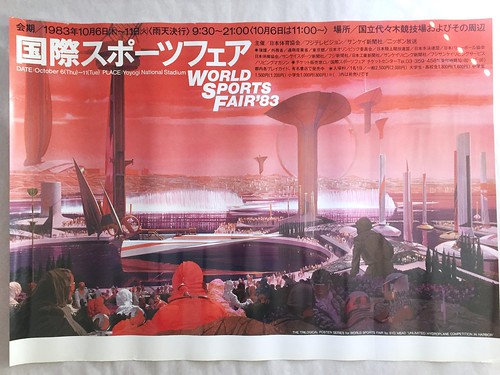
A poster apparently designed by Syd Mead for the 1983 World Sports Fair in Japan
Syd Mead created designs and conceptual art for clients including Ford Motor Company and Philips Electronics.
In the 1970s and 1980s, Mead and his company provided architectural renderings, both interior and exterior, for clients including Intercontinental Hotels, 3D International, Harwood Taylor & Associates, Don Ghia, Gresham & Smith and Philip Koether Architects.
As the 1980s came around Mead developed working relationships a number of Japanese corporations including Sony, Minolta, Dentsu, Dyflex, Tiger Corporation, Seibu, Mitsukoshi, Bandai, NHK and Honda.
Mead cemented his place on popular culture with his work on
Mead’s world, was the world that my generation were promised but was never delivered. Instead we got social media. (If you want to see more of Mead’s work I suggest Sentury and Sentury II.)
NEOM advert in the FT
NASA has an art program that is still running, all be it in a diminished form today. During the 1970s NASA Art Program artists and researchers at the NASA Ames Research Center explored what a future space colony might look like.
Toroidal Colony – Cutaway view, exposing the interior. Art work: Rick Guidice. NASA Ames Research Center
Torus Interior. Interior view. Art work: Don Davis. NASA Ames Research Center
That feeling of retrofuturism might not be accidental. An architect writing in the FT commented on the similarity between The Line and a concept proposed (as more a provocation or thought experiment) by a group of Italian artists called Superstudio who proposed a white gridded wall across the Arizona desert in the late 1960s called Il MonumentoContinuo or Continuous Monument in English.
The case for a city like The Line
Firstly, Saudi Arabia has to do something, doing nothing isn’t an option.
At the moment, the population is growing at about 1.65% a year and the average age of the population is just below 30 years old. By comparison the population in the UK is 43. Energy consumption tripled from 1981 to 2010 and if things carry on like this the country will soon move from being the worlds largest energy exporter, to a net importer.
The Saudis only have so much time to do something before the favourable petro-economy conditions turn against them.
The demand for oil won’t dry up completely, but the economics change when oil becomes about supplying legacy transport in the developing world, which will likely go on for a long while, together with a small amount of vintage vehicles run by enthusiasts.
To give you an idea of how long this can be. Leaded petrol started its phase out in cars back in 1975, in the US, and only stopped being sold in 2021. Leaded fuel is still used for some aviation power plants.
Then there will also be a continued need for chemical feedstocks for the likes of the pharmaceuticals sector and manufacturing. At the moment Saudi Arabia’s GDP is just under 600 billion pounds a year, but that doesn’t mean that it will stay at this level for long, or by how much it will decline.
Then there is the challenge of making Arabian peninsula liveable during climate change. They’ve seen the Arab spring in Egypt and Tunisia, or the Syrian civil war and they don’t want it to happen in Saudi Arabia.
Concentrated populations in cities are better for the environment than having them spread out homesteading or living in suburbia. Less environmental impact delivering services. All of which Stewart Brand puts the case for; far more elegantly than I could in his Whole Earth Discipline: An Ecopragmatist Manifesto.
Where does my own opinion lie on The Line?
I can understand why the Saudis have gone there. They have sound pragmatic reasons for doing something.
I also feel nostalgic about the childhood future I dreamed of seeing when I looked at Syd Mead and the NASA space colony art work in children’s science books and a sense of a bright future lost.
But I don’t know how much of it will actually work.
Will the Saudis be able to find design fixes for migrating birds or animals in the same way that roads have developed overpasses or underpasses in the west?
Will the smart city systems work?
What about the renewable energy capacity?
Will there be an economy inside The Line? What will it look like?
What kind of society will be constructed inside The Line?
Will The Line be able to cope with an extreme weather event like a sandstorm, or the flash floods from rare rainstorms that occasionally happen even in the desert?
How will the infrastructure be repaired or upgraded once its all built?
Will the Saudis be able to afford completing The Line, or will they run out of money? The 2008 financial crisis crushed development in Dubai the following year and the aftershocks are still being felt through stretching out debt deadlines. Dubai property developers like Limitless went through successive rounds of financial restructuring. The Line is a project on a far grander scale.
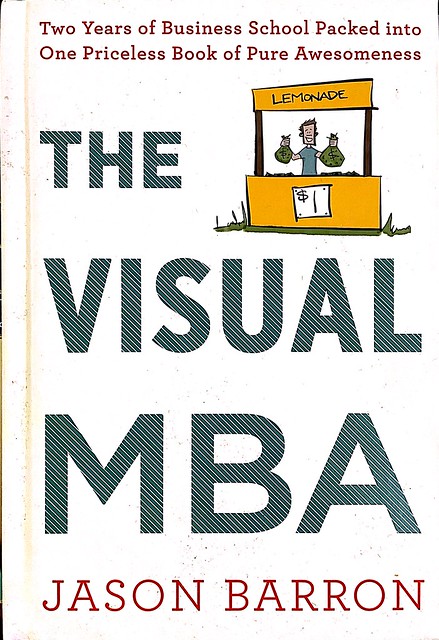
Jason Barron’s book The Visual MBA looks to distill down business principles into more easily understandable formats. The Visual MBA has been translated into a number of European languages since it was published in 2019, which is a good indicator of the book’s utility. So I thought I would take the time to reviewThe Visual MBA and see how I got on with it and whether it lives up to its premise.
Areas covered in The Visual MBA
The content of The Visual MBA is broken down into a number of areas including:
Leadership
Corporate financial reporting
Entrepreneurship (management and financial focus)
Management accounting
Business finance
Marketing
Operations management
HR
Strategy
Ethics
Decision making
Startups
The book itself is a robust hardback book that would be fine in a daypack lugged around campus. As with any book there are things that could be put in and taken away. My impression of the content is that would be useful to someone studying business at A’level or in the first year of an undergraduate degree. I personally found the marketing section frustrating. Part of the reason for this is that the depth of the subject was barely scratched. Readers were not prompted to even ask the right kind of questions.
There was nothing that would spur you to read more and read widely. I suspect that this would be the case with the other areas covered by the book as well. It creates the false confidence that would appeal to a surface player. I think that is dangerous for readers and the businesses that they work for.
Do I think the premise of the book works?
The book neatly summarises many of the key concepts that would be taught in a general business course and it explains the points in a simple manner. For instance the idea of balance sheets reminded me of the first semester in the first year of my marketing degree in terms of its explanations.
Where I am less sure of the book’s benefits was whether the illustrations would make me retain any better the content of the book? I will ignore the fact that for some pages the drawings weren’t illustrated but instead representations of the headlines in a hand drawn typography. I might the book beneficial if they were my diagrams that I was sketching in my notes. But I don’t think they have the same effect on a reader of the book.
In summary I would recommend that one buys the book as a simple guide to business studies or commerce rather than the visual aide memoire that the book seems to promise. If this sounds of interest to you you can get more information here.
Before there were minivans, MPVs (multi-purpose vehicles) and people carriers there was the the Peugeot 505 estate. It had three rows of seats. As a child, I remember that the diesel version was used for private hire cars transporting families to the airport and similar uses. At the time, private hire companies used to have names like ‘Airport Express’ and other terms. This was decades before Addison Lee or Uber. The Peugeot 505 could still be seen in Africa and the middle east well into the 2010s, which gives you an idea of how robust the Peugeot 505 and the relative simplicity of repair. It was Peugeot’s last rear wheel drive vehicle. The Peugeot 505 could be found in turbo and GTi versions and was converted by Dangel to become a port-SUV. Four wheel drive, but a monocoque chassis rather than the frame-and-ladder structure still used by serious four wheel drive vehicles like the old model Land Rover Defender, and current Toyota Land Cruiser, Lexus LX and Toyota Hilux pick-ups.
Consumer behaviour
The Secret to Being Lucky | WIRED – we’re only as lucky as we think we are. We only find luck when we look for it. Better still—for those who like action items—luck begets luck. You look for sunny weather, you’re more likely to find it; you find it, you come to think you’re lucky; you try your luck looking for more sunny weather and you luck out again. In Aeon magazine, Hales wrote, “Luck might not be a genuine quality of the world at all.” Fine. But neither is beauty or justice. At the same time, the Bloomsburg researchers discovered “a significant positive correlation” between people’s temperaments and how lucky they thought others were. “One of the things this means is that the more optimistic you are, the more you think others are lucky.” For “optimistic,” I might substitute “happy-go-lucky.”
The airline lounge has arrived at destination undignified | Comment | The Sunday Times – It’s summer 2022, a weekday morning and at Heathrow terminal 2 the “fast track” is closed to premium travellers (lack of staff) and, over at terminal 5, passengers are confusing the BA lounge with a branch of M&S, an adult daycare centre and their living rooms. Buffets are raided and carry-ons filled with cans and bottles, grown men and women are wandering around in what they think is chic athleisure but is really just synthetic jammies, trainers are propped up on tables and every other passenger seems to be suffering from an overheating crotch as legs are splayed wide open. – nice summation of British consumer behaviour
Audi’s digital matrix headlights: do they work? | CAR Magazine – I would not of thought that DLP chips would find their way into car headlights to provide a MEMS powered version of the old swivelling headlights that I remember of Peugeots of the 1990s
Sony will work with Honda to build EVs | CAR Magazine – If I had the money and was in the market I would be happy buying a Sony branded car – a ‘Sony Driveman’ if you will. It makes sense that Honda would partner for electric vehicles. I think that this and Toyota and Hyundai‘s separate hydrogen programmes are a couple of the most exciting developments at the moment
Amazon acquires Roomba maker iRobot for $1.7bn | Financial Times – Amazon is in a tussle with the European Commission over the placement of its own-brand products on its platform. Antitrust regulators suggested Amazon was using its size, power and data to prioritise its own items over competing merchants on its ecommerce platform. The commission is seeking views by September 9 on concessions offered by the tech company that aim to address the issues raised – what will the iRobot purchase tell Amazon about the inside of our homes?
Why Is the Web So Monotonous? Google. :: Reasonably Polymorphic – The primary purpose of the web today is “engagement,” which is Silicon Valley jargon for “how many ads can we push through someone’s optical nerve?” Under the purview of engagement, it makes sense to publish webpages on every topic imaginable, regardless of whether or not you know what you’re talking about. In fact, engagement goes up if you don’t know what you’re talking about; your poor reader might mistakenly believe that they’ll find the answer they’re looking for elsewhere on your site. That’s twice the advertising revenue, baby! But the spirit of the early web isn’t gone: the bookmarks I’ve kept these long decades mostly still work, and many of them still receive new content. There’s still weird, amateur, passion-project stuff out there. It’s just hard to find. Which brings us to our main topic: search. This fits in really interesting with The Founder of GeoCities on What Killed the ‘Old’ Internet | Gizmodo
Security
On cruise missiles and precision weapons. There is an interesting paradox between usage and the very slow replacement rates for missiles which affects Russia and western powers.
Software
Tracking the Faceless Killers who Mutilated and Executed a Ukrainian POW – bellingcat – Using the face of the main person of interest, the website search4faces returned a profile on Odnoklassniki, a Russian social network, which contained this individual’s name. This, in turn, allowed researchers to discover a Facebook profile linked to this individual which contained more photographs – these were useful, given that most images of this individual on his other social media profiles were at least six years old. A search on PimEyes using a photograph from this Facebook account returned frames from the aforementioned RIA and RT videos in which the person of interest was visible. As seen in the perils of widely-spread misidentification on Twitter, Russian-created facial recognition algorithms perform poorly with non-Caucasian faces. While the algorithms used by these tools are not openly accessible and verifiable, it is plausible that this poor performance is due to the ethnic and racial bias within the user bases of large Russian social networks such as VKontakte and Odnoklassniki. A 2020 Harvard study revealed facial recognition algorithms’ biased results when working with non-white faces, though most of these studies have focused on American examples and Black faces. – interesting points on facial recognition software used by western and Russian internet services. I imagine that would be different biases in Chinese machine learning algorithms