Category: innovation | 革新 | 독창성 | 改変

Innovation, alongside disruption are two of the most overused words in business at the moment. Like obscenity, many people have their own idea of what innovation is.

Judy Estrin wrote one of the best books about the subject and describes it in terms of hard and soft innovation.

  • Hard innovation is companies like Intel or Qualcomm at the cutting edge of computer science, materials science and physics
  • Soft innovation would be companies like Facebook or Yahoo!. Companies that might create new software but didn’t really add to the corpus of innovation

Silicon Valley has moved from hard to soft innovation as it moved away from actually making things. Santa Clara country no longer deserves its Silicon Valley appellation any more than it deserved the previous ‘garden of delights’ as the apricot orchards turned into factories, office campus buildings and suburbs. It’s probably no coincidence that that expertise has moved east to Taiwan due to globalisation.

It can also be more process orientated shaking up an industry. Years ago I worked at an agency at the time of writing is now called WE Worldwide. At the time the client base was predominantly in business technology, consumer technology and pharmaceutical clients.

The company was looking to build a dedicated presence in consumer marketing. One of the business executives brings along a new business opportunity. The company made fancy crisps (chips in the American parlance). They did so using a virtual model. Having private label manufacturers make to the snacks to their recipe and specification. This went down badly with one of the agency’s founders saying ‘I don’t see what’s innovative about that’. She’d worked exclusively in the IT space and thought any software widget was an innovation. She couldn’t appreciate how this start-ups approach challenged the likes of P&G or Kraft Foods.

  • Pizza Hut Projector Box + more

    Pizza Hut Projector Box

    Pizza Hut Projector Box + Subtraction.com – interesting Pizza Hut projector box design by Ogilvy for Pizza Hut. You know that the image from the Pizza Hut projector is likely to be a bit like watching an old VHS pirated recording of a film. I would have serious worries about a smartphone being bright enough to work. But I can also see how it enable impromptu social watching of content on the Pizza Hut projector box. It also cements the mental linkage between pizza and watching a movie at home

    Business

    Growth accelerates at WPP PR and public affairs arm, but not in UK | PR Week – All regions, except the United Kingdom and continental Europe, were up. It is interesting that public affairs was highlighted as a growth driver

    Fetchr just got $11M to take conventional mail to United Arab Emirates | VentureBeat | Deals | by Sindy Nanclares – so the future of the web is horizontal stratification of concierge services….

    Design

    Why Are Design Firms Stagnating? | Co.Design – some interesting takes on the state of the industrial design sector

    Gadget

    Pens Are Making a High-Tech Comeback | WIRED – first of all, a nice piece of storytelling by Waggener Edstrom; secondly an interesting take on tablet and pen computing which in some ways hasn’t moved on in the past eight years or so

    Distribution challenges for China’s flatlining smartphone sector | TelecomTV – slower movement at the bottom of the market

    Luxury

    Sunglasses Shape Up | Business of Fashion – using design rather than logos to sell. Interesting take on Luxottica being crippled by being unable to take risk – hence boring looking Oakleys and not replicating the variations seen in Bausch & Lomb era Ray-Ban

    Marketing

    Land Rover Adventuregram (@go_for_a_drive) • Instagram photos and videos – interesting creative

    Online

    Freebooting: Stolen YouTube videos going viral on Facebook. | Slate – how Facebook could leapfrog YouTube on the cheap by building critical mass through piracy

    Security

    Hospital Medical Devices Used As Weapons In Cyberattacks | Dark Reading – Some of these devices are based on Windows, for example, Rios says, so they are often susceptible to Windows exploits. “There have been previously reported cases where these devices have become infected by run-of-the-mill malware.  While this malware isn’t custom-made for medical devices, it shows that the devices are vulnerable to exploitation,” says Rios, who is founder of Laconicly LLC.

    PRESS RELEASE: House Passes Massie Amendment to Strengthen Privacy and Security | Congressman Thomas Massie – “When our government weakens encryption software to spy on citizens, it puts everyone at risk.  Hackers can exploit weak encryption to gain access to Americans’ confidential health records and financial information,” said Congressman Massie. More on security related content here.

    Software

    Microsoft Thinks the Smartphone Is Over. It’s Wrong | WIRED – the smartphone isn’t over, but Microsoft realises that there isn’t room for another mobile OS – learning the lessons of OS/2, BeOS and Linux for desktop in the PC eco-system. This comes on the back of Jolla’s decision to focus on software and give up its own hardware business. It has most success selling a secure mobile OS to governments, rather than selling handsets to consumers. More wireless related posts here.

    Telecoms

    Don’t believe the spin BT will not manage EE any better than it’s current owner – Ian Wood quite rightly calls BS on the PR campaign that positions BT as a viable triple play based on its ability to get more value out of EE. If one remembers their history, BT used to own Cellnet and spun it in 2002

    Wireless

    Xiaomi, China’s New Phone Giant, Takes Aim at World – WSJ – interesting that Xiaomi isn’t compared to other domestic brands in this article

  • Nuon & other things

    VM Labs

    Remembering Nuon, the gaming chip that nearly changed the world—but didn’t | Ars Technica UK – it was interesting as a bet against commotisation of PC hardware rather like CDi by Philips by VM Labs. VM Labs Nuon processor looks more like a product of today as the pendulum in semiconductors has swung away from general purpose to tailored designs again. When computing power was the most important thing; general purpose made sense. The move towards computing power per watt changed the balance completely over time towards tailored semiconductors.VM Labs main problem was being ahead of their time.

    Ideas

    RISC vs CISC: What’s the Difference? | EE Times – interesting how architectures have become largely irrelevant over the past few years. It makes sense when one thinks about Apple’s move to Intel. It also says a lot for Intel’s potential opportunity in mobile applications; if Intel doesn’t manage to fumble the ball on chip design, or semiconductor fab process improvements

    Luxury

    LVMH diversifies into Chinese food as sales decline | WantChinaTimes – interesting move. Luxury goods were ‘tools’ of status as is food gifts and restaurants – smart lateral play by LVMH. More luxury related posts here

    Media

    Exactly what does Cannes celebrate? | canalside view – interesting prespectives on Cannes. Cannes comes across as a client knees up. It could be so much more by increasing the knowledge sharing at Cannes

    Microsoft Said to Exit Display Ad Business, Cut 1,200 Jobs – Bloomberg Business – one can only wonder what will happen in the phone business

    Online

    DuckDuckGo Blog : Play Ball! Live Scores for Every MLB Game – chipping away at Google piece-by-piece

    Security

    Sony Pictures: Inside the Hack of the Century, Part 2 – Fortune – a good reason not to register your Sony products because judging by this write-up of the Sony Pictures debacle

    These hackers warned the Internet would become a security disaster. Nobody listened. | The Washington Post – “If you’re looking for computer security, then the Internet is not the place to be,” said Mudge, then 27 and looking like a biblical prophet with long brown hair flowing past his shoulders. The Internet itself, he added, could be taken down “by any of the seven individuals seated before you” with 30 minutes of well-choreographed keystrokes (paywall) – more security related content here

    Technology

    OEM Conundrum – commoditisation, hyoer-competition

    Wireless

    EBN – Jim O’Reilly – Smartphone Saturation Becomes

  • HSBC PMI + more things

    HSBC PMI

    HSBC will no longer provide one of the best gauges of China’s economy – Quartz – but hopefully someone else will step up to do the sponsorship instead. The HSBC PMI measure was the most reliable economic measure coming out of China that was wasn’t skewed by state-owned enterprises (SOEs). SOEs get easy state bank loans where as the private SMEs that the HSBC PMI looks at don’t have that advantage and so provide a ‘truer’ picture of what is actually going on. Does this mean a longer term difficult position for HSBC as well as transparent economic data like the HSBC PMI?

    China

    Born Red – The New Yorker – interesting profile of Xi Jinping

    Culture

    Check out MelodySheep’s album on Bandcamp. More culture related content here.

    483 lines by Seoul-based Kimchi and Chips is a welcome break from 3d projection mapping for interesting visualisations. It reminds me of the work Troika turn out

    Economics

    A generation from now, most of the world’s GDP will come from Asia | Quartz – get ready for the new order of things

    FMCG

    I was doing some research and came across the collaboration between MelodySheep and General Mills to remix Lucky Charms adverts. His interpretation shows a darker side to the kids hunting for Lucky Charms

    Innovation

    SoftBank Robot Pepper Sells Out in a Minute – Japan Real Time – WSJ – via Aldebaran Robotics (paywall) – much of this is about Japanese culture’s positive reception to robots as it is to the quality of Pepper itself. There are other robots that can fill a similar kind of customer service role. Its really worth reading about how Japanese consumers interacted with their Sony Aibo

    Japan

    This wonderful film of Tokyo by Brandon Li which somehow feels as if it should be a Guinness advert, partly due to the narration by Tom O’Bedlam

    It is interesting how the Guinness brand has came to own strong storytelling in advertising.

    Media

    Cannes: Google’s agency-sales head wants to push creativity – Campaign Asia – ZOO – Google’s creative agency butts up against agencies to get creative briefs (paywall)

    Online

    2015/16 Fixture List Released | Barclays Premier League – interesting that the FA are recommending match-by-match hashtags to build conversations on Twitter

    I have been using Ben Haller‘s Fracture fractal screensaver for almost as long as I have used Mac OS X (back when it was called Puma). Michael Clark has a site for images used creating Fracture called Fractal of the Day with achingly beautiful tripped out abstract images. The Mac has traditionally been a home to lots of passionate small software development companies who code thoughtful apps. These apps then build a passionate user community around them.  
    mandelbroitset

    Security

    GCHQ spies discredit targets on the internet – Business Insider – about what I would expect them to be doing. More security related posts here.

    Technology

    I, Cringely The U.S. computer industry is dying and I’ll tell you exactly who is killing it and why – I, Cringely – cloud computing is economics not innovation

  • Space dogyssey & more things

    Space Dogyssey

    Space Dogyssey – beautiful college student animated film. Space Dogyssey is interesting mixed media. A mix of stop animation  and cel animation 

    Roger Linn

    Great panel discussion with three great designers of electronic music instruments: Roger Linn (LinnDrum, Linn 9000, Akai MPC originator), Dave Smith (Prophet 5, MIDI inventor) and Tom Oberheim (Oberheim Voice synthesisers). The LinnDrum

    The Latin Rascals

    Great early mix from The Latin Rascals who were influential remixers, influential producers of freestyle tracks and makers of epic tape edits back in the mid-1980s. The Latin Rascals did amazing remix work, even for the likes of Bruce Springsteen, the Force MDs, the Pet Shop Boys and Duran Duran. They influenced and eventually worked with Arthur Baker and Civilles and Cole. One of the Rascals Tony Moran still produces and DJs.


    Canadian Caper

    Amazing psychadelic artwork drawn by Jack Kirby, that was used to sell in Argo to the Iranians and everyone else for that manner. Argo was a science fiction film project that the CIA used as a cover in order to get diplomatic staff out of Iran during the revolution. Kirby’s drawings were supposed to be concept art and the escapees were pretending to be location scouts. This operation went to be known as the Canadian Caper. It was adapted into a film featuring Ben Affleck called Argo. The original space opera envisioned by Jack Kirby never got beyond the artwork that I have linked to. You can read more about the Canadian Caper as the operation has since been called here.

    Syd Mead inspired animation

    Amazing Mobius / Syd Mead inspired animated video. More design related content. The vivid world that the animator creates is nothing short of stunning. The use of flat colour gives a kind of ‘anti-anime’ feel to the video. Instead it feels like I am looking at a Mobius graphic novel and hallucinating the movement on the page.

  • An odyssey to get online

    I have gone through a number of journeys to get online. This year I will have been connected to the internet for 20 years. I actually had email even longer. Back in 1994, I was working on a temporary contact at a company called Optical Fibres – a collaboration between Corning and UK cable maker BICC. Even back then there was price pressure on optical fibre as globalisation kicked in, less than a decade later where I worked is now a greenfield site, half of which is included in the space for expansion of a Toyota engine factory.

    I had an email address that was a number.
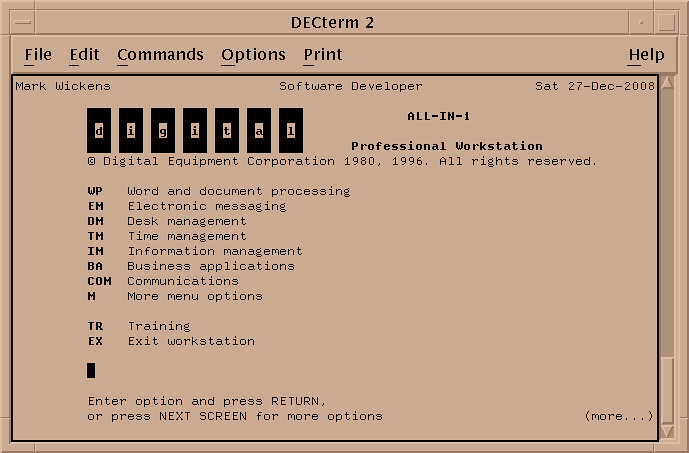
    DEC ALL-IN-1
    It was attached to a DEC VAX ALL-IN-1 productivity suite account. I was able in theory to email anyone who worked at Corning sites around the world. But email was my only form of being able to get online..

    While ALL-IN-1 was able to support external (pre-internet) email networks like CompuServe, I only dealt with people internally. It was a step up from having to check the pinboards in communal areas and the sporadic internal mailroom deliveries.

    Having managed to get online, I sent my first spam email, when I tried to offload some Marks and Spencers vouchers that I had been given on to my colleagues, but that’s a story for another time.

    In September that year I went back to school, this time to university. Computer labs had changed a bit in five years or so since I left secondary education. The computers were on an ethernet local area network, this local network was connected to the nascent internet.

    I had an email address with a ‘@hud.ac.uk’ domain, but my name was still a number. My teachers didn’t use email as part of their teaching process then and you couldn’t submit your work via email. Email was a POP3 format. Given that it saved emails on the machine I spent an inordinate amount of time getting my own computer up for running on the college facilities against the rules.

    It involved a mix of software and hardware kludges, since I had to make use of the AppleTalk port on the laptop to somehow connect to the ethernet network at college.

    Internet access at college was quite liberating. I was able to do online research and cite online articles. I kept in touch with a couple of friends at college and university from home who also had email at the time: for free.

    I got a Yahoo! email address during my last year of college so that I had something which would last me beyond graduation.

    My year after graduation was largely lacking in connectivity. I hunted around for an cyber cafe which were starting to crop up around the place. I eventually found one around the corner from James Street station which I used to go to with my friend Andy on a Saturday. I would bring a floppy disk with my CV on to reply to a series of job ads from The Guardian, PR Week and Campaign. I showed Andy how to use Netscape during this time.

    The cafe atmosphere and dedication to good coffee was reminiscent of independent cafes today in London, I remember seeing a couple of multimedia art exhibits there occasionally – this was back when Flash was bleeding edge and promised a whole new world of visual stimulation.

    A move to London meant around the clock access to the net through work. I lived in a house of five Serbs and no phone line and smartphones were HP personal organisers that allowed you to clip a Nokia 2110 on the back or an infra red connection between an Ericsson SH-888 phone and a laptop or early PalmPilot device.

    I built up a collection of early house music sets encoded in Real Media files from an FTP site in Chicago hosted by the people who ran what become Deephousepage. At the time they used a faculty account at the University of Wisconsin-Madison, which would have provided high quality free hosting.

    A lot of this material was legendary to me, only a small amount of it made it on cassettes as far as Liverpool in the late 1980s. 1980s Chicago was as distant to me as the Northern Soul scene in Wigan some 20 years previously.  My FTP client would run at work during the weekend, I would bring in a CD-R and get it burnt down during the week. I also did the same for the latest software that I used on my Mac.

    After 18 months of shared housing, I bought my own place to the north of London in the Home Counties, nothing fancy, but it was my own space and I could finally have a phone line. At this time, Freeserve was offering fixed price connectivity dialling into a free phone 0800 number. And I had my first email account at home.

    I had a Palm Vx PDA which allowed me to sync web content on to the device and read it on the way home .

    I moved job, wasn’t that keen on it and started to think about what was next and getting ready to potentially go freelancing.
    Jaguar
    The economy went into dot.com freefall and I finally upgraded my computer to a second generation iBook. I then upgraded that machine to OS X and the new operating system highlighted to me the need to go and start using internet broadband. Freeserve was my first choice of DSL provider, simply because it was easy to upgrade from my dial up connection.

    The internet suddenly started to become much more useful. Yahoo! Messenger and email kept me connected to my London-based friends when I walked out of the agency role I had into the world of freelancing.

    Around this time, I got my first smartphone, a Nokia 6600. I had tried using my Nokia 6310i phone as a wireless modem for my Palm PDA but it was a painful process. What moved things forward was the IMAP email account I got as part of Apple iTools. IMAP allows email to be synched across different devices.

    This was all still done over GPRS and later EDGE. 3G services were limited, crippled and the network reception was awful – truth be told it still is in many places. Truth be known things have improved incrementally.

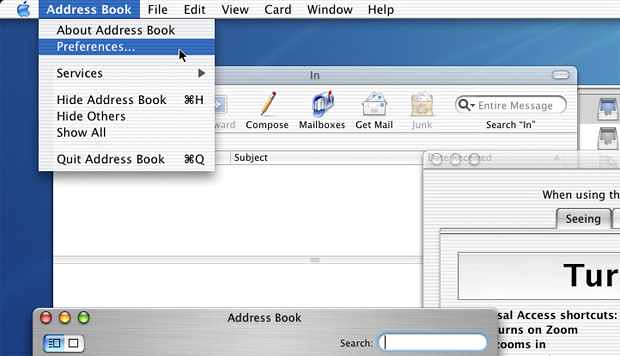
    I went through a succession of Palm Treo and Nokia Symbian smartphones until finally moving to the iPhone. The killer application was an address book that just worked rather than corrupting my data or bricking the handset.

    Whilst the first five years I saw big changes in my wired netizen status, over the past five years my connectivity has changed little if at all. The key change being an iPad at home as an additional mode of access. I still use DSL, mobile internet which is patchy and upgraded equipment around the same essential paradigms. More online related content here.

    More information

    Quick History of ALL-IN-1 | Email Museum