Category: jargon watch | 術語定義 | 용어의 정의 | 用語の定義

Jargon watch as an idea was something that came from my time reading Wired magazine. I found that in my work terms would quickly spring up and just as quickly disappear. So it made sense to capture them in the moment.

The best way of illustrating jargon watch is by example. I came across the term black technology through mainland Chinese friends. One of the key things that Chinese consumers think about technology products is the idea of ‘black technology’. This makes no sense to your average western reader. It equates to cool and innovative.

The term itself comes from a superior technology featured in a Japanese manga series plot. As an aside the relationship between Chinese and popular Japanese culture is becoming increasingly attenuated due to Chinese nationalism.

What might be black technology this year might be humdrum in six months as the companies quickly catch up. Black technology is a constant moving target, but generally its sophisticated and likely has a cyberpunk feeling to it.

I keep an eye out for jargon like this all the time, hence jargon watch. I find this content in my professional reading and in the sources that I follow online. What makes something worthwhile to appear here is purely subjective based about how I feel about it and how much I think it resonates with my ideas or grabs my attention. A lot of British youth culture doesn’t make it because it doesn’t have that much of an impact any more beyond the UK.

  • AI two-step

    The phrase AI two-step is something I first heard from my friend Antony Mayfield. He used it to talk about how companies were adopting the latest developments in AI for business processes. And then reduce headcount to reflect the newly AI derived tasks instead.

    The AI two-step isn’t necessarily a new concept, companies like Pegasystems were using rules-based systems to take away the drudgery of back office work in banking and fund management for decades.

    Further back, companies like Experian, through their access to CCS’ CardPac software provided a service for credit card issuers in the UK using rules-based credit scoring and applications approval. This ran on time-shared mainframe computing resources, which also provided Experian with a good source of ongoing credit worthiness data. All of which reduced the back office work and employees needed by the credit card company. MBNA used to make a virtue out of having every decision reviewed by real live credit analyst, who could overwrite a scoring decision if they saw a compelling reason to do so. (CCS became part of First Data and eventually part of Fiserv).

    HAL 9000

    As these services were being rolled out, there was a corresponding cut in jobs.

    Examples

    Here are just a few examples of businesses adopting AI, some of which are prime examples of the AI two-step.

    IBM

    While IBM may no longer trumpeting its Watson AI service as loudly as it used to, AI methods are dispensing with the need to replace staff who leave the technology company.

    Pfizer’s Charlie

    One might think in the UK that Pfizer should have thought a bit more carefully about the name Charlie, but the aspiration behind the platform is interesting. Charlie was noted to be helping with content creation, fact checking and legal reviews. Research by Bain & Company have found that it isn’t just Pfizer in the pharmaceutical and biotechnology sector that are taking this approach. Some 40 percent of executives who were surveyed said that uses of generative AI were factored into their 2024 budgets.

    Bain indicated uses across a wide range of business functions within pharma:

    • IT programming code review
    • Competitive intelligence
    • Research and biomedical literature review
    • Marketing copy
    • Augmenting the selling process as a sales co-pilot and contact centre automation

    Publicis

    French listed marketing combine Publicis made a high profile adoption of machine learning and AI-based services back in 2017 under the moniker Marcel. Back then Marcel was being used for workflow type tasks and organisation of data. This year Publicis rebranded its approach to the less playful CoreAI, so far it has cut the use of freelance staff – which are usually essential for project delivery in ad agencies, rather than the usual AI two-step of lay-offs.

    UPS

    UPS adoption of AI techniques in everything from workflow to customer service allowed the logistics company to make the largest lay-offs in its 116-year history.

    Clear analogues to the AI two-step?

    Various commentators compare the AI two-step happening to the dot com boom of the mid-1990s to the early 2000s. The comparison with the dot com boom is easy at first. You have businesses that have phenomenal share price growth, widespread interest and experimentation. Business sectors from advertising to Hollywood are concerned about massive disruption.

    The examples I would think about would be factory automation and business process re-engineering. In factor automation, over decades companies used machines to negate the need for unskilled and semi-skilled workers. A friend of mine worked in Huddersfield in a textile mill. He was one of just a couple of people who worked a shift. None of them were weavers, they were engineers and an IT admin who maintained the lines of machines turning out high-end suiting fabric that was mostly sold to Japanese clothing manufacturers. This came very close to being a ‘lights out production line‘ where the product is handmade by robots as they used to say in the old Fiat car advertisements.

    Weavers and machine operators were replaced by a lot fewer, but more expensive roles.

    Business process re-engineering was driven by enterprises implementing enterprise software to drive efficiencies and automate workflows. This was a lucrative time for consultancies who were brought in to shape a company’s workforce and processes to fit a software company’s pre-defined template for that industry. This was usually based on average industry standards. Software giant SAP have been building and refining these templates for the best part of 50 years, each industry template draws on individual units that might cover a business function like HR, finance or asset management.

    A bit of software customisation was needed to fit a given business, and it might have to interface with third party products to handle market complexities such as different tax regimes.

    The consultancy teams also laid-off employees that didn’t fit the framework. That’s what business process re-engineering actually meant.

    Automation was responsible for putting up to 47% of American jobs at risk. However other research indicates that new forms of skilled or professional jobs are being created. One of the big problems with this data is that they are speculative models. More positive takes from businesses fuelling automation like McKinsey and Company versus more critical predictions from government think tanks and academics.

    Factory automation and business process engineering are both similar to the use of AI in business, in that they are primarily helping mature businesses maintain their position and drive efficiency. The dot com boom on the other hand was much more disruptive and spawning more upstart businesses – some of which were very successful and leaving mature businesses struggling to cope. From financial services to media – pre-internet businesses are still struggling to cope with the innovation and disruption that begat the dot com boom.

    Optimists versus pessimists

    The optimists highlight a number of nuances that they think mediates the impact of automation and machine learning over time.

    Tasks over jobs.

    It’s tasks rather than whole jobs are being lost. Yet if you look at the data that Scott Galloway shared in his newsletter and the speedy ‘these job losses aren’t down to AI denials’ this optimistic assumption is pure fiction. The jobs being lost are the second part of the AI two-step.

    Creative destruction.

    Jobs are being created too and it’s often about ‘skill shifts’ rather than ‘job shifts’. While there are redundancies being made, there is a requirement (at the moment) for people skilled in writing ‘prompts’ to get the most out of the AI models created.

    Overconfidence.

    Overconfidence in technology and what it can do. An extension of this is a belief in the perfectibility of technology. A classic example of this is Air Canada’s recently aborted use of an AI-powered customer service chatbot. The airline quietly pulled its chatbot offline after being found legally liable for bad advice given by the customer service bot to a customer.

    Moffatt booked airfares and retrospectively submitted an application for a refund to the reduced bereavement fare after travelling. Air Canada denied the request. Moffatt challenged that decision, saying he was owed the refund because he had relied on the information provided to him by the chatbot on Air Canada’s website. Air Canada admitted that the information provided by the chatbot was “misleading”, but it contested Moffatt’s right to a refund, highlighting that he had been provided with the correct information via the link the chatbot shared in its message.

    The Civil Resolution Tribunal considered whether Air Canda was liable for negligent misrepresentation, which arises under Canadian law when a seller does not exercise reasonable care to ensure its representations are accurate and not misleading. Moffatt was required to show that Air Canada owed him a duty of care, that its representation was untrue, inaccurate or misleading, that Air Canada made the representation negligently, that he reasonably relied on it, and that that reliance resulted in damages. The court held that Moffatt met those requirements.

    The Civil Resolution Tribunal noted that Air Canada had argued that it could not be held liable for information provided by one of its agents, servants or representatives, including a chatbot, but had not explained the basis for that suggestion. The Civil Resolution Tribunal rejected as a “remarkable submission” Air Canada’s suggestion that the chatbot was a separate legal entity that was responsible for its own actions.

    Air Canada chatbot case highlights AI liability risks by Meghan Higgins, Pinsent Masons

    Demographic change.

    Demographics – the idea that aging countries from the west to China, Japan and Korea have skills deficits due to population decline. Automation is one of the coping mechanisms alongside globalisation and migration that have been suggested solutions. The Chinese are also looking at building factories in countries like Ethiopia, who have a young and growing population. Automation makes sense where migration would adversely affect social cohesion and the cost of globalisation would be more expensive than automation technologies. Workers in the global south are dependent on being cheaper than machines, rather like the American legend of John Henry versus the steam engine.

    Companies like Automata have been looking to help businesses automate repetitive low skilled work, such as sandwich making in food service factories or low volume manufacturing tasks.

    John Henry Statue

    The state of automation in different roles is running along at different rates of progress. While John Deere have managed to make the most of arable farmland through the use of telematics and GPS guidance of tractors, automating farming for tasks like harvesting is proving more difficult. This is exasperated in the UK at least by the challenge of getting sustained venture capital for hardware. Technology automation in other sectors such as construction and healthcare continues to move at a slow pace.

    In an area like consumer electronics we have seen benefits and declines in automation. Benefits in the way a company like Apple can manage a sophisticated global supply chain workflow via automated software. Apple has also pioneered the use of robotics in dismantling its more modern smartphones when they are brought in to be recycled.

    The declining area has been one of design choice. Prior to the smartphone and broadband internet, companies like Panasonic designed circuit boards that were less dense with components. The reason for this was to facilitate automated board manufacture through the use of ‘pick and place’.

    Nokia used similar techniques for its cellphones and smartphones until the business was disrupted. Apple iPhones needed much more manual assembly because of the tightly packed components in their phones. Young women were valued for their small hands and manual dexterity leading to concerns about worker conditions.

    More work to be done.

    Creation of new jobs seems to be a matter of faith. IT in businesses drove an increased amount of management, the move online drove a need for webmasters, web designers and online marketers. There is an assumption that over time AI will have a similar effect, beyond people who can write prompts.

    Limiting factors

    Technology

    While GPT based models have surprised both in terms of what they can do and fail to do, there is a belief amongst experts that:

    Data sets will only get you so far. There is no clear path to a new technique, or what older techniques would need to be combined with GPT-based systems. Of the data sets out there, a significant minority could be filled with ‘poison’ data like nightshade.

    That there isn’t enough data to train models in a lot of cases and synthetic data is often used instead. Others believe that this will corrupt and stunt future AI models rather than help them.

    Resources

    AI systems like crypto mining consume a lot of energy and require a lot of water for cooling which is already straining data centres and infrastructure. All of which will impact corporates ESG profile and larger investor relations health. You could have an amazing AI model, but if you have as bad an ESG rating as Exxon you willl struggle to raise funds.

    More information

    Corporate Ozempic | No mercy / no malice

    No, Robots Aren’t Destroying Half of All Jobs | London School of Economics (LSE)

    Antony Mayfield – Antonym newsletter

    AI feedback loop will spell death for future generative models | TechSpot 

    Mixtral 8x7B: Quality, Performance & Price Analysis | Artificial Analysis 

    AI-poisoning tool Nightshade now available for artists to use | VentureBeat 

    AI sucks at telling jokes — but it’s great at analyzing them | The Next Web 

    At WEF in Davos, Sam Altman and Will.i.am differ on AI | Quartz 

  • Innovation signalling

    What is innovation signalling?

    Innovation signalling has some similarities with its counterpart virtue signalling in terms of authenticity in terms of behaviour and the projected image. An organisation looks to demonstrate its ‘high degree’ of innovation with actions and projects with the external image firmly in mind. There may be an internal learning, or business benefit to this as well, but the image projected is the main objective.

    How to Complete Label’s Fashion Challenge in Animal Crossing: New Horizons

    As I wrote this post a collaboration between Moncler and Adidas dropped putting innovation signalling at its core involving both involving NFTs and AI generated designs and models.

    Open Sea has an NFT where the owner gets a Rolex watch on submission of the NFT. This has since been extended into the US market by CRM Jewellers in Miami.

    AI has its place for instance, simulating and optimising product design based on physical properties. NASA has used AI for just this purpose in conjunction with additive manufacturing techniques for small production runs of parts needed for the space programme.

    It’s not just the luxury sector

    This might read like I have been picking excessively on the luxury sector. I use them as exemplars mainly because their examples are so high profile. But there are examples in other sectors. For instance, Walmart partnering with IBM to use block chain to track individual lettuce heads from farm to customer trolley.

    There were similar partnerships that IBM hatched with Unilever, Nestlé and Dole Foods as well, but the fruits of these projects were not publicised to the same degree.

    You can find similar posts here and this metaverse discussion paper that helps to cut through the blockchain and metaverse hype.

    More information

    Dior takes its Chinaverse presence to new heights with second virtual showcase | Digital | Campaign Asia

    How the metaverse downturn is benefitting digital designers | Vogue Business

    Kim Jones designs skins and vintage car for Dior’s gaming debut | Vogue Business

    Inside The Metaverse Strategies Of L’Oréal And LVMH | The Drum

    Meta’s new digital fashion marketplace will sell Prada, Balenciaga and Thom Browne | Vogue Business

    When it comes to Roblox, Gucci is not playing around | Vogue Business

    Gucci Town Lands on Roblox With Activities and Shopping Experiences – Robb Report and Gucci Cosmos Land brings physical heritage to the metaverse | Vogue Business – on The Sandbox

    VR Experience for Santos de Cartier Launch – Virtual Reality Marketing

    Cartier Plugs into VR to Sell Historical Watch Story to China | Jing Daily

    LVMH’s Arnault is wary of the metaverse “bubble”. Should luxury be? | Vogue Business

    Marni introduces digital fashion with new virtual world | Vogue Business

    Tiffany’s Alexandre Arnault joins the NFT Cryptopunks community | Vogue Business

    Roblox earnings: Why enticing brands is key to the future of the metaverse platform – Digiday

    What fashion week looks like in the metaverse | Vogue Business

    Luxury brands are ditching KOLs for virtual influencers in China: how Alexander McQueen, Dior and Prada are turning to digital avatars and AI idols to woo millennials | South China Morning Post

    An Outfit to Match Your Chain – Google Drive – Highsnobriety has interviews where these intersect with luxury and fashion. It will be probably handy for a couple of client presentations

    NASA Turns to AI to Design Mission Hardware | NASA.gov

    From Farm to Blockchain: Walmart Tracks Its Lettuce – The New York Times

    Walmart and 9 Food Giants Team Up on IBM Blockchain Plans | Fortune.com

  • Technonationalism

    Technonationalism as a term has started to spring up in Chinese policy discussions regarding technology trade with the US and China.

    Technonationalism origins

    Technonationalism is a term used by economist Robert Reich in 1987 to describe the relationship between technology and national security. Reich used the term in an article that he wrote for The Atlantic. It originally referred to the intervention of the Reagan administration in the United States to prevent the acquisition of Fairchild Semiconductor by Japan’s Fujitsu. Reich felt that the Reagan administration mis-understood the the technology problems faced by the US and blocking the Fujitsu-Fairchild deal was the wrong thing to do.

    Fairchild Semiconductor
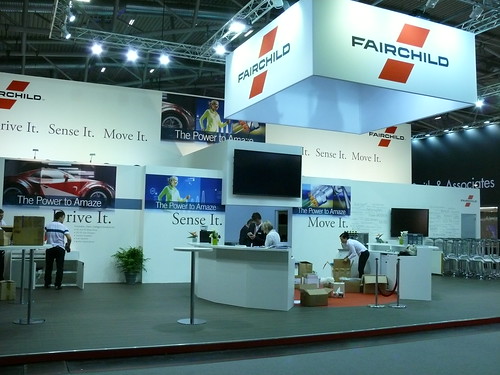
    Elkor Labs photo of Fairchild Semiconductor exhibition stand.

    The China effect

    In English language usage, it started to be mentioned in publications as far back as 1969 and seems to have had two distinct peaks. The first was from the Brezhnev-era Soviet Union through to 1990. The second peak coincides with China’s rise.

    techno-nationalism

    From a Chinese perspective, strategic conflicts between major powers have revitalised the concept in the international political arena. Of course, this ignores China’s own actions and their perceptions by other countries:

    Today, the competition between China and western democracies is focused on critical materials like pharmaceuticals and a range of strategically important advanced technologies.

    These sectors include:

    • Electric vehicles (or as they are called in China new energy vehicles)
    • Drones, virtual reality,
    • Various type of machine learning ‘artificial intelligence’
    • Big data and data mining
    • Robotics and automation
    • 5G networks
    • The Internet of Things (IoT),
    • Synthetic biology

    This conflict is considered more severe than the US – Japanese semiconductor trade friction of the 1980s. But Japan and the US were largely aligned from a political, defence and economic perspectives during this time.

    The technology related to disputed sectors are seen as key to the next generation of defense systems, industrial capabilities and information power China and western democracies.

    Neo-liberalism & technonationalism

    This implies that economics is an extension of defence rather than completely separate, as implied by the western neo-liberal laissez-faire approach to globalisation. This places company leadership dead set against the wider interest of their own western countries. During the cold war with the Soviet bloc western companies were much better aligned with their country’s interests.

    Palmer Luckey’s Anduril represents a notable exception in Silicon Valley and its attitude is remarkably different to the likes of Apple or Microsoft.

    Post-war Asian miracle model

    While technonationalism as a term was given voice in the mid-1980s, one could consider the directed economy efforts by the likes of MITI in Japan and its counterparts in Taiwan and South Korea as being technonationalist in nature.

    From this perspective, technonationalism played a crucial role in post-World War II economic and industrial policies, fostering domestic industries, promoting scientific and technological innovation. These polices propelled Japan to become a global technological power. Korea took a similar tack with Park Chung Hee’s compact with the chaebols and the Taiwan government was crucial in the roots of Taiwan’s dominance in semiconductors.

    Back to the present

    The current increase in technonationalism by China and western democracies means that international trade in many fields will continue to change due to national security concerns evolve. This is often masked in language such as de-risking, de-coupling and de-globalisation.

    More related content here.

    More information

    警惕日本的技术民族主义

    The Rise of Techno-Nationalism | The Atlantic

    Is ‘Made in China 2025’ a Threat to Global Trade? | Council for Foreign Relations

    Chip War by Chris Miller

    How Asia Works: Success and Failure in the World’s Most Dynamic Region by Joe Studwell

  • MCN

    MCN stands for multi-channel network, these are companies, often based in the likes of China and Japan who actively develop popular influencer channels. They work with influencers to help them improve the quality of their content and then build their audience. In return the MCN gets a cut of the revenue from the influencers channel. In some respects it is similar to the traditional model of record labels, in particular their A&R and ‘plugging’ functions.

    Classic examples of MCN augmented influencer channels

    Li Ziqi (李子柒)

    Sichuan native Li had worked in a number of jobs including being a singer and DJ, prior to returning home to the countryside to care for a sick family member. She initially developed video content to help support the family business selling agricultural produce on TaoBao. Eventually she partnered with MCN Hangzhou Weinian Brand Management to shoot and distribute content. This partnership included building a 17.7 million strong subscriber base at the time of writing on YouTube.

    Li has stopped producing content in 2021 due to a dispute with Hangzhou Weinian, the full details of which haven’t been disclosed.

    John Daub

    Daub is an American living in Japan. He started his career in Japan as an English teacher, settled down and married a local woman with whom he has a child. Eventually John Daub got experience in front of the camera as a reporter for NHK World. NHK World is the Japanese equivalent of the BBC World Service.

    Eventually Daub took his NHK World experience online and create his own content alongside his occasional NHK World presenter work. Only In Japan filmed content around the country focusing on food, technology culture and places to visit. Daub partnered with the WAO Corporation in an MCN style relationship to built a channel called WAO RYU!Only in Japan.

    Daub and WAO parted company in 2020. At the time the YouTube channel had 1.35 million subscribers. WAO has continued the add content to the channel but only managed to grow it to 1.44 million subscribers at the time of writing.

    Daub set up a new channel and an audience of 277,000 subscribers. WAO and Daub’s separation seems to be more amicable than Li & Hangzhou Weinian Brand Management. But if they had remained combined, they would have likely become more successful.

    MCN eco-system in China

    mcn

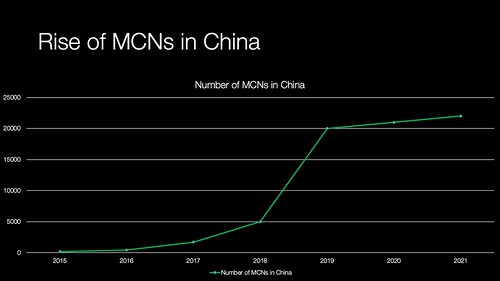
    The MCN eco-system in China has grown in leaps and bounds. This could be everything from houses of live streamers, that are basically e-commerce sweatshops through to TV programme level productions like Li’s channel content. Live streaming services featuring virtual gifting and e-commerce integration was responsible for that step change between 2018 and 2019. This happened despite Chinese government efforts to ‘purify’ internet content.

    More related content can be found here.

  • Clustomers

    Intuit Mailchimp are brave in terms of the the approach that they take to their marketing and Clustomers is a prime example of this.

    Clustomers is a great campaign that builds on the frustrations that marketers face about segmentation and personalisation of communications. It is fantastically single-minded in its execution, which is what you want in an effective advert. I could have been seen how the rats nest of people could have come across as creepy rather than surreal and the art direction gets the tone right wonderfully.

    But I think that the communications around clustomers to be more nuanced.

    The Clustomers campaign

    The Clustomers advert itself is the first point of evidence I would use is a brand building, distinctly non-personal campaign. The fact that I am writing about it, speaks a lot to its ‘talkability’. It has carved out its own small part of culture.

    It looks to place MailChimp as the marketing technology vendor for start-ups and small to medium sized businesses. But like many political campaigns, it promises a simple solution to a challenge that might be more complex.

    But this isn’t a campaign that will be only seen by the small business owner, or someone with a slide hustle. The message of personalisation might be received, without the nuanced understanding of marketing that MailChimp has demonstrated in the way that they’ve built the campaign. CFOs don’t have a sufficient understanding of marketing to understand this. For many of them it’s just a set of line items on the wrong side of a spreadsheet.

    C-suite misconceptions

    As I’ve said, I think that the message Clustomers gives is problematic in a wider context. A good deal of that problem is down to business founders and the C-suite having fundamental misconceptions on what marketing communications purpose is and how it does it.

    Advertising isn’t fluffy or all about colouring in. It’s a legitimate and important tool for driving business success. The trouble is that CEOs, CFOs, founders and investors sometimes forget that fact. They’re sceptical about advertising at the best of times and often pull the plug when the economy feels wobbly.

    Dr Grace Kite, Marketing Week

    Clustomers fuels a perception that personalisation is the key to marketing and by implication performance marketing is the only marketing required. The reality is more complex. The Ehrensberg Bass Institute’s Byron Sharp talks of ‘smart mass marketing’ and brand building as being the key for the majority of marketing activity in conjunction with personalised communication. The Institute of Practioners in Advertising has been doing sterling work trying to educate the C-suite, but technology specialists like Adobe, Google and Meta have been negating a lot of that good work done.

    Portumna

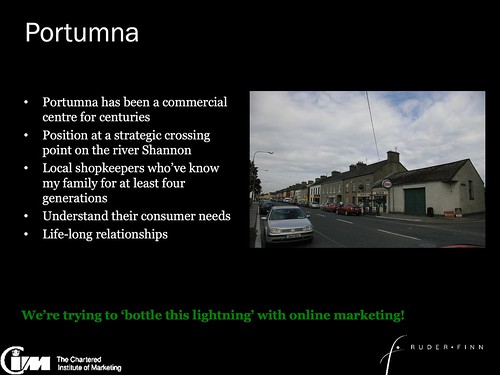
    Prior to COVID-19, back when I presented a lot more in public I used to present the following slide and when I talked to it I probably reflected some of what MailChimp customers would look for, and was behind Clustomers.

    Portumna is the closest market town to where my family originated. My cousin still works part-time on the family farm. Portumna has been a commercial centre for centuries because of geography. It sits at a strategic crossing of the River Shannon. The Shannon divides the east of Ireland from the west of Ireland and has been a shipping way from centuries past to the present day.

    portumna

    A number of the shops including grocery stores, hardware and farm supplies, the sub-post office and the local pharmacy are family businesses. At least four generations of shopkeepers in the town knew my family and did business with them over the centuries.

    There were life-long relationships formed. When I go home, I am loyal to the grocery store and pharmacy that my Uncle and grandparents used. The shopkeepers understood the needs of relatives who lived in the area and the kind of farm that they ran. The kind of online marketing that clustomers seeks to bring forward, is the kind of relationships that were in place in Portumna for centuries.

    But those relationships were not just about personalised communications. There was a wider cultural context and even ‘brand’.

    • The fact that the family in question had built up trust in the community.
    • That they were known to be ‘respectable’.
    • That they had delivered for my family and people that they new in the past.
    • These brands were local oligarchs. They had one or two competitors at best.

    So the customer mental models around farm supplies, the butcher or the grocer were very strong and constantly reinforced. And this is the kind of stuff that advertising as part of non-personal communications is best at doing.