Category: online | 線上 | 온라인으로 | オンライン

The online field has been one of the mainstays since I started writing online in 2003. My act of writing online was partly to understand online as a medium.

Online has changed in nature. It was first a destination and plane of travel. Early netizens saw it as virgin frontier territory, rather like the early American pioneers viewed the open vistas of the western United States. Or later travellers moving west into the newly developing cities and towns from San Francisco to Los Angeles.

America might now be fenced in and the land claimed, but there was a new boundless electronic frontier out there. As the frontier grew more people dialled up to log into it. Then there was the metaphor of web surfing. Surfing the internet as a phrase was popularised by computer programmer Mark McCahill. He saw it as a clear analogue to ‘channel surfing’ changing from station to station on a television set because nothing grabs your attention.

Web surfing tapped into the line of travel and 1990s cool. Surfing like all extreme sport at the time was cool. And the internet grabbed your attention.

Broadband access, wi-fi and mobile data changed the nature of things. It altered what was consumed and where it was consumed. The sitting room TV was connected to the internet to receive content from download and streaming services. Online radio, podcasts and playlists supplanted the transistor radio in the kitchen.

Multi-screening became a thing, tweeting along real time opinions to reality TV and live current affairs programmes. Online became a wrapper that at its worst envelopes us in a media miasma of shrill voices, vacuous content and disinformation.

  • Platform utility

    Silicon Valley VC Andreessen Horowitz put togethers slides that cover platform utility and the role of network effects. The  presentation does a good job at providing a taxonomy on different products. It comes in handy when thinking about channel role / platform utility from a media planning perspective and also evaluating start-up ideas. They define platform in terms of development, but for advertisers we can think of it wider as we are likely to be making API calls in terms of data, targeting and ad placement. It is something that we are building demand or brand equity on.

    Key takeouts from the presentation

    • A network effect occurs when a product or service becomes more valuable to users as more people use it

    Network effect benefits

    • Create barriers to exit for existing users
    • Create barriers to entry for new companies
    • Protect from competitors eating away at margins
    • Creates a winner takes all style market

    Communications networks laws that provide indicators likely platform utility

    • Sarnoff’s law – the value of a network is proportional to the number of viewers
    • Metcalfe’s law – the value of a network is proportional to the square of number of connected users
    • Reed’s law – value of a group forming network is proportional to the number and ease with which groups form within it (subgroups grow faster than sheer number of P2P participants

    If it isn’t clear where they fall within these networks, it’s a warning flag for brands on whether to invest in the platform.

    User modes

    • Single ‘player’ mode – the product has immediate utility for a single user. Examples would be Flickr in the early days for photo storage, Foursquare in the early days to bookmark places you’d been to as a locative memory. Social bookmarking sites like Pinboard, or Delicious would have been in here had it not been retired
    • ‘Multiplayer’ mode – the product has no utility for a single user. This is particularly true for communications products. Examples would be Viber, Skype, Slack, Zoom etc.
    • Products can be both single player and multiplayer. So the community that built around Flickr for example.
    • Single player is more powerful when accompanied by an initial tactic to drive early network growth. Instagram photo filters was a way to post pictures on Twitter before there was enough critical mass. They help with adoption in the early days of a product when network effects aren’t sufficiently strong yet.
    • What’s the initial growth lever or tactic that will get it to scale?

    Case studies

    • Facebook found that connecting a new user to 10 friends within 14 days of sign-up was key to improving retention
    • Focus on daily usage (habit building) to help grow network. Focus on engagement rather than just overall number growth
    • Growth usage, even as user numbers grow is a sure sign of network effects at work
    • Facebook took a clustered approach: Harvard, then Stanford and eventually other universities in the US and abroad. Rather than focusing on growth. The immediate ‘single player’ utility they offered was an online school directory
    • WhatsApp had a different network type to Facebook. Each WhatsApp user had about 20 connections compared to approximately 980 friends on Facebook. Fewer connections also meant clustering around family, close friends of interest based WhatsApp groups with more engagement
    • AirBnB had two sides of their network. More hosts attract more guests and even become guests themselves. More guests means more business and money for hosts
    • Medium found that ‘single player mode’ can help get to ‘multiplayer mode’ through building sufficient critical mass.
  • Facebook messenger content + more

    Next Up: Facebook Messenger Content From Publishers? – will Facebook Messenger content as publishing platform happen? WeChat has already got a mature content platform offering. This provides a clear framework for how Facebook Messenger content could look and feel. A bigger challenge for publishers and Facebook is how to monetise it

    SMARTPHONES: Dakele Becomes First Smartphone Victim – Bottom line: The closure of small smartphone maker Dakele marks the latest distress signal from the sector, with one or more larger, more familiar brands likely to close shop within the next 6 months. Component makers have already gone under

    BMW Group THE NEXT 100 YEARS | BMW Pressclub Global – intersting concepts and ideas

    Facebook pulls demand-side platform from Atlas – Business Insider – bots and bad quality adverts

    Why “Go Viral” Is Not An Effective Content Marketing Strategy | Marketingland – bookmark this article, share it with colleagues, peers and clients

    WPP Reports 5.3% 2015 Organic Revenue Growth | MediaPost – By comparison, Interpublic reported 6.1% organic revenue growth for 2015, while Omnicom Group reported 5.3% and Publicis Groupe reported 1.5%

    How China’s rich shape national policymaking | The Japan Times – Prime Minister Li Keqiang, as part of his report on the government’s plans and activities, announced the launch of an “Internet Plus” strategy. Insiders immediately realized who had coined that term. It was none other than Pony Ma, who had started to use that phrase beginning in 2013, based on the concepts developed by his company’s own research institute. Even though Ma is not a member of the CPC, the “paternity” of the “Internet Plus” is undeniable

    Mutual Funds Sour on Startup Investments – WSJ – feels eerily like the end of the original dot com bust

    ‘Features-as-a-service’ is changing the game for app makers – looks and feels like mash-ups did during the height of web 2.0

    Capturing the Productivity Impact of the ‘Free’ Apps and Other Online Media By Leonard Nakamura and Rachel Soloveichik – or apps haven’t driven productivity any further in the 2000s. it is especially shocking when the product gains from internet connectivity from 1995 – 2000 are considered (PDF)

    Huawei MateBook shipments expected to reach 400,000 units in 2016 | Digitises – Huawei’s MateBook 2-in-1 is expected to achieve annual shipments of 400,000 units, a lot lower than market watchers’ expectations of 1-2 million units as Huawei is mainly pushing the device in the high-end enterprise market instead of consumer segment

    UK newspaper industry: Rewriting the story – FT.com – “The Internet is very tabloid-y,” says one Fleet Street executive. “Facebook is effectively a tabloid – short, attention-grabbing pieces of information.” – (paywall)

  • Online advertising targeting

    Ad blocking has become a thing; with a UK government minister likening it to a protection racket kneecapping online advertising targeting. This felt similar to  the the early 2000s and political action against file sharing.

    A cursory glance of publicly available data shows a few  things:

    • Correctly targeted advertising (in terms of content type, context and placement) would have a substantial receptive audience – if consumer opinions are to be believed
    • Current advertising technologies are negatively impacting consumer web experience by driving up page load times dramatically
    • Ad-blocking usage is steadily increasing, so governments have their work cut out regulating it out of existence

    This starts to paint a picture of something being broken in the way advertisers deploy targeting technologies and the way targeting technologies work.

    Government regulation is only likely to delay industry change. If the music industry is an analogue to follow ad blocking would look at legal means to slow things down and then technological means to resolve the issue.

    The bigger question is, is the problem resolvable? The ad industry is being squeezed on multiple fronts:

    • Ad blockers don’t like the detrimental user experience that they get from interception-based advertising and extremely long page load times
    • The economics of ad funded content doesn’t work for a lot of online publications, leading to a flight to subscription based business models. This would negate ad blocking; because there would be less ad inventory to block
    • Power in online advertising is coalescing in the hands of Amazon, Facebook and Google in the West. In China the equivalent companies would be Tencent, Baidu and Alibaba. Ad blocking is probably the least of many online advertising companies worries
    • In general, online advertising is used in an ineffective short-termist way. Marketing campaigns are becoming less efficient. Marketers are starting to pay attention to this, although the change may take a lot of time. Again this represents a bigger worry in the medium to long term for online advertisers than ad blocking

    More information

    IAB Ad Blocking FAQs 2015 (PDF download)
    IAB Believes Ad Blocking Is Wrong
    Adblocking is a ‘modern-day protection racket’, says culture secretary | The Guardian
    Advertising isn’t the problem with ad-blockers – telecoms edition
    Advertising isn’t the problem with ad-blockers

  • Lotte + more news

    Lotte

    Lotte shareholders reject bid to remove Chairman Shin Dong-bin as family feud continues | The Japan Times – particularly interesting Chaebol feud given the unique Japan-Korea structure of Lotte. Lotte in Korea is huge in FMCG, entertainment, hospitality and retailing. Lotte has been driven out of China by the government. More Korea related posts here

    Business

    Changing of the Guard – Edelman – nice bit of shade by Richard Edelman on group margins and independent versus publicly listed holding groups

    Consumer behaviour

    Which Generation is Most Distracted by Their Phones? | Priceonomics

    Economics

    Silicon Valley Has Not Saved Us From a Productivity Slowdown – The New York Times – In mature economies, higher productivity typically is required for sustained increases in living standards, but the productivity numbers in the United States have been mediocre. Labor productivity has been growing at an average of only 1.3 percent annually since the start of 2005, compared with 2.8 percent annually in the preceding 10 years – Silicon Valley failed

    How to

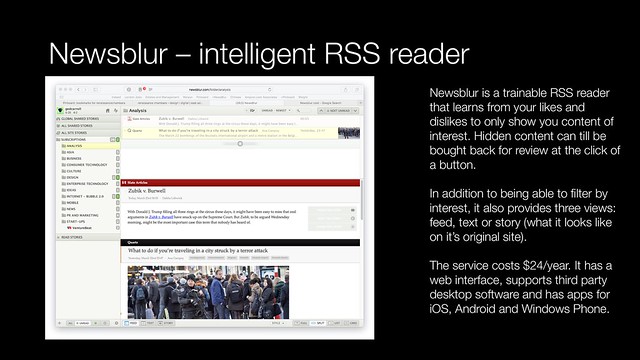
    Tracking story changes with NewsBlur – as if NewsBlur’s learning technology and mobile clients aren’t enough, being able to track changes on stories is a powerful online journalism tool

    Ideas

    The People’s Net – Douglas Rushkoff’s original article on the dot com crash for Yahoo! Internet Life revisited for the current age of unicorns – Time to channel my inner Dave Winer – Joi Ito’s Web and Joichi Ito on the same theme

    The rise of American authoritarianism – Vox – scientific explanation behind Trump but also the pervasive fear of terrorism that has gripped the west

    Korea

    As 4th trial nears, Samsung asks judge: Make Apple stop talking about Korea | Ars Technica – it because perhaps they’ve mentioned the dishonest involvement in political slush funds as background to explain relative brand honesty and trustworthiness?

    Media

    Maxus launches mood-based planning tool | Marketing Interactive – interesting, particularly with political campaigns

    Welcome to the Era of Programmable Marketing – The AppNexus Impressionist – great primer on programmatic

    China’s new television rules ban homosexuality, drinking, and vengeance – Quartz – so that leaves dramas about patriotic war against the Japanese sans Nanking massacre and dramas about Mao sans cultural revolution

    Online

    Apple is Running BitTorrent Trackers in Cupertino – TorrentFreak – Using the file-sharing protocol, we launched a side-project called Murder and after a few days (and especially nights) of nervous full-site tinkering, it turned a 40 minute deploy process into one that lasted just 12 seconds – interesting article that touches on the enterprise use of BitTorrent. I suspect Apple’s use of trackers is IP enforcement related

    Retailing

    It’s Discounted, but Is It a Deal? How List Prices Lost Their Meaning | NYTimes.com – interesting article. I remember being shocked when I was first guided through Shenzhen’s markets where products originally destined for UK markets were sold to local consumers – with price reduction tags already attached.

    No surprise with Powa | Steven Prowse – almost as good as The Kernel’s legendary dissection of SpinVox

    So how much was Powa Technologies really worth? | FT Alphaville – clear gap between claimed value and real value even before administration (paywall)

    Adidas to operate 12,000 shops in China by 2020 in bid to tap growth in leisure wear, sports participation – interesting that they are going to 3,000 additional real-world stores rather than focus on e-tailing (paywall)

    Security

    Swarm of Tiny Pirate Transmitters Gets the Message out in Syria – could also reinvigorate pirate radio…

    The FBI Might Be Apple’s Best Ally In iPhone Encryption Flap | Fast Company – the government messed up and its backfired

    Software

    Microsoft canceled $8 billion Slack bid due to Bill Gates and Satya Nadella pushback – Business Insider – Qi Lu would have known Butterfield from Yahoo! ,both worked in the search business at the some time

    Why I’m breaking up with Slack | Quartz – interesting perspective

    Wireless

    In Search of the Amazingly Elusive Non-Smartphone Owner | Recode – not really surprising. I imagine the privacy aspects might encourage a small set to follow them

  • Oculus + more news

    Oculus Founder: Rift will come to Mac if Apple “ever releases a good computer” | Ars Technica – indicates its basically a very top end gaming machine minimum requirement for Oculus. It also indicates that there will not widespread adoption any time soon. State-of-the-art games consoles don’t cut it either according to Oculus. It means that the bar for content creation will also be very high for Oculus type devices which will have a negative effect on adoption. It will take a while to move Oculus style experience to a wireless device that would allow free movement. Expect at least one VR winter before Oculus type experiences are ready consumer adoption, if there is sufficient volumes of compelling content created

    Marketers Flock to Programmatic Ads Despite Concerns About Fraud and Transparency – WSJ – 79% of advertisers have made programmatic ad buys over the past year. That is up significantly from a similar study that was done in 2014, which found only 35% of the advertisers had used programmatic buying – relatively small sample size of 128 respondents via Forrester Research. Forrester also don’t seem to understand that role that programmatic would play in a media mix and the marketing science for, and against over-personalisation / targeting. It also has implications for businesses in terms of the burden of data that they have to handle (paywall)

    Amazon Quietly Removes Encryption Support from its Gadgets | Motherboard – While Apple is fighting the FBI in court over encryption, Amazon quietly disabled the option to use encryption to protect data on its Android-powered devices. Amazon devices look very similar to Chinese brands in this regards. They’re probably bought by value orientated consumers and it positions privacy as a luxury good. All of which should be a cause of concern for consumers in the medium to long term