I was inspired to write a 2020 media diary after re-reading a post that I had contributed to Stephen Waddington’s blog back in 2015 that looked at my online and offline media consumption. Prior to COVID; it wouldn’t have changed that much from the 2015 variant. In fact in 2020, a lot is still the same through COVID. A number of the changes had happened had been driven prior to COVID.
But lets start off the 2020 media diary with the COVID effects.
Zoom fatigue
When I started off working in agency life. Being able to work from home wasn’t possible for a couple of reasons. I didn’t have my own space that I could work at. Even if I could, I would need to find a block of work where I would need to write and concentrate rather than bounce ideas of colleagues.
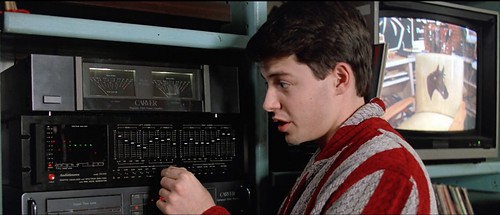
I idealised working from home as a bit like the early bits of Ferris Bueller’s Day Off. Working in my pyjamas, with a kick ass hi-fi. The future is more banal. I own a nice Sony pre and power amp combo rather than a Carver Audio system based around the M-500t power amplifier.
But what its actually meant was an extension of the working day and a blurring of the line between work and personal time. I empathised with those people I saw using the edge of the bed as an office chair and their dressing table as a desk on Zoom calls.
Zoom fatigue set in. Zoom was tiring for a few reasons. Calls were often stacked up one after the other. Secondly you couldn’t carve out blocks of time for it like email. Instead its a constant low level presence; rather like Stack or WhatsApp groups. When you did a group video call, there is a lot happening on screen and its much more of a cognitive load than your average meeting. Finally there is the extension of the working day.
And no, I haven’t managed to work in my dressing gown.
Return of the desktop
If I had written my 2020 media diary before March, I would have referenced discussions around ‘post-PC age’; even if it wasn’t mirrored in my own behaviour. I primarily used my Mac for content creation because I spent a lot of my time outside the home. Not being so mobile has meant that my iPhone has been used less and my Mac has been used much more.
Continuity provided integration across my iPhone, iPad and Mac. All my messenger apps have a desktop client, which I can toggle between on the Mac. A lot of the apps in my personal use made no sense as I have been by my home entertainment set up all the time. Ocado stopped supporting their mobile app as they become overwhelmed with orders; which meant that my shopping was completed on my Mac. My iPhone was then only really useful as a phone.
Messenger for keeping in touch and on track
I have been using messenger clients for almost as long as I have been online. I used to have them all together in an app called Adium X on the Mac. Unfortunately that isn’t possible any longer. Instead I am using a hodge podge of clients
WeChat, LINE, Signal, Skype, Apple Messages, Slack, Zoom, Teams, WhatsApp and KakaoTalk. Over the past 12 months Signal has become very popular and I am using WeChat with contacts inside and outside China much less. Signal took off because of concerns about privacy amongst my network at home and abroad.
Secondly, I have been using my Mac as my primary messaging device which was definitely an effect that COVID had on my 2020 media diary.
From always on to keeping it off
When I started to use internet based services, you made an active decision to get online. You dialled up or logged on. For the best part of the past few decades we moved towards an always-on world. People often complained about the amount of email received at work; the way the email client was a constant draw, when they could be getting things done instead. First my Mac at home was constantly connected to the internet and mobile phones allowed us to be called directly on the go. Then we had mobile email and a nascent web experience. From there it was apps. My 2020 media diary has seen this accelerate even further. Immediacy has been accelerated even further and has been making people burn out and feel sick.
Turning off and keeping the internet off has now become an active decision. All be it, one that has become much harder to make.
Flickr is an archive
Flickr is still my visual archive and an essential part of my 2020 media diary; but since I have been out and about much less. Its less of a source of anxiety for me since Smugmug purchased it from Yahoo!
Facebook is private groups
I continue to use Facebook in a similar way to developer friends using Stack Overflow or other forums for professional social discourse on a couple of private groups. I go directly into the groups, I don’t bother looking at the home page news feed.
Twitter: paring back
Back in 2019, I started to cut back what I posted on Twitter and how long I wanted it to be on there. Generally posts won’t last more than a week on my profile.
My Instagram has been paired back and just shares a record from my collection now and again. Just enough activity for people to know that I am still alive, but that’s it.
Media content
2020 saw me bulk up my vinyl collection. I bought digital music and vinyl records on Bandcamp. I also bought CDs and vinyl from the Discogs marketplace.
The major change has been the way I listen to my music. When I was out and about I use a late model iPod Classic upgraded with 256GB flash memory storage. My listening has now moved to my Mac. I invested in a high quality pair of headphones (Beyerdynamic x Massdrop.com DT177X Go for home listening, they are 32 ohms which makes them very easy to drive). I don’t have to worry about driving them with a big amplifier. I also don’t need noise cancelling to deal with the the clutter of my office surroundings. My Bose headphones are charged but unused for the past eight months.
I have been using my Mac’s native Podcasts app and have pretty much given up watching news from the major UK news channels. The whole Brexit debacle and a failure to hold politicians of all parties accountable meant that I instead listen to content from the likes of RTÉ, CNBC, NPR, NHK and KBS instead. I get this content via their podcasts.
I still have an Apple TV box that I use for Bloomberg TV, Yahoo! Finance (which is surprisingly good), Netflix, Amazon Prime Video and iTunes store content.
News is print, the web and RSS.
Given everything that has been going on, I decided to invest in a print and digital Financial Times subscription. Why print? I like to scan my news quickly on the newspaper with my morning coffee. I can then dive into stories that catch my eye in more depth online. Placement on print provides a layer of context that digital doesn’t really have.
My RSS reader of choice is still Newsblur.com. That is now supplemented through email updates from Sinocism, the China Research Group and a whole pile of marketing and advertising newsletters.
I still read magazines. I am currently subscribed to Monocle and the US edition of Wired magazine. I have print and digital access to both.
Search promiscuity
I still bookmark with pinboard.in and now have almost 55,000 bookmarks at the time of writing. This represents a ‘trusted universe’ of web pages that I often search in first before going to DuckDuckGo and then Google. I use DuckDuckGo as my first option of search engine. It isn’t because it the best, but for many searches its good enough. Going there first means that I am giving Google less of my data, which has incremental benefits from a privacy point of view. I would like to see DuckDuckGo improve the quality of its organic search results, but that is likely to be a slow process since it is based on Bing search technology.
Brands that cut through
I first wrote the headline brands that cut through in my 2015 post. And I started to question as I wrote my 2020 media diary, what does cut through mean in a COVID world? I don’t need the kind of purpose advertising that Dettol came up with in the UK.
For many of the brands that I like, the product is the marketing – the online marketing efforts of these brands are coincidental.
COVID tested service brands. Ocado came close to losing me as a customer.
Hermes reinforced my impression of their service being dreadful.
The Royal Mail and Parcelforce delivery people continued to shine. Though I have qualms about Amazon’s business practices, they did what I wanted them to. Prior to lockdown I had upgraded my parents to a newer model Apple iPad and have Facetimed them every day. Each day the quality has been consistently good.
If one brand stood out in terms of its marketing, it was Carhartt US stood out for me this year in the way that it tried to be useful in a low key way to the essential workers and first responders in its customer base.
Authority in crisis
Five years ago, if you had told me that I wouldn’t be listening to the BBC any longer and that the prime minister would be so bad at handling a crisis. I wouldn’t have believed you. It sounds like some fantastical dystopian vision. Some institutions have managed to burn through a lot of latent goodwill, moral and intellectual authority. But it’s not just the UK. The Hong Kong government has issues that go beyond the 2019 protests; with a diffusion of power and responsibility. In the US, the Trump administration was surreal. The one bright light being Mike Pompeo, who was at least consistent with regards China.
Examples of the kind of good leadership that we should expect, stood out for their abnormality; when in reality it should be the other way around. Democracy should give us great leaders in moments of crisis, shouldn’t it?
Veering towards the jackpot
In William Gibson’s last two books The Peripheral and Agency, there is the concept of a slow and steady apocalypse known as the jackpot. It isn’t one thing that does the human race in like a meteor, a rogue AI or a nuclear holocaust. Instead its a slow drumbeat of events over decades: changes in weather, mass pandemics, flood, drought and populism.
I’ve previously enjoyed William Gibson’s visions of the near and far future. It taught me a lot about technology and where the rubber hit the road between tech and people. 2020 has felt like we’ve veered towards the jackpot. Now having lived in Hong Kong post-SARS, I realise that feeling is overly dramatic. We have historically lucked out in the west. COVID-19 posed a unique challenge, because you spread the virus before you exhibit symptoms, which is remarkably different to SARS and other conditions. I hope I am here in five years time to review this 2020 media diary and write a more upbeat 2025 media diary.