Category: online | 線上 | 온라인으로 | オンライン

The online field has been one of the mainstays since I started writing online in 2003. My act of writing online was partly to understand online as a medium.

Online has changed in nature. It was first a destination and plane of travel. Early netizens saw it as virgin frontier territory, rather like the early American pioneers viewed the open vistas of the western United States. Or later travellers moving west into the newly developing cities and towns from San Francisco to Los Angeles.

America might now be fenced in and the land claimed, but there was a new boundless electronic frontier out there. As the frontier grew more people dialled up to log into it. Then there was the metaphor of web surfing. Surfing the internet as a phrase was popularised by computer programmer Mark McCahill. He saw it as a clear analogue to ‘channel surfing’ changing from station to station on a television set because nothing grabs your attention.

Web surfing tapped into the line of travel and 1990s cool. Surfing like all extreme sport at the time was cool. And the internet grabbed your attention.

Broadband access, wi-fi and mobile data changed the nature of things. It altered what was consumed and where it was consumed. The sitting room TV was connected to the internet to receive content from download and streaming services. Online radio, podcasts and playlists supplanted the transistor radio in the kitchen.

Multi-screening became a thing, tweeting along real time opinions to reality TV and live current affairs programmes. Online became a wrapper that at its worst envelopes us in a media miasma of shrill voices, vacuous content and disinformation.

  • Citizen M Hotel & other things this week

    Citizen M Hotel

    I had some meetings and discovered what a good meeting space the lobby of the Citizen M Hotel in Bankside is. The downside I managed to lose my favourite pen, that was my fault; not the hotel. Of course, that didn’t take the sting out of it.

    The Citizen M Hotel lobby area is part lobby, part co-working space that feels airy, but with some privacy, which makes it ideal for the kind of discussions that I was having at the time. It’s comfortable, but not opulent or luxurious by any stretch of the imagination.

    Eames lounger

    My dream chair is an Eames lounger and I am fascinated by production processes. This video from fulfils both admirably; showing how the Eames chair is made. A few things struck me abut the manufacturing process:

    • The dynamic nature of curved plywood, that is used in ways that plastics might be used now for structural strength, for instance in the Aeron chair that I am currently sat in.
    • The user serviceability of the product item, making it relatively easy to repair for a user or a professional with the right tools and parts.
    • In the same way that we’ve been divorced from how our food is grown, globalisation has divorced us from how things are made. This is particularly true in a de-industrialised country like the UK

    Jeremy Healy

    This week, I went back, way back, back into time and ended up listening to this mix of Jeremy Healy at Hot To Trot. What gets me about this is diversity of the set. The slight crunchiness in the beat mixing early on adds to its charm. Now of course, these sets would be laid out in Digidesign allowing for a seamless flow. More culture related content here.

    Chinese privacy

    This Chinese made video on privacy has more than an element of truth beneath the humour. It would give Black Mirror a good run for its money.

    Global digital snapshot

    Last thought… 2018 Q2 Global Digital Statshot by wearesocial

  • RSS renaissance + more news

    Now Is The Perfect Time For An RSS Renaissance | Neflabs – great read and a much needed request for a lean web. There has been a post-Google Reader RSS renaissance in terms of readers out there. My favourite reader of the RSS renaissance is Newsblur

    Here’s What Facebook Won’t Let You Post | WIRED – pretty grim read

    CIA agents in ‘about 30 countries’ tracked by technology, top official says – CNNPolitics – “Singapore’s been doing it for years,” she told CNN following her keynote speech on Sunday morning at the 2018 GEOINT Symposium, hosted by the United States Geospatial Intelligence Foundation. Meyerriecks did not elaborate with further examples. – It makes total sense that the CIA is building a ‘Google Maps’-style dead ground map of areas that they operate in using machine learning. More related content here.

    Chinese cult writer Chen Qiufan on pushing the boundaries of sci-fi | FT – good read with the obligatory name check of Liu Cixin (paywall)

    g2g, brb, and what the loss of early MSN language means | Dazed – interesting change in consumer behaviour as time spent online creeps upwards with the move towards ubiquitous connectivity

    P&G returns to YouTube but with a more selective mindset | Marketing Interactive – ultimately brands are powerless in the face of Google, Facebook and Amazon advertising if they insist on not running with a media neutral approach

    China opposes all forms of protectionism, commerce minister says – says market with high levels of implicit and explicit protection

    No, a keyboard app can’t ‘prevent tragedy from depression’ | Advertising | Campaign Asia – quite shocking claims

    Google’s new video ad format doesn’t need YouTube | Digital | Campaign Asia – interesting move

    AI in the UK white paper | House of Lords – (PDF)

    Microsoft gives up artificial intelligence sales over ethical concerns – interesting positioning, it would be good to get an understanding on on what the board would define as a bad actor

    After Sir Martin Sorrell: The Reckoning | LinkedIn – interesting analysis of the marketing sector, I disagree with the way that some of it hangs together

    Gchat could have saved Google the trouble of launching yet another messaging service. | Slate – what this forgets is that GChat ended up having a lot of bots and spam accounts. For me it was worse than Skype or Yahoo! Messenger at the time. I could see business historians highlighting this as a lost opportunity in the story of Alphabet

  • Coldcut + more things

    CLOT Magazine | COLDCUT, a journey through cut and paste and audiovisual innovation – great overview of Coldcult creative efforts and an interview with the group. Coldcut started off as DJ / producers and along the way evolved into multimedia artists as well. Along the way Coldcut founded the Ninja Tunes record label, and in Hex helped push forward multimedia just before the web came along.

    Flickr Takes Another Sad Turn, Gets Bought by Something Called SmugMug | Gizmodo – I am thankful that flickr hasn’t been shut down but pensive over what the plan SmugMug has. The sale of flickr means that I am pretty much done as an Oath customer then with the exception of Yahoo! Finance news content. More flickr related content here.

    Do Chinese Luxury Consumers Care About British Heritage? | Jing DailyIn the West, we buy into lifestyle brands—we like brands that can sell us everything. But the Chinese consumer likes to go to a specialist for each item. They like to buy their knitwear from one place and their shoes from another. They value quality and are willing to pay for it. – which is where premium streetwear gets in the door

    Facebook – Bipedal voting | Radio Free Mobile – interesting analysis

    EX-99.1 Amazon letter to shareholders – quite a scary document via our Matt

    Agency Layoffs Or Agency Calibration? | Forrester Research – examine the characteristics of the players winning creative assignments for digital experiences. Tech consultancies like Accenture Interactive, Deloitte Digital, IBMiX and PwC are successful with system integration and digital experiences. Their combination of data, strategy, implementation and creative is a potent offering for marketers. Yet, their ability to capture the essence of the brand is still developing. For agencies – large or small, public or independent – brand creativity is differentiating

    A Renewed Vision For WPP | Forrester Research – I don’t think that a technology leader would get creative businesses and you’d end up with yet another ad tech business with the rest of the value withering away but interesting reading

    The Battle for the Gayborhood Has Become A Passive-Aggressive Turf War – I was reading this and thinking about the way Canal Street in Manchester became invaded by hen parties from across the UK from the late 1990s onwards

  • GDPR resources

    Partly due to Cambridge Analytica, General Data Protection Regulation (GDPR) is going to have a more profound impact on data usage globally. GDPR would have been seen as an extra-legal reach, but Facebook is making it look like a good idea.

    I thought I would pull together a few resources that I thought would be of interest around GDPR since there is a lot of snake oil being sold as consultancy around it at the moment. I am not going to pretend that I am an expert, so I thought it would be useful to share some of the GDPR related resources that I have been looking to learn from.

    Not only in terms of what the regulation is, but what techniques can be deplored to act in the spirit as well as the letter of regulations. Demonstrating a basic respect for the consumer won’t harm any brand, but might point to badly designed KPIs that direct and digital marketers might be measured from.

    Andreessen Horowitz put together a good podcast on it.

    Privacy by Design – The 7 Foundational Principles by Ann Cavoukian, Ph.D. (PDF) – is a must read paper for creative agencies and product teams. It is based on work that was started in the late 1990s. Cavoukian lists a site as a reference ‘privacybydesign.ca’ – but that seems to be down.

    1. Start by thinking about privacy by design from the start or as Cavoukian says preventative rather than remedial, proactive rather than reactive
    2.  Privacy as the default setting
    3. Privacy embedded into the design of systems and processes (which sounds like a reinforcement of her first point
    4. Not viewing consent in terms of a zero-sum
    5. Privacy secured throughout the lifecycle from end to end.
    6. Being open and transparent about processes to keep the organisation honest and stakeholders informed
    7. Respect for user privacy based on a user-centric ethos

    Via James Whatley’s newsletter this article on UX –  GDPR: 10 examples of best practice UX for obtaining marketing consent seems to be complementary to Cavoukian’s work. This is in sharp contrast to the dark patterns often used to force consent by many sites.

    More related posts here.

  • App constellations 2018 research

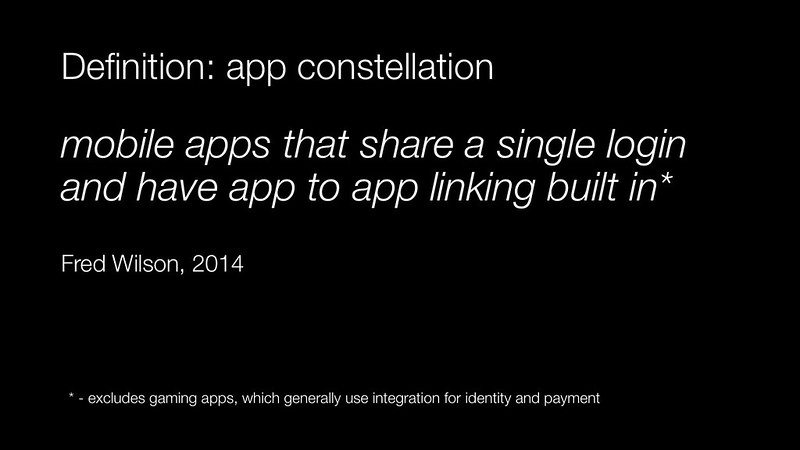
    I initially looked at app constellations back in 2014, when Fred Wilson put a name to the the phenomena. And every two years or so I have gone back and looked at a number of major internet companies to see how many different types of apps that they had in play.

    I originally selected the companies back in 2014 because I felt that they represented the largest and best of their ilk. It skews Asian because the west can be viewed as one eco-system represented by Google, Facebook and Microsoft.

    China is an enclosed eco-system; though Microsoft is actively engaged in the app eco-system there. I chose Tencent and NetEase as being my Chinese bellwethers. DaumKakao and Naver were representative of the Korean eco-system which blends highly-used domestic services with western platforms. Finally LINE of Japan (a subsidiary of Korean company Naver) provided a similar bellwether of the hybrid Japanese eco-system which mirrors Korea.

    App constellations survey methodology

    For the sake of convenience I have compared the contents of Apple’s mobile app store for each of the companies. While most of the internet companies have some Android-only or iOS-only apps; the iOS app store is still a good indicator of their app activity.

    I stayed true to the definition of app constellations in terms of deciding what kind of app should go in.
    App constellation definition

    I manually assessed each app, rather than relying on the category that the app had been submitted into. Tencent and Netease, had a number of mobile utilities that aided discussion and kept players updated on their favourite game. These didn’t fit within the definition.

    Changes in the environment

    Since 2016, a couple of things have changed:

    • Apple had a purge of apps that didn’t support 64 bit processing
    • They moved away from supporting the app store within iTunes application and on the web; to within the app store on the device

    2018 marks over a decade of mobile apps in the Apple store. Many of the major players have delisted almost as many Android and iOS apps as they currently have in the store. This happens for a number of reasons:

    • The app was serving a purpose for a fixed time
    • It is an application that has fallen so far out of favour that it is no longer worth maintaining
    • The code base no longer meets Apple’s or Google’s minimum standards
    Data analysis

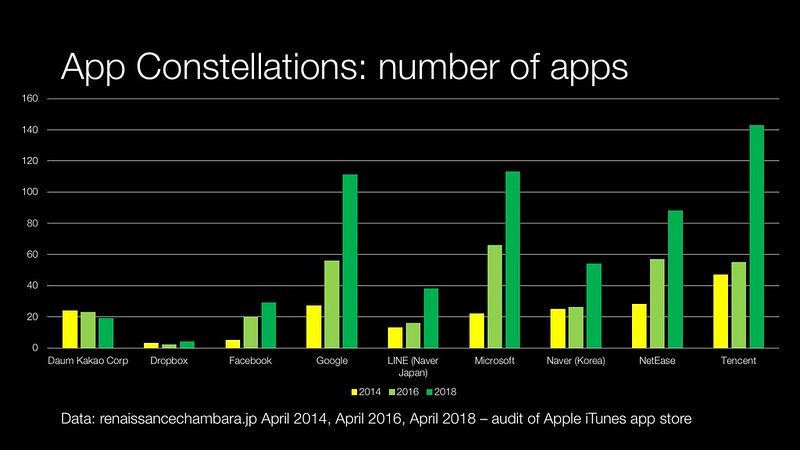
    I started off by looking at the number of apps. In terms of app constellations:  Tencent, Microsoft and Google were clear winners.
    Number of apps

    Both Microsoft and Google’s growth has been driven by ‘experimental’ apps that they have put out in the public for their own reasons and enterprise focused apps.
    compound annual growth in app number

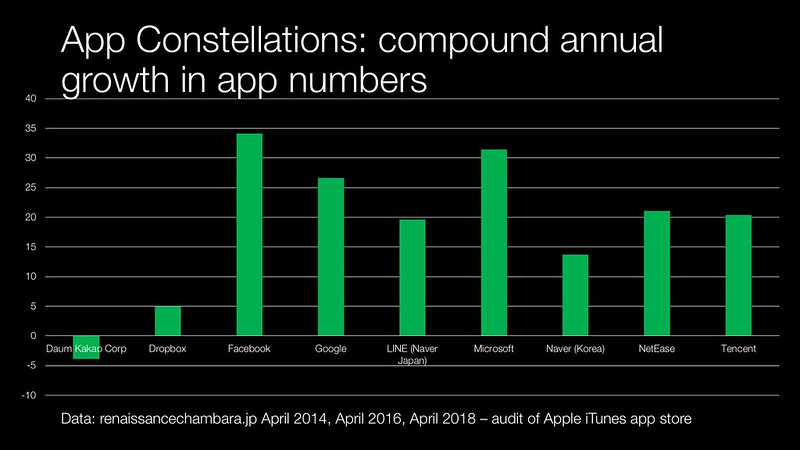
    But it was quickly apparent to me that the number of apps developed were only part of the story. What about the rate of change in numbers of apps developed? This would be indicative of the rate of change in moving to mobile. Here both Facebook and Microsoft’s pivot became immediately apparent. The Asian companies looked less impressive as they had been able to keep steady in their focus on mobile.

    All of this growth in the number of apps developed by major internet companies is all the more remarkable when you consider the following:

    • In mature markets consumers are not really downloading new apps
    • They are sticking with a few in terms of regular usage. Many of the apps on their phones don’t get used
    Notes on a few of the companies in terms of their app constellations
    • Daum Kakao – notable for being the only company who I looked at who had a decline in the number of applications versus 2016. A lot of this seems to be in service consolidation of both Daum and Kakao to remove duplications or non-core services. It is the Daum brand that has taken the biggest impact. This is understandable, since Daum struggled on the move to smartphones and Kakao is a mobile-first brand.
    • Dropbox – the growth in apps has been down to the larger business acquisition strategy at Dropbox. I don’t expect further growth like what we have seen with  Facebook’s pivot to mobile
    • Facebook – Facebook’s pivot to mobile was one of the reason why I decided to look at compound annual growth rate as well as the size of app constellation in terms of app numbers. In terms of raw app ‘SKUs’ Facebook is dwarfed by most of the other companies that I have looked at. It is only by looking at the growth in apps developed where one can really see their move to mobile
    • Netease – was interesting for its focus in a couple of areas. Like other Asian internet companies, education was a big target area, but Netease went into it with major commitment. Both NetEase and Tencent were big in magazine and book apps as well. I think this is down to the fact that ‘traditional’ web surfing is harder to do with (at the moment) when URLs are written in western script and numbers.
    • Tencent – the raw app numbers beggars belief. There are a number of reasons for this. Like NetEase, Tencent has a lot of apps solely optimised for the iPad and a separate iPhone app. There are free and paid-for product variants. Lastly Tencent will have four or five apps competing in a given category like streaming music which seems insane. Only time will tell if Tencent is spreading itself too thin; like when Yahoo! was described Brad Garlinghouse’s Peanut Butter Manifesto
    More information

    Jargon watch: app constellation – back in 2014 when I wrote this post, it still took me the best part of a week to research and describe each of the apps in the main eco-systems. It would take me much longer today due to the growth in apps

    Peanut Buttergate – analysis of Garlinghouse’s original memo about Yahoo! from back in 2006