Soon after I started writing this blog, web services came up as a serious challenger to software. The thing that swung the tide in software’s favour was the rise of the mobile app ecosystems.
Originally mobile apps solved a gnarly problem for smartphone companies. Web services took time to download and were awkward compared to native software.
Now we tend to have a hybrid model where the web holds authentication functionality and the underlying database for many applications to work. If you pick up a Nokia N900 today, while you can appreciate its beautiful design, the device is little more than a glowing brick. Such is the current symbiosis between between software apps and the web services that support them.
That symbiosis is very important, while on the one hand it makes my Yahoo! Finance and Accuweather apps very useful, it also presents security risks. Some of the trouble that dating app Grindr had with regards security was down to the programmers building on third party APIs and not understanding every part of the functionality.
This means that sometimes things that I have categorised as online services might fall into software and vice versa. In that respect what I put in this category takes on a largely arbitrary view of what is software.
The second thing about software is the individual choices as a decision making user, say a lot about us. I love to use Newsblur as an RSS reader as it fits my personal workflow. I know a lot of other people who prefer other readers that do largely the same job in a different way.
Old money style has been a pre-occupation behind the recent fascination with quiet luxury a la Zegna and Loro Piana.
Loro Piana advertising
The fascination with old money style isn’t new. Streetwear brands and hip-hop culture borrowed from preppy style over the years. Brands like Stüssy, A Bathing Ape, Phat Farm and Sean Jean had pieces that aped preppiness – a second old money style. Prior to Phat Farm, Ralph Lauren had trodden the same path and it inspired ‘Dad style’ in Japan.
Barbour jackets moved off the grouse moors and on to the backs of yuppies in the 1980s and 1990s UK – an urban preoccupation that is still maintained today.
Normcore is the practice of wearing great fashion basics that aren’t heavily branded. More related content can be found here and here.
Harry Farrell and Abraham Newman on the weaponisation of the global financial and trade system highlighted in their book Underground Empire. If I had one criticism it would be viewing this purely as an American trait. A classic example would be Chinese policies (cyber-sovereignty, shadow trade sanctions, coerced technology transfer), Russian food terrorism or EU sanctions on Russia.
Bill Gates feels Generative AI has plateaued, says GPT-5 will not be any better | Technology News – The Indian Express – Gates also predicted that in the next two to five years, the accuracy of AI software will witness a considerable increase along with a reduction in cost. This will lead to the creation of new and reliable applications. Interestingly, he also said that he anticipates a stagnation in development initially. The billionaire said that, with GPT-4, the company has reached a limit, and he does not feel that GPT-5 will be better than its predecessor.
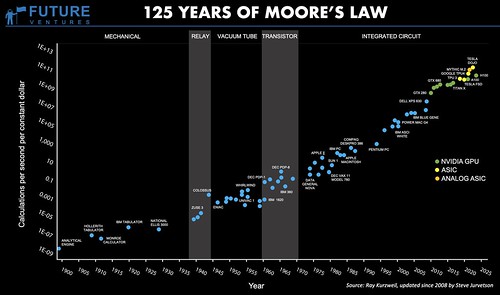
I started thinking about Canon semiconductor manufacturing disruption when I read this article: Canon looks to nanoimprint tech for 2nm lithography | EE News Europe. Canon semiconductor manufacturing disruption looked on the horizon with the announcement of its nano imprint technology. Nano imprint approach is something that has been explored for a a couple of decades, but had so far been rejected due to challenges of implementation.
Future Ventures on Moore’s Law
Canon now claims that they have it ready for production on middle edge processes with a potential address current leading edge processes. Canon has stuck with nano imprint as a development approach because it is adjacent to Canon’s core technology expertise in inkjet printing.
Canon semiconductor disruption depends on whether it can change the technology roadmaps of memory chip makers and other fabs. This is going to be unlikely, but Canon semiconductor manufacturing disruption could disrupt the outlook for other vendors, notably Dutch equipment maker ASML.
Canon semiconductor disruption seems to be part of a wider movement to rethink how semiconductors and adjacent products are manufactured to better facilitate further scaling at reduced capital costs, but few if any will be successful: Dracula plans Europe’s largest OPV plant with inkjet printing | EE News Europe
A New Age Of Genderless Brands? – Branding Strategy Insider – Mikimoto pearls managing to attract men. I see this as an extension of century’s old ‘dandy’ culture from the pearly kings and queens, to 1970s African American style in Detroit and some of Dapper Dan’s work that looked to come up with ostentatious looks.
Chinese Bloggers Might Soon Be Required to Display Their Real Names on Social Media Platforms – the government already knows who they are, this seems to be an effort to expose them more to the general public – which can be volatile and vindictive. And so, this is likely to be an effort to use crowd pressure to reduce divergent or innovative opinions, so the party becomes the originator.
Amazon is thinking about quantumcomputing | Patent Drop – Amazon’s tech essentially acts as a middleman between a quantum computer and the user interface. First, a user makes a request with this service through an “edge computing device” — their own device that isn’t connected to the quantum computer itself. Then the system will “automatically translate the quantum task, quantum algorithm, or quantum circuit” into a representation that a quantum computer can understand. This system will then pick the right quantum computer for a certain job, and work with it on the back end to complete the request
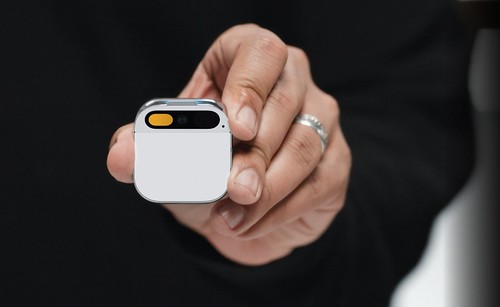
The Humane AI pin has been hyped for a while. Now it’s been launched as a product with what seems to be a small initial batch based on a waiting list and drop type distribution model. I thought I would wait a bit to post on the Humane AI pin and let the dust settle.
The Humane AI pin is an interesting take on a personal device. particularly with its ‘AI experience’ switching – picking the right smarts for the right task. This seem to fulfil the kind of vision that the likes of Kevin Kelly have outlined in the past. It also seems to access communications services like messaging services and the audio design in the product seems interesting. There is also a projected interface of sorts on the Humane AI pin. It’s an interesting alternative direction to the spatial computing vision of Apple’s Vision Pro.
The Humane AI device falls down in being such a network-centric device. Although it has onboard machine learning technology, its reliance on a relationship with T-Mobile US’ cellular network is problematic. Cellular connectivity is not ubiquitous. It is one of several device visions that have been articulated over the years, but what I still don’t understand is the ‘why?’
What’s going to be more interesting is what the Humane AI pin does next?
US law firms rethink China future amid economic woes, data crackdown | Reuters – Of the 73 largest U.S. law firms with a presence in China, 32 shrank their attorney presence in the last decade, according to a Reuters review of data from Leopard Solutions, which tracks law firm hiring. In Beijing, 26 of the 48 largest U.S. law firms drew down their presence since 2018. Worthwhile reading with: US consultancy Gallup withdraws from China | FT – market research was sensitive when I worked in China. Gallup’s business was closer to consulting than a pollster to get around these challenges. Interesting that they can no longer thread the needle in China
China’s family-run businesses face succession challenges – Nikkei Asia – more than 80% of China’s 1 billion private enterprises are family-owned, with about 29% of these businesses in traditional manufacturing. From 2017 to 2022, around three-quarters of China’s family businesses are in the midst of a generational leadership transition
Post-pandemic party’s over as Americans shun cognac | FT – Half of all cognac in the US is drunk by African Americans, a demographic that has been disproportionately affected by the cost of living crisis, according to analysis by Bernstein. The skew to African American consumers is in part due to the fact that French spirits producers ignored the segregation mandated by America’s Jim Crow laws and “cultivated the African American market segment in ways that other producers did not,” said David Crockett, professor of marketing at the University of Illinois Chicago. French spirits producers at the time marketed to Black-owned and targeted publications. As early as the 1970s the advertisements conveyed a message of upward socio-economic mobility, said Naa Oyo Kwate, a sociologist at Rutgers University
Wong wanted to enter the U.S. consulate. The diplomats told him that only the rooms in the St. John’s Building were on offer, and that the office tower did not offer the protection of a diplomatic compound. In Washington, Ngo took the matter up with one of Hawley’s policy advisers, reasoning that the ultra-Trumpian senator might have the president’s ear. Responding at 1 a.m., Hawley’s staffer promised to pass the message on to his boss, but nothing changed. On July 1, the national-security law passed. The diplomats’ positions were the same: Wong couldn’t enter the consulate and couldn’t apply for asylum from outside the United States. Wong and Ngo knew the rules. But they were asking for the same pathway to haven that had been granted to Fang and Chen…
The focus in Washington has moved on from Hong Kong to Taiwan. The island is under constant military threat from Beijing, which claims the territory as its own, even though the Chinese Communist Party has never controlled it. But for those in Taiwan who cherish their democracy, Hong Kong’s story offers a cautionary tale. The United States gave Hong Kong’s cause its vocal backing, then abandoned the city in its time of greatest need.
Asia is much more important to U.S. interests than the Middle East | Noahpinion – East Asian cities like Tokyo, Seoul, Singapore, and until recently, Hong Kong are arguably the world’s most magnificent — hyper-dense and efficient and bustling with life and creativity and personal freedom, but also extremely safe. East Asia is a wealthy region with high quality of life across the board, rivaled only by North Europe and parts of the Anglosphere. Maciej Cegłowski called them “Zeroth World”, and I think that is an apt description. – the burn for Hong Kong on this is real
Ideas
The challenges of sustainable societies and solar punk.
The one where Chandler Bing’s impenetrable job defined a generation | FT – André Spicer, Executive Dean of Bayes Business School, suggests a new category altogether: a “Chandler Bing job”, one indifferent to finding meaning, “low on existential rewards but relatively high on extrinsic rewards, like pay and promotion”. Chandler’s stoicism more broadly reflects Gen X’s tacit acceptance of their lot: the forgotten latchkey kids squished between the Baby Boomers and the Millennials. Jennifer Dunn, author of Friends: A Cultural History, says he “showed that we might not all find fulfilment in the first, or even the longest lasting job we will ever have.” Compared to today’s employers who are increasingly concerned about making their younger colleagues happy, few cared about Gen X’s work-life balance.
Is Open AI the equivalent of Sir Hiram Stevens Maxim? Maxim invented the Maxim gun. A belt fed machine gun that helped colonial powers grab territory in the scramble for Africa. It was reputedly used by one British official to help clear game from land that was soon to be put to farming use in Kenya. Later on it was used by both sides in the Russo-Japanese war and World War 1, due to Maxim’s business associate Sir Basil Zaharoff.
Investors are betting that Open AI will have a similar role in the battle shaping out between tech giants over generative machine learning related processes.
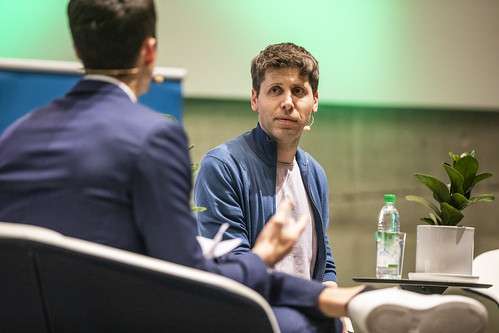
Sam Altman of Open AI
When a company that has issues with making profits can raise money at a valuation of $85bn, it becomes abundantly clear that investors in generative AI have taken leave of their senses
I can understand the argument that Richard Windsor is making with this argument. While others might point out how dominant funding drove Amazon’s present-day monopoly, there are other precedents like Netscape, General Magic, Uber and WeWork that others can point to.
There are bigger questions about whether the LLM approach is in itself a limited model to pursue? If so, Open AI could look more like when IBM bet the farm on Josephson Junctions. The use of synthetic data implies that LLM scaling might already be at its limit. Nvidia looks like a better bet from this angle despite its own extremely high valuation.
Brand purpose has a lot of issues, but it’s worthwhile bearing in mind the kind of marketing Unilever was pushing out prior to buying fully into the concept. These efforts came to light from social sharing about the the British ‘vulgar wave’ that contextualised Russell Brand.
Unilever Heart Brands UK
While China’s ads skewed conservative compared to the UK’s vulgar wave of 1997 – 2012, this Axe (Lynx in the UK and Ireland) ad isn’t exactly on brand purpose. The spokesperson in the advert is Edison Chen. At the time Chen was a star in Hong Kong’s entertainment circles. But getting involved in street fights and a leaked hard drive full of pornographic images of girlfriends he dated meant he withdrew from the industry. Now he is better known for owning streetwear brand CLOT.
Dove Sparks Boycott Calls Over New Partnership—’Never Buy Them Again’ | Newsweek – controversial question, but have Unilever gamed out that conservatives are more likely to use Irish Spring or similar products over Dove? I suspect that there might be something in the semiotics of cleanliness in this. African Americans by contrast might have challenges like ashen skin that would benefit from soap that cleans and moisturises, hence the popularity of shea butter based products.
Hong Kong
Architect Demi Lee on Kowloon’s Walled City. The comparison with the idea of rhizome was very interesting.
Ideas
Demi Lee’s video on how elements of cyberpunk are leaking into our current reality.
Beauty masks have been mainstreamed by the mainstreaming of Asian beauty culture norms. There isn’t the faff of having to make something up or smear something on. Instead, pop the mask on, leave it on for a specified time (usually 15 minutes) and peel off. If Switzerland is the home of fine watchmaking or chocolate; then South Korea is the home of beauty masks. Beauty masks are really relaxing to pop on whilst bingewatching a show or film series.
This footage of beauty mask manufacture in Busan South Korea intrigued me. I was surprised by how small scale production was in this factory, even though it’s a batch manufacture process, I was expecting greater scale given how ubiquitous Korean beauty masks are.
Can Echo Finally Break Through in Home Automation? – Amazon has expanded the Echo line to include models that are tailored to certain use cases and certain rooms – like small screen models for bedside, large screen models for kitchens, high quality speakers for living rooms and dens, and small, inexpensive models for everywhere. We see efforts to get Echos into multiple rooms in Amazon’s promotions, where they sold multiple device packages of the least expensive models in the early days, and aggressively discount a variety of models regularly throughout the year. Amazon clearly has room to go in pursuing this strategy. Nine years in, most Amazon Echo owners still have only one device. In the most recent twelve-month period, 69% of US Echo owners have one, and about one-quarter have two or three
You need to talk to your kid about AI. Here are 6 things you should say. | MIT Technology Review – a variant of sage advice for everyone 1. Don’t forget: AI is not your friend 2. AI models are not replacements for search engines 3. Teachers might accuse you of using an AI when you haven’t 4. Recommender systems are designed to get you hooked and might show you bad stuff 5. Remember to use AI safely and responsibly 6. Don’t miss out on what AI’s actually good at
Move over AI, quantum computing to be most powerful technology | VentureBeat – Leaders in the military and cybersecurity community believe that quantum computing could become a potentially serious threat in 4 – 6 years. Quantum computers have been proven to vastly outperform traditional computers on specific sets of problems. A vastly outperforming computer like this could pose a serious threat to cybersecurity across several critical industries like banking and logistics. While potentially impactful in the future, the technology is currently limited by a lack of ability to reduce probabilities of errors. Extreme temperatures required to operate the computers are also a barrier.