It’s hard to explain to someone who didn’t live through it how transformation technology has been. When I was a child a computer was something mysterious. My Dad has managed to work his way up from the shop floor of the shipyard where he worked and into the planning office.
One evening he broad home some computer paper. I was fascinated by the the way the paper hinged on perforations and had tear off side edges that allowed it to be pulled through the printer with plastic sprockets connecting through holes in the paper.
My Dad used to compile and print off work orders using an ICL mainframe computer that was timeshared by all the shipyards that were part of British Shipbuilders.
I used the paper for years for notes and my childhood drawings. It didn’t make me a computer whiz. I never had a computer when I was at school. My school didn’t have a computer lab. I got to use Windows machines a few times in a regional computer labs. I still use what I learned in Excel spreadsheets now.
My experience with computers started with work and eventually bought my own secondhand Mac. Cut and paste completely changed the way I wrote. I got to use internal email working for Corning and internet connectivity when I went to university. One of my friends had a CompuServe account and I was there when he first met his Mexican wife on an online chatroom, years before Tinder.
Leaving college I set up a Yahoo! email address. I only needed to check my email address once a week, which was fortunate as internet access was expensive. I used to go to Liverpool’s cyber cafe with a friend every Saturday and showed him how to use the internet. I would bring any messages that I needed to send pre-written on a floppy disk that also held my CV.
That is a world away from the technology we enjoy now, where we are enveloped by smartphones and constant connectivity. In some ways the rate of change feels as if it has slowed down compared to the last few decades.
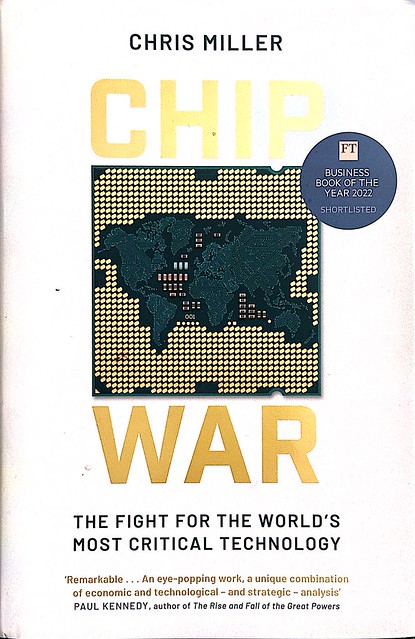
It has taken me far too long to finish Chip War and write this review, so apologies in advance. Chip War was one of the FT’s best business books of 2022. In reality it’s a book about history, that happens to feature businesses.
The lens shaping everything else that I have written here
I am a sucker for books on the history of technology and Chip War was right in my wheelhouse. It complemented, rather than overlapped some of my existing favourite technology history books like Bob Cringely’s Accidental Empires, John Markoff’s What The Dormouse Said or most of Michael Malone and Steven Levy’s output to date.
The author
The author Chris Miller wasn’t a familiar name to me. Unlike Cringely, Markoff, Malone or Levy; Miller is an academic rather than a former journalist. Miller currently teaches international history at Tufts University. Chip War wasn’t his first book, his previous ones have focused on Soviet and Russian history. As a technology sector outsider, Miller’s Chip War has a very different tone my other favourite books from the genre.
It also allowed Miller to view the history of semiconductors in terms of a global perspective, that I hadn’t previously seen done.
On to Chip War itself
Other reviewers have used words like ‘outstanding’ and ‘epic’ to describe the book – which while being a reasonable guide to overall quality and length of read aren’t really all that helpful. It took me six months to read as a casual book. This is partly down to a hectic work schedule and that its a long book. I suspect that some readers when they reviewed the book seem to have thought ‘long’ as difficult to read. It’s actually 351 pages ignoring acknowledgements and the footnotes at the back of the book. Being an academic Miller worked hard to source everything in Chip War.
The book starts in the post-war period as the defence industry moves from being focused on hammering steel to developing smarter systems using semiconductors. That road takes the book past Texas Instruments and the early Silicon Valley of Bob Noyce and other members of the treacherous eight.
The book also zooms out to cover the Soviet Union’s failed efforts to replicate Silicon Valley as well as domestic industrial espionage and the start of globalisation which begat the current industry.
The Japanese challenge is covered in depth as is the rise of Korea including challenges that the industry faced in the early 2000s. The rise of Taiwan and its use of semiconductors as a hedge against invasion from the mainland. European tool maker ASML gets its own section, which is a case study in how to make a virtue of necessity. Finally it covers the technology conflict with China. Bring this up to date circa 2022.
If you are student of Silicon Valley history, then Chip War is unique in the way it puts everything in context. There were some completely new parts to me such as the political role that Sony founder Akio Morita played in advocating for a robust Japanese semiconductor industry as part of reasserting Japanese importance internationally.
You can get hold of Chip War here. More book reviews here.
Switching off as a choice is a relatively new phenomenon. A few blogposts ago I talked about how consumer internet usage started for me 25 years ago. Back then going online was an active choice. In my case I would have to travel to an internet café. Later I would have to dial-in to an ISP or log into a wi-fi network.
Confluence of always-on elements
Wireless home broadband allowed seamless connectivity around the house or the workplace. The next thing that changed was laptop battery battery life improved to the point that one could realistically work for a 8 hours on writing or emailing at a conference or coffee shop without a power cable. Social media became a thing, first it was a positive influence, but gradually it had a more complex social impact.
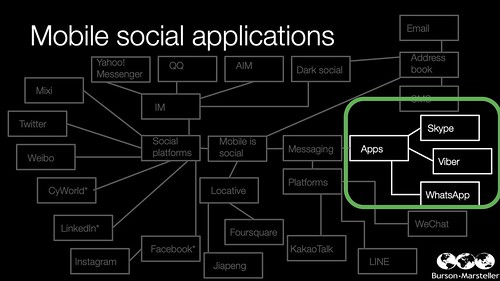
Finally there was smartphones. Nokia, BlackBerry, Palm and Microsoft smartphone attempts gave way to a duopoly of Apple and Alphabet’s respective eco-systems. I went back to an old presentation that I did a number of years ago. Here’s a chart from it, that I pulled together of publicly available active user numbers by time from December 1997 to April 2016.
The dramatic take off in Gmail email accounts in 2011 and beyond is down to the rise of the Android operating system. By 2013, smartphone users were engaged by a series of compelling always-on applications to counter switching off.
Ged Carroll for IMM Conference, Hong Kong (August 2013)
Switching off became important. ‘Crackberry‘ – a light hearted take on smartphone addiction and an ability to turn off peaked as a thing as far back as September 2009 according to Google Trends. 12 months later the Crackberry book advised us on how to put down our smartphones. Four years later, the self-help books became more strident in their exhortations: Put Down Your Damn Phone Already: A (loving) rant about your obnoxious cellphone use being a case in point.
The biggest concerns now, seems to be about two things where correlation if not causality supports beliefs about:
From a professional perspective and increasingly a personal perspective, consumers have become smartphone human cyborgs.
Class as a determinant of switching off
Switching off is also about culture and behaviour. A discussion that I had with a friend about phones being turned off and put in a box before a night at the opera, reminded me of how ‘class’ in its widest sense can be one of the biggest determinants of switching off. You see it in homes that put phones away before a family dinner, or cinema-goers who are happy to turn their phone off before the main feature starts.
The bulk of people may have the devices as always-on pacifiers. This quietens children and is seen as a continued source of confidence and validation rather than switching off.
Secondly, we’re also seeing a small proportion of people choosing to use feature phones as a way of disconnecting. This might happen all the time or at the weekend, when they don’t want to be bothered by Microsoft Teams and WhatsApp messages.
The world’s last internet cafes – Rest of World – Internet cafes were more than just places to log on. They emerged in the waning years of the 20th century — a post-Cold War moment full of techno-optimism. Sharing a global resource like the internet “was going to bring different people in different cultures together in mutual understanding,” historian and author Margaret O’Mara told Rest of World. It was an era in which, both physically and digitally, “people were moving across borders that before were very difficult, if not impossible, to cross.”
The politics of Prada challenged what I knew about the luxury brand. I knew that Prada started off as a handbag company that then pivoted into apparel. I also realised that some Prada items probably borrowed from military clothing design and fabric technology, such as Prada’s iconic black Pocono fabric backpacks.
This is pretty common across Italian design with Stone Island CP Company being prime examples. If you would have asked me about the politics of Prada, I would have expected it to be part of the wider anarcho-far left hatred of all prestige brands.
I didn’t realise that Miuccia Prada’s clothing designs reflected her own left wing, pro-feminist politics. The connections of Prada with yachting has less to do with the politics of Prada and more to do with the passion of her husband and business partner Patrizio Bertelli.
One forgets how politics in Italy, had elements of the far left with the Communist Party and the Red Brigades pitted against reactionary right including the Propaganda Due (P2) masonic lodge and the Bologna central station bombing on August 2, 1980. The politics of Prada is by its nature Italian. More related content here.
Aimé Leon Dore x DJ Stretch Armstrong
Aimé Leon Dore got Stretch Armstrong in for a set playing sublime vintage soul 45s.
Scott Galloway on the intersection of economics and technology
Professor Scott Galloway on the intersection of economics, social trends, consumer trends and technology.
Iran-Contra affair
The Iran-Contra affair was how the president Reagan administration, specifically ‘rogue’ elements within it like Oliver North and John Poindexter, came to swap heavy weaponry with the terrorist sponsoring government of Iran in exchange for the release of American hostages, and how money from these deals came to be diverted to a secret and illegal war in Central America.
Sean Munger provided one of the best accounts of it that I have seen outside of the Congressional report.
The most Hong Kong thing I saw all week
HKIB News – a cable and online TV news channel featured a news story about the first trip of local bus company KMB’s electric double decker bus. At the bus stop was a mix of young and middle aged (mostly) male business enthusiasts. In Hong Kong, bus enthusiasts is much more mainstream in the UK. There are shops that sell die-cast scale models of buses in different liveries, so you can get an exact period-correct bus. Bus enthusiasm and the continued popularity of radio controlled car builds as mainstream hobbies were two distinctive aspects of Hong Kong culture for me.
Much of this is down to the limited size of Hong Kong and the public transport infrastructure. Generations of small children have enjoyed some of their happiest memories starting and ending with a bus trip. Buses are the first line of public transport. Hong Kong, (and Singapore) have a good number of young men and women for which it is the dream career. Which is remarkable given that these are part of the developed world and have a good education system.
Instead in the UK, you have a job that pays minimum wage that no one dreams doing.
LK99 is some sort of lead phosphate compounds called lead apatite with small amounts of copper in it. Apatites are a class of mineral, found in everything from marble to bone and teeth enamel. In marble and other rocks apatites tend to be clear but soft crystals. However, these apatites usually are made of calcium or potassium rather than lead.
The material was discovered by two people at Korea University in 1999.
What’s happened about room temperature semiconductors?
In March, a paper was put online by Korean researchers that proposed a theoretical model of room temperature semiconductors using LK99 as a material. A video was put online that is alleged to support a practical test of a room temperature superconductor.
The theoretical paper was formerly published at the end of April in a Korean journal.
In July, they put a paper online and submitted it for peer review claiming that LK99 had exhibited room temperature superconducting properties. EETimes Europe immediately picked up the paper and pointed out its current pre-publication, pre-peer review status. Early reactions to the paper from experts interviewed by Scientific American indicated a high level of skepticism.
Some claims about about LK99, such as the material’s structure have been verified but at the time of writing the substantive claims of room temperature superconductivity have not been replicated.
What’s a superconductor?
A superconducting material allows electricity to pass through it without resistance. This will also exhibit magnetic properties as a magnetic field occurs at right angles to a flow of electricity.
Superconductivity usually occurs at temperatures near absolute zero.
High temperature semiconductors
In the mid-1980s, IBM Research got everyone excited when it did foundational work on creating special materials that allowed superconductivity to happen at higher temperatures. High temperature superconductivity meant that you could cool the materials with liquid nitrogen, rather than having to use liquid helium. So still extremely cold and often also under extreme pressure. The most common high temperature semiconductors operate at up to -163 centigrade, or 100 Kelvin. The jump from semiconductors operating at -270 centigrade to -163 centigrade bought a lot of hope at the time that a boundless future was just in front of us.
Modern superconductors are used in hospital MRI scanners, which is where most people will get to see them. They are used in these machines to create powerful electro-magnets. High temperature superconducting materials have yet to be used widely in applications like this due to cost.
Potential uses
Cost effective superconductors operating at room temperatures open up a range of possibilities:
Much smaller and cheaper to operate hospital scanners
Improved efficiency for electricity generation and transmission
Improved electric vehicle performance such as practical magnetic levitation railways ushering in aircraft level speeds of travel
More efficient electric motors
Lower power consumption in electronic devices
Commercially viable nuclear fusion for power generation
Launching satellites via a rail gun rather than a rocket
Convention weapons of unimaginable speed and power
If this sounds too good to be true, it might be because it is; or we can’t conceive of the technology to do it successfully yet. Think about how unrealistic an iPhone would have seemed to the boffins of Bletchley Park in the 1940s.
If LK99 were real, it could herald in an exciting future.
Best case scenario, commercialisation takes a long time
Even if LK99 was proven to be a room temperature superconductor, it would take decades to make the technology commercially usable. For example, the forerunner of the modern lithium ion battery was invented by a researcher at Exxon in the early 1970s. They tried to commercialise the battery technology, but eventually stopped due to safety concerns. (Given that this was the 1970s, those safety concerns must have been real and reasonably harsh.)
The Exxon work was built on by multiple universities including Stanford. In 1983, a Japanese team at a joint venture company between Asahi Kasei and Toshiba built an initial prototype, which they then modified and came up with a prototype of a battery close to what we use today in 1985. Sony went on to commercialise the batteries in 1991 and the Asahi Kasei-Toshiba joint venture did so a year later. Sony introduced lithium ion batteries on their Sony CCD-TR1 consumer camcorder in 1991. This was a small (allegedly ‘passport sized’ but more like a stout paperback book to read on holiday) high-end machine at the time featuring Hi-8 (high-band 8mm video recording).
The Ericsson T28 cell phone was notable at the time for its use of a lithium ion battery when it launched in 1999.
Worst case scenario
LK99 adversely affects the reputation of Korea University, one of Korea and the world’s most foremost research universities. There is a lot at stake. You can find out more about materials here.
An interesting documentary from 1971 that explores the idea of ‘The Irish Race’ – it is one episode in a 10-part documentary series ‘We The Irish’. It features some of Ireland’s leading public thinkers at the time including Conor Cruise O’Brien and Seán Ó Faoláin. ‘Race’ as a term is more problematic now than back then as there were so few Irish people who weren’t white European looking as Ireland was a next exporter of people rather than welcoming inbound migrants until recent decades. Secondly, the Irish people were constantly having to establish their identity, culture, language and accomplishments in the shadow of their former colonial rulers.
Ó Faoláin an internationally famous short-story writer, a key part of the Irish arts establishment and a leading commentator and critic – a role played by the likes of Fintan O’Toole today.
The discussion about the Irish race was an essential part of decolonising the Irish identity; by emphasising Irish distinctiveness and salience rather than reinforcing racial superiority. A process that countries like Singapore and Malaysia would wrestle with in subsequent decades too.
Tracing The Irish Race
Ó Faoláin starts his discussion with the book Facts About Ireland that was published for over three decades by the Irish Government. The book itself is like a more in-depth version of the CIA World Fact Book profile on Ireland. It was available in souvenir shops up and down the country, my parents probably have my copy of the 1979 edition that I purchased from Salmon’s newsagent and post office in Portumna
O’Brien was part of the Irish elite. His father was a journalist for a Republican newspaper pre-independence and he married into the political establishment of the Irish Republic. But that shouldn’t take away from his achievements in the various facets of his career by turns was an Irish diplomat, politician, writer, historian and academic.
The series also marks a different kind of high brow factual television than we are used to seeing now.
The Case for a Hard Break With China | Foreign Affairs – U.S. theorists and policymakers ignored the potential risks of integration with an authoritarian peer. Globalization was predicated on liberal economic standards, democratic values, and U.S. cultural norms, all of which were taken for granted by economists and the foreign policy establishment – the arguments in the article are not new, what’s interesting is that they are being run in Foreign Affairs magazine and that should worry China
Tesla’s secret team to suppress thousands of driving range complaints | Reuters – Tesla years ago began exaggerating its vehicles’ potential driving distance – by rigging their range-estimating software. The company decided about a decade ago, for marketing purposes, to write algorithms for its range meter that would show drivers “rosy” projections for the distance it could travel on a full battery, according to a person familiar with an early design of the software for its in-dash readouts. Then, when the battery fell below 50% of its maximum charge, the algorithm would show drivers more realistic projections for their remaining driving range, this person said. To prevent drivers from getting stranded as their predicted range started declining more quickly, Teslas were designed with a “safety buffer,” allowing about 15 miles (24 km) of additional range even after the dash readout showed an empty battery, the source said – fundamentally dishonest
Six Bubble Tea Chains Plan IPOs in Bet on China Consumer Revival – Bloomberg – Firms with fast franchise growth not allowed to list onshore. Mixue, ChaBaiDao, GoodMe among firms weighing listings. Who is to say that these businesses won’t be like Luckin Coffee? If the Chinese government won’t allow them to list at home and they don’t want to list in Hong Kong, one has to wonder about the state of these businesses
A couple of things about this video. Major Australian TV network asked YouTuber ColdFusion to make this documentary. YouTubers are now competing against TV production houses for production briefs. Secondly, the video offers a positive take on how machine learning may impact healthcare.
JustoffJunction.co.uk – genius app for planning British motorway travel, the reason why you would care would be the inflated prices at motorway services stops