Category: technology | 技術 | 기술 | テクノロジー

It’s hard to explain to someone who didn’t live through it how transformation technology has been. When I was a child a computer was something mysterious. My Dad has managed to work his way up from the shop floor of the shipyard where he worked and into the planning office.

One evening he broad home some computer paper. I was fascinated by the the way the paper hinged on perforations and had tear off side edges that allowed it to be pulled through the printer with plastic sprockets connecting through holes in the paper.

My Dad used to compile and print off work orders using an ICL mainframe computer that was timeshared by all the shipyards that were part of British Shipbuilders.

I used the paper for years for notes and my childhood drawings. It didn’t make me a computer whiz. I never had a computer when I was at school. My school didn’t have a computer lab. I got to use Windows machines a few times in a regional computer labs. I still use what I learned in Excel spreadsheets now.

My experience with computers started with work and eventually bought my own secondhand Mac. Cut and paste completely changed the way I wrote. I got to use internal email working for Corning and internet connectivity when I went to university. One of my friends had a CompuServe account and I was there when he first met his Mexican wife on an online chatroom, years before Tinder.

Leaving college I set up a Yahoo! email address. I only needed to check my email address once a week, which was fortunate as internet access was expensive. I used to go to Liverpool’s cyber cafe with a friend every Saturday and showed him how to use the internet. I would bring any messages that I needed to send pre-written on a floppy disk that also held my CV.

That is a world away from the technology we enjoy now, where we are enveloped by smartphones and constant connectivity. In some ways the rate of change feels as if it has slowed down compared to the last few decades.

  • Microsoft Surface

    Some thoughts on the implications of the Microsoft Surface launch:

    Microsoft and tablets

    I found the Microsoft a curious device full of interesting design choices. It was interesting because it seemed to be defined by what it wasn’t. The device was a world way from the clunky tablet keyboard combos by the likes of Fujitsu and Motion Computing who had helped Microsoft get tablets a niche place in the enterprise many years ago.

    The keyboard covers were also an acknowledgement that whilst keyboards are useful tablets aren’t really content creation devices in the sense that ultra books are. The keyboard looked like the kind of membrane keyboard found on industrial computer kiosks or the vintage Texas Instruments Speak’n’Spell toy. For the supposed ultra book competitor it was an interesting choice. As a MacBook Air user, I already chafe at the limited travel keyboard on the device with its limited haptic feedback which acts as a limiting factor on my touch typing speed.

    What I haven’t been able to reconcile is where a tablet fits into my life. I have used one to enjoy my South China Morning Post subscription and have skimmed the online version of Wired magazine (give me the print any day). However most of the time it just services as an ancillary screen displaying ambient media like TweetDeck or the occasional Skype call. Quite how tablets will revolutionise my life is at the moment unclear. My architect friend who evangelised the iPad to me originally seems to be using it a lot less since upgrading to an iPhone 4S, and isn’t in the market for a new iPad unless something radically changes.

    Curious design language

    When I saw the pictures of the Microsoft Surface, the first thing that I thought of when I saw the magenta and cyan keyboards was Nokia’s design language for the Lumia handsets. The Windows 8 colour palette may naturally dictate some of the colour choice, but it did make me think that Nokia could be integrated into a newly muscular hardware division at the right (fire sale) price. Quite how Microsoft would keep the complex carrier relationships and channel together is another matter, maybe I am reading too much into this design choice?

    Microsoft and the PC manufacturer

    Whilst some articles have talked about the Microsoft Surface as signalling a post-PC age; I think that this lacks a certain amount of nuance. It more resembles the approach of corporations who ‘right-size’ their organisations cutting out swathes of management and flattening the organisation to get closer to the consumer. In this respect the Surface is an expression of an aspiration for a post-PC manufacturer age.

    Let’s reflect for a moment on the relationship between Microsoft and its manufacturer partners. The Microsoft monopoly was started off by IBM back in 1981 and innovators like Dell and Compaq were instrumental in driving the PC into the corporate arena. Compaq is now just a memory as part of HP’s business pioneered portable computing, Windows-based PDA devices and the MP3 player. IBM’s ThinkPad line was a mix of robust engineering and clever product design that popularised the notebook as an enterprise computing device. Dell innovated on process, allowing customers machines tailored to their needs, developed new techniques in global supply chain management and pioneered direct-to-customer telephone and online sales.

    By the early noughties however, the PC as a product offered little margin of profit for the manufacturer. Manufacturers like Sony and HP relied on software distribution deals to subsidise the cost of a computer and IBM had realigned its business towards services and consultancy so saw no need for its own PC business.

    It is hard to invest in continual product innovation when you are running flat-out to stay afloat. By this time, Microsoft had maximised its profit on these computers, but its partners had reached the end of their usefulness so a vertically integrated model became inevitable.

    This antagonistic and excessively exploitive approach to business is likely to act as a warning for future Microsoft potential partners like cellular phone and fixed line telecoms providers or handset manufacturers. Every step forward that Microsoft takes disrupts an intricate thread of relationships in markets that are key to the company’s future.

    Microsoft and technical capability

    One of the arcane features of using Microsoft Windows over the years has been getting the different components to talk to each other. A PC gaming rig at one time needed as much care and attention as an MG sports car, tweaking, prodding or even replacing components to get the machine to work with a new game. Prior to Windows’95 it was the Sound Blaster series of audio cards that allowed multimedia playback. A standard that coalesced in spite of Microsoft rather than with their help. All the different hardware permutations that need to be accounted for take a toll on code creation, integrity and innovation.

    By taking control of the complete product including both industrial design and hardware, Microsoft has reduced this effort massively. It means that the all-in-one vertically integrated model of old computing (DEC, Hewlett-Packard, IBM, CDC etc) that was considered to handicap Apple is now economically sensible again. It is like the swing of a massive pendulum with a forty year sweep is finally going backwards.
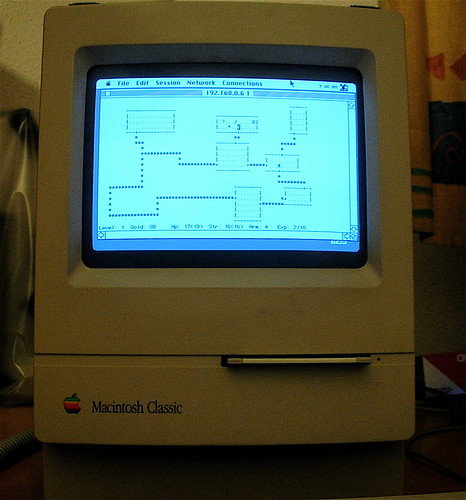
    Rogue on Mac Classic
    When Steve Jobs was commissioning the original sit-up and beg Mac design he looked to the likes of Sony and Cuisinart for inspiration. Apple’s concept of the computer as an appliance took about three decades to get mass-acceptability and the Surface gives it the Microsoft seal of approval as an approach.

    Microsoft and the channel

    The fact that Microsoft is prepared to go to the mats with the manufacturers that have supported its business for the past three decades indicates that Microsoft doesn’t need these people to reach out to the channel. Of course, Microsoft has its own retail channel relationships for software, the XBox and accessories like mice and keyboards. The question is how receptive and/or passive will the channel response be to Microsoft? If Microsoft will roll on partners like Dell and Acer with this tablet launch what will it do to the channel partners?

    Secondly, as the PC industry became unprofitable companies like IBM, HP and Dell moved into services; for large enterprise clients the very manufacturers that Microsoft has just spurned become the channel. Awkward.

    Microsoft and the supply chain

    Looking at the Surface immediately brings home the fact that Microsoft must have worked closely with an original design manufacturer such as the likes of Foxconn, Compal or Quanta to create their tablets. This is a calculated risk by the company involved as it is likely to lose business from affected PC manufacturers.

    The choice of original device manufacturer will be instructive, if it was Quanta in particular, Microsoft is likely to be relying on their patent portfolio to provide the Surface with ‘air cover’.  Foxconn is more likely to invest in specialist production facilities like the thousands of milling machines it uses to produce Apple’s i range of devices.

    You can find more Microsoft related content here.

  • Retina screens

    Unlike most long-term Apple customers, I was disappointed by the new Apple MacBook Pro models with the retina screens.

    What are Retina screens?

    Retina screens aren’t a distinct display technology, they are Apple marketing catchall term for new screens that have a number of distinct properties.

    A pixel density that would be comparable to your basic laser printer output or better. So a large display on a laptop or desktop machine can have a lower pixel count than a phone because they are viewed at further distances. An iPhone would have a pixel density of 325ppi versus a pro display of 210ppi.

    Appliances

    The original Mac Classic was in part inspired by Sony consumer electronics and the Cuisinart range of kitchen equipment. Back then appliance meant that the product worked. Form followed function.

    Globalisation brought a pivot back to manual assembly due to a  large Chinese work force. Product innards could be packed tightly like a watchmaking process. This meant smaller, thinner products were possible. Apple has been moving its consumer products to an appliance model where the products have little to no user serviceable parts because of the way they are designed and assembled.

    Professional equipment in comparison allows a certain amout of configuration and upgrading such as replacing a hard drive, switching out a battery or upgrading the available memory.

    When Apple moved to the unibody MacBook Pros Apple reassured the community that it would make replacement of the buit-in batteries cost effective. The latest models now have batteries that are glued in place so it would require replacement by Apple. (It also dents the computer manufacturer’s claims about the environmental friendliness of its device). You also can’t upgrade the RAM because it is soldered in.

    The flash memory for the solid state drive are proprietary components rather than an ‘off-the-shelf’ drive.

    The screen is now a one-piece unit so if you have a road-warrior accident, its likely to cost even more to replace.

    What you end up is a device that is ‘Pro’ in price, but not in terms of design. It is likely to drive up the total cost of ownership for businesses and consumers.

    More information

    MacBook Pro with Retina Display Teardown – iFixit

    *Archived here from a blog that I used to write for PR Week.

  • Worm by Mark Bowden

    Worm author Mark Bowden is better known for his other non-fiction (non-technology) books Black Hawk Down and Killing Pablo. He has a background as a journalist and has contributed to The Atlantic magazine. I was curious to know how a non-tech journalist would handle a story as complex as the Conficker botnet as some of the subtleties of technology are lost on people from outside the field.

    In terms of timing Worm couldn’t have come out at a better time, Stuxnet autopsies were shedding light on the complexity of the software used to cripple Iran’s nuclear programme and at the time of my reading the book the details of FLAME started to permeate out into the public view.

    Bowden did a good job getting to grips with the personalities that he chose to follow around Conficker and the hapless nature of the US government in facing the potential threat posed by Conficker; but I don’t think that he got under the skin of hacker culture or the technology.

    Because of this aspects of the characters become cartoon-like and the technology in an overly superficial way that is more Marvel than Discovery Channel. And since no one knows who really built Conficker or what it was really designed to do it feels like one of them TV series that gets cut by the network half-way through first run with the script writers desperately trying to tidy away loose ends.

    I found Worm a welcome break from the academic books that seem to be my life at the moment, but somewhat wanting in terms of substance. More book reviews can be found here.

  • London 2012 + more news

    London 2012

    London 2012 brought into sharp focus the high cost and low benefit of hosting the Olympics. The Olympics has a low to negative economic impact. London 2012 was a way of seizing land for redevelopment that benefited a few investors. To do this the organising committee of London 2012 closed down a plethora of small businesses and a previously affordable London neighbourhood was priced out of the reach of many Londoners.

    So, you thought London 2012 was for spectators? Wrong | guardian.co.ukIn 2005 the International Olympic Committee passed a 109-page document to the British Games organisers in which they described, in mind-bending detail, how Lord Coe and his colleagues at the London Organising Committee of the Olympic Games (Locog) should run the media strategy for London 2012. “The preparation period is likely to be the most difficult for Locog in terms of communications,” it explains. “Popular support may decline … soft targets should be identified … Meanwhile, there will be an enormous range of milestones that can be taken advantage of to demonstrate positive progress.” We are now well into what the document calls the operational readiness phase, during which every celebrity “honoured” to carry the Olympic torch has helped Locog satisfy their requirement to show “positive progress” with the Games. The torch run is a truly inspired PR tool. Alas, the hourly stories of its ponderous progress have not yet drowned out all coverage of those “soft target” stories which, with equally ponderous regularity, are beginning to reveal who may stand to benefit most from the Olympics – the corporate sponsors and the IOC themselves. – Not terribly surprising, just emphasises how huge a  mistake of having the London 2012 Olympics was. However The Guardian misses the big picture. The Olympics sees the city captured by a non-governmental body that answers to elites of a criminal or authoritarian nature. They dictate media laws, traffic laws and planning laws. They provide a detailed guide on media manipulation like the example quoted above for London 2012.

    Dazed Digital | East London 2012: Is It Dead? – to give an idea of how London 2012 is facilitating a real estate ponzi scheme: Reuters reported that Shoreditch was on course to become a “mini Bond Street” that would welcome luxury retailers eager to capitalise on Shoreditch’s “edgy image”. Property values in areas such as gallery-strewn Redchurch Street have doubled in the past decade, and have the potential to do so again in the next five years as the retail giants move in. For those stores that chose east London as a cheaper, dirtier alternative to the Royal Borough of Kensington and Chelsea, the unthinkable has happened – the east is now mimicking the west

    Consumer behaviour

    Japan: The Country Where 59% of Households Still Have a Fax – The Atlantic because it works

    Study: First-Time Moms Spend More Time On Facebook After Giving Birth – AllFacebook – it makes sense, keeping in touch and support networks

    Design

    How Products Are Made – does what it says on the tin

    Ken Shirriff’s blog: Apple iPhone charger teardown: quality in a tiny expensive package

    Economics

    The “American Dream” Is Now A Myth – Business Insider

    China exports show big increase | RTHK – Chinese imports also increased. Reversed pattern of (relatively) weak exports

    Fed’s Fisher welcomes China FX moves but caution needed| Reuters – according to top Fed official

    Price has grown steadily as the primary driver of U.S. consumers’ purchasing decisions, – to 66% in 2012 from 60% in 2010 (paywall)

    HK economy shows ‘first signs of fissure’ | SCMP.com – due to weak Eurozone and declining Chinese economic growth (paywall)

    Finance

    Moody’s downgrades German lenders – FT.com

    How to

    Test your IPv6.

    Download Any File or Web Page by Pasting Its URL Into Firefox’s Download Window

    Ideas

    A Celebration of Brandvation | Nigel Scott – new money for old rope well presented

    Is there a terminal velocity for youth and digital? Will we burn out kids out? | The Wall Blog

    Innovation

    Corning Willow Glass announced, enables flexible displays

    Japan

    Oshima’s win in AKB48 election big news in Japan ‹ Japan Today: Japan News and Discussion – Japanese youth do not believe they can change real politics, where old politicians hold a tight grip on power, but they believe they can change AKB48

    Sony market value slumps to lowest since release of Walkman | TechEye

    Korea

    Potential of US-South Korea FTA Extolled – WWD.com (paywall)

    Luxury

    China’s reluctant tourists puzzle officials – FT.com (paywall)

    China’s frugal millionaires: moving beyond bling? | beyondbrics

    Exclusivity is not a criteria for luxury” – FT.com

    European Luxury Union flexes political muscle | Material World

    Media

    Why growth is the least of Facebook’s problems – Nigel Scott on his own version of Facebook Is A Dead Man Walking

    Parents call for ban on Facebook advertising to children – Telegraph

    Slate doubles down on podcasts, courting niche audiences and happy advertisers » Nieman Journalism Lab – charging audience entry to tapings

    Google Makes Renewed Grab for the Rest of Online Advertising – Forbes

    Don’t Mean To Be Alarmist, But The TV Business May Be Starting To Collapse – Business Insider

    Online

    ‘Facebook tax’ could make web companies pay for usage outside the US — Engadget – could also nuke start-ups

    Facebook And Twitter Shares Closely Linked With High Google Search Rankings Says New Research – according to research by Searchmetrics

    Retailing

    Improving Product Returns Presents Biggest Opportunity for Retailers – low-hanging fruit in e-commerce

    Security

    Flame espionage malware issues self-destruct command | Ars Technica

    Germany agency to mine Facebook for credit worthiness info | TechEye

    Ad Networks Bypass iPhone Privacy Rules – WSJ.com – (paywall)

    Software

    App Developers Signal Apple Allegiance Ahead of WWDC and Google I/O

    Samsung Joins Linux Foundation as Platinum Member | The Linux Foundation

    HTC to offer Sony Playstation games on smartphones – Campaign Asia-Pacific – HTC one-ups Samsung in war of content; Flipboard versus PlayStation games

    Why I left Google – Spencer Tipping – probably getting more attention than its worth at the moment, but an interesting point-of-view none the less. Interesting how Google’s engineering culture in some ways conflicts with trying to build a social application / platform

    Technology

    The giants keep getting larger and stronger | EETimes – on technology sector structure

    Sharp, SEL Revamp IGZO TFT — Tech-On!

    Web of no web

    E3 2012: Wonderbook: Book of Spells Features Writing from J.K. Rowling – PlayStation Blog – really impressive print / console game integration to create a web-of-no-web experience makes more sense than mobile augmented reality like Layar

    New Technology Adds Keyboard Feel To Touchscreens – BYTE

    Wireless

    Sharp, Hon Hai to make smartphones for China ‹ Japan Today

    IDC: Nokia moved just 2.2 million Lumias this winter, but stay tuned — Engadget – explains why Microsoft maybe pushing HTC out, to leave room for Nokia

    HTC Said to Be Shut Out of Next Version of Windows – Bloomberg – sounds a bit deja vu

    Communities Dominate Brands: Smartphone Markets Shares in 2012, some relevant illustrations to understand the Bloodbath

    TI OMAP 5 kicks iPad 3 GPU butt

    Face To Face: How Airtime Will Re-Humanize The Internet | TechCrunch

  • Facebook IPO postmortem

    This post is a collection of thoughts that I’ve had about the Facebook IPO, I realise that there may not be a cohesiveness to some of this but I wanted to put it all down in one place. In less than two months, Facebook has gone from being the technology sector darling to its typhoid Mary; what does this all mean?

    One thing as a reader that you may want to bear in mind is that I have been pointing out flaws in the Facebook model since 2008 on this blog, I stand by the content that I put in those earlier posts.

    I have broken this post down into five parts:

    • Factors that maybe influencing the Facebook IPO cynicism
    • How much is Facebook actually worth and did the Facebook IPO over, under or right price it?
    • What are you actually buying with the Facebook IPO?
    • How might the Facebook IPO debacle adversely affect Facebook beyond the class action law suit and likely SEC investigation?
    • The Facebook IPO and those that have gone before

    Factors that maybe influencing the Facebook IPO cynicism

    • Silicon Valley is biased toward the new new thing; since that is where they make their money: the start-up that gets bought or (less likely now) the small public company that grows into a leviathan a la Apple. By comparison Facebook is already a leviathan and the fortunes have been already made
    • There is at least some unease that Facebook represents a turning point for Silicon Valley and not in a good way. It is much easier for VCs to fund ‘easy’ innovation like Facebook rather than ‘hard’ innovation in semiconductor designs and processes or biotechnology. There are also structural aspects to this: the US is no longer the pre-eminent market for new product or service categories, other countries like China and India have the intellectual firepower and capital to do it at home now. Just look at Jack Ma of Alibaba, Robin Li of Baidu and Pony Ma of Tencent. China is designing some of the world’s most powerful supercomputers running on its own chip designs and with both Huawei and ZTE the world’s leading creators of telecoms equipment
    • When you are worth in the region of $100 billion dollars as a company it hard to grow at a respectable percentage, so sustaining a value of 100x earnings is really hard to do as this implies an astronomical continued growth trajectory
    • A subsidiary point to the market capitalisation growth prospects above is that Facebook hit the market with a valuation of 100 times earnings – which implies a massive growth trajectory and in turn a massive leap of faith by shareholders
    • Marketers public disenfranchisement with Facebook as an advertising platform. General Motors announcement that they would not be using Facebook advertising anymore two days before the IPO was a lightning rod for that sentiment. I think that the timing of the announcement indicated a desire to put the knife into Facebook, which gave an idea of how alienated GM felt as a Facebook client
    • Instagram seemed like a rather expensive folly to many at a share only deal worth $1 billion. However paying in shares isn’t like paying in cash and it took a fierce potential competitor off the table
    • The structure of Facebook’s voting arrangements emasculates shareholders, Mark Zuckerberg held some 57% of voting rights post-IPO which makes the stock unattractive to more active institutional investors. For instance, shareholders have a limited ability to push for dividends
    • Facebook managed to alienate rather than inspire trust in institutional investors by doing things differently. Mark Zuckerberg didn’t turn up to the pre-IPO roadshow but instead focused on running Facebook. This was also partly because Facebook didn’t need the capital injection, it was forced to do public reporting because of its number of shareholders, so it may as well go public
    • Facebook priced the IPO to maximise the amount of capital that the company got from the markets and didn’t price in an expensive PR ‘pop’ to the first day share price, so investors didn’t get to enjoy ‘free money’

    How much is Facebook actually worth and did the Facebook IPO over, under or right price it?

    Which is the billion-dollar question – whilst I couldn’t put some definitive value  on it there are some pointers that we can use to steer our thinking. Let’s notionally say that Facebook has already reached its first billion users, we know that the next billion will be worth substantially less than the first billion.Frédéric Filloux pointed out in The Guardian the following advertising  ARPU (average revenue per user) numbers:

    • $4.34 overall
    • $9.51 North America
    • $4.86 Europe
    • $1.79 Asia
    • $1.42 rest of the world

    Looking at those numbers, one could confidently say, if the numbers stayed the same, the overall ARPU would decline as growth is likely to occur in Asia and the rest of the world. It also tells us that there are a number of markets that Facebook isn’t currently seeing the full potential from. Once could imagine that Europe’s ARPU number could grow significantly, and a similar effect in the more developed markets of Asia: Korea, Japan, Hong Kong, Singapore.

    Facebook could look at improving the efficiency and effectiveness of advertising platform by looking at new formats and finding ways to more effectively use data gathered from the likes of Facebook Connect and mobile applications. The company could also try and grow non-advertising parts of the business from its present 15% or so. Gaming is a huge online social activity for many people in Asia so  there is maybe more scope to grow.

    I don’t think that China will be the next billion users, primarily because you have highly innovative competitors in the market already and Facebook has shown an unwillingness to bend to cultural norms such as forcing real world identity on Japanese web users. Secondly, an involvement in China would pose issues with US politicians who would use the opportunity to take a further look at the company. Whilst Facebook has stocked up on lobbyists at a commendably early opportunity compared to other technology peers it would still be unwelcome attention.

    But on the face of it, none of this adds up to more than low multiples on current revenue streams, Facebook needs to reinvent other markets beyond online advertising whilst leveraging the advantage of its current user base.

    What are you actually buying with the Facebook IPO?

    So having looked at the current value of Facebook IPO at the time of its IPO, the rationale for 100 times earnings didn’t seem immediately apparent. Don’t get me wrong Facebook has a lot of accomplishments that make it a very valuable company, just not 100 times earnings kind of valuable.

    To realise that value you would need to transform several markets, so does Facebook have the kind of qualities that would allow it to do so?

    • A founder CEO with enough power to carve their own path – check
    • A CEO with vision – I am less sure about this one, I would argue that Zuckerberg’s skill is in a sense of timing rather than a sense of vision. He certainly doesn’t have the design sensibility or consumer zeitgeist meter than Steve Jobs did
    • Being small enough to do rapid change. This is something that Larry Page has struggled to enforce at Google and Facebook is likely to have a better chance since it is a smaller organisation at the moment
    • A strong sense of purpose? Beyond the social graph probably not

    So the real question is ‘Do you feel lucky, well do you punk?

    How might the Facebook IPO debacle adversely affect Facebook beyond the class-action law suit and likely SEC investigation?

    I suspect that the main negative impacts if they were to occur would be in sales and engineering. Firstly sales, the teams would have to earn their money dealing with the FUD (fear, uncertainty and doubt) that the IPO threw up around the efficiency and effectiveness of their current products. Now that the quiet period is over, the company can go public on the premium inventory it has and start to answer concerns directly in the media as well as verbal briefings via account managers. The impact won’t be too severe if Facebook can change the game (like it has done by moving to a CPM measure for new formats) successfully or arrest the decline in click-through rates.

    In common with other technology companies Facebook depends on being able to get the best engineering and sales talent to work for them and stay with them. This is usually done through the use of share options and giving shares themselves to engineers. The attractiveness of these offers depends on the share price continuing to rise. Now with engineers it often isn’t just about the money, but also about the kind of challenge that engineers can embrace, a good example of this would be some of Spencer Tipping’s reasons for leaving Google. But whichever way look at it money is important.

    Share options buy homes, pay off college loans and pay for important life events like weddings. Shares are important for future talent acquisition and existing talent retention, so this is where there maybe more of an impact, depending on if there was a continued decline, what the vested share price for the employee, how many options they have and what their lock-in period is.

    The Facebook IPO and those that have gone before

    Much of the analysis has compared Facebook to Google or Amazon but I think that the comparisons are inaccurate and misleading for a number of reasons. Facebook compared to:

    • Google – Facebook has reached a Google-level of ubiquity in many markets, however I think that is where the similarities end. Facebook unlike Google doesn’t currently have a ‘killer’ advertising format, and Google had a much more unbounded growth trajectory ahead of it when it went public in 2004. If we think about Facebook’s core business versus Google’s core search business, the cost of servicing each account and customer costs much more with Facebook which will also affect profits
    • Amazon – The links between Facebook and Amazon are tenuous: both enjoy founder CEOs like Google, all three don’t march to the beat of the active shareholder drum and all of the companies have an extensive web infrastructure that they try to leverage to gain consumer advantage. Amazon has managed to expand much further in terms of organisation scope than Facebook is likely to have to grow. Amazon is selective about the geographic markets it enters so it can keep driving its average revenue per customer
    • Yahoo! – Facebook’s advertising model is similar to Yahoo!’s display model, the main difference is that the portal pays for the vast majority of its content, Facebook gets its content for free. Yahoo! has a fractured structure; particularly in Asia where Softbank and Alibaba essentially run franchise operations which means that the company doesn’t get as much economies of scale and its product offering varies enormously territory by territory. Many of Yahoo!’s early adopter customers in the UK for instance use US services (guilty as charged Your Honour) and half the UK’s traffic used to come from India. So Yahoo! has challenges in terms of advertising efficiency and effectiveness

    I personally think that if you buy into Facebook’s future promise, Facebook looks more like Xerox. In the 1950s, the Northeastern US was the Silicon Valley of its day; with engineering and chemical factories around New Jersey and the Boston corridor through to New York being the home of the infant computer industry. Xerox was founded as a photographic supplies company that made equipment to develop photographic film, it eventually incubated its killer product –  xerography  which begat photocopiers and fax machines after a decades worth of work. Later on in the development period, the company invested in an insurance company to provide cash flow for future model developments. If you believe that Facebook has a bright future ahead of it, then by implication, it’s current and immediate future products like premium ads in the news feed look more like cash generative businesses to fund ‘project X’ whatever that turns out to be.

    More information

    The Facebook | Instagram post – renaissance chambara
    Facebook: the collective hallucination | guardian.co.uk
    why I left google – Spencer Tipping
    Zynga IPO and thoughts – renaissance chambara
    The Facebook IPO post – renaissance chambara
    US shares skid as Facebook IPO stumbles
    Facebook debut disappoints
    Facebook Breaks Another Record: Volume – WSJ
    Facebook IPO Post-Mortem – The Atlantic
    Facebook’s Debut Marred by Trading Flaws – NYTimes.com
    Ed Cotton: Facebook’s Dangerous Game @PSFK
    Facebook’s Real Problem in Just 44 Words
    Zynga Shares Jump On Facebook IPO Connection | TIME.com
    What Facebook isn’t telling you about its risky ad business | VentureBeat
    Analysis: A sobering look at Facebook | Reuters
    Here’s The Real Problem For Facebook’s Stock Valuation
    Is Facebook peaking in the US? – FT.com
    Why Facebook is a dead man walking
    Why Facebook is a dead man walking part II?
    Why Facebook is a dead man walking part 2.5?
    Risk Reduction Strategies on Facebook – danah boyd
    Teens Find Innovative Ways to Control Their Facebook Presence – All Facebook
    On Facebook deactivations – Jillian C. York
    Is Facebook peaking in the US? – FT.com
    Facebook (Kinda) Disputes Slowdown Estimates, But Declines to Give Actual Stats – AllThingsD
    Facebook Is Losing Users In The Countries Where It Took Off First
    If growth in the US is flatlining then where is Facebook’s growth going to come from? « excapite
    Report: Facebook Grew Only 1.7 Percent in May, Dragged Down By Losses in Oldest Markets – AllThingsD
    Has Facebook Peaked? | WebProNews
    Thoughts on Facebook’s apparent decline in the developed world
    Facebook, privacy and consumer behaviour
    Facebook fatigue