Category: web of no web | 無處不在的技術 | 보급 기술 | 普及したテクノロジー
The web of no web came out of a course that I taught at the La Salle School of Business at the University Ramon Llull in Barcelona on interactive media to a bunch of Spanish executive MBA students. The university wanted an expert from industry and they happened to find me by happenstance. I remember contact was made via LinkedIn.
I spent a couple of weeks putting together a course. But I didn’t find material that covered many of things that I thought were important and happening around us. They had been percolating around the back of my mind at the time as I saw connections between a number of technologies that were fostering a new direction. Terms like web 2.0 and where 2.0 covered contributing factors, but were too silo-ed
So far people’s online experience had been mediated through a web browser or an email client. But that was changing, VR wasn’t successful at the time but it was interesting. More importantly the real world and the online world were coming together. We had:
Mobile connectivity and wi-fi
QRcodes
SMS to Twitter publishing at the time
You could phone up Google to do searches (in the US)
Digital integration in geocaching as a hobby
The Nintendo Wii controller allowed us to interact with media in new ways
Shazam would listen to music and tell you what song it was
Where 2.0: Flickr maps, Nokia maps, Yahoo!’s Fireeagle and Dopplr – integrated location with online
Smartphones seemed to have moved beyond business users
Charlene Li described the future of social networks as ‘being like air’, being all around us. So I wrapped up all in an idea called web of no web. I was heavily influenced by Bruce Lee’s description of jeet kune do – ‘using way as no way’ and ‘having no limitation as limitation’. That’s where the terminology that I used came from. This seemed to chime with the ideas that I was seeing and tried to capture.
CES 2023 marks the 25th year since I first started working in agency life. Back then I was working in what was the exciting world of technology. I had nascent internet clients, networking / telecoms clients and Palm, who were leaders in the personal digital assistant market. Things were just hinting at the convergence of the technology and consumer electronics world.
Like most trade shows CES 2023 works on two levels. The bit that’s in the media that helps people like me understand manufacturer led product and service trends. Some of the trends went well, like LCD televisions and some did badly like 3D television screens. The bit that wasn’t seen was the sales meetings that fuel much of the global trade in finished electronics products. 100s of billions of dollars in sales were agreed through CES Los Vegas each year and CES 2023 was likely to be similar to other years in this respect.
China at CES 2023
China had about half the companies that attended CES pre-COVID pandemic. This was a mix of:
Washington Entity list. Large technology players including DJI, ZTE and Huawei are barred from doing business with American partners. So turning up to CES 2023 would have a limited utility for them even if they were allowed to have a booth
COVID-disruption. Large swathes were locked down, something that the country has only recently opened up
Economic head winds at home
Finally, government focus on the right kind of business development with a tiered funding model
Bankers and experts said that the CSRC was trying to funnel money towards sectors it deemed strategically important as the country pushed for technological self-reliance and economic growth. The regulator’s move to refresh the listings guidance underscores Beijing’s efforts to make the country’s equity exchanges serve its national agenda, said analysts. “The Chinese government doesn’t want a market-based stock market,” said Larry Hu, an economist at Macquarie Group in Hong Kong. “It wants one that helps the authority carry out industry policy.”
A plethora of projector companies made a pitch to replace the TV set with 8K resolution projectors.
The physical nature of TV sets is considered to be a ‘problem’ that manufacturers are trying to solve. A second way to do this was through wireless technology. LG separated its TV set from its HDMI and other connectors, instead having the cables to go into a hub that then wirelessly connected to the TV.
If I was to make a guess as to why this was happening, I would partly credit the pandemic and the way some consumers looked to change their living space during that time. Another TV which seemed to capture lots of TV news overage of the show was the Displace wireless TV set. It completely dispensed with a power cable due to being powered by TV sized lithium batteries and was held up with a suction cup.
Descriptors used included comparisons to it being a ‘giant iPad’ which wasn’t really true as its not really a tablet computer. This probably says more about the iPad being co-opted as a media consumption device. Secondly, just because it grabs attention doesn’t mean that it has a consumer use case.
IoT (internet of things)
IoT is often called smart home or home automation. Like most technology ideas it actually goes back several decades. In the case of home automation, the pre-internet communications protocol was X10, invented by a Scottish technology start-up in the 1970s. My 1978, X10 enabled products were on sale in the Sears department store (then the US’ largest retailer) and Radio Shack (for UK people of a certain age: Tandy).
Use of IP protocol has allowed for much more functionality and use cases. It is even parodied with the Internet of Shit.
According to veteran analyst Tim Bajarin, a decade ago IoT the way we now think of it didn’t have its own section at CES, five years ago it suddenly did. CES 2023 didn’t necessarily present solutions to IoTs myriad of problems, such as cybersecurity and personal security.
It’s still a very important trend, despite the decline in Chinese vendors turning up with weird new products this year.
The underlying of technology has inspired new applications in
Health technology
Food technology
Sports technology
All of which now have their sections at CES 2023.
Health technology
Healthcare monitoring has been a big area of growth. The reasons for this are many-fold:
Consumers increased focus on their own health, from the quantified self to the rise of smart watches like the Apple Watch
Organisations like US healthcare provider Kaiser Permanente who have pioneered a focus on preventative health and maintenance rather than waiting for people to get sick
People are increasingly living with co-morbidities such as diabetes
You now have traditional big pharmacy companies like Abbott appearing at CES 2023 with their health monitoring solutions
This surge in healthcare technology has been enabled by smart sensors and machine learning powering hardware and software solutions enable it. Some technologies like accelerometers have moved along in leaps and bounds alongside other silicon MEMS chips. However as we have seen with high profile cases such as Theranos, there often isn’t the miraculous leaps forward in technology that we might expect in other areas due to the likes of Moore’s Law.
Some analysts have speculated that pet health and activity tracking will be the next growth areas after their humans have digitised their own health regimes.
Adaptive technology that could be considered to fit within the health technology space can reduce the cost of care in a similar way to self monitoring, or can be an exercise in ‘brand purpose’ like L’Oreal’s robotic lipstick applicator. In L’Oreal’s case, brand purpose and cynical PR stunt seem to be interchangeable.
For someone who grew up with personal stereos and iPods, I can understand how there would be a demand for a set of headphones that sit somewhere between the Apple AirPod and a hearing aid. Sennheiser have introduced the Conversation Clear Plus and Jabra have a similar offering.
Advertising technology
A good deal of hardware technology is supplied to the consumer on razor thin margins and innovation allows greater data collection. This has meant that ad technology was an area of discussion at CES 2023. Experian were there to sell products that allow advertisers to deal with ‘pesky’ issues like consumer privacy, regulatory requirements and data deprecation. Your internet connected TV and streaming hardware are target advertising platforms and are snitching on your viewing habits.
As someone who works in the advertising industry, I can understand the rationale; as a consumer I detest the invasion of my privacy.
Metaverse
The metaverse had its own sections and both hardware and software companies were noted as having some innovative products.
I think that there is a wider question over the health of the metaverse and related technologies such as Web 3.0 and VR. As CES was on, Microsoft got ready to shut down its virtual reality optimised social network Altspace which had a small but vibrant community on there.
We’re at least a decade away from the open VR web-like metaverse imagined by technologists and the financial downturn isn’t helping with this.
Some of the technology on show was also related to other trends such as the head-up displays rolling out on connected cars.
Automobiles
At the start of my career, car stereo head-units and DVD players may have got a look in at CES. For CES 2023, with the move towards electric vehicles, digital cockpits and a desire for more autonomous driving the car looks more like a computer system on four wheels.
Gains in autonomous vehicles have been modest and this was apparent in the mature GPS based tilling programming for John Deere tractors and the simple shuttle service between halls provided by Tesla.
The big thing this year was an upgradeable module to power the digital dashboard and in-car entertainment. This doesn’t sound much of an exciting product, until you realise that cars take longer to develop than gadgets and new cars can be relying on technology that is 10+ years old.
If nothing else upgradeability would solve issues with trying to source obsolete micro-processors for car manufacturers. The automotive sector is sufficiently important to CES that agricultural equipment and ride on lawn mower maker John Deere gave a keynote at the show.
CES 2023 Gadget Gap
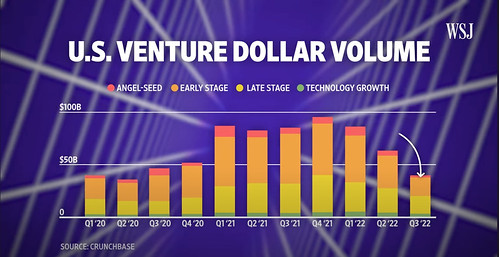
The Wall Street Journal walk around highlighted a number of issues at CES 2023. It noted that new product companies in the hardware space were finding a lack of funding, COVID-related development, manufacturing and logistics issues; together with consumer demand challenges would be here for the long haul. They quote a 50 precent drop in venture capital funding.
This has implications for future years of the CES show. They even gave it a name the ‘Gadget Gap’.
A lack of focus
Reading this post on CES 2023, will make you aware of the lack of focus in the event. A good deal of CES is no longer products aimed a consumer end audience, the participation of Experian, John Deere and Caterpillar were a case in point. Yes, CES is still the world’s largest technology trade show, but what does it mean? It feels too broad to have a meaningful purpose. It feels to me like some dystopian digital skid stain across all aspects of modern life. This at odds with the excitement I felt over game changing technologies in previous years. Others like analyst and author Jonathan Goldberg noticed the lack of focus too.
Combine the lack of focus with the broken globalisation model due to the US – China war means that CES needs to move on from CES 2023, or it will go the way of similar trade shows like CeBIT – nothing but a memory full of old news releases on technology company websites.
I subscribe to all kinds of weird and wonderful newsletters to get content for these posts, the idea of a Ukraine beta test was inspired by this post on SOFREP: Combat Sandbox: Ukraine’s ‘MacGyver Army’Tests Western Weaponry | SOFREP. SOFREP is written a self-described team of a team of former military, intelligence and special operations professionals. While some of their stories are repeats of tabloid fantasies: UK Apache helicopter gunships for Ukraine, they also provide some smart editorial thinking.
Western military ideas were designed to run against Russian and Chinese campaigns. The Ukraine beta test seems to have failed for Russia’s hybrid warfare concept, when it was executed on a large scale basis. Russia were trying to execute on an idea first outlined by an American theorist Frank Hoffman in his work Conflict in the 21st century: the rise of hybrid wars for a think tank. The Russians themselves call it ‘non-linear warfare‘. After careful preparation, Russia used non-linear warfare to capture Crimea and parts of eastern Ukraine in 2014. On the surface of it, a successful Ukraine beta test for Russia. Yet 7 years later on a larger scale approach Russia failed and is having to go back to older ways of doing things.
Part of the Ukraine beta test works because of the Ukrainians and everything that they have on the line. Part of it was down to better tactics by Ukraine compared to Russia and at least some of which was down to the use of western weapons systems used in an innovative way.
There has since been a Ukraine beta test of western military ideas:
Delta is a system for collecting, processing and displaying information about enemy forces, coordinating defense forces, and providing situational awareness according to NATO standards, developed by the Center for Innovation and Development of Defense Technologies of the Ministry of Defense of Ukraine, founded in 2021 at the base of the A2724 military unit, which, in turn, was created in 2015 from the volunteer group Aerorozvidka.
Delta is used for planning operations and combat missions, coordination with other units, secure exchange of information on the location of enemy forces, etc. In particular, Delta has integrated chatbots developed by the Ministry of Digital Affairs – “eVorog” and the Security Service of Ukraine – “STOP Russian War”.
The system is equipped with modern means of monitoring suspicious activity. From 2021, allied cyber units are constantly scanning the system for vulnerabilities, intrusion attempts, data leaks, and more.
According to the developers, Delta provides a comprehensive understanding of the battle space in real time, integrates information about the enemy from various sensors and sources, including – intelligence, on a digital map, does not require additional settings, and can work on any device – laptop, tablet or even on a mobile phone. Roughly speaking, Delta is such a modern real-time command map and troop control center
It has taken years for western powers to build comparable systems. Delta is powered by a mix of human intelligence, Ukrainian open source intelligence and also includes NATO electronic intelligence and satellite imagery. Integration of NATO for Delta is a Ukraine beta test in itself. NATO will learn from the successes and challenges of Delta. At a tactical level the idea of a Ukraine beta test shows how well weapons systems work under real-world ‘near peer’ war conditions, giving them valuable understanding of what systems are most effective against Russian systems.
The Ukraine beta test shows where the gaps are in NATO systems. For instance the Gepard tank is a short range anti-aircraft system phased out by Germany a decade ago, that has shown the value of similar gun based systems against drones and low flying aircraft as a cost effective method to engage.
All of which makes me wonder why the arms industry aren’t taking the obvious step and ‘donating’ trial systems to the Ukrainian military for a Ukraine beta test to show their mettle and value to western clients? The closest that we’ve seen to this is the GLSDB. The GLSDB is an existing Boeing bomb mated to recycled rocket motors. But the arms industry could do so much more as part of a Ukraine beta test.
China
The politics of China’s Belt and Road workers in Africa – Asia Times – strong empirical evidence that democracies host significantly fewer Chinese workers than autocracies, all other things being equal. The results hold up using a variety of different statistical modeling techniques. In Ghana, a vibrant democracy, we found that both the country’s main political parties faced pressure to ensure that Chinese-built projects delivered local jobs. For example, in the construction of the Bui Dam, the agreement between Sinohydro, the Chinese state-owned behemoth contracted to complete the project, and the Ghanaian government stipulated that a certain proportion of the workforce would be local. In Algeria, on the other hand, Chinese labor has been used to quickly complete projects seen as politically expedient. Algeria is a “hybrid” regime that was ruled by a single man, Abdelaziz Bouteflika, from 1999 to 2019. Even when domestic discontent over Chinese workers prompted measures to limit their presence, the measures were not implemented. Our findings have several important implications. First, host country agency is important. Host governments have the ability to ensure Chinese companies hire locally. Second, projects that hire locally may bring more long-term economic benefits to host countries. This can happen both directly through the jobs that they create, and via knowledge and technology transfers into the wider economy. Our analysis, therefore, suggests that the wider developmental benefits of Chinese-built infrastructure may actually be stronger in democracies than in autocracies
China is flashing red on the skewed consensus indicator | Financial Times – The only strong standout finding is on China, around which a strength of current optimism has no offset. Morgan Stanley didn’t think to even offer one. It’s a Goldilocks scenario with no bears – this doesn’t make sense. Wall Street seems to have an irrational belief in China as a market. For example: China moves to take ‘golden shares’ in Alibaba and Tencent units | Financial Times – expect this is to be about more than censorship. More like military – civil fusion – also likely to have big implications for media engagement on social platforms
Ryanair unsure if softening in UK demand here to stay – “There’s no doubt that the UK economy by any stretch of the imagination, in terms of going into recession or whatever, is different than the other European economies,” – interesting that they are concerned about travel overall rather than thinking about a pivot to them from BA etc
Is this the end of the bachelor pad? – The Face – the bachelor pad has been gobbled up by the economy. Nearly a third of 20 – 34-year-olds in the UK are living at home with their parents. I did feel a bit triggered by the author’s dismissal of stainless steel as a material and good quality furniture like an Eames lounge chair as being emblematic of toxic masculinity. But the economic points are very valid
Mainland rush to return to Hong Kong, Macau post zero-Covid nears 1 million | South China Morning Post – travel demand has been growing since China relaxed its border restrictions in December, with around 998,000 mainland residents applying for travel documents to Hong Kong or Macau, and 353,000 people applying for a new passport – expect Hong Kong fatalities to surge. Hong Kong has an even older population than mainland China. There is a corresponding low vaccination rate amongst them, partly down to vaccine distrust due to often Chinese orchestrated misinformation
Wokeness as prairie fire – by Noah Smith – Noahpinion – Anyway, with all that said, the point of this post is that wokeness’ role in American society is evolving as we move into the early 2020s. In particular, I see three simultaneous trends:
An increasing anti-woke pushback from conservatives
Increasing entrenchment of woke ideas and practices within liberal institutions
A general exhaustion with wokeness among thought leaders and young people
Who Are You Calling a Great Power? – Lawfare – trying to define great power status is difficult in ways that are evident from the mismatched assortment of candidates that emerge in the recent literature. Power varies across issues and domains in ways that are glossed over when international politics is reduced to great power competition. It can be a convenient shorthand, but policymakers should not lose track of the nuances: Who counts as a great power may vary from issue to issue
Saudi Aramco bets on being the last oil major standing | Financial Times – What is often forgotten is how oil is also needed as a feedstock for materials. You want electric batteries they need a plastic based insulator and cables need plastic insulation. Mercedes et al tried soy plastic based cable insulation in the late 1990s and the wiring looms of these cars have had to be remade. All of which will be needed if you want a LiON or hydrogen economy. Then there are seals, bushings, coatings, medicines etc all of which rely on hydrocarbon feedstocks. Oil isn’t just about carbon emissions. Aramco is being prescient about this, Companies like Shell etc are increasingly looking at plastics manufacturing for exactly the same reasons
Lidl, Zara’s owner, H&M and Next ‘paid Bangladesh suppliers less than production cost’ | Retail industry | The Guardian – Lidl, Zara’s owner Inditex, H&M and Next have been accused of paying garment suppliers in Bangladesh during the pandemic less than the cost of production, leaving factories struggling to pay the country’s legal minimum wage. In a survey of 1,000 factories in the country producing clothes for UK retailers, 19% of Lidl’s suppliers made the claim, as did 11% of Inditex’s, 9% of H&M’s and 8% of Next’s. A majority of suppliers of those four brands, and also of Tesco and Aldi, told researchers that almost two years after Covid-19 was declared a global pandemic they were still being paid at the same rate – despite soaring raw material and production costs in the interim
EU draws up plans to stockpile scarce medicines | Financial Times – “a systemic challenge with numerous vulnerabilities”, including overreliance on a few countries for certain products, and the way drugs are regulated and bought. The EU’s Health Emergency and Response Authority (Hera), established in response to the Covid-19 pandemic, could organise joint procurements for several countries to improve supply. Health commissioner Stella Kyriakides outlined the plan in a reply to Greek health minister Thanos Plevris, who had demanded action in a letter to her last week. “There is a shortage in certain branded drugs containing paracetamol, antibiotics and inhalers . . . particularly for children,” Plevris said at a news conference last week where he announced a series of measures that would tackle the shortages. – because China
UK supermarket uses facial recognition tech to track shoppers – Coda Story – In July, civil liberties group Big Brother Watch filed a complaint to the U.K.’s Information Commissioner’s Office against Southern Co-op and Facewatch — the company providing the surveillance system. Joshua Shadbolt, a duty manager at the Copnor Road supermarket, told me that high levels of theft have forced him and his colleagues to hide, for instance, all the cleaning products behind the till. Without the technology, he fears customers would be given free range to steal. Since Covid restrictions were lifted in the U.K. in early 2021 following a third national lockdown, shoplifting has been on the rise. This is likely to have been compounded by a cost-of-living crisis. Still, even if theft has not reached pre-pandemic levels, for Shadbolt, the biometric camera has been an effective and necessary tool in tackling crime. For Big Brother Watch, the camera is a breach of data rights and individual privacy. Every time a customer walks into a shop or business that uses Facewatch’s system, a biometric profile is created. If staff have reasonable grounds to suspect a customer of committing a crime, whether it’s shoplifting or disorderly conduct, they can add the customer to a Facewatch list of “subjects of interest.” Facewatch’s policy notice says that the police also have the power to upload images and data to Facewatch’s system. Anyone uploading the data, which includes a picture of the suspected person’s face, their name and a short summary of what happened, must confirm that they either witnessed the incident or have CCTV footage of it. But the policy does not indicate what the bar for “reasonably suspecting” someone is.
Visvim’s Toshiyuki Ueno in this film made in partnership with Porsche Japan, as we learn about the fundamental philosophy of ‘monozukuri’, or craftsmanship, behind the storied Japanese brand, as well as Ueno-san’s joy of ownership with long-lasting products.
Ueno’s joy of ownership comes from products that are potential candidates of what I called on this blog ‘heirloom design‘. Something that might develop a patina, but manages to last a lifetime. EDC or everyday carry is a category of products designed around the joy of ownership. Products over engineered and made of easy to service parts, yet are used everyday.
One can see this joy of ownership ethos in Visvim’s own products such as their iconic daypack. These look superficially like the classic Jansport design, but are over built in order ensure the bag outlasts the owner.
The joy of ownership is at odds with many aspects of our modern world. People no longer have digital or music collections. Instead relying on play lists on streaming services to give them the right muzak for whatever they are doing at the time. Online business Rent The Runway does away with the joy of ownership and curation of your look, you no longer need a wardrobe beyond the basics. Luxury brands are now talking about a circular economy play where consumers are encouraged to only enjoy the joy of ownership for a short while and they might then be resold. At the other end, fast fashion from Shein and H&M.
The much prescribed ethos of fast failure, agile methodologies and Facebook’s ‘move fast and break things’ are a world away from the philosophy behind the joy of ownership. This is the reason why Bang & Olufsen is a shadow of its former self, yet a vintage BeoSystem still provides the joy of ownership. More related content to the joy of ownership can be found here.
Xi Jinping shows his strength by muscling women away from power – Nikkei Asia – China’s path toward becoming a modern socialist country, as officials describe their aim, has historically been framed as incorporating gender egalitarianism. “Genuine equality between the sexes can only be realized in the process of the socialist transformation of society as a whole,” Mao Zedong wrote in 1955. By this measure, one would expect the Chinese Communist Party to at least signal that it cares about women’s representation in 2022. But last month’s 20th National Congress of the Chinese Communist Party broke tradition by elevating 24 men and no women to the party’s Politburo, omitting its usual token female for the first time in 25 years. Women took just 11 of 205 seats on the new party Central Committee. Loyalty and utility to the top leader, above qualifications or affirmative action-style standards, are now the major determinants of officials’ prospects for promotion. Party leader Xi Jinping no longer feels any obligation to gesture toward gender equality – what this misses out on is that Mao Zedong’s public and private conduct were in sharp contrast. Mao was an avowed paedophile.
TikTok ‘ghost mall’ indicator of problems with Malaysia’s failed Silicon Valley | South China Morning Post – “It’s the only Malay-Muslim concept mall in Malaysia,” Abdul said, adding that he feels attached to the mall as “there is a brotherhood here.”While the mall didn’t have many customers, I was struck by the lively camaraderie among the staffers working there. Outside the mall, I found a singer performing for a small crowd. A couple meters away stood a unit where a popular Thai restaurant once operated. While it’s listed as operating on Google Reviews, one of Fadzil’s staff told me it has “closed down for good.” The restaurant appeared to once have good reviews online, with diners describing the food as “affordable” and “delicious.” The lot was padlocked and the tinted glass walls obscured what was inside, but my fat zoom lens captured an eerie image of the restaurant’s interior. Kitchen tools were piled in a corner and dozens of bottles of beverages stood packaged together, unused. It looked like a scene that had been quickly and hastily abandoned. – retail is tough at the best of times, but there is also a constant tale in Malaysia of expensive white elephants and failed economic policies once it had been decolonised
Ethics
Filmmaker Andrew Callaghan Says Cable News “Ramped People up” for Jan. 6 – I think that January 6th is much more of a riot than it is an insurrection. And I think that the mainstream media is endlessly focusing on it because it’s, it’s very good eye candy. It makes great news. It makes all conservatives look like absolute morons, and it’s good for selling ads. So it was a terrible thing, but there’s reasons they’re dragging it out, and they’ll continue to drag it out until the next major conservative fuck up like that. I don’t feel, necessarily, that the frontline brainwashed Capitol riot soldier is to blame for what happened. I think it’s the people who push them into action, particularly on the fringe as well. I think mainstream media and social media play a role in ramping up division, but I think it’s people like Alex [Jones] and Enrique [Tarrio] who really are primarily just merchandise salesmen. We have a serious problem with media echo chambers and informational literacy in this country. We have to take it upon ourselves to be more educated and think on a different level. So what’s in it for influencers like them? The “MAGA-sphere” allows for a ridiculous array of hustles and grifts. There’s Forgiato Blow, who built a rap career around the MAGA train. Enrique Tarrio runs the largest right-wing t-shirt shop on the Internet. Alex Jones makes millions of dollars selling brain pills, basically. There’s so many ways to make money in the MAGA world. It’s really appealing for someone trying to get their start as an entrepreneur or a politically active person – probably one of the smarter views that I have read on January 6.
Siegfried Muller’s interview shows the complexity in modern German history. Muller was plied with alcohol and interviewed by East German interviewers who then put together this film (presumably with editing). For Muller, the threat of communism was real. You can read more on Muller here.
The War in Ukraine Highlights European Rifts – Carnegie Endowment for International Peace – Despite the destruction Russia is wreaking on Ukraine, both Chancellor Olaf Scholz and sections of his Social Democratic Party and business lobbies hanker after the status quo ante. Herein lies the second rift. It is linked to EU member states’ varied historical experiences and the resulting threat perceptions. The EU as a peace project was finessed over the years without a voice from the Eastern or Central Europeans. They had to endure living under the dictatorship of the Soviet Union. Today, Western Europe, particularly France and Germany, considers a future European security architecture involving Russia in some form. For the East Europeans, security is about defending themselves against Russia. That is why the latter want Ukraine to win and Russia to be defeated. For them, Russia’s invasion of Ukraine threatens Europe’s stability and security—a threat that would be compounded if Russia were to win
Health
Race is on to develop new generation of weight-loss drugs | Financial Times – this looks like a Viagra like gold rush, on the plus side there is a lot of scientific progress being made. The biggest barriers are socio-cultural in nature. Disclosure, I worked on the global launch of Wegovy – the current category leading treatment
Hong Kong committee can bar foreign lawyers from national security cases: Beijing — Radio Free Asia – “Now the national security committee gets to decide what is and isn’t a matter of national security in all cases, not just national security cases, but in any other court cases and also in all matters of government policy, without being subject to judicial review,” he said. “They could claim that pandemic prevention was a matter of national security, or education,” Yam said. “It’s not just about the judicial system.” “It affects legislation and anything that takes place throughout the entire government system.” – Australian lawyer Kevin Yam points out the weakness that anyone using Hong Kong as a legal jurisdiction in contracts should be concerned about. Is the counter-party connected to the government, in a strategically important sector, government owned or supported by government loans? Do they employ mainland employees who might be affected by the contract. All of this could fall within the national security law. Another take by Hong Kong based legal scholar and former judge Henry Litton: HKU Legal Scholarship Blog: Henry Litton: Red Alert: Hong Kong Judicial Independence Under Existential Threat (Comment on the Admission of Owen KC). Samuel Bickett’s take on things here: Beijing’s New Year’s surprise: awarding itself broad new powers over Hong Kong and NPC Observer: Explainer: NPCSC’s Interpretation of Hong Kong National Security Law over Jimmy Lai’s Foreign Defense Counsel – Beyond the confines of Lai’s case and the specific issue it raised, the [NatSec] Committee’s seemingly broad and unreviewable power to “make [enforceable] judgments and decisions” on whether an issue of national security is involved, regardless of setting, could be cause for concern. It awaits to be seen whether and to what extent it would invoke this newly declared authority to deal with other situations in the future.
Three ways Big Tech got it wrong | Financial Times – Most of Big Tech got rich on software, which is easily updatable and basically free to distribute at scale. Such online innovation rightly places a huge premium on “failing fast”: getting a product out quickly, building a following and fixing the bugs later. The same is simply not true for a car, a medicine or even a new flavour of packaged meat. They have to work correctly and meet regulatory standards right off the bat. Production facilities and distribution networks cannot be conjured out of thin air, or easily amended after the fact. In the physical realm, an innovator can see its lead evaporate in the face of competition from rivals with experience in production and distribution. Tesla is discovering this the hard way. Tesla’s share of the US electric vehicle market has dropped below 65 per cent from 79 per cent five years ago. S&P Global Mobility predicts it will fall below 20 per cent by 2025 as other makers bring out electric trucks and cheaper models faster than Tesla can build new factories
A few things on this. I believe that hydrogen will play a far bigger role in the energy mix for transport. These cars are Toyota Mirai vehicles. Secondly, look at how easy it is for the workers to get the fit and finish right on the cars, which says a lot about the precision of their component manufacturers to get to Toyota’s legendary reliable, rattle-free vehicles.
William Davies · The Seductions of Declinism: Stagnation Nation · LRB 4 August 2022 – The claim that everything has been getting worse for decades is a gift to Thatcherites and Brexiters, who promise a dramatic turnaround in the fortunes of the nation, and would like to banish those who talk down Britain’s prospects. Edgerton went to considerable lengths in The Rise and Fall of the British Nation: A 20th-Century History to dispute the claim that the interwar and postwar British economy was a failure, or that it needed ‘reviving’ in the way Thatcher promised. For Edgerton (and the Resolution Foundation appears to agree), Britain’s current economic malaise began under Thatcher, when rent-seeking via the housing market, privatisation and financial ‘innovation’ became the basis of Britain’s economic growth. But even Edgerton would agree that we are now in a very bad way. The poor quality of the Tory leadership candidates and the unseriousness of the debate between them creates the impression of a country that can now only speak to itself in slogans, oaths and insults, and has no capacity to describe or explain its problems. Away from the theatre of the leadership contest, the signs are that Britain’s elites now intend to stake everything on another financial free-for-all. Inexplicably, the Bank of England recently abolished the regulations that impose affordability criteria on the sale of mortgages, meaning that lenders no longer need to check whether borrowers have the capacity to repay if interest rates rise further. A new Financial Services Bill, supported by Sunak and the current chancellor, Nadhim Zahawi, will challenge the power of the Bank of England to regulate financial services, with the aim of releasing the City of London to engage in greater risk-taking. The Brexiters’ ideology, according to which Britain remains restricted by its conformity to EU rules, may have one more hurrah, if it can liberate speculators for another few years before the Ponzi schemes finally collapse
Fake ‘Rothschild’ Was Chased by Russian Organized Crime When She Took Pictures With Trump at Mar-a-Lago – OCCRP – the self-confessed grifter was a Ukrainian immigrant tangled up with Russian organized crime, a joint investigation by the Pittsburgh Post-Gazette and OCCRP has found. OCCRP and the Post-Gazette revealed in August how Yashchyshyn gained access to Mar-a-Lago without any background checks, making at least four trips to the estate in two days. The investigation and an FBI action that same month to retrieve documents from Mar-a-Lago renewed questions about security at the private club that has hosted powerful U.S. and world leaders. Those questions will only grow with the new revelations that the fake Rothschild was being chased by a serious organized crime figure as she mingled with prominent club guests and the ex-president himself.
Singapore redevelopment of its harbour in the early 1980s is fascinating. The area is now a mix of bars, cafes and restaurants. Among the buildings lost was a cinema built and owned by The Shaw Organisation – who were responsible for the post-war boom in kung fu martial arts films and even helped finance Blade Runner. The Shaws came out of a merchant background and were big in pre-war Shanghai as one of the big three film studios. They diversified into amusement parks over a decade before Disney did; though the Shaws were not as single-minded in their focus on ‘family-friendly’ experiences as their US counterpart.
The limits of growth in Singapore, some of these factors feel very Brexity, partly due to neo-liberalism
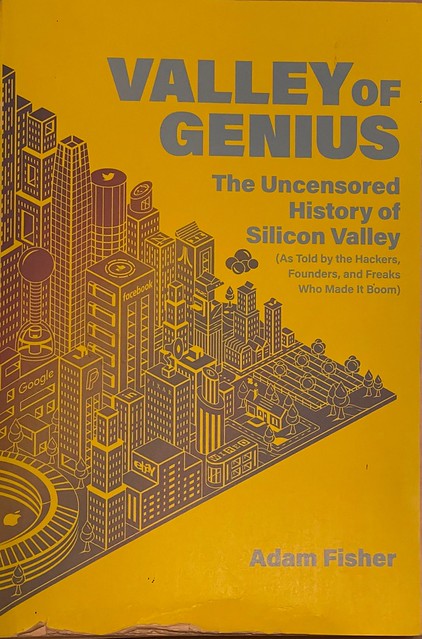
Valley of Genius by Adam Fisher promises to be ‘the uncensored history of Silicon Valley’ based on stories that founders and programmers told to each other. All of which begs the question how much is myth making and how much is true?
Valley of Genius front cover
Getting to the truth
Having worked for Silicon Valley clients and in-house at Yahoo!; I recognise that the truth doesn’t get out there and the myth making is largely self-serving. There is also a big question about how far the collective memory actually goes back.
Finally, there is the challenge of how big tech companies have got so good at controlling their story in the wider world. Whether it was keeping close tabs on journalists like Fred Vogelstein found out while working at Wired magazine, through Frank X Shaw’s reputation for robust rebuttal, funded their own media outlets like Pando Daily and eventually disintermediated the media altogether.
Adam Fisher
Adam Fisher grew up in the Bay Area and became a journalist and later editor at Wired. He left there and freelanced for a number of publications, branching out from technology writing to other areas like travel and tourism.
Style
The most noticeable thing about Valley of Genius when you get into it is that there is no prose. It is all dialogue. Fisher has cut together segments of interviews to tell a story. Sometimes it feels like people around a table, other times it feels more disjointed.
The book is described as an oral history and Fisher in his interviews describes the process as being like putting together documentary interviews.
Fisher went out and interviewed many of the great and the good of Silicon Valley to get this material, however given some of the soundbites were things I had heard before such as Steve Jobs talking about a computer as a ‘bicycle of the mind’; I was not sure if these people like to self reference or if Fisher has interspersed his interviews with archival material. Right at the end of the book, Fisher comes a list of people by chapter and where he had to source secondhand quotes from.
I’ve read a number of books on Silicon Valley over the years, so had a frame of reference and I had context, so I found Valley of Genius enjoyable to read. But for someone who is coming to the subject with just a cursory knowledge of Silicon Valley, there is benefits to having a guide. Reading the quotes without understanding the context, or having been to Silicon Valley still leaves you outside.
I honestly don’t know if Fisher would have been a good guide, so him removing his voice from the book maybe less of a loss than we might think. But a new reader to the subject matter would benefit from a guide like Michael S. Malone or the insider snark of Robert X. Cringely (aka Mark Stephens). Fisher’s book Valley of Genius is a book for insiders and future academics who might be looking at the history of Silicon Valley in the future. According to Fisher, he managed to secure the last interview that Bob Taylor ever gave. Bob Taylor played key roles in moving Silicon Valley forward while in managerial positions at NASA, ARPA and XEROX PARC. In those interview quotes are more granular aspects of things, like Nolan Bushnell having a champagne party on the grass outside the offices of a recently bankrupt competitor, or that the video card to power the monitor used in Doug Engelbart measured about 3 foot by 4 foot in size.
It’s also a very one dimensional view of Silicon Valley. It largely misses out hardware and hard innovation; which is problematic for a technology hub that is competing against China and India for that matter. There is no 3Com, Cisco or Juniper Networks. The hardware story is very much lacking, there is no Intel, AMD or Nvidia, Sun Microsystems or SGI. It is largely a consumer technology vision that writes out businesses like Oracle and Salesforce together with the characters that lead them.
Plot line
Valley of Genius ignores a good deal of early Silicon Valley, such as the the pre-war nature of Stanford, Varian, Bill Hewlett and David Packard’s garage start-up, Shockley Labs, the treacherous eight, defence contracting and the missile age.
Mother of all demos
Instead Valley of Genius history starts at 1968, when Dough Engelbart of Stanford Research Institute provides the Mother of all Demos to a mix of academics, government people from the likes of the department of defense and technologists.
Engelbart talks about his developments in 1986
He the talked about his career on the Google campus in 2007.
Atari
The story moves on to Atari and Nolan Bushnell. Bushnell was responsible for popularising computer games and arcade consoles. Bushnell was a bridge between the counter culture and Silicon Valley hustle. A few chapters later Valley of Genius also covers the acquisition and eventual (first) failure of Atari.
Here’s Bushnell being interviewed for the 50th anniversary of Atari by IGN.
Bushnell did a Google Talk a number of years ago as well.
Xerox PARC
PARC (Palo Alto Research Center) was a west coast R&D facility put together by Xerox to understand what the future of work would look like. They had already realised that it would be computerised. From PARC came modern computers, local area networks, file servers, laser printers and productivity software.
Apple
In separate chapters Valley of Genius covers Steve Jobs and Steve Wozniak’s commercialisation of phone hacking tools, and the evolution of the Apple computer line up from the Apple II to the Macintosh.
Retailer High Technology did the first adverts featuring the Apple II computer
Which was a far more budget affair than Apple’s own launch of the Machintosh.
The book goes on to cover the return of CEO Steve Jobs and the rejuvenation of Apple as a business including the iPod, iPhone and iPad through to the death of Jobs.
The hacker ethic, or hacker culture
The hacker ethic or culture, a digital equivalent of the person who tinkers away with things in a shed or garage has their own section. The section is atemporal in nature, which I can understand to a certain extent. Steve Wozniak came out of hacker culture, as have many software developers over time.
Fisher focuses on what hacker culture is, rather than what it means (both good and bad). I would recommend Steven Levy’s Hackers: Heroes of the computer revolution as a companion to this chapter in Valley of Genius. The copy I read years ago was published by Penguin, but O’Reilly have re-published it as the book this is part of myth-making and cultural norming in software development teams.
The WeLL
The WeLL was the proto-online community that is still going and features first generation digerati such as journalist Wendy Grossman, the founders of Wired magazine and cyberpunk author Bruce Sterling.
Stewart Brand talked about the founding of The WeLL during a Google hosted talk
The WeLL never scaled in the same way that we think about social networks now but it has quality discussions and is much kinder than Twitter or Reddit.
VPL
VPL was a failed start-up in the mid-1990s that set much of the expectations and tempo on VR to this day. You will most likely know it from the VR suit featured in The Lawnmower Man movie. I covered it in more depth in my metaverse discussion paper.
General Magic
Take a series of burnt out Apple employees and have them invent a predecessor of the net appliance or smartphone. That was General Magic and it was a glorious failure. Sarah Kerruish’s documentary on General Magic tells the story much better.
Wired magazine
Wired magazine gets its own chapter. it represented a way of melding culture and technology. I had read Wired before I had used the web, but it gave me a good idea of what to expect. But I don’t know if it is more important than ZDnet or other technology publishing houses. Valley of Genius goes on to celebrate Wired’s online endeavours including HotWired, Suck – a sarcastic version of Wired and Webmonkey – which taught a lot of people web development skills and probably doesn’t get the love it deserves in Valley of Genius. Mondo 2000, a rival to Wired in terms of setting the cultural zeitgeist for technologists also gets a chapter.
Pixar
Pixar as a Silicon Valley story is an accident due to two things
George Lucas’ Industrial Light & Magic being based in North California rather than in Los Angeles
Steve Jobs looking for a project post-Apple
But it didn’t necessarily move Silicon Valley forward.
Netscape
The jump to Netscape as the first commercial browser makes sense. AOL, AT&T True Experience, CompuServe and Prodigy services were all driven by businesses outside the traditional Silicon Valley space.
At the time Netscape seemed as much about the crazy public valuation of the business which was emblematic of the dot com boom, as it was about the software that would kick off the open web. These kind of valuations re-emerged with businesses like Uber and WeWork.
eBay
eBay was the standout e-commerce play for Silicon Valley. Amazon was a Seattle company and so was an outsider in a similar way that Microsoft always had been. eBay was also founded by an ex-General Magic employee and so was part of Silicon Valley’s version of ‘Rock family trees‘. We see this even now with the ‘PayPal mafia’.
Google
Google changed the web experience that Silicon Valley had pioneered via Yahoo! and Excite. Brin and Page became a key point of focus in Valley of Genius. However, this ignores the complexity both around search and the development of foundational web technologies that other companies produced. If you are interested about the nature and history of Google, Steven Levy’s In The Plex is probably a better option to read.
Google’s move to pay per click advertising gets its own chapter that greatly reduces the complexity of the real story.
Napster
Napster was the poster child of market value destruction and disruption that predated Uber and its ilk.
Dot bomb
The dot com boom can be charted from the last quarter of 1995 and reached its nadir in the last quarter of 2002.
Eric Steiner tells his tale as the CEO of Inktomi through the dot com boom and bust
Valley of Genius covers it in terms of its sociological impact on the Bay Area, as much as its economic impact. The reality is more complex, even the dot.com label attached to it is a misnomer. It encompassed telecoms, networking hardware, datacenters and more in terms of its impact rather than just e-businesses.
Facebook
While Facebook was an east coast invention, the movement of the company and its CEO Mark Zuckerberg west saw a cultural change in Silicon Valley that took it down a much darker patch. By comparison Twitter in its start-up phase looked more like Atari in terms of its counterculture influence.
Future gazing
At the end of the book there is a section on future gazing, which became what made Silicon Valley great. The business model was prioritised over innovation. Veteran journalist John Markoff even talked about how Salesforce had moved to a ‘vertical campus’ model with Salesforce tower. Which is how every other business in places like Singapore, Hong Kong and even Wall Street work anyway.
There was a singular lack of reflection on challenges ahead or areas of introspection by the people telling these stories. If anything, that was what concerned me the most about the book. Innovation is at a technological, scientific and socio-cultural cross-roads and the inhabitants of the Valley of Genius apparently doesn’t have a clue. More on the book here. You can find more of my book reviews here.
Extra content – Valley of Genius promotional tour interviews
Panel hosted by Adam Fisher to promote the Valley of Genius book
Leo LePort interviews Fisher on Valley of Genius at the time of its launch.
As cybercrime has become more common there has been a move towards the incidents becoming uninsurable hacks in nature. 2022 looks like a watershed moment in the move to uninsurable hacks.
Lloyd’s of London defends cyber insurance exclusion for state-backed attacks | Financial Times – Lloyds of London were looking at state backed exclusions. The parallel between a state backed cyber attack and and an act of war have clear parallels from an insurance point of view. An act of war would be exempt from most insurance policy cover. A state backed cyber attack then becomes an uninsurable attack. However, while a business could expect government retribution and likely support in an act of war, the uninsurable hack exists in a grey zone just below the threshold of government response.
The closest thing that has happened was criminal charges filed against Park Jin Hyok for the Wannacry ransomware that affected the NHS, Bangladesh Central Bank theft and the Sony Pictures hack. Russia has attempted attacks against at an oil refinery in at least one NATO country likely due to the material support that Ukraine has been receiving. NATO isn’t in a state of war with Russia and there are likely to be few repercussions and deterrents. Chinese backed hackers dismantled Nortel and helped drive the business into bankruptcy. These would all be uninsurable hacks as the risk is unmanageable in nature.
North Korea presents a particular type of risk for uninsurable hacks, using cyber crime to finance its sanction hit economy.
Companies like NSO and service companies based in India have democratised sophisticated intrusions for legal firms and business purposes. Widening the risk even further and creating a shadow economy of such scale that it creates uninsurable hacks by his own nature. Some of these law firms may even work with insurance companies in other areas; indicating the kind of perverse business incentives that drive these uninsurable hacks.
The final aspect ushering in uninsurable hacks is one of scale. Due to the economics of digital business – criminal or otherwise; they scale in a non-linear fashion. Insurance insiders see these as uninsurable attacks as they are ‘civilisation level’ attacks. Uninsurable hacks also come from an inability of the insurance industry to absorb pay-outs on a massive scale. But what can be done about uninsurable hacks since Pandora’s box has been opened?
Business
This story how Balkan organised crime groups completely compromised MSC is stunning for its audacity and impact.
Mao and markets – great talk on the permeable membrane between communist thought and capitalism.
China Makes Moves in Middle East After Biden’s Frosty Reception – An eagerness to offer “Chinese wisdom” to the Middle East’s problems is symbolic of Xi’s decade in power, during which time he has thrown off the humble shackles of his predecessors to raise his country’s stature on the international stage. Welcome or not, his offer signals to China’s domestic audience Beijing’s growing influence abroad and its capacity to advise others on successful governance. However, China’s exact role in realizing its peacekeeping recipe remains unclear. A frequent critic of U.S. military intervention in the Middle East and elsewhere, Beijing knows all too well the political, economic and military costs of becoming involved. Its willingness to do so is also a matter of constant debate. “China is cautiously increasing its presence in the Middle East, driven more by Middle Eastern states than its own ambitions,” said Jon Alterman, director of the Middle East Program at the Center for Strategic and International Studies. “China sees the Middle East as volatile and an area still dominated by the United States. They are cautious about getting sucked into the region’s conflicts.”
Mr Tape used custom modified reel-to-reel tape recorders. The reason why he can handle the reels is that its actually the tape capstans rather than the reels that are powered on a tape machine. So very different to how a cassette tape recorder works.
Henry Cavill on his love for Warhammer 40K. He is seriously invested in the universe.
Making Products in America Means Stuff Will Be More Expensive | Business Insider – cost is less clear when one takes into account carbon tax. It is also worthwhile thinking about how this could drive an improvement in product quality as well as production moves away from China. Improved quality could help reduce consumption and improve environmental impact
Ethics
The Camp Fix: Infrastructural Power and the “Re-education Labour Regime” in Turkic Muslim Industrial Parks in North-west China | The China Quarterly | Cambridge Core – Drawing on worker interviews, government documents, industry materials and images this article shows that for-profit public-private industrial parks have been built as part of a “camp fix” mechanism centred on detaining and “re-educating” Uyghurs and Kazakhs at the periphery of the nation. It argues that these industrial parks concentrate forms of repressive assistance and “dormitory labour regimes” that operate at other frontiers of Chinese state power and point these strategies of disempowerment towards a seemingly permanent, ethno-racialized underclass, producing a “re-education labour regime.” It further argues that the material infrastructures of these surveiled and policed spaces themselves are productive in enforcing the goals of the “camp fix”: the creation of high-quality, underpaid, docile and non-religious Muslim workers who are controlled through the built environment – this is the environment that large corporates have used in their supply chain. Companies such as VW Group and Anta (aka Salomon, Arc’teryx etc)
Finance
Scott Galloway breaks down a number of financial stories from 2022.
Visual Framing: The Use of COVID-19 in the Mobilization of Hong Kong Protest | The China Quarterly | Cambridge Core – messages and images posted on Lennon Walls between January and April 2020 have used COVID-19 to extend public expression of sentiment on the debates around the Hong Kong government and to further mobilize a sense of Hong Kong identity against China. The findings contribute to the understandings of how the cultural politics surrounding the pandemic became a collective action frame in the mobilization of a localized Hong Kong political identity against the Hong Kong and Chinese governments – this linking of COVID-19 to political discourse makes public health communications much more complex
Hong Kong property: developers mourn demise of ‘coffin homes’ boom | Financial Times – Analysts, including Goldman Sachs, expect Hong Kong home prices to drop by 30 per cent by the end of next year. Shares of CK Asset and Henderson Land have fallen about a tenth in the past six months. The latter trades at 10 times forward earnings, which is more than 40 per cent lower than even 2014 levels — during the last property market decline — reflecting the dire outlook. – add into this also the amount of Hong Kongers leaving the city as well
In Indonesia, ‘all-gendered’ priests are fighting to keep their traditions alive | South China Morning Post – With fewer than 40 Bissu remaining in areas across South Sulawesi, a community which once held divine status is now fighting against extinction. Many Bissu were accused of violating Islamic principles and faced persecution, but some are trying to preserve their heritage by performing cultural, shaman-like roles – the implicit influence of gulf Arab style muslim beliefs is not only about extremism but presenting a dead orthodoxy that will make Indonesia as unattractive as Malaysia has become
Read Zuckerberg’s 2019 Deposition on Facebook User Data | Business Insider – A 2017 report in The New York Times had said Cambridge Analytica previously claimed it could use data to glean voters’ inclinations. Zuckerberg appeared to address those types of news reports in his testimony to SEC regulators, saying it piqued his interest about how the company might have been using Facebook at the time. “I kind of remember having this reaction to this, which is, if they are using our systems for advertising, then I’m curious to understand if they’re actually doing anything novel that matches the rhetoric that they have, or if they’re just kind of puffing up rhetoric around what would be a relatively standard use of our ad systems,” he told the SEC in 2019, according to the newly released testimony. – to be fair Zuckerberg’s reaction reminds me of a lot of discussions that I was having with peers about Cambridge Analytica at the time
How SpaceX’s Starlink terminals first arrived in Ukraine | Quartz – Weeks before Russia invaded Ukraine, the US began scrambling to find satellite communications equipment that could keep the Ukrainian government connected to the rest of the world, new documents reveal. Those efforts resulted in thousands of satellite-antenna terminals that connect to SpaceX’s Starlink broadband internet network being sent to Ukraine. They have proven vital to Ukraine’s war effort, but became a source of controversy for both SpaceX and the US over the service’s cost, and who is paying for it. Government contractor DAI began searching for the right equipment as early as Feb. 11, according to documents Quartz obtained through a Freedom of Information Act request. Russia invaded Ukraine on Feb. 24, shocking many, but not the US government, which sounded the alarm ahead of the invasion
TikTok admits tracking FT journalist in leaks investigation | Financial Times – ByteDance, the Chinese owner of viral social media platform TikTok, has admitted it inappropriately obtained the data of users, including a Financial Times journalist, in order to analyse their location as part of an internal leaks investigation. Over the summer, four employees on the ByteDance internal audit team looked into the sharing of internal information to journalists. Two members of staff in the US and two in China gained access to the IP addresses and other personal data of FT journalist Cristina Criddle, to work out if she was in the proximity of any ByteDance employees
Software
How Amazon Uses AI To Automate Work In Its Corporate Headquarters – I was struck by how deeply artificial intelligence was already ingrained in their cultures. With in-house AI research labs that rank among the globe’s best, the tech giants were automating wide swaths of their operations and changing the nature of work within their companies. This commitment to AI in the workplace is newly relevant as powerful tools like Dall-E, ChatGPT, and their ilk make their way into the public’s hands. As access to this powerful technology spreads, nearly all companies will soon have tools like those I saw inside Amazon, Apple, Facebook, Google, and Microsoft. So work inside our companies will change as well
Asianometry does a run down of Sun Microsystems history. A few things. When I started working agency side, this was what our client websites were hosted on. Sun had a partnership with Netscape to have a great software stack. Oracle’s hardware business is the old Sun Microsystems business. Cisco routers and other manufacturers as well were basically a Sun motherboard and a raft of ethernet ports together with a look-up database that handled the routing.
Vietnam loses 25 ancient books related to culture and sovereign territory — Radio Free Asia – one of which is “relevant to Vietnam’s sovereign territory,” according to the deputy head of the literature department, Nguyen Xuan Dien. Posting on his Facebook page on Tuesday, a day after the institute’s annual meeting, Dien said the books were “extremely important for national culture.”The institute said Wednesday the books were among 35,000 volumes it had cataloged and preserved at the request of the Vietnam Academy of Social Sciences When it inspected the inventory in April 2020, for the first time in over 10 years, it discovered that 29 books were missing. Four of the books were later found on the wrong shelves. Among the books still unaccounted for are four written by scientist Le Quy Don and two books which record the precise geography, boundaries and borders related to Vietnam’s sovereign territory, according to Dien. Those two volumes could help substantiate Vietnam’s territorial claims in the South China Sea – I would guess that these books have been incinerated in China, as it helps China’s territorial claims in the South China Sea and debilitates Vietnam’s rival claims