Category: branding | 品牌推廣 | 브랜드 마케팅 | ブランディング

The dictionary definition of branding is the promotion of a particular product or company by means of advertising and distinctive design.

I have covered many different things in branding including:

  • Genesis – the luxury Korean automotive brand
  • Life Bread – the iconic Hong Kong bread brand that would be equivalent of wonder loaf in the US
  • Virgil Abloh and the brand collaborations that he was involved in
  • Luxury streetwear brands
  • Burger King campaigns with Crispin Porter Bogusky
  • Dettol #washtocare and ‘back to work’ campaigns
  • Volkswagen ‘see the unseen’ campaign for its Taureg off road vehicle
  • SAS Airline – What is truly Scandinavian?
  • Brand advertising during Chinese New Year (across China, Hong Kong, Singapore and Malaysia)
  • Lovemarks as a perspective on branding
  • BMW NEXTGen event and Legend of Old McLanden campaign
  • Procter & Gamble’s Gillette toxic masculinity ads
  • Kraft Mother’s Day campaign
  • Kraft Heinz brand destruction
  • Porsche Design in the smartphone space
  • Ermenegildo Zegna
  • Nike’s work with Colin Kaepernick
  • Counterfeit brands on Instagram, Alibaba and Amazon
  • Gaytime Indonesian ice cream
  • Western Digital
  • Louis Vuitton collaboration with Supreme
  • Nokia
  • Nike Korea’s ‘Be Heard’ campaign
  • Mercedes SLS coupe campaign
  • Brand collaborations in Hong Kong
  • Beats headphones
  • Apple
  • Henrion Ludlow Schmidt’s considerations of branding
  • Cathay Pacific
  • Bosch
  • Mitt Romney’s failed presidential bid
  • Microsoft Surface launch
  • Oreo Korean campaign
  • Chain coffee shop brands and branding
  • Samsung’s corporate brand
  • North Face’s brand overeach in South Korea
  • Mr Pizza Korean pizza restaurant and delivery service brand
  • Amoy Hong Kong food brand
  • Chevrolet Corvette ‘roar’ campaign promoting a build your own car service
  • Creativity in data

    I had the honour of being part of a panel for the PRCA on the creativity in data run in association with The Work Crowd.

    Creativity and data

    Here was the synopsis of the panel discussion that the PRCA put out.

    Communications is frequently seen as all about ‘big ideas’. But increasingly, it’s being recognised that to develop a big idea that’s really going to have an impact, it’s not just about creativity. Now, the winning formula is creativity + data.


    Of course, data has always played a role in the creative process, but historically through a more ‘rear view’ measurement of past behaviours. However, with technology advancing and predictive analytics utilising newly available data, the data we have access to is more forward-looking than ever.


    The ability to synthesise these insights is super-powering strategic planning for businesses, but it’s definitely not just the boardroom who should be interested in ‘running the numbers’. Maths and data may not be seen as natural bedfellows of storytelling and creation, but have we been underestimating the power of creativity in data? Ultimately, is data a friend or foe to the creative process?

    I kicked this around with Camilla and Richard. Here are my thoughts that came from this process in no particular order below:

    I wondered what the forefathers of the communications industry would have thought about the question? Leaving ethical considerations aside for a moment about the legitimacy of their techniques, what would they have thought?

    Edward Bernays was famous for using consumer insight, research and psychology in his work. It would likely have felt very alien to Bernays that we were even asking such a question. He would have felt that the answer is self-evident a 100 years later.

    Data isn’t a friend or foe to the creative process. It is part of the creative process. The sieving of data to get down to the grain of truth – the insight that you can hang your creative idea off.

    Thinking about the nature of data itself is muddled. Over the past couple of decades the communications industry has struggled with measurement. This then shaped its perception of data.

    • Data is quantitative
    • Data is tech dependent
    • Data is precise

    All of which is wrong:

    • Data can be quantitative, but qualitative data is also important, particularly to the creative process. Qualitative data is the stuff of stories and storytelling
    • A lot of data is technology dependent, but a lot of good stuff from a creative perspective isn’t. Marketing communications as an industry, has increased its use and importance of cultural insights in planning
    • Quantitative data isn’t always precise. Correlation and causality aren’t the same things. In addition, if online ad fraud has taught us anything, it is to be skeptical of data quality

    I am not saying that communications should move away from obtaining and using quantitive data. But this should be balanced by a focus on qualitative data as well.

    Data is seen paradoxically as ‘all around us, pervasive’ and expensive to obtain.

    So what data should the creative planners of the communications industry care about? Some of the sources listed below are free, some are books that are worthwhile investing in and others are expensive services that even the largest agencies struggle to afford in many markets.

    The data that the client has already

    Clients are already sitting on a wealth of information inside their organisation:

    • Past marketing campaigns. What has worked, what hasn’t.
    • Web analytics – what content is doing well. What do we know abut site visitors?
    • Key words that they use for SEO. What language should we be using for coming with messaging?
    • Sales data. Not just qualitative data, but what is coming out of sales calls and customer services enquiries? What concerns prospective and current customers? Why do they buy? Do they stay loyal? Do they have great stories? Who buys and who is likely to influence a buying decision?
    • Competitor research including brand tracking data if available
    • Planning work and creative briefs done by the clients other agencies. Chances are that a comms agency will have been brought in after other agencies. What channels are those agencies looking to leverage. Where can you complement their work? What is the human truth that they are hanging their creative from? Are there any design cues in their artwork?

    Work smarter, rather than harder. It is foolish to try and do the same information gathering twice. A client’s willingness to dig and get this for you gives you a rough read on how important your work is for the organisation.

    Best practice data on efficiency and effectiveness

    The marketing industry as a whole has put a lot of money into the Ehrensberg Bass Institute and they have compiled decades of marketing science research to some accessible books. How Brands Grow parts 1 and 2 are constant references for me.

    The IPA’s publication The Long and The Short of It by Les Binet and Peter Fields is another reference for me. Binet has updated this research to cover B2B recently.

    They help me answer questions such as:

    • Is PR the right tool to solve the client’s current problem?
    • Is our creative likely to be effective?
    • How much should be focusing on brand building versus activation?

    To make your life easier, here’s a slide where I distilled optimal channel choice versus marketing strategy.
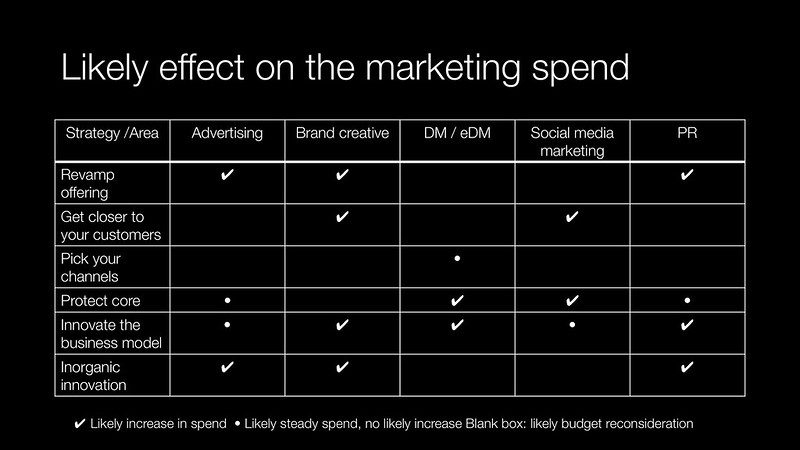
    Zero-Based Budgeting

    Where you see ticks, that’s when the marketing tool (PR, advertising etc) will do the most good.

    The Holmes Report and WARC have collaborated so that if you have a WARC subscription you can access award winning case studies and learn from campaigns that have solved similar problems to the ones that you face. None of the industry organisations or communications have distilled this kind of data down into a comms agency equivalent and Binet and Fields.

    Desk research

    • Videos – its amazing the insights you can pick up from observing YouTube videos
    • White papers – I have become a pack rat for these, I download everything and keep them on my machine because you never know when you might need it
    • Your own data bank. I have over 40,000 site links to content that I’ve found of use in the past. It’s where I go to before DuckDuckGo since I already know its of a certain quality. I use a social bookmarking tool called Pinboard

    Academia

    Both Scopus and Google Scholar have got great resources on social science based research. In addition, Wolfram Alpha is a really good sources of validated data points. The British Library can also be a treasure trove of content.

    Articles

    • Blog posts (like this one)
    • Free and paid resources for example: Apollo Research, Business Insider Research / Contagious / Datamonitor / D&B Hoovers / Ebiquity / Emarketer / Economist / EIU / Financial Times / Forrester Research / Gartner L2 / Global Web Index / IPA databank / Kantar / Lexis Nexis / Little Black Book / Mintel / Nielsen / Pew Research / Statista / WARC / YouGov
    • Management consultancies in particular McKinsey do a wide variety of research
    • Other planners (for instance here’s an article that I wrote about trends in the beauty sector)
    • Trade bodies (particularly good examples are the GSMA Intelligence and CES)

    Government statistics bodies

    • CIA World Handbook
    • EuroStat
    • Government national statistics offices (Wikipedia has a great category page that points you to the right countries and regions for these sources)
    • IMF
    • UN Statistics Division
    • World Bank
    • World Economic Forum

    Social listening data

    Social listening data needs to be used with a certain amount of caution. It is a measure of the level of discussions around a given subject but not the sum of them. Some of them are likely to happening in real world settings, many in ‘dark social’ – social interactions that tools can’t see.

    As a rule of thumb in European countries there tends to be less B2B social discussions going on than the US. For consumer brands there has been some good work done to show how social media listening attributions (volume, share of voice, sentiment etc) can approximate to brand tracking.

    Primary research

    This could be everything from:

    • Quantitative focused research: running a quick and dirty survey on Survey Monkey, a reputable omnibus survey provider like Dalia Research, Kelton Global or YouGov through to commissioning a piece of bespoke research
    • Qualitative research: eye tracking, focus groups, interviews, neurological scans to analysis response to stimulation, observational research, video diaries
    • Field trip: go out with sales people, meet clients, walk around stores and notice what people do, strike up conversations in stores or trade shows. The art of the flâneur is made for the planner

    More information

    Academia

    British Library – getting a reader pass

    Google Scholar

    Scopus (paywall)

    Wolfram Alpha

    Best Practice

    How Brands Grow What Marketers Don’t Know by Byron Sharp

    How Brands Grow: Part 2: Emerging Markets, Services, Durables, New and Luxury Brands by Jenni Romaniuk and Byron Sharp

    The Long & The Short of It: Balancing Short Term and Long Term Marketing Strategies by Les Binet and Peter Fields

    Other

    FT Graphics

    World Economic Forum reports

    Governmental organisations data

    CIA World Factbook

    Eurostat

    IMF Data

    UN Statistics Division

    Wikipedia category page on national statistical services

  • Tide Super Bowl ads + more

    Tide Super Bowl Campaign

    A little bit old, but this Mark Ritson advertising case study of Tide Super Bowl campaign is must watch material. I like the Tide Super Bowl campaign as creative and media planning came together.

    The ad industry insider in me liked the way the Tide Super Bowl campaign spoofed various genres of advertising. More marketing content here.

    Lowersumerism

    ‘Lowersumerism’ by Box 1824 reflects on the tension between environmentalism and consumerism. Manufacturing, advertising and consumption are a virtuous cycle. Individuality drove the process further forward. What Lowersumerism doesn’t provide is a viable answer or approach to consumerism.

    National Film Board of Canada

    Amazing collection of modern culture for the commons – Watch 3,000 Films Free Online from the National Film Board of Canada, Including Portraits of Leonard Cohen, Margaret Atwood & Jack Kerouac | Open Culture 

    The quality of the content that has been made available by the National Film Board of Canada is stunning.

    Recycling robot

    MIT put out this demo of a recycling robot. It doesn’t answer challenges such as laminate packaging, but it’s very interesting in terms of its automation of sorting. In a lot of countries this sorting process is often done by hand with a limited amount of machine input. Recycling supports some of the poorest people in the world’s societies.

    Fall or Dodge In Hell

    Author Neal Stephenson has been promoting his new book Fall or Dodge In Hell and as always the talk is well worth listening to. Stephenson’s work has the eye for the human condition like Douglas Coupland. But he marries this with a great understanding for mathematics and technology. Fall or Dodge In Hell riffs on characters from his previous book Reamde.

    In this reading he talks about myths and storytelling as an operating system for the human mind and optimised sleep.

  • Bullet time + more things

    Bullet Time – Logic Magazine – Bullet comments, or 弹幕 (“danmu”), are text-based user reactions superimposed onto online videos: a visual commentary track to which anyone can contribute. Started in Japan, but popularised massively in China. When a beloved character dies in a web series, a river of grieving kaomoji (╥﹏╥)—a kind of emoticon first popularized in Japan — washes over whatever happens next. The bullet time interface reminded me of the realtime information one would see in things like trading desks. Its an emotional barometer amongst your people for real time content.

    Mark Ritson: Binet and Field aren’t perfect but it doesn’t make them wrong | Marketing Week – well deserved defence of Les Binet and Peter Field by Mark Ritson. Models are never perfect

    Why Strangers Are AirDropping You Memes and Photos – The Atlantic – everything old is new again as Bluetooth sharing ‘Bluetoothing’ gets a refresh. Taylor Herring used this to share a job advert at the recent PR Week Awards

    Does the UK Benefit From Chinese Investment? – Carnegie Endowment for International Peace – short answer no – it’s actually harmed by it as investment is power projection and compromises the UK’s strategic capability

    Mark Read: CMOs have become too much like chief communications officers | PR WeekA lot of CMOs have become too much chief communications officers, not chief marketing officers,” Read said. “Our job is to help to put the ‘market’ back into the word ‘marketing’. “Communications has an important role, but it needs to be “the right element” within the wider marketing mix, according to Read: “Marketing means: what markets are we in? What products do we offer? What prices do we do? How do we understand and anticipate consumers?”

    Despite Fears, Aviation’s Future Will Be More Automated | Time – so why the move towards more automation in cars such a good idea based on what we know about airliners from this article?

    The Hottest Chat App for Teens Is Google Docs – The Atlantic – context specific

    WalktheChat | WeChat Live Streaming Case Study: 48% Sales Conversion Rate! – really interesting read. China’s mix of live-streaming and e-tailing is shopping TV for the 21st century

  • Qualcomm licensing + more

    Judge Koh: Qualcomms Licensing Practices Destroyed Competition, Harmed Consumers – Disruptive Competition Project – as best as I can understand this, the analogy of Intel and AMD comes to mind in terms of the kind of case Judge Koh has described her thoughts. But the case is different which is what makes this a bit odd. Especially odd given that there is so much more to criticise on Qualcomms licensing practices. In particular the coercive cross licensing conditions that are part of Qualcomms licensing practices. More on Qualcomm here.

    Blockchain officially confirmed as slower and more expensive | FT Alphaville – Oracle et al should be showing this to clients

    Field Notes: Highlights from Huawei – Andreessen HorowitzMy family uses Apple’s phones; Apple’s ecology is very good. When family members travel abroad, I would gift them an Apple computer. One can’t narrow-mindedly believe that if you love Huawei then you must only use Huawei mobile phones. – Chairman Ren says that when he and his family are looking for premium smartphones they use an Apple

    TV makers to reduce display panel stocks, says IHS Markit | EE Times – expectation of economic contraction

    China’s robot censors crank up as Tiananmen anniversary nears – Reuters – there’s a definite tension between western media fake news and Chinese censorship coverage. Not that there’s moral equivalence, but a lack of awareness about the thread connecting the subject areas

    Dunkin Donuts Refuses to Get Woke: ‘We Are Not Starbucks’ – Sometimes the brand purpose is what it says on the tin

    Uber introduces quiet mode for premium customers | Canvas8 – you need an app to mediate a simple request FFS

    Global Competition and Brexit | American Political Science Review | Cambridge Core – highlights the importance of globalisation in driving populism in post-industrial economies. This is probably why Trump and American politicians are in the trade cold war for the long haul and likely to see similar in the EU – its only a matter of time

    Nigel Farage seeks to establish a viable far right UK party — Quartz – If you don’t read anything else about Brexit and think that the current populism will peak and subside with Brexit ponder “Anyone who is not the governing party is going to benefit from the governing party inflicting food shortages. Medicine shortages will be very immediate. All of which he will be able to blame on Brexit not being done properly, and at least some people will be receptive to that message.”

    China showing signs similar to Japanese housing bubble that led to its ‘lost decades’, expert warns | South China Morning Post – I’ve heard this more than once, though there are two things to consider: 1/ the Bank of Japan was much more hands off than Chinese monetary policy 2/ China has opacity of data and more levers to pull in its favour in property market. Bigger issue is corporate and government debt

    Exclusive: Behind Grindr’s doomed hookup in China, a data misstep and scramble to make up – ReutersWhile it is known that data privacy concerns prompted the crackdown on Kunlun, interviews with over a dozen sources with knowledge of Grindr’s operations, including the former employees, for the first time shed light on what the company actually did to draw U.S. ire and how it then tried to save its deal. Reuters found no evidence that the app’s database was misused. Nevertheless, the decision to give its engineers in Beijing access to Grindr’s database proved to be a misstep for Kunlun, one of the largest Chinese mobile gaming companies

    Mediatel: Newsline: Sex sells, right?So, with that in mind, can sex still have the selling power for advertisers that it once did? 
    “Ultimately? Yes and no,” Jem Fawcus, CEO of brand strategy partner and insight agency Firefish, tells Mediatel. 
    “Every well observed element of human life can sell if used in the right way. But if used just for titillation and as an attention grabber, absolutely not.”

  • Gundam into Space + more stuff

    Japan Wants to Launch Gundam Into Space for the 2020 Tokyo Olympics – I am looking forward to the next Tokyo Olympics. Not for the athletics but everything else that the Japanese organising committee wraps around it. I mean if a Gundam goes into space, what’s next? Godzilla takes part in the olympic torch relay and hands off to Shotaro Kenada on his iconic bike?

    Challenging stereotypes has become a key trend in advertising recently. Part of it is down to the movements supporting diversity and LGBTQ communities. GS Caltex have chosen to challenge the stereotypes surrounding stepmothers in Korean society with this advert. These  were run on YouTube and distributed via online fairy tale platform “Iwing” and on Naver, a leading portal in Korea. You don’t need to speak Korean to understand the gist of where campaign was going.

    A bit of oil history for you. GS Caltex is a joint venture business between what was then GoldStar (now LG) and Caltex. Caltex was an joint international joint venture between Chevron (Standard Oil of California or SOCal) and Texaco. Both of which were part of the Seven Sisters of western oil companies who dominated exploration, production and refining until the 1970s.

    We’re starting to see an increased focus on craft in advertising after a decade of obsession with performance marketing to the detriment of brand. So now is as good time as any to revisit London agency CDP (Collett Dickenson Pearce) work on Hamlet cigars during the 1970s.

    I love this cheeky send-off and backhanded tribute that BMW gave Dieter Zetsche when he retired as CEO of Mercedes-Benz. In reality Mercedes-Benz and BMW have different brand attributes and strengths.

    IDEO has commissioned an oral history of itself as a corporate video. It covers their move from industrial design to the design of ideas.