Category: branding | 品牌推廣 | 브랜드 마케팅 | ブランディング

The dictionary definition of branding is the promotion of a particular product or company by means of advertising and distinctive design.

I have covered many different things in branding including:

  • Genesis – the luxury Korean automotive brand
  • Life Bread – the iconic Hong Kong bread brand that would be equivalent of wonder loaf in the US
  • Virgil Abloh and the brand collaborations that he was involved in
  • Luxury streetwear brands
  • Burger King campaigns with Crispin Porter Bogusky
  • Dettol #washtocare and ‘back to work’ campaigns
  • Volkswagen ‘see the unseen’ campaign for its Taureg off road vehicle
  • SAS Airline – What is truly Scandinavian?
  • Brand advertising during Chinese New Year (across China, Hong Kong, Singapore and Malaysia)
  • Lovemarks as a perspective on branding
  • BMW NEXTGen event and Legend of Old McLanden campaign
  • Procter & Gamble’s Gillette toxic masculinity ads
  • Kraft Mother’s Day campaign
  • Kraft Heinz brand destruction
  • Porsche Design in the smartphone space
  • Ermenegildo Zegna
  • Nike’s work with Colin Kaepernick
  • Counterfeit brands on Instagram, Alibaba and Amazon
  • Gaytime Indonesian ice cream
  • Western Digital
  • Louis Vuitton collaboration with Supreme
  • Nokia
  • Nike Korea’s ‘Be Heard’ campaign
  • Mercedes SLS coupe campaign
  • Brand collaborations in Hong Kong
  • Beats headphones
  • Apple
  • Henrion Ludlow Schmidt’s considerations of branding
  • Cathay Pacific
  • Bosch
  • Mitt Romney’s failed presidential bid
  • Microsoft Surface launch
  • Oreo Korean campaign
  • Chain coffee shop brands and branding
  • Samsung’s corporate brand
  • North Face’s brand overeach in South Korea
  • Mr Pizza Korean pizza restaurant and delivery service brand
  • Amoy Hong Kong food brand
  • Chevrolet Corvette ‘roar’ campaign promoting a build your own car service
  • Legend of Old McLanden & things from last week

    BMW’s X7 advert about the Legend of Old McLanden has been cited as a piece of feminist advertising. I won’t spoil it for you watch the clip and you’ll see why.

    I think that its part of something different which has been less heralded: a return to craft in advertising. We’re starting to see a refocusing of marketing. Away from the shiny toys of ad tech and influencer networks back to advertising craft.

    The Legend of Old McLanden would fit comfortably with the golden age of TV adverts and I think that’s a good thing for brand building. Especially when we usually only see this kind of thing during the Super Bowl.

    I am a big fan of Visual Politik’s videos, but was unimpressed by this video on crypto currency. I get the attractiveness of a more decentralised internet, BUT I don’t buy into the cryptocurrency hype and believe that blockchain is at best a solution for niche problems.

    The video reminds me a lot about the techno-utopian opinions of the early web, P2P technologies etc. It has value, but it isn’t likely to be transformative in the way its implied.

    SK-II has a new instalment in its #changedestiny themed campaigns called ‘Meet Me Halfway’. This time they focused on the pressure that single Chinese women face during family gatherings for lunar new year.

    It follows on the SK-II marriage market makeover campaign done in 2016. More beauty related content here.

    Whilst many consumer brands have dashed into the influencer marketing space, it interesting that adidas have developed a contra-influencer content. It does

    Diesel’s ‘Be A Follower’ campaign took a similar line to this latest Adidas campaign.

  • Apple and Jaguar Land Rover in China

    Apple and Jaguar Land Rover blamed the Chinese economy for their recent financial results. The truth is probably more complex. What factors are affecting affecting Apple and Jaguar Land Rover that aren’t directly related to the Chinese economy?

    The reality is that Apple and Jaguar Land Rover are being buffeted by very different forces, some of which are their own making.

    Apple

    China is a unique mobile environment and in some ways it mirrors the hopes (and fears) for the internet in the late 1990s. Oracle and Sun Microsystems spent a lot of time during the dot com boom developing technologies that would allow applications to run on the web. Enterprise software sudden had a user experience that could be accessed via a web browser. Java allowed applications to be downloaded and run as needed. Netscape had a vision of the internet replicating the operating system as a layer that would run applications. Microsoft also realised this which was why they developed Internet Explorer, integrated it into Windows and killed off Netscape. The Judge Jackson trial happened and that was the start of the modern tech sector allowing Google and Apple to rise.

    Move forwards two decades and most computing is now done on mobile devices. In China, WeChat have managed to achieve what Netscape envisioned. Their app as a gateway to as many services as a consumer would need including a plethora of mini applications. It doesn’t suffer the problems that native web apps have had in terms of sluggish user experiences. In addition, WeChat has invested in a range of high-performing start-ups to built a keiretsu of businesses from cab services, e-commerce, property companies and even robotics. In the meanwhile Tencent who own WeChat have a range of consumer and business services as well.

    What this means for Apple is that many of its advantages in other markets are negated in China. The OS or even performance of a smartphone doesn’t matter that much, so long as it can run WeChat and a couple of other apps. The look and feel of the app is pretty much the same regardless of the phone OS. Continuity: where the iPhone and a Mac hand-off seamlessly to each other doesn’t matter that much if many consumers use their smartphone for all their personal computing needs.

    This has been the case for a few years now in China – but Apple haven’t found a way around it.

    As for phone industrial design – Apple lifted the game in manufacturing capability by introducing new machines and new ideas. To make the iPhone 5, Apple helped its suppliers buy thousands of CNC machines. This grew the manufacturers capability to supply and the amount of pre-owned machines that eventually came on the marketplace. It meant that other manufacturers have managed to make much better phone designs much faster.

    That meant Chinese consumers can buy phones that are indistinguishable from an iPhone if you ignore the logo and function the same because of China’s app eco-system. Again this has been the same for a few years and has accelerated due to the nature of the dominant smartphone form factor. The second iteration of the iPhone X form factor is what really changed things. The phones were different to what has come before, but they weren’t demonstrably better. They were also more expensive.

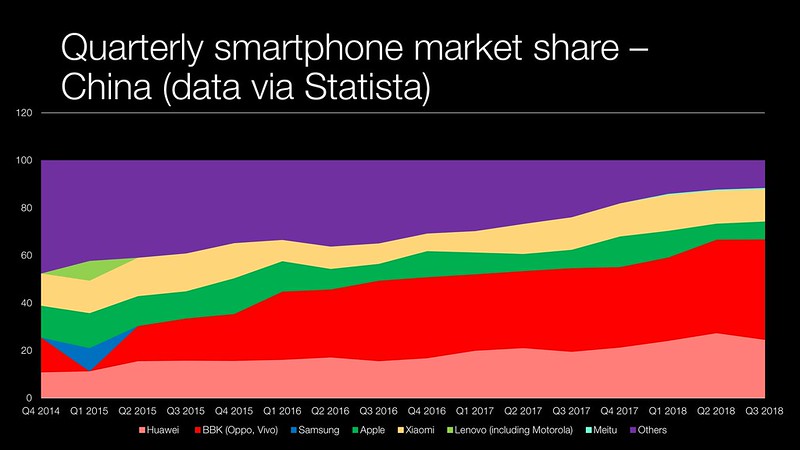
    In the mean time Huawei and others have continued to make progress, particularly in product design and camera technology – the two areas where Apple led year-on-year. Huawei devices can be expensive for what they are, but they gave domestic manufacturers ‘brand permission’ in the eyes of many Chinese consumers to be as good as the foreigners.

    This wasn’t helped by Samsung’s missteps in the Chinese market that started with the global recall of the Samsung Galaxy Note7 battery recall. Samsung hasn’t managed to make that gap back up and seems to make marketing missteps regularly such as its recent tie-in with the ‘fake’ Supreme brand holder China. If you’re a Chinese consumer the additional value or status that you used to see in foreign handset brands is now diminished. This seems to be a wider theme as domestic brands are also making similar gains in market share compared to foreign FMCG brands. Although there are also exceptions like baby formula.

    Domestic brands have done a good job marketing themselves. BBK in particular are very interesting. Whilst Huawei makes lots of noise and bluster at how big they are, BBK creeps up. It has a number of brands in China and abroad OnePlus, Oppo, Vivo and RealMe going after particular segments. The brands are focused but run separately like companies in their own right. Apple’s marketing riffs on its global marketing (though it did a great Chinese New Year themed ad last year). This reinforces the perceived common view that foreign businesses are full of hubris and don’t sufficiently localise for China. Apple’s recent pricing strategy in a market where this is so little to show in value provided looks like the epitome of hubris.

    180120 - China smartphone market

    Finally, there has been a massive amount of consolidation of brands in the China smartphone market over the past four years. That provides for scale in terms of logistics, supply chain, design, component sourcing and marketing.

    Jaguar Land Rover

    If we move to the automotive sector and look at Jaguar Land Rover – their problems in China look self inflicted. China’s car market has declined for the first time in 20 years. But it seems to have mostly affected brands like Hyundai rather than prestige brands like Mercedes Benz or BMW. The reasons why aren’t immediately apparent. Yes diesel cars are less popular, but BMW, Audi and Mercedes make diesel cars.

    Jaguar Land Rover aren’t the only foreign brand suffering: Toyota has had problems in China since the last round of strong anti-Japanese sentiment exploded in 2012.

    More information

    Why Does WeChat Block Competitors, While Facebook Doesn’t? | Walk The Chat

    Apple’s China Problem | Stratechery

    Samsung recalls Galaxy Note 7 worldwide due to exploding battery fears | The Verge

    Samsung angers hypebeasts by partnering with fake Supreme brand in China | The Verge

    Fake News: Samsung China’s Deal With Supreme “Knock-off” Spurs Drama | Jing Daily

    Chinese car sales fall for first time in more than 20 years | World news | The Guardian

  • On the sofa: The Man from Mo’Wax

    The documentary The Man from Mo’Wax was something that I’d been looking forward to watching for a while. James Lavelle made his name as the guy at Honest Johns who was the go to guy for Major Force Records releases. Major Force was a Japanese hip hop label that featured the likes of

    • Hiroshi Fujiwara
    • Takagi Kan
    • Masayuki Kudo
    • Milo Johnson (who was part of the pre-Massive Attack group The Wild Bunch)
    • “Tycoon” Toshio Nakanishi
    • Scha Dara Parr
    • Ishida Yoshinori

    These were the people who influenced 

    • Bomb The Bass’s first album Into The Dragon
    • The subsequent trip hop movement
    • Japan’s streetwear scene (Goodenough, Fragment) which has a continuing impact on the global streetwear scene

    Lavelle’s impact before Mo’Wax was huge. His column that had the Mo’Wax name and identity was huge. Mo’Wax the record label in its tunes and championing the designs of Swifty and Futura’s art have been hugely influential. Lavelle was the tastemaker that drove BAPE before the Americans like Pharrell Williams got hold of it. He did things in collectable figures and fashion that other labels still haven’t done. Surrender was a great streetwear label. The first UNKLE album was brilliant. 

    But he lost it; drugs and self indulgent projects that burned money and credibility. He was sufficiently narcissistic to document his life two decades before social media, which is the reason why you have a lot of warts and all material that has elements of Spinal Tap. Lavelle lacked the introspection and self examination in the documentary to make a real turn around. It ends up coming across as a two-hour pitch video for James to take part in a pop star re-invention on VH-1 a la Remaking Taylor Dane. The Guardian’s review summed up Lavelle and The Man From Mo’Wax really well. 

    …from superstar DJ to rock bore

    Cath Clarke, The Guardian (August 30, 2018)

  • iPhone X production + more things

    Apple reportedly resumes iPhone X production to recover from dismal sales | The Next Web – altering iPhone X production numbers would affect margins, so its a complex algebraic problem and then there is the question about differentiation between XS and X models. It is worthwhile probably looking at an SE model to the 8 and 8 plus due to many people being wedded to the home button and better battery life. The design still has a respectable margin to it, but probably not as much as iPhone X production or XS production for that matter. The cynical would view iPhone X production as gouging their loyal consumers.

    Designing for Gen Z: How to connect with the next generation of influencers | Netimperative – latest digital marketing news – reminds me a lot of stuff that was written about gen-y at the beginning

    Mark Ritson: The threat of direct-to-consumer disruption is overblown | Marketing Week the likes of private label at Ocado and Amazon pose a bigger threat

    Mark Ritson: Don’t just look at the long term, look at the long, long term | Marketing Week – so much here. Ritson is right, but so many agendas against this:

    • The disruption trope beloved of management consultants and management boards
    • Digital assets tend not to be as memorable because they are focused no short term effectiveness and that’s where sexy is in marketing. But digital was used to support the Old Spice man and Cadburys gorilla ads for instance when it has been done
    • Senior marketers tend to not last long in a role, so there are perverse incentives to think purely about short term gains

    Korea’s Wireless Carriers Rev Up their War against Apple’s Promotions Policy with Threats of Legal Action and more – Patently Apple – this is kicking off as Samsung is bleeding, Korea doesn’t have an effective way to go after Huawei and other Chinese vendors eroding its business

    A Chinese Research Firm Turns the Tables on Apple Claiming that iPhones Appeal to China’s ‘Invisible Poor’ not Middle Class – Patently Apple – interesting reading. This is more subtle than the data appears. Apple seems to have much more of a secondary market for its refurbed / secondhand handsets that is skewing the data. You have to wonder about the motives of the research company. Apple gets this due to desirability perception compared to a Huawei, HTC or Samsung

    Not So Big in Japan: Apple Cuts Price of iPhone XR to Boost Sales – WSJ – Major wireless carriers in Japan plan to cut iPhone XR prices as early as next week, people with direct knowledge of the plan said, without giving details of the extent of the cut. Japan is one of the most lucrative markets for Apple, which has a dominant 46.7% share of the smartphone market, according to a survey conducted by MMD Labo from July 31 to Aug. 1.

    The XR is available in Apple stores in Japan from about $750, but carriers’ pricing is more opaque as phones are bundled with data plans. (paywall)

    Elliot Schrage on Definers | Facebook Newsroom – not exactly the smoking gun for the New York Times article, but also shows how public affairs is well out of step with societal norms

    What Chinese women want from men nowadays | HKEJ Insight – when I was in college, and I wanted to be a journalist or writer. [In those days], we could easily attract girls if we could write a poem or play guitar. But now the world has changed. Girls want something else. Women change the way men look at this world.

    Bringing the Android kernel back to the mainline [LWN.net] – this is explains why Google had been looking at Fuschia for a long time rather than following with updating Android radically

    Know Your Chinese Social Media – The New York Times – (paywall) goes beyond the big platforms to cover some of the emerging ones that I don’t know well

    How China Walled Off the Internet – The New York Times – DNS poisoning (paywall)

    Valve discontinues the Steam Link, the best wireless HDMI gadget ever made – The Verge – interesting how PC gamers rejected the device

    If you want to understand Silicon Valley, watch Silicon Valley | Bill Gates – Bill Gates on why he likes Silicon Valley

    Nine of every 10 Silicon Valley jobs pays less than in 1997 – big technology companies like Google and Facebook are so dominant in their respective markets that they have been able to direct a larger share of revenues to investors and some top employees.

    At the same time, the region’s increasing cost of living is leading to some of the highest poverty rates in the country, he said. Adjusted for living costs, California has the second-highest poverty rate in the U.S., according to the U.S. Census Bureau

    Shortlist axe proves how hostile the men’s mag market is today – but all hope is not lost | The Drum – With the male market being so fragmented, it’s difficult to connect with men in the same way as Stylist has created a connection with a young, professional female audience. Shortlist may have had compelling, world-class editorial, but it didn’t connect as a brand in the same way Stylist does

    Instagram kills off fake followers, threatens accounts that keep using apps to get them | TechCrunch – well that’s a lot of influencers dead in the water right there

    Dolce & Gabbana’s New Ad Campaign Sparks Uproar in China | Jing Daily – ok. So the model meets western rather than Chinese beauty norms, don’t get me wrong she is very pretty but she isn’t the kind of face you’d see as a famous actress. Look at Fan Bingbing, Angelababy or Zhang Ziyi. Beautification photo apps tend to make the eyes wider and almond shaped, the skin uniformly pale and smooth. The face shape more heart-shaped. So that’s one aspect of ignorance that builds up a picture of ‘racism’.

    Showing Chinese people how to use chopsticks overshot the cross cultural humour D&G were looking for. In this particular case the outrage. It was a hackneyed attempt to copy the kind of physical humour popular on Chinese social media channels. The dialogue is full of double entrendres making is excruciating to sit through. Think dialogue from a Carry On film ‘Ewww errr matron what a big thermometer you have’ with Benny Hill style physical comedy.

    Finally nationalism and the constant viewpoint that foreign brands are just itching to insult the Motherland and; or the Party which are largely one and the same.These nationalists jump the Great Firewall and attack western social profiles like what happened to Mercedes.  Interesting that western social platforms don’t bother blocking or filtering these mainland groups at all. Many use a Facebook group as a rallying point which I expect happened here. Western brands should be demanding more from Zuckerberg and Co.

    What’s interesting is that the advert hasn’t been carved up from a feminist perspective; helpless squirming, awkwardly giggling embarrassed woman has #metoo moment with douche bag commentator.

    Potential Policy Proposals for Regulation of Social Media and Technology Firms by US Senator Mark R Warner – requiring bots / bot ran accounts to be clearly labeled as such. Making tech companies liable for defamation under state tort laws, building wider media literacy, GDPR type legislation. Audit of algorithms by government, requiring data portability between services (PDF)

    RIP Apple networking, Time Capsule and AirPort no longer available from Apple – 9to5Mac – 9to5mac.com – interesting comments from Apple customers, particularly with providing an alternative to Google networking products and the Apple’s permission to play in the smart home space with no networking product in place

    Digitisation is key to upgrading Asia’s fashion factories. Just do it responsibly, says Fung Group’s director of sustainability | Apparel Industry Interview | just-style – a fiend of mine has a family firm in Sri Lanka where they automated things like embroidery well over a decade ago. It is the more manual tasks that when digitised will cause most social disturbance – an example of this would be Frontline Clothing’s innovative process in distressing denim using lasers; which had previously been a manual process

    A Japanese detergent maker’s first steps towards personalisation | Analysis | Campaign Asia – personalised fragrances

  • Thoughts on Design

    Paul Rand’s slim book Thoughts on Design was originally written after World War 2 when he was in his 30s. He hadn’t yet done some of his most iconic work such as the IBM or TV network ABC.

    Untitled

    Straight out of the gate it focuses on design and its applicability to the job in hand. My friend Stephen used to talk about designers falling into two categories:

    • Idea led designers that focus on the communications problem
    • Style-led designers. Their work has a particular look and feel, that might be fashionable (for a while). The Designers Republic as falling into this category

    Rand is blunter in his assessment under a section called The Beautiful and The Useful. His point isn’t that they are mutually exclusive. Obeying classical art rules creates useless design unless it addresses the communications. The sad thing is that 70 years later it still needs to be said with the same urgency.

    Rand describes the designers challenge as an overlap with strategy and planning functions in agencies. Rand started in agencies a generation before planning emerged as a discipline. Planning started in London advertising agencies. The idea of leaving pre-conceptions out of the process is a keystone of planning and strategy.

    Finally, Rand focuses less on typography than one would expect. Instead he focuses on the creative use of space and direction. He viewed debates around the use of typography as an unnecessary distraction. Typography decisions would be resolved by wider thinking on space and direction. Thoughts on Design is surprisingly accessible. More book reviews can be found here.