Category: branding | 品牌推廣 | 브랜드 마케팅 | ブランディング

The dictionary definition of branding is the promotion of a particular product or company by means of advertising and distinctive design.

I have covered many different things in branding including:

  • Genesis – the luxury Korean automotive brand
  • Life Bread – the iconic Hong Kong bread brand that would be equivalent of wonder loaf in the US
  • Virgil Abloh and the brand collaborations that he was involved in
  • Luxury streetwear brands
  • Burger King campaigns with Crispin Porter Bogusky
  • Dettol #washtocare and ‘back to work’ campaigns
  • Volkswagen ‘see the unseen’ campaign for its Taureg off road vehicle
  • SAS Airline – What is truly Scandinavian?
  • Brand advertising during Chinese New Year (across China, Hong Kong, Singapore and Malaysia)
  • Lovemarks as a perspective on branding
  • BMW NEXTGen event and Legend of Old McLanden campaign
  • Procter & Gamble’s Gillette toxic masculinity ads
  • Kraft Mother’s Day campaign
  • Kraft Heinz brand destruction
  • Porsche Design in the smartphone space
  • Ermenegildo Zegna
  • Nike’s work with Colin Kaepernick
  • Counterfeit brands on Instagram, Alibaba and Amazon
  • Gaytime Indonesian ice cream
  • Western Digital
  • Louis Vuitton collaboration with Supreme
  • Nokia
  • Nike Korea’s ‘Be Heard’ campaign
  • Mercedes SLS coupe campaign
  • Brand collaborations in Hong Kong
  • Beats headphones
  • Apple
  • Henrion Ludlow Schmidt’s considerations of branding
  • Cathay Pacific
  • Bosch
  • Mitt Romney’s failed presidential bid
  • Microsoft Surface launch
  • Oreo Korean campaign
  • Chain coffee shop brands and branding
  • Samsung’s corporate brand
  • North Face’s brand overeach in South Korea
  • Mr Pizza Korean pizza restaurant and delivery service brand
  • Amoy Hong Kong food brand
  • Chevrolet Corvette ‘roar’ campaign promoting a build your own car service
  • Brexit segmentation

    Inspiration for brexit segmentation

    This chain of thought on Brexit segmentation got fired up when my Facebook filled up with calls to petition British Airways to stop the distribution of the Daily Mail, mainly because of headlines like:
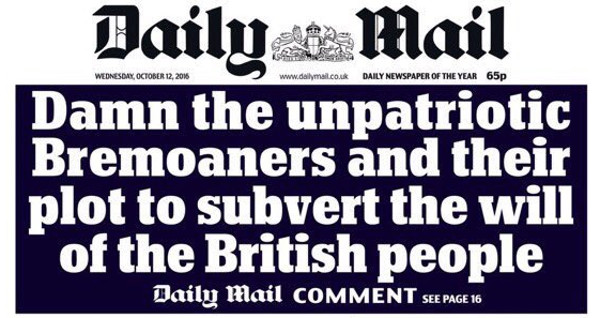
    mail headline
    So can a brexit segmentation be used as part of a marketing strategy? There are at least 16 million consumers that would broadly fit within the brexiter segment. When one looks at the demographic split of leave versus remain voters you start to see clear segmentation ideal for marketing opportunity.

    You already have brands doing this in the U.S. for instance standing up for LGBT rights. Unilever’s Ben & Jerry’s have come out in support of Black Lives Matter.

    Now lets look at research done into the demographics of the voters.

    Much has been made of the splits in UK society:

    Young people who voted tended toward Remain; the older you were the more likely you would be a Brexiter

    (73%) of 18 to 24 year-olds voted to remain…

    A majority of those aged over 45 voted to leave, rising to 60% of those aged 65 or over

    Working class areas outside London and other major cities voted to leave

    The AB social group (broadly speaking, professionals and managers) were the only social group among whom a majority voted to remain (57%). C1s divided fairly evenly; nearly two thirds of C2DEs (64%) voted to leave the EU

    Labour claimed that a majority of Labour supporters who voted voted remain

    Nearly two thirds of Labour and SNP voters (63% and 64%), seven in ten Liberal Democrats and three quarters of Greens, voted to remain

    The correlation between class and voting broke down in Scotland and Northern Ireland were working class areas outside major cities narrowly voted to stay.

    Some of it was certainly a protest vote, large swathes of the country feel that they have been ignored by a professional city-orientated political class. As the Political Economy Research Centre reflected:

    The geography of leave voters reflected the economic crisis of the 1970s, not the 2010s.

    Concerns about financial future and family’s well being were stressors rather than root causes. Research attributed it to more deep seated attitudes that shaped world view.

    Work by the London School of Economics showed that when  attitudes were mapped against income level; working class status wasn’t as much a deciding factor as pollsters would have had one believe, instead it seemed to correlate close to personality traits.

    Closedness and openess

    Back in the 1950s American academics sought to answer the question of how Hitler and Mussolini  could have become so popular in what were initially democratic societies? What they and subsequent research found was that a certain amount of  a given population tend to have more of a closedness (or authoritarian dynamic) in their world view.

    This can be amplified through:

    • Culture
    • Fear
    • Change
    • Economic insecurity

    They look for strong leaders and simple answers. Nostalgia and the past is reassuring. They are less interested in ‘sensation seeking’ and want to fit in.

    Liberal values tended to be more orientated towards aspects of openness that embrace newness, sensations, innovation and change.

    The Google Trends spike

    Much was made of a post-election Google Trends spike on searches such as ‘What is Brexit?’ as a demonstration of a key democracy failing. According to political scientists voters having an understanding of what they are voting for is key in a democracy. If it were true it would cast a shadow on the likelihood of the underlying electorate traits being useful for segmentation. The Google Trends story wasn’t necessarily correct; (but it was great fodder for the news cycle)

    • Google Trends is about the rate of change in searches, so it might be moved dramatically by a relatively small amount of searches
    • Having been working on using Google Trends, we’ve found that there are inconsistencies in data in terms of timing and peaks depending on which IP address it is drawn from and what is the exact mix of terms compared.
    • There is nothing but a hypothesis to associate the peak with people who were eligible to vote.

    National versus international businesses

    There are a number of British brands on the high street that are geographically focused for whom taking a resolute Brexit stamp would not cause brand harm or investor protest. Examples of this would be Tesco – who have pared back their international footprint and are likely to continue to do so, Wetherspoons, Poundstretcher and payday loans brands like Wonga.com.

    For more internationally orientated publicly listed companies, the UK becomes less attractive. Senior government thought leaders such as conservative MP John Redwood have made it clear ‘interference’ including voicing concerns about the Brexit process would be unwelcome.

    …companies who did not stay silent on the country’s EU membership would pay a “very dear economic and financial price”.

    Chief executives who decide to take a corporate position on the issue could lose their jobs while those campaigning against membership would ensure there were financial consequences…

    As the UK becomes a more isolated economy  two steps behind its European peers there could be a temptation to spin off their UK business. This could happen in two ways.

    Selling on local gem brands

    Selling on local gem brands (brands with only significant sales in the local country). Examples could be brands like:

    • Ambrosia
    • Hovis
    • Cabrini sportswear
    • K cider
    • Barclays
    • Wonga.com
    • Royal London

    Disposal of UK assets

    Alternatively disposing of UK subsidiaries would make sense as Brexit represents a permanent reduction reduction in profit margins. For someone like McDonald’s Restaurants, that would likely mean pressing ahead with an ‘all-franchise’ model in a similar approach to what it has taken recently in China.

    In order to sell they are likely to require some sort of assets rather than just a sales agreement with the parent company. If they have become only a UK sales organisation, then the viability of this approach depends on the supply chain. One way of adding value into the supply chain would be for these businesses to open up a direct sales channel.

    Companies like Unilever already look at how they can integrate into supermarkets supply chain, with ‘buy it now’ buttons on their own site that take you to their online retail partners. They could also open up a direct e-commerce channel; given the Marmitegate debacle with Tesco; expect examination of alternative business models like America’s Dollar Shave Club and Amazon’s Dash.

    Modern international brands are already used to marketing towards the ‘open consumer’ who was likely to vote remain. Products that feel up to date, innovative and socially responsible.  A classic example would be Dove, Innocent smoothies, AirBnB or the average family car. Using a brexit segmentation would feel uncomfortable or just wrong for these brands.

    Marketing to the pro leave part of Brexit segmentation

    A local business for local people with brands that appeal to leave voter demographics could be more explicit in courting leave voter’s spend utilising a geographic and demographic aspects to Brexit segmentation.

    Tapping into the ‘authoritarian outlook’ would mean tapping into nostalgia; throw-back branding and possibly rolling back political correctness in the name of common sense.

    An extreme outcome could be Robertsons bringing back their original Golly character; though thankfully I suspect that would be step too far – even in post-Brexit Britain.

    Rejection of expert is partly down to wanting a reduction in complexity. This has huge implications for a wide range of products, particularly in the financial services sector or mobile tariffs.

    Choice is the enemy, a simple product, down-to-earth, unambiguous in its claims. Mobile tariffs without bolt-on features, complex phone upgrade cycles or value-added services. In the case of pensions and insurance, with the assurance that they could help ward off a sinister future full of negative change rather than rich rewards. Perceived good value wouldn’t do any harm either.

    In terms of how the product or service fits into the Brexiter’s life it is less about being part of a creative expression of individuality. Instead it is more about the ‘grey man’; blending in. Blending in is a threat coping mechanism, a form of risk reduction (think Dilbert cartoons). It shouldn’t mistaken for being more community-spirited, instead the community is of mutual convenience – a shoal of people.  A consequence of this is that persona creation becomes harder or derivative, the stellar insight from the planner loses its gloss. Agency creatives are likely to struggle with consumer empathy beyond utility.

    From the advertisers perspective appealing to leave brexit segmentation means blunt simplicity rather than clever creative. Audience reach is still important, but a higher frequency is likely required to achieve a comparable impact. This is to get over the Brexiter’s higher degree of inertia to marketing and making them feel that accepting the brand is part of conforming within society. It is part of the eco-system, traditional brands have an advantage due to their familiarity and heritage. Even if its a new brand it feels as if it has always been part of the consumers fabric.

    More information

    Ben & Jerry’s came out in support of Black Lives Matter. Naturally, some cops are freaking out | Fusion
    Business Leaders Speak Out Against North Carolina’s Transgender Law | Wall Street Journal
    These 70 Corporations Want to Block North Carolina’s Transgender Bathroom Law | CBN News (US news outlet for the evangelical christian audience)
    How the United Kingdom voted on Thursday… and why | Lord Ashcroft Polls
    How Demographics Decided Brexit | The Market Oracle
    How has Brexit changed the mindset of a nation? | Bucks New University Business School
    How do Britain’s ethnic minorities view the EU referendum? | Kings College London
    Making Sense of Brexit – the data you need to analyse | UK Data Service
    Who is voting to leave the EU and why? | openDemocracy UK
    Thoughts on the sociology of Brexit | Political Economy Research Centre
    The 2016 Referendum, Brexit and the Left Behind: An Aggregate-Level Analysis of the Result by Goodwin and Heath – PDF
    Businesses that speak out for Britain’s EU membership will be punished, vows John Redwood | The Telegraph
    UK voters don’t understand Brexit, Google searches suggest | Ars Technica UK
    Marmitegate is ‘just the tip of the iceberg’ as cheese, chocolate and wine all face ‘punishing tariffs’, Nick Clegg claims | The Telegraph
    It’s NOT the economy, stupid: Brexit as a story of personal values | British Politics and Policy blog | LSE
    Brexiters would rather trust the wisdom of ordinary people than the opinion of experts | Quartz
    The One Weird Trait That Predicts Whether You’re a Trump Supporter | Politico
    Brexit Voters: NOT the Left Behind | Fabian Society
    Authoritarianism and Political Behavior by Janowitz & Marvick | Public Opinion Quarterly (Summer 1953)
    Voters’ personality traits in presidential elections by Barbaranelli, Caprara, Vecchione and Fraley | Personality and Individual Differences 42 (2007) – PDF document
    Personality Traits, Partisan Attitudes, and Voting Behavior. Evidence from Germany by Schoen | Political Psychology (August 2007) – PDF document
    Grey Man Strategies 101: Peeling Away the Thin Veneer of Society | Imminent Threat Solutions
    How To: The Modern Grey Man Philosophy | Loaded Pocketz
    EU referendum results | The Electoral Commission

  • Facebook marketer tools +

    Facebook marketer tools – Digital media has been historically very focused on performance marketing tools. The new generation of Facebook marketer tools are an attempt to shake things up from a brand marketing perspective. A lot of inspirational work coming out of Brazil (non-olympic related).  Don’t think of it as hyper-targeted advertising, think of it more akin TV advertising. The challenge is then where does it fit in terms of relative cost of reach in comparison to old media. At the moment old media has that as an advantage. While we wait for old media / new media dynamics to change check out the following Facebook marketer tools:

    • Telescope TV – great tools producing live TV broadcast experience on Facebook Live (I presume it would also integrate with the likes of U Stream, YouTube streaming etc)
    • Facebook’s business and developer facing site on all things Messenger
    • +rehabstudio – agency with a similar mix of hardware and coding a la Berg London (RIP) who are doing interesting things on Messenger (ok interesting-ish things copying what’s already been done on WeChat and LINE). The website doesn’t show it but they were behind National Geographic’s Tina the T-Rex chatbot
    • Pullstring – better quality chatbots

    P&G to Scale Back Targeted Facebook Ads – WSJ – interesting read, P&G moving more towards reach and frequency away from targeting. On a cost basis traditional broadcast media may be more competitive in their fight with online. Which explains the business imperative behind these Facebook marketer tools

    Culture

    Bret Easton Ellis weighs in on the ‘snowflake generation’ | Dazed

    Design

    rule40 – the ironic thing is that their clothing feels like a branded by absence product similar to Muji. I haven’t bothered watching the Olympics and don’t intend to thanks to Netflix and similar

    Subway launches refreshed logo | Branding Source – nice in a 1970s kind of way

    Finance

    WSJ City – City Lobby Groups Jostle to Be Heard on Brexit – not terribly surprising, expected that it would be a feeding frenzy of lobbyists

    Innovation

    Apple’s stagnant product lines mostly reflect the state of the computer industry | ExtremeTech – Apple’s relatively lax refresh cycle is mostly driven by the low rate of improvements in PC hardware these days. Apple is just more honest about it – and this says a lot about Moore’s Law

    4K, 8K: In Japan, ‘TV Is The Thing’ | EE Times

    Media

    Reporters, Editors Still Rely on ‘Old Media’ (Study) | SocialTimes – interesting article, surprised that social media as a source ranked so high in APAC compared to other regions

    ‘We need to be better and faster at making work’ Ogilvy & Mather UK CEO Annette King tells staff as Ogilvy Labs shutters | Marketing | The Drum – interesting move apparently attached to the Brexit outcome. The tone it sets is interesting

    Hulu Ends Free Streaming Service | Variety – and this makes the Verizon deal potentially more interesting

    Not every white male creative is a member of the boys club – Mumbrella

    Online

    Yahoo patented technology to ‘pre-deliver’ emails before you even write them – Business Insider – interesting…

    People are using Instagram’s ‘Stories’ feature to ask for follows on Snapchat | TheNextWeb – interesting to see how Instagram will handle this

    Social Music App Eyegroove Shuts Down, Team Joins Facebook. Should Musical.ly, Dubsmash Be Worried? – hypebot – seems to be a wider challenge in social music based platforms – though Crowdmix are an outlier due to their management issues

    Uber uses Brexit to pressure TfL over English tests | Campaign Live – on the other hand it offers another opportunity to close Uber out of London

    The Deeper Significance of Didi Chuxing — The Information – this is positioned as new, but the reality is that Baidu out-exexcuted Google in China as well. When Google complied with Chinese law it failed to understand the dynamics of the Chinese web and Baidu out crawled them. Google did its China market ‘stunt’ after having lost the mass market in China

    Didi, SoftBank Lead $600 Million-Plus Round for Grab – Bloomberg – which will then be competing against Uber – interesting, I suspect Didi will win this battle as well

    Retailing

    Retailer Acceptance – Contactless Life – basically your wallet isn’t dead yet

    Web of no web

    Artificial Intelligence Drone Defeats Fighter Pilot: The Future? « Breaking Defense – here comes SkyNet…

    This site lists all the Siri commands you’ll ever need | TheNextWeb – useful, but also shows the current problem with AI-like technology; it needs its own guide / instruction manual

    Wireless

    China, Not Silicon Valley, Is Cutting Edge in Mobile Tech – The New York Times – actually much of this is a continuum from what was happening in Japan, but a hell of a lot bigger, interesting that Huawei and Xiaomi didn’t get a name check though

  • MasterCard logo + more

    MasterCard logo redesign struck a nice balance between  change and heritage. Wired magazine has more details on the MasterCard logo redesign and how it has changed or evolved over the years. More on branding related stories here.

    Snoop Dogg on a US game show via Zak Agency’s ‘cool sh*t‘ email newsletter. Legendary undersells the Doggfather.

    Masaaki Hiroi’s wooden toys look amazing. They are a great example of how Japanese artisan crafts continue to manage remaining relevant.

    Our Iain switched me on to Snoring (music to sleep by) from IGLOOGHOST. Which makes a lot of sense given the amount of focus on mindfulness and white noise generators in smartphone app stores.

    I went to see The Avalanches play their new album at Oval Space back in June and there were a number of people in the audience ignorant of their process and exceptionally vocal on social media.


    I honestly don’t know what they were expecting – Led Zeppelin type stage antics? They didn’t realise that The Avalanches are producers and turntablists. I guess this is what we get when people only know their music through their favourite playlists on Spotify rather than being able to read album notes.

    This was in advance of their new album drop Wildflower. The album is tremendous; Wildflower has been on heavy rotation in/on my iPod. It moves on from the ethereal quality that their first album had to something more confident in nature. Buy it, gift it to friends and relatives.

    The folks at who sampled put together this great run through of where all the pieces came from. Given The Avalanche’s creative process, this is a long but very worthwhile video walk through the Wildflower album.

  • Nice & other things

    Nice

    Nice murder-by-truck incident – My social media feed filled up with poor ad placements against news about the Nice murder-by-truck incident. Sesame Street’s handling of the event on the social media accounts was a paragon of how these things should be done on Twitter and YouTube

    Hat tip to our Ana

    Culture

    INDUSTRIAL JP / Record Label of Factory – really interesting Japanese record label that takes the principles of music concrete and turns them in to great house and techno tracks. The videos that accompany the tracks are hypnotic.

    My soundtrack for the past week has been The Avalanches new album Wallflower and this epic Paul Daley (Leftfield) mix from five years ago with an Ibizan vibe that belies cruddy summer weather we’ve been having

    This is what happens when you let Rus Khasanov loose with glitter and ink. The music is by Dmitry Evgrafov

    Web of no web

    Virtual reality lets Chinese customers shop Macy’s New York store on the world’s biggest shopping day – really interesting e-commerce offering. It is an illustration of how much China-international e-commerce is so important.

  • Weiying + more news

    China’s Tencent and Weiying Take $85 Million Stake in Korea’s YG Entertainment | Variety – China is the market for a lot of Korean TV. Gaining soft power through culture is part of the government’s aspirations – this deal makes both political and business sense. Korean production companies have found that their shows are often blocked by Chinese regulators. Instead the best way around this has been licensing the formats for a remake locally, which offers modest payments. Whether it is good for Korea in the longer term is another matter.

    China has a number of problems on its hands before it can replicate Korea’s success. China has a warped production model that works on patronage and ever bigger budgets and returns. Great for doing a large scale fight scene, not so good for romantic dramas. China hasn’t managed to build up a bench of likeable stars with international appeal in the same way that Korean has managed in a consistent manner. The desire of the government propaganda department blunts the appeal of dramas. Weiying will struggle to give China the kind of soft power that Korea and Japan enjoy respectively abroad. More on Korea related topics here.

    Discover Vietnam’s most chosen brands | Kantar Worldwide – well done Unilever. Unilever is especially interesting because of its success with both Vietnamese urban and rural consumers. However Nestle is a high-performing number 4. Unilever’s competition isn’t P&G, but local brands Musan and Vinamilk.

    How Akira sent shockwaves through pop culture and changed it | Dazed Digital – still an amazing film. I remember seeing it at the 051 cinema in Liverpool, some time before 1994 and it blew me away. It wasn’t just an engaging story but a well thought out future. Architecture wasn’t just new and shiny like Star Trek, but there were new and old side-by-side like London or Hong Kong. It was the future cyberpunk Japan that author William Gibson mirrored in his own early books. The impact of Akira encouraged me to watch more anime, when then led to my love of Ghost In The Shell.

    Tumblr is now blocked in China | Techinasia – surprised it hadn’t happened already given its meme and porn driven nature