I flew to Hong Kong with Cathay Pacific and had a stopover in Europe and it reminded me why I love to travel with them. My flight from the UK was with British Airways, who used a long haul plane on a short haul route meaning that some people got a flat bed to have a nap in business class, whilst other business class passengers put up less luxurious surroundings, but like the Murphys I’m not bitter. There was no invitation to their lounge on the break of the flight in Europe, no real up-selling the benefits of OneWorld at all.
I eventually connected with my Cathay flight at the gate and was told to report to the Cathay counter regarding my boarding pass. The first thing that went through my mind was ‘I hope they don’t bounce me off my flight for some other person’. Instead it turns out that despite my flight being booked through BA; my passport details hadn’t been shared with Cathay for the second leg of the trip. Whilst there the Cathay people asked me if I would like to use their arrival lounge at Hong Kong airport and gave me the pass for it, they then pointed out that gate wouldn’t open for ten minutes and I still had time to use their business lounge before the flight. It was small things that they did that went out of the way.
Onboard, I have a penchant for Hong Kong-style milk tea and Cathay Pacific do a version of it. Cathay’s version of Hong Kong-style milk tea tastes even better if you get them to throw an Earl Grey tea bag into the cup with it, I ask them for this concoction and they don’t bat an eyelid at the weird aging-hipster of an Irishman in row 11 with the odd request. I wouldn’t do it with BA even if they served Hong Kong-style milk tea, because matron wouldn’t be happy.
As you would expect with an Asian long-haul airline there is a decent seat to get some sleep in, and a toiletries bag that is is practical. Agnes B did the design which turned out sufficiently practical you want to take it with you. Entertainment-wise Cathay benefits from Hong Kong’s film industry as well as the usual Hollywood fodder.
All that Cathay Pacific would need to do to be perfect is:
Make the shoe locker in their business class seats a bit larger, not everyone wears brogues. They couldn’t fit my Zamberlan boots in let alone cope with a pair of ladies healed boots, a full-sized pair of Timberlands or Jordan 11
Allow you to be permanently logged in on their mobile application
cini me looks to solve the challenge of validating reach in cinema advertising. Cinema advertising is one of the most targeted ways of reaching younger people and I have used it as a vehicle to target parents through buying adverts in mothers-and-baby screenings. The problem is that it’s hard to know the actual reach and impact of cinema advertising until now.
cini me – is a smartphone application that allows consumers to answer questions posed by a programme embedded in adverts prior to the film trailers. cini.me is interesting because it can track ongoing engagement across campaigns over time on an ongoing basis, and is likely to be only downloaded by the most motivated and regular cinema-goers.
The quiz when I was saw it was sponsored by Sony PlayStation meaning that the application competition was probably self-liquidating at the very least. From Sony’s point-of-view participation numbers give a proxy measure of reach and attention at the time the segment was running. You can see more on that campaign here.
Finally it helps the cinemas, providing evidence that with the right campaign, cinema can drive a mobile call-to-action. From there is is up the advertising agency and media buying agency to demonstrate return on investment on behalf of their clients.
There is a fly in the ointment for all this, no wifi in the cinema and next to no mobile reception either. The combination of both affects the volume and quality of the data received by the advertiser in a manner that can’t be readily modelled for.
I am surprised that clients, haven’t integrated mobile search into cinema campaigns before in that way that I have seen done previously on out of home advertising in the UK or on television advertising in both Japan and Korea for years. If mobile network infrastructure improves that could be a missed opportunity for advertisers.
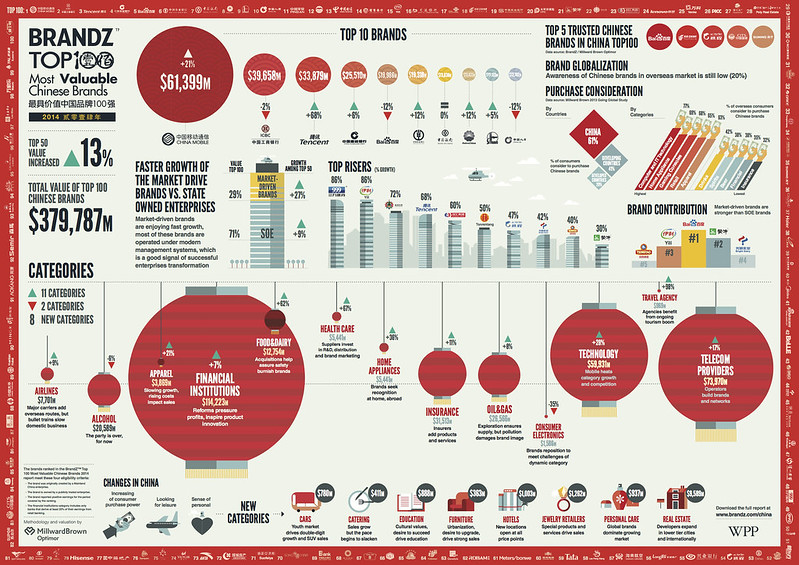
One has to have a certain amount of scepticism about the science that goes into brand lists but they do serve a purpose to show how marketing changes. Brand Z (part of the WPP Group for which I also ultimately work) have released their top 100 Chinese brands of 2014. Here is what I thought were the most interesting takeaways on China top brands 2014 were from the document:
Chinese brands are considered by Chinese consumers to have equivalent ‘brand equity’ to foreign brands. This is huge as increasingly nationalistic considerations will kick in as part of the future envisaged by likes of Xi Jingping
Chinese brands have managed to improve in terms of relevance, performance and presence, but lag in terms of bonding (emotional attachment)
They also struggle with overseas awareness, a lot of this is down to poor media investment and hubris that Chinese creative will work elsewhere
Two of the top three most trusted brands were online brands: Baidu and Ctrip
Private enterprises on the list tended to spend more on print and online advertising compared to State-Owned Enterprises
Challenges for brands
Challenges for brands identified by Brand Z include:
Building and maintaining trust
Developing a distinctive brand personality
Being more human as a brand
Older brands need to put a greater value on their heritage
There is a nice infographic that goes with all this
More information on China top brands 2014 – Brand Z Top 100 Chinese Brands 2014 (PDF). More branding related content here.
I was talking to colleagues during the week and thought it would be timely answer the question, what does Google moving search click-throughs on to HTTPS mean for PR people?
We have less data to use as part of a scientific approach to developing messaging as HTTPS moves inbound search words private. For non-mainland Chinese audiences we are reliant on Google advertising keyword data rather than what has been working driving traffic to their site. For instance, when we think about how we use websites, what might work in a sales situation, may not work when we are looking for information or customer support
When creating content for websites, there needs to be a greater focus around the quality of the content rather than the classic focus on keyword density, since there are less clues on organic searches with HTTPS. This is a key advantage for PR people over ‘content marketers’ who have focused on creating content that is just good enough. We can still see which posts are the most popular for traffic coming from Google and then look to infer what works by looking at commonalities across the pages: content themes, likely audience intent etc.
HTTPS reduces intelligence. Inability to draw conclusions whether our content has an effect on consumer behavior, which keywords were used to reach the intended website, and the penetration of our messaging in the public lexicon when they search and arrive at the specific site. For example, a campaign to promote the ‘Bold washing powder’ causes a rise in searches for “Bold washing powder” to arrive at the P&G UK website, now we no longer able to draw this conclusion. In essence, it is much harder to prove online behavioural change from offline PR activity
A move towards increased link building for client’s websites; blogger relations and responding to posts becomes more important, since there is less of a focus on keywords
Client spend on search advertising is likely to increase as it becomes harder to prove the ROI on tactics used to bolster organic search traffic
More to think about HTTPS here. More on Google here.
This is the first in a number of posts that are designed to expand upon a post I published in May about eight trends for the future. They appear in the order in which I bite them off, chew them around and verbally masticate as posts on the blog. For this post I am looking at digital interruption.
The U.S. civil rights movement
I started thinking about the civil rights movement in the U.S.
By the late 1950s the US civil rights movement found that discourse and letters hadn’t moved the needle meaningfully and it took events like Rosa Parkes sit-down protest and the Stonewall riots to move the process forwards towards a more equal rights for all.
If one looks at the process in terms of mechanism, rather than the politics behind it; the Greenham Common Women, the tunnels dug by road protesters like Daniel Hooper (aka Swampy); they are an extension of the tactics used by civil rights movements decades before.
The first digital protest
The first digital-powered civil rights protest was the burning of draft cards by young American men from May 1964 onwards. The cards were printed with a font that could be read by an optical card reader connected to a mainframe computer, allowing the processing of draftees more efficient. 46 Americans were subsequently prosecuted for destroying their draft cards.
Digital interruption: learning from the Max Headroom takeover
Analogue interruption of media as a form of protest hasn’t worked that well in general. Whilst pirate radio stations routinely disrupted analogue broadcast transmissions, there weren’t a form of protest media, but generally a form of expression.
Probably the most famous hack was the Max Headroom broadcast interruption in Chicago.
The takeover likely to have been done by transmitting a more powerful microwave signal at the transmitter on the Sears Tower used by local broadcast TV stations. The people behind the Max Headroom takeover have never been caught, though there seems to be a number of people on Reddit who have a good idea who they are based don the some of the discussions you can Google. There were two things with analogue interruption:
You had to have a good deal of specialist knowledge to do it
It was quite hard to not get caught, similar media interruptions that occurred earlier by the likes of Captain Midnight (aka John MacDougall) who was busted the previous year whilst protesting at HBO’s unfair charges to satellite dish owners
The roots of computer hacking come from a wide range of sources from the political movement of the Yippies providing guides to phone phreaking (getting the phone network to do things the telephone companies wouldn’t like – giving you free calls etc.) to researchers finding flaws in early mainframe programs in the mid 1960s.
By the 1980s, bulletin board services had started to become popular; mainly because local calls were bundled with the line rental of a phone and so were effectively free in the U.S; allowing a pre-internet digital culture to build up. Bulletin boards also existed in other countries but the relatively high costs in regulated telecoms markets across Europe was a major barrier to take-up.
Computer viruses that were propagated disk-to-disk could extend their reach; particularly as magazine cover disks were often compiled with shareware and freeware originally downloaded from a bulletin board as a service to their readers. Magazines were also paid to distribute trial versions of commercial software and dialers for the likes of CompuServe.
It is interesting to note that the online chat function which drove the adoption of services like CompuServe and AOL whilst mirroring much of the bulletin board function; drew their paradigm from CB radio; with CompuServe’s online chat function being originally branded a ‘CB Simulator’.
Other forms of protest such as flame wars and trolling which came out of the bulletin board culture could be seen as incubators for similar behaviour on Internet platforms from Usenet groups to Facebook pages.
Underlying internet technologies have facilitated a step-change in protest; on the one-hand functions like emailing a politician or an online petition have become increasingly ineffective. ‘Peaceful’ consumer protests against the likes of the UK’s Digital Economy Act were ignored by the politicians and petitions supporting Edward Snowden achieved nothing but provide the authorities with a list of trouble-makers.
Brands that have come under attack on their Facebook pages like Nestle have demonstrated a remarkably thick skin, showing the online people power via social media is often a fallacy.
Consumers were taught by the body-politic that vigorous discourse and petitions don’t work compared to the face-to-face interactions with corporate lobbyists from industry bodies like the BPI, the MPAA or the RIAA.
From this lack of effectiveness came the modern digital interruption. Denial of service attacks have been happening for years as a prank or financial shake down but first came into their own as a form of political protest with the use of the low orbital ion cannon (LOIC) program by members of Anonymous to attack sites related to the Church of Scientology and the RIAA. Whilst this form of protest is illegal in many countries, it is seen by those who use it as a form of civil disobedience; similar to overloading a switchboard with protest calls or a picket line.
People involved are jailed and since Anonymous, like democracy is as much an idea as an organisation; the attacks continue.
Website blackouts by authoritative brands themselves have proven to be much more effective. On January 12, 2012, Wikipedia, Reddit, Flickr and a host of other large sites were effective in overturning the RIPA and SOPA pieces of proposed legislation in the US.
On their effectiveness MPAA chief executive Chris Dodd was quoted in the Los Angeles Times:
“It is an irresponsible response and a disservice to people who rely on them for information and who use their services,” Dodd said in a statement. “It is also an abuse of power given the freedoms these companies enjoy in the marketplace today.”
It was a tacit admission that whilst consumers could do without films and music, internet search, email and Wikipedia were now must-haves. The web blackout scared politicians because of the services ubiquity to modern life. They couldn’t be ignored like the petitions or emails and be dismissed as a fringe influence.
The world will break down into two types of organisations:
Social
Anti-social
From a communications point of view anti-social means not engaging for a specific reason, be it regulatory or not wanting to change controversial business practices. Conversely a social organisation not only communicates with it’s audience but also acts on what it hears from co-creation to changing business practices. Reputation management opportunities for agencies will occur when a client organisation tries to fall between the two categories and need to be guided between one or the other. Key skills will include:
Closing down social presence to deny digital interrupters an attack platform
Being conversant with techniques to help harden non-social online presence
Management consultancy to bring about business process change as part of making an organisation a social one