Category: branding | 品牌推廣 | 브랜드 마케팅 | ブランディング

The dictionary definition of branding is the promotion of a particular product or company by means of advertising and distinctive design.

I have covered many different things in branding including:

  • Genesis – the luxury Korean automotive brand
  • Life Bread – the iconic Hong Kong bread brand that would be equivalent of wonder loaf in the US
  • Virgil Abloh and the brand collaborations that he was involved in
  • Luxury streetwear brands
  • Burger King campaigns with Crispin Porter Bogusky
  • Dettol #washtocare and ‘back to work’ campaigns
  • Volkswagen ‘see the unseen’ campaign for its Taureg off road vehicle
  • SAS Airline – What is truly Scandinavian?
  • Brand advertising during Chinese New Year (across China, Hong Kong, Singapore and Malaysia)
  • Lovemarks as a perspective on branding
  • BMW NEXTGen event and Legend of Old McLanden campaign
  • Procter & Gamble’s Gillette toxic masculinity ads
  • Kraft Mother’s Day campaign
  • Kraft Heinz brand destruction
  • Porsche Design in the smartphone space
  • Ermenegildo Zegna
  • Nike’s work with Colin Kaepernick
  • Counterfeit brands on Instagram, Alibaba and Amazon
  • Gaytime Indonesian ice cream
  • Western Digital
  • Louis Vuitton collaboration with Supreme
  • Nokia
  • Nike Korea’s ‘Be Heard’ campaign
  • Mercedes SLS coupe campaign
  • Brand collaborations in Hong Kong
  • Beats headphones
  • Apple
  • Henrion Ludlow Schmidt’s considerations of branding
  • Cathay Pacific
  • Bosch
  • Mitt Romney’s failed presidential bid
  • Microsoft Surface launch
  • Oreo Korean campaign
  • Chain coffee shop brands and branding
  • Samsung’s corporate brand
  • North Face’s brand overeach in South Korea
  • Mr Pizza Korean pizza restaurant and delivery service brand
  • Amoy Hong Kong food brand
  • Chevrolet Corvette ‘roar’ campaign promoting a build your own car service
  • Rituals and artefacts

    I have been reflecting on rituals and artefacts. This line of thought started when I met up with Marc Sparrow and we talked about many things. The one that stuck out in my mind the most was that we were two tablet computer owners, but we both insisted on reading the Sunday newspaper in a dead tree format.

    Marc went on to tell me that he saw from his friend’s Facebook updates that they were passing on rituals including getting a print Sunday newspaper on to their children too. The Sunday Times was no longer about news and analysis but a marker for Sunday like the traditional roast dinner or church service and a way of unwinding before the week ahead.
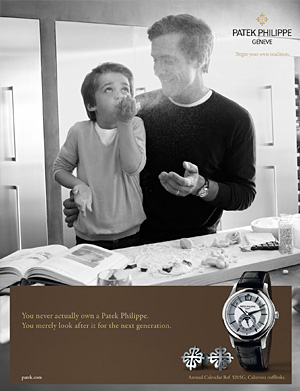
    Patek Philippe advert
    When one looks at Patek Philippe’s adverts the thing that stands out is the strapline:

    You never actually own a Patek Philippe.
    You merely look after it for the next generation.

    Whilst being a clever bit of marketing, I think that it says a lot about some brands and contexts. In particular, how rituals and artefacts are central to context. Whilst brands like Louis Vuitton and Gucci have blurred the line between fashion and luxury; the great Swiss watch brands like Rolex rely on old-fashioned word-of-mouth. Omega is part of my evoked set (despite my not liking a lot of their watch designs or the way way they have fashionised the brand) because of my parents. I got my first Rolex because I had a bad experience diving with a Seiko watch and my dive buddies explained why they thought Rolex was more resilient.

    This didn’t happen in Facebook but in Snowdonia, in the dead of winter in front of a man-made lake that had killed a number of scuba divers. Within half an hour of my having made a forced ascent as my dive watch had popped off my wrist and sailed to the bottom of the lake some 80 metres down.

    As an industry we often forget about physical context, rituals and artefacts. Ironically it is about going back to marketing 101 and the year 1960. E. Jerome McCarthy came up with what was then the four Ps, to which were added another three over time. Since then marketers have thought about looking at these from a consumer point of view and you had other models like the four Cs, but for the sake of simplicity I will list out the 7 Ps:

    • Product
    • Price
    • Place
    • Promotion
    • Physical Evidence
    • People
    • Process

    I would argue that physical evidence is more than the salesroom experience and people are the customer base as well as the sales and supply chain. Think about how on the road arrogance affected the perception of certain car marques in the UK:

    • Mondeo Man
    • The Volvo Driver
    • White-Van Man

    All of these stereotypes have had a grain of truth to them and affected the way we think about the brands. Look at the way Burberry and Stone Island got affected by their football casual customer base.

    As clever marketers we can also create rituals:

    • Mother’s Day
    • Take a break, have a Kit-Kat
    • Royal British Legion poppy campaign
    • Guinness co-opting St Patrick’s Day

    More related content can be found here

  • Bosch brand

    I mean’t to publish this a while ago but a lack of time got the better of me. Lucre‘s social media team were supporting Bosch UK in their positioning of Bosch is all around us.
    Untitled
    It got me thinking about what Bosch meant to me. Primarily the brand was about three things:

    • Power tools – I used Bosch power tools to prepare my O’level project in Craft, Design and Technology. My Dad worked in a plant hire company and so I could get hold of a power sander and a power router which made the whole process much easier. Bosch and Makita are still the gold standard of power tools, if anything Makita has managed to edge power tools
    • Electrical car parts – in particular the iconic brown distributor cap that sat under the bonnet of my first car and doled out electricity to the Bosch spark plugs. Their windscreen wiper blades are made to a similarly high standard
    • Kitchen appliances – my 40 something fridge which finally got thrown out when I moved out of my house in London. It still worked and had served as a store for cold drinks in my garage when I listened to records during the summer. My parents had bought it after they moved into their first house and it got relegated to their garage when they bought a fridge freezer in the mid-1980s. They are now three fridge freezers on whilst I was still using the Bosch fridge. It is probably sitting on a landfill in the south of England punching a hole in the ozone layer with its vintage CFCs

    While Bosch may have been all around me, it stayed around me because the products were generally very well made. Something that many of it’s competitors can’t truthfully claim. More brand related content can be found here.

  • Chinese brands opportunity

    Chinese brands opportunityl – a sister company of my agency has launched a report on the top 50 Chinese brands. The report is exhaustive and has lots of smart stuff in it that will undoubtedly make it into the PowerPoint presentations I have to churn out over the next year. Leafing through it though I was immediately struck by one aspect of the data in particular.  Four of the top ten brands derived less than 20 per cent of their turnover from outside China. And nine of the top ten brands derived more more than a third of their revenues from outside the country.

    In fact, it was only Lenovo that made over half its money outside China. This immediately struck me: abroad was Chinese brands opportunity. As the bulk of these brands have services that would certainly work internationally and there is an unreleased potential to create the next Shell, Citibank, British Airways or Whirlpool. Given that China is looking to move up the food chain as countries like Vietnam and the Philippines have lower cost workforces than areas like Shenzhen, international brand growth by these Chinese companies or their peers is only a matter of ‘when’, rather than ‘if’.

    The biggest barrier for fulfilling Chinese brands opportunity is the ability of the management team to move past hubris and a China-first focus. This is something that ‘struggle’ or wolf culture organisations like Huawei fail to do that well.

    More information
    BrandZ – Top 50 most valuable Chinese brands 2013

    Archived from blog posts I wrote for PR Week. More business related posts here.

  • Clone

    I wrote a bit about my experience speaking with a consumer electronics salesperson on a post I wrote for PR Week. It was this conversation where I heard the phrase clone used.

    When I heard clone, I thought of Dolly the sheep, or the lumberjack ‘castro clone’ subculture in the gay community that borrowed from 1960s rockabilly and drove the Levi’s 501s as fashion movement. It also had a clear influence on grunge fashion of the early 1990s

    However n this context it meant a piece of consumer electronics badged with the brand name of, and sold by a famous Japanese brand that has been made in China by an ODM (original device manufacturer), and where many of the critical  components were not sourced from within the industrial group of the Japanese brand. It was a negative term implying that the product was in many respects counterfeit or unauthentic.

    The concept in itself isn’t a new idea. During the golden age of Japanese hi-fi you saw similar ODM relationships. The most egregious example is from some 30 years ago it was well-know that  Ferguson’s Videostar machines were re-badged JVC models. Show a picture of a JVC HR-3300 to your average British person of a certain age and they might tell it was a Ferguson Videostar or a Baird. Grundig and Philips shared a similar relationship back in the 1980s.

    What is interesting is the corrosive effect that the clone accusation must have on a brand, particularly when it comes from a figure like the sales person I spoke to who would be considered by the consumer to be a domain expert.  I gnaws away at reputations based on quality and design over decades and explains how globalisation and digital convergence has destroyed giants like Panasonic, Sony, Pioneer and Sharp.

    This contrasts sharply with the perception of Apple, which uses a similar ODM-based supply chain yet has managed to grow from strength-to-strength. More gadget related content can be found here.

  • Completely wrong

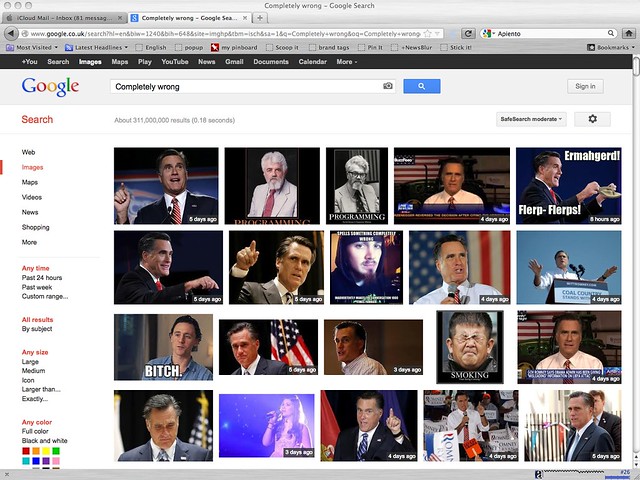
    I didn’t notice this until Laura Scott pointed it out on Twitter yesterday, but Mitt Romney dominates searches for completely wrong on Google image search.
    Romney google bombed
    At first I thought that this was some form of Google bomb perpetrated by liberal leaning digerati, but on investigation it seems to have been self inflicted by the Romney campaign.

    The 47 per cent

    At a fund raiser in May this year, Mitt Romney had characterised 47 per cent of the US population as ‘government dependent victims. The problem was the the fund raiser had been secretly filmed and the footage made public by people sympathetic to the Barack Obama presidential election bid.

    Its the kind of thing that one would expect a candidate to say while looking to fund raise from wealthy people who have more than a passing familiarity with Hayek’s Road to Serfdom. 

    Mr Romney admitted that his remarks regarding 47 per cent of the electorate were ‘completely wrong‘ during a Fox News interview. This turn of phrase then appeared in coverage alongside pictures of Mitt Romney. As online and print media shared analysis and the highlights of the latest and most important aspects of the presidential campaign. 

    Completely wrong didn’t really become a meme of the campaign like say George Bush’s ‘read my lips, no more taxes’, or the Conservative party 1979 election print ad slogan ‘Labour isn’t working’. Given Mr Romney’s current standing in the latest opinion polls he seems to have largely put him and Mr Obama within striking distance of each other. 
    completely wrong

    Search reinforcement

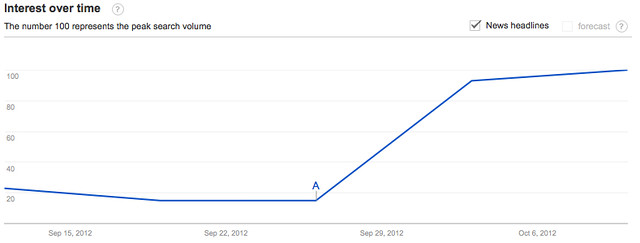
    Added to the content, there seems to have been an elevated level of search of the phrase ‘completely wrong‘ presumably as a way of tracking down the relevant Romney campaign coverage, so reinforcing the Google algorithms association between pictures of Mitt Romney and ‘completely wrong‘.

    Now that this is a known phenomena the behavioural part of this equation will probably provide even  a further strengthened linkage between Mitt Romney and ‘completely wrong‘.

    This all tells us a couple of things:

    • It will be harder to find bespoke ‘right search’ as Google reinforces the  head at the expense of the long tail of search results. Which isn’t great for doing research, or really digging into subject matter. Consumer behaviour is arguably more important than content, which may encourage ‘search bot’ farms
    • Politicos will be pondering how to retain coherence in rebuttals without being repeatedly on message and reinforcing a phenomenon like completely wrong. And its going to be hard to go against 1,000s of years of human evolution