Category: branding | 品牌推廣 | 브랜드 마케팅 | ブランディング

The dictionary definition of branding is the promotion of a particular product or company by means of advertising and distinctive design.

I have covered many different things in branding including:

  • Genesis – the luxury Korean automotive brand
  • Life Bread – the iconic Hong Kong bread brand that would be equivalent of wonder loaf in the US
  • Virgil Abloh and the brand collaborations that he was involved in
  • Luxury streetwear brands
  • Burger King campaigns with Crispin Porter Bogusky
  • Dettol #washtocare and ‘back to work’ campaigns
  • Volkswagen ‘see the unseen’ campaign for its Taureg off road vehicle
  • SAS Airline – What is truly Scandinavian?
  • Brand advertising during Chinese New Year (across China, Hong Kong, Singapore and Malaysia)
  • Lovemarks as a perspective on branding
  • BMW NEXTGen event and Legend of Old McLanden campaign
  • Procter & Gamble’s Gillette toxic masculinity ads
  • Kraft Mother’s Day campaign
  • Kraft Heinz brand destruction
  • Porsche Design in the smartphone space
  • Ermenegildo Zegna
  • Nike’s work with Colin Kaepernick
  • Counterfeit brands on Instagram, Alibaba and Amazon
  • Gaytime Indonesian ice cream
  • Western Digital
  • Louis Vuitton collaboration with Supreme
  • Nokia
  • Nike Korea’s ‘Be Heard’ campaign
  • Mercedes SLS coupe campaign
  • Brand collaborations in Hong Kong
  • Beats headphones
  • Apple
  • Henrion Ludlow Schmidt’s considerations of branding
  • Cathay Pacific
  • Bosch
  • Mitt Romney’s failed presidential bid
  • Microsoft Surface launch
  • Oreo Korean campaign
  • Chain coffee shop brands and branding
  • Samsung’s corporate brand
  • North Face’s brand overeach in South Korea
  • Mr Pizza Korean pizza restaurant and delivery service brand
  • Amoy Hong Kong food brand
  • Chevrolet Corvette ‘roar’ campaign promoting a build your own car service
  • Microsoft Surface

    Some thoughts on the implications of the Microsoft Surface launch:

    Microsoft and tablets

    I found the Microsoft a curious device full of interesting design choices. It was interesting because it seemed to be defined by what it wasn’t. The device was a world way from the clunky tablet keyboard combos by the likes of Fujitsu and Motion Computing who had helped Microsoft get tablets a niche place in the enterprise many years ago.

    The keyboard covers were also an acknowledgement that whilst keyboards are useful tablets aren’t really content creation devices in the sense that ultra books are. The keyboard looked like the kind of membrane keyboard found on industrial computer kiosks or the vintage Texas Instruments Speak’n’Spell toy. For the supposed ultra book competitor it was an interesting choice. As a MacBook Air user, I already chafe at the limited travel keyboard on the device with its limited haptic feedback which acts as a limiting factor on my touch typing speed.

    What I haven’t been able to reconcile is where a tablet fits into my life. I have used one to enjoy my South China Morning Post subscription and have skimmed the online version of Wired magazine (give me the print any day). However most of the time it just services as an ancillary screen displaying ambient media like TweetDeck or the occasional Skype call. Quite how tablets will revolutionise my life is at the moment unclear. My architect friend who evangelised the iPad to me originally seems to be using it a lot less since upgrading to an iPhone 4S, and isn’t in the market for a new iPad unless something radically changes.

    Curious design language

    When I saw the pictures of the Microsoft Surface, the first thing that I thought of when I saw the magenta and cyan keyboards was Nokia’s design language for the Lumia handsets. The Windows 8 colour palette may naturally dictate some of the colour choice, but it did make me think that Nokia could be integrated into a newly muscular hardware division at the right (fire sale) price. Quite how Microsoft would keep the complex carrier relationships and channel together is another matter, maybe I am reading too much into this design choice?

    Microsoft and the PC manufacturer

    Whilst some articles have talked about the Microsoft Surface as signalling a post-PC age; I think that this lacks a certain amount of nuance. It more resembles the approach of corporations who ‘right-size’ their organisations cutting out swathes of management and flattening the organisation to get closer to the consumer. In this respect the Surface is an expression of an aspiration for a post-PC manufacturer age.

    Let’s reflect for a moment on the relationship between Microsoft and its manufacturer partners. The Microsoft monopoly was started off by IBM back in 1981 and innovators like Dell and Compaq were instrumental in driving the PC into the corporate arena. Compaq is now just a memory as part of HP’s business pioneered portable computing, Windows-based PDA devices and the MP3 player. IBM’s ThinkPad line was a mix of robust engineering and clever product design that popularised the notebook as an enterprise computing device. Dell innovated on process, allowing customers machines tailored to their needs, developed new techniques in global supply chain management and pioneered direct-to-customer telephone and online sales.

    By the early noughties however, the PC as a product offered little margin of profit for the manufacturer. Manufacturers like Sony and HP relied on software distribution deals to subsidise the cost of a computer and IBM had realigned its business towards services and consultancy so saw no need for its own PC business.

    It is hard to invest in continual product innovation when you are running flat-out to stay afloat. By this time, Microsoft had maximised its profit on these computers, but its partners had reached the end of their usefulness so a vertically integrated model became inevitable.

    This antagonistic and excessively exploitive approach to business is likely to act as a warning for future Microsoft potential partners like cellular phone and fixed line telecoms providers or handset manufacturers. Every step forward that Microsoft takes disrupts an intricate thread of relationships in markets that are key to the company’s future.

    Microsoft and technical capability

    One of the arcane features of using Microsoft Windows over the years has been getting the different components to talk to each other. A PC gaming rig at one time needed as much care and attention as an MG sports car, tweaking, prodding or even replacing components to get the machine to work with a new game. Prior to Windows’95 it was the Sound Blaster series of audio cards that allowed multimedia playback. A standard that coalesced in spite of Microsoft rather than with their help. All the different hardware permutations that need to be accounted for take a toll on code creation, integrity and innovation.

    By taking control of the complete product including both industrial design and hardware, Microsoft has reduced this effort massively. It means that the all-in-one vertically integrated model of old computing (DEC, Hewlett-Packard, IBM, CDC etc) that was considered to handicap Apple is now economically sensible again. It is like the swing of a massive pendulum with a forty year sweep is finally going backwards.
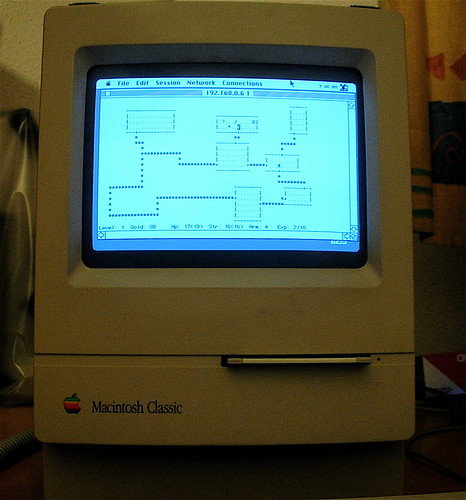
    Rogue on Mac Classic
    When Steve Jobs was commissioning the original sit-up and beg Mac design he looked to the likes of Sony and Cuisinart for inspiration. Apple’s concept of the computer as an appliance took about three decades to get mass-acceptability and the Surface gives it the Microsoft seal of approval as an approach.

    Microsoft and the channel

    The fact that Microsoft is prepared to go to the mats with the manufacturers that have supported its business for the past three decades indicates that Microsoft doesn’t need these people to reach out to the channel. Of course, Microsoft has its own retail channel relationships for software, the XBox and accessories like mice and keyboards. The question is how receptive and/or passive will the channel response be to Microsoft? If Microsoft will roll on partners like Dell and Acer with this tablet launch what will it do to the channel partners?

    Secondly, as the PC industry became unprofitable companies like IBM, HP and Dell moved into services; for large enterprise clients the very manufacturers that Microsoft has just spurned become the channel. Awkward.

    Microsoft and the supply chain

    Looking at the Surface immediately brings home the fact that Microsoft must have worked closely with an original design manufacturer such as the likes of Foxconn, Compal or Quanta to create their tablets. This is a calculated risk by the company involved as it is likely to lose business from affected PC manufacturers.

    The choice of original device manufacturer will be instructive, if it was Quanta in particular, Microsoft is likely to be relying on their patent portfolio to provide the Surface with ‘air cover’.  Foxconn is more likely to invest in specialist production facilities like the thousands of milling machines it uses to produce Apple’s i range of devices.

    You can find more Microsoft related content here.

  • Luxury QRcodes

    Luxury QRcodes give advertisers the opportunities to be creative in the ‘noise’. This happens in two ways.

    Luxury QRcodes increase the brand footprint, allowing for more brand salience

    Luxury QRcodes allow for less copy on page, increasing the size of a visual advert and tagline. This allows the brand to better use the space for generating brand salience. The body copy can be on a website linked by the QRcode together with a call to action. For instance, purchase online through the website or find and book an appointment with a boutique. Both of which fit in with the wider luxury brand move to go vertical into retail. This allows them to own the consumer relationship rather than a multi-brand boutique like Harrods or Lane Crawford.

    Luxury QRcodes can personify the brands

    The second aspect to this is less noticeable to the casual observer. But carefully done QRcodes can personify the brand itself. The first thing that needs to be done is minimising the data enclosed (for instance using a URL shortener) in the QRcode. Then there is careful positioning of the data within the QRcode square. There were some online tools that used to help with this. The code for tools designed to do this is freely available. QRCode Monkey provides a simple version of this kind of capability.
    Untitled
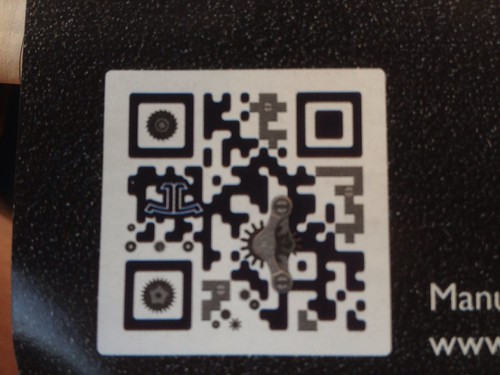
    A classic example of this approach to luxury QRcodes is Swiss luxury watch brand Jaeger LeCoultre.  JLC uses some carefully placed watch components in their QRcode and the complexity of QRcodes to human eyes (rather like the visual complexity of a watch movement). It was a subtle understated modification of a QRcode that fitted right in with the brand.

    More luxury related content here.

    More information

    Want to build a creative QRcode? QArt Coder is a good place to start

  • VC industry transformation

    Technology venture capitalists (VC)  have been going through a lot of change since the dot.com bust, with disruptions to their model including start-ups needing less cash and Sarbanes Oxley suppressing the pipe line for early exits via an IPO. As innovation (ok web services) has become cheaper, it has attracted a wider range of entrepreneurs than bright (usually male) engineers with an idea. A new class of angel investor has filled some of the slots that venture capital firms would have traditionally filled.

    Kleiner Perkins Caufield & Byers is one of the cornerstones of Silicon Valley VC culture. Eugene Kleiner (the Kleiner in KPCB) was one of the traitorous eight who where responsible for much of the modern semiconductor industry as we know it. The VC sector like technology start-ups have traditionally been very male orientated environments have had to change as society and the companies that they fund change. Junior partner Ellen Pao is one of the most prominent women at KPCB with an impressive track record and range of qualifications.

    News sources in the US published that Ms Pao had filed a sexual discrimination suit against the company with a number of allegations against a senior colleague. This has had reverberations throughout the industry:

    • KPCB is a flag carrier for the VC industry
    • VC companies roles are being questioned as there has been a flight of capital from ‘hard’ investments in areas of innovation like biotechnology and the next generation semiconductor technologies – which impacts negatively on the global competitiveness of the US
    • Venture capitalism already feels out of touch with the kind of start-ups that it looks to fund, stereotyped as a preppy gentleman’s club
    • Female entrepreneurs are less likely to want to work with KPCB limiting the company’s access to some of the hottest start-ups

    What’s the PR opportunity?

    The opportunity for PR agencies is to sell reputation repositioning to venture capital companies:

    • Making them look relevant
    • Positioning them as open, inclusive organisations

    Venture capital companies have historically under-invested in brand building and marketing in general, so there maybe an education process required.

    Archived from posts that I wrote for PR Week. More finance related posts can be found here.

  • Nokia N9

    Hong Kong-based independent mobile industry analyst Tomi Ahonen is one of the most prominent critics of Nokia. One of the points that Ahonen makes is that the Nokia N9 (based on the MeeGo operating system; parts of which has now been incorporated into Samsung’s mobile operating system Tizen) is more attractive than the equivalent Nokia Lumia phones.

    Nokia has been suspiciously ambiguous about Nokia N9 sales numbers. Mr Ahonen has made some guesses that put the N9 selling in broadly the same numbers as the Lumia range; despite not being sold in many developed world markets and not being backed by a $150 million advertising campaign. These are just estimates so I was curious to to see what the relative interest was for Lumia devices versus N9 when they are sold side-by-side.

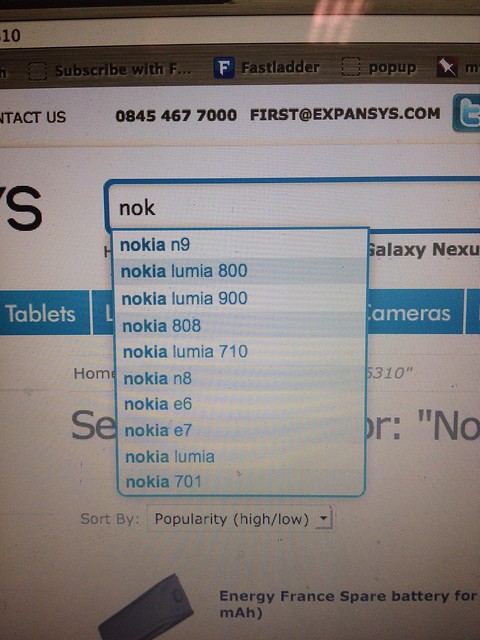
    I decided to look at Expansys.com. Expansys is the place to go for early adopters to get the kind of handsets that UK carriers, Phones4U and Carphone Warehouse don’t want to sell. In common with many sophisticated e-commerce websites Expansys has a search function that has an auto-suggestion function based on popularity to help get consumers to the item they want as fast as possible.
    Untitled
    In this unscientific study the Nokia N9 is more popular than all the Lumia models – when the products are sold side-by-side, which is probably why Nokia has taken care to minimise the amount of market competition between the Lumia and the Nokia N9. This still doesn’t give me any idea on differentiation between the N9 and the Lumia models.

    I decided to have a look at the different Lumia models and the N9 on Google Insights for Search. What this shows is an overall decline in interest on all the premium Nokia brand phones I looked at over time. Whilst the Lumia 800 has been the most popular on the chart, the gap between it and the Nokia N9 doesn’t merit the fact that Nokia blew an estimated $150 million promoting the Lumia 800 – their biggest ever budget and didn’t for the N9.

    One could argue that Nokia has been handicapped in its carrier relations because of Microsoft’s Skype acquisition, and reviewers have given the handsets themselves mixed reviews. But what I found most disturbing is that it seems that the evidence suggests consumers have failed to be sufficiently excited the Lumia phones; that an unpromoted, unsupported handset running an operating system that Nokia has killed off is giving the Lumia range a run for its money – despite the Lumia range having Nokia’s largest ever marketing campaign behind it.

    Nokia still has a stretch of runway to make its transformation complete, but it doesn’t fill one with confidence, perhaps RIM will be the third mobile eco-system? More Nokia related content can be found here.

    More information
    Who Wants Numbers? Lumia on T-Mobile? Lumia 800 vs Lumia 710? How Many Nokia N9? – Communities Dominate Brands

  • Korean Oreo ad

    Korean Oreo ad

    Looking at the Korean Oreo advert that seems to have caused a stir in the US, it seemed obvious to me that the advert was a case of throwing creative against the wall. It may have been used as a calling card, a way to spur debate or a mock-up for an award as Kraft seem to suggest.

    In this respect it is rather like Volkswagen Polo car bomb ad that went around London agency world a number of years ago.
    Controversal Oreo advert
    Korea like Singapore and China is a quite conservative country and has a higher proportion of practicing christians than you would expect. So I am not inclined to think that this was really designed to go out as marketing material from the band.

    The Korean public would create uproar. Korean consumers have a reputation for staging protests and product boycotts. That would be way too risky for a foreign brand like Kraft.

    I also found it is also interesting that Kraft has thrown Cheil under the bus really fast on this.

    For what it’s worth I think that this could be a great creative if it had the right context – say targeting young men as a snack rather their more traditional demographic of  family decision-makers – housewives. But you would have to select your media very carefully and be prepared for Lynx / Axe type backlash. More related content here.

    More information

    Double Slip: Controversial Korean Oreo Ad Leaked – ABC News