Category: branding | 品牌推廣 | 브랜드 마케팅 | ブランディング

The dictionary definition of branding is the promotion of a particular product or company by means of advertising and distinctive design.

I have covered many different things in branding including:

  • Genesis – the luxury Korean automotive brand
  • Life Bread – the iconic Hong Kong bread brand that would be equivalent of wonder loaf in the US
  • Virgil Abloh and the brand collaborations that he was involved in
  • Luxury streetwear brands
  • Burger King campaigns with Crispin Porter Bogusky
  • Dettol #washtocare and ‘back to work’ campaigns
  • Volkswagen ‘see the unseen’ campaign for its Taureg off road vehicle
  • SAS Airline – What is truly Scandinavian?
  • Brand advertising during Chinese New Year (across China, Hong Kong, Singapore and Malaysia)
  • Lovemarks as a perspective on branding
  • BMW NEXTGen event and Legend of Old McLanden campaign
  • Procter & Gamble’s Gillette toxic masculinity ads
  • Kraft Mother’s Day campaign
  • Kraft Heinz brand destruction
  • Porsche Design in the smartphone space
  • Ermenegildo Zegna
  • Nike’s work with Colin Kaepernick
  • Counterfeit brands on Instagram, Alibaba and Amazon
  • Gaytime Indonesian ice cream
  • Western Digital
  • Louis Vuitton collaboration with Supreme
  • Nokia
  • Nike Korea’s ‘Be Heard’ campaign
  • Mercedes SLS coupe campaign
  • Brand collaborations in Hong Kong
  • Beats headphones
  • Apple
  • Henrion Ludlow Schmidt’s considerations of branding
  • Cathay Pacific
  • Bosch
  • Mitt Romney’s failed presidential bid
  • Microsoft Surface launch
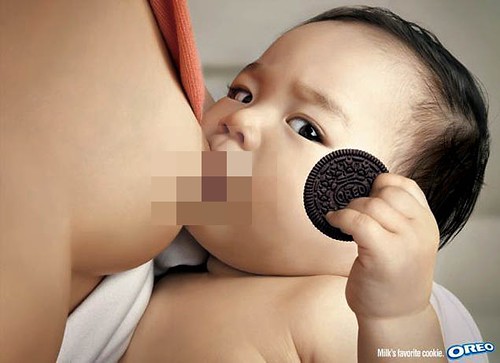
  • Oreo Korean campaign
  • Chain coffee shop brands and branding
  • Samsung’s corporate brand
  • North Face’s brand overeach in South Korea
  • Mr Pizza Korean pizza restaurant and delivery service brand
  • Amoy Hong Kong food brand
  • Chevrolet Corvette ‘roar’ campaign promoting a build your own car service
  • Being useful: or what can Lei Feng teach us about digital marketing?

    A while ago I built a framework from a hodge lodge of ideas to think about social marketing with being useful as a foundational element. I was thinking about this as I read a number of Chinese news sources,  the name Lei Feng had started coming up a lot recently. The reason why it was coming up was that it marked the 50th anniversary of Mr Lei’s death. The Chinese government was trying to use this date to encourage a greater sense of community and altruism in modern Chinese society including a Weibo hashtag with Monday having been ‘Learn from Lei Feng’ day.
    Poster of Lei Feng selfless soldier and model citizen

    Being useful exemplar – Lei Feng

    Mr Lei was a 22-year old soldier who drove military trucks for a living. He was killed when a telegraph pole was felled by another truck and landed on his cab. This would have been just another sad but unnoteworthy accident, had not Mr Lei left behind a 200,000 word diary which was naturally full of content about how great the party was and documented an otherwise selfless life where he continually focused on being useful to those in his community.

    Mr Lei was an orphan which meant that it was easier to use him posthumously as an example to others. March in Chinese schools is learn from Lei Feng month. Today Mr Lei is considered with mixed feelings by Chinese people; his selflessness is at odds with a laissez-faire market economy and the use of his life is viewed with some cynicism by many.

    Regardless of the realpolitik surrounding the legacy of Lei Feng his focus on being useful could teach brands a lot about social media.

    A lot of the time colleagues and clients come up to me and say we want something that’s ‘viral’ and I die a little inside. Its all about the brand rather than the brand interaction with the consumer.
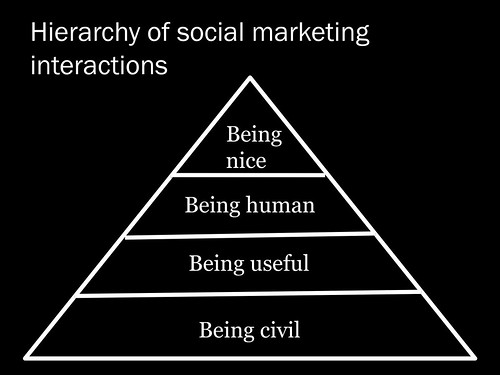
    Being civil
    I wish there were more brands that aspired to being useful. It’s simple to do, it opens a natural point for engagement because it fits nicely into the intent and context of the audience: – it builds long-term relationships rather than campaign statistics.

    Being useful in action

    A couple of great examples of being useful include the University of Westminster who provide tips on the shops and restaurants who offer students discounts.
    Useful social media
    Or the way Vodafone in the UK uses social media as the tip of the spear to address customer care issues.

    I contacted Vodafone so that I could merge my identities into one, with one place to manage my devices on the Vodafone network. I got in touch by Twitter; they responded below:
    voda
    I then completed a web-based form and was contacted by phone by one of the web team called Cate. She explained to me how they were going to address what I needed and resolved the problem without my having to hang on listening to hold music a la my previous experiences with 3UK or T-Mobile.

    Now I am not suggesting that we all dress in olive fatigues; but it would be a good idea to lift ourselves out of what do we want – profits, fame, fortune, a Cannes Lion award and instead start thinking a bit more about the person on the other end of the communication. Being useful like Lei Feng and being open to the insights that this provides is also more likely to provide the inspiration over time for a really great word-of-mouth idea upon which you can start to built your path to fame and glory as a marketer.

    More information

    China to step up “Learning from Lei Feng” campaigns – People’s Daily
    What China’s Talking About Today: Questioning a Maoist Icon – The Atlantic
    Chinese Heroism Effort Is Met With Cynicism – New York Times
    China promotes late altruism icon to bring hope – China Daily
    Foreign students learn more about hero – China Daily
    Lei Feng spirit to inspire new generation – China Daily
    Complete works of late Chinese altruist published – People’s Daily
    NPC deputy proposes Chinese Thanksgiving – China.org.cn
    Lei Feng spirit personified in E China – China Daily
    A guide to reviving the Lei Feng spirit – China.org.cn
    China to stage programs promoting Lei Feng spirit – People’s Daily

  • All is social by Graham Brown

    I’ve known All Is Social author Graham for a number of years. We first met when he ran MobileYouth selling marketing research to mobile operators, focused on the youth market. All is social is a mix: Graham’s own journey as an observer of Japanese society during his time as a JET scheme member and onwards with his experience in market research to date and a treatise on the interactions of consumers and brands. He considers that this all has an essential social component which makes a lot of sense.

    Graham puts out marketing, the idea of branding on its head. Instead brand comes from consumer’s use for the brand. The brand as tool, or what we describe as ‘intent and context’ at Ruder Finn. He thinks that innovation is in the use rather than the design. I’d be less inclined to completely believe this, when I think about how iconic design and engineering can make a difference:

    • Dieter Rams work at Braun, which was part of the German economic miracle and has echoed down into many Apple products
    • Christian Lindholm’s work at Nokia on smartphone user experience: S60
    • The industrial of design of Sony from the 1960s through the 1990s
    • Henry Ford and the Model T
    • The user experience of Twitter and Google

    But anthropological co-creation can make a real difference. Whilst Graham’s writing focuses on young people, I think that it the principles fit consumers in general. Check it out Kindle. More book reviews here.

  • Samsung brand challenge

    One of the things that I had been thinking about for a while was the way the smartphone handset market; the Android eco-system had the value hollowed out of the business for the manufacturers including the Samsung brand. In some ways this process seemed to mirror what happened in the PC market through the 1990s and into the 2000s.

    Home computing

    But let’s go back to where it all began. Back at the end of the 1960s and into the early 1970s, home computing meant having a ‘dumb terminal’ connected to a mainframe or mini-computer at a large corporation or university via a telephone line. Due to the price of local calls in the US versus Europe; it was natural that should develop first in any meaningful way. Even then it was used by a very small number of early adopters. At this time Samsung was better known in Korea for fertiliser and started a partnership with Sanyo to learn about electronics.

    However there was a latent demand for personal computing, you had a few geeky counterculture types who had an old mini-computer in a building and provided terminals and accounts to members of the public and community groups free of charge. Outside San Francisco however this latent demand wasn’t being met. The Homebrew Computer Club that held most of their meetings in an auditorium attached to the Stanford Linear Accelerator had a different idea.

    In essence they looked to reinvent personal computing by using simpler less powerful hardware. This unleashed a wealth of innovation from the first spreadsheet to at-home stock-trading and eventually World of Warcraft.

    Mobile devices are a similar point of reset in personal computing. Many of the tasks that we do from word processing to entertainment don’t necessarily need the amount of computing power that we have. Secondly even this Mac that I am writing the post on probably has lots of unnecessary code that isn’t really required by me. For people who don’t create a lot of content mobile devices from tablets to smartphones are ideal for their needs in many respects.

    Beyond this moving forward through simplicity there is another aspect to the the rise of mobile devices that mirrors the PC world; like the Windows Intel eco-system before it – the Android ARM eco-system is becoming commoditised; defined by specification (processor, Android version and screen dimensions). This is what Nokia was afraid of when they decided not to go down the Android route; though the level of control that Microsoft has over Windows Phone hardware specification and and user experience could be argued make the lack of differentiation amongst Android competitors a mute point.

    HTC looks as if they have been trying to do something about this, in terms of hardware: purchasing a majority stake in fashion audio brand Beats Electronics LLC and S3 Graphics. This was matched by a similar effort in software with their HTC Sense interface skin with some productivity and communications applications.
    The problem with Android
    Technology marketers haven’t been doing themselves any favours with co-marketing budget type ads like these ones that I took a picture of last year for different Motorola phone models.
    Android marketing fail
    In reality, the HTC Sense interface isn’t the differentiator that one would have thought, they haven’t yet used the Beats audio brand in any meaningful way, nor has the S3 graphics come into the marketing mix. Sony Ericsson and Motorola have fared worse and Samsung has come out on top.

    Why has Samsung been successful?

    I think that this is down to a number of factors:

    • Samsung like Nokia has built up an extensive effective global logistics and channel network
    • An extension of this would be Samsung’s relationships with wireless carriers
    • Samsung can sweat the supply chain largely because it owns the supply chain: it makes LCD screens, memory, ARM procesors for instance. Thus allowing it to compete on price/performance points that many of the other players couldn’t match

    In this respect, Samsung’s operational efficiency and effectiveness is similar to Dell in it’s prime (the main difference is that Dell wasn’t a vertically-integrated component manufacturer). Samsung’s head marketer Younghee Lee wants to turn Samsung into an emotional brand rather than a rational one. Historically consumers have known Samsung as making reasonably good products; but many didn’t even realise that the company is Korean rather than Japanese.

    The company has a modicum of product design smarts that has allowed it to make in-roads in the television and brown goods markets at the expense of Panasonic and Sony – but it still isn’t operating at the same level of design acclaim as Apple.

    Ms Lee’s aspiration for people to feel something about the Samsung brand is at odds with the adverts that the company has been running in the US.

    (The embedded video is on Tudou, so will need patience whilst it loads).
    The adverts generally follow a pattern:

    • Attacking iPhone customers as foolish zealots
    • Demonstrate a Samsung | Android feature
    • Finish on a rational message

    It is the advertising equivalent of the Japanese phrase that ‘the nail that stands up must be hammered down‘. The problem for Samsung is that you don’t get a consumer to switch brands by berating or insulting them; those kind of motivators tend to only work as a line management technique in command-and-control companies (a la Apple).

    Secondly, the rational reason doesn’t give a reason to switch from Motorola or HTC to Samsung with the disdain of iPhone customers as a common bond.

    If Samsung wants to become a brand that consumers feel passion for, it won’t come through these attack adverts, but from the product design outwards in every part of the customer experience. In this respect Ms Lee’s hands are tied – as the product design and customer experience would need to be raised consistently across the Samsung product range; not just smartphones to make this happen effectively.

    It takes years to get this right in an organisation of the scale of Samsung, whilst that is happening Samsung can consider how it can do more appropriate consumer marketing and advertising – I’d suggest by thinking about how to encourage and empower existing Samsung customers to become passionate advocates of the brand.

    More information
    2012: just where is digital going?
    Things I’d like to see in 2012
    The demise of Palm | HP portable devices post
    The mobile and the PC market – an exploration in value
    Samsung’s Marketing Chief Aims to Stir Passion for Korea’s Electronics – AllThingsD
    EUROPA – Press Releases – Antitrust: Commission opens proceedings against Samsung
    Feature Phones Now More Profitable Than Mid-tier Smartphones – Forbes
    The mobile and the PC market – an exploration in value
    The folly of technology co-marketing budgets

  • The North Face and Nike

    The North Face and Nike on marketing

    The North Face seems to have just peaked on its cultural moment in Korea. The North Face jackets are worn by all strata of society. Below is a Korean blog post that compares Its winter coats with different types of high school students as the brand has become so ubiquitous in South Korean school yards and on the backs of consumers during the winter months.

    The bottom of the blog post goes on to compare The North Face with the duffle coats worn by previous generation of school children in a mocking way.

    it is as much the winter uniform of the Korean salary man as his tie.

    The North Face sees itself as a technical brand rather than a true luxury brand, but the vast majority of its jackets don’t see the mountains and ski slopes for which they were originally designed. It has begun to treat itself as a premium brand with its purple label retro designs and different fabrics like Harris Tweed – currently exclusive to the Japanese market. But how can this be maintained if the brand becomes this overexposed?

    It is not a corner that it can easily get out of and technical innovation in the clothing design will be of limited use.

    North Face overexposure

    Part of the problem is the nature of Korean society itself which has a certain conformity to it. This means that once a trend picks up, it goes everywhere. But then because it goes everywhere it has a finite life. A small amount of tastemakers move on and the cycle begins again.

    The next winter jacket might be Canada Goose or Moncler.

    Contrast this with Nike: The Wall Street Journal has an interesting article about how Nike and Footlocker maximised revenue from the Jordan franchise through careful timing of limited product releases. More marketing related posts here.

  • Consumer interest in iOS etc.

    If you’re like me you read far more journalist analysis of the wireless phone market than is good for you. I thought that it would be instructive to have a look at what consumers are looking for instead and look for any patterns. After sales availability and visibility consumer interest is probably the biggest determinator of success. My weapon of choice was Google Insights for Search. My research was based on a few assumptions about consumer interest in the wireless space and some limitations in the tool that I was using:

    • Consumers know what type of smartphone that they want
    • Consumers decisions aren’t carrier loyal
    • Consumers used Roman script to search for the brand
    • Search is a good proxy for consumer interest – it hasn’t been disrupted by Facebook in this regard yet despite what others may tell you
    • China despite being the world’s largest market isn’t going to be providing meaningful data because Google Insights for Search doesn’t cover that market
    • The Russia sample is indicative of overall consumer sentiment in Russia (Yandex is a big search player in Russia)

    Consumer Interest in platforms
    Some of the biggest interest in handset brands is in the developing world. In many respects this is their PC revolution. In developed Asian markets like Hong Kong and Singapore there is a much higher interest than EU countries – partly because of on-the-go lifestyles and partly because of the economic cataclysm that the western world is facing. The iPhone still attracts the most interest, but what is interesting is the acceleration that Android seems to have in terms of increasing interest. Microsoft’s efforts, whilst lauded by critics haven’t yet turned into consumer interest.  Research In Motion’s Blackberry platform seems to be down but not out yet in the consumer stakes.

    Nokia

    I took a snapshot of consumer interest in Nokia over the past three months to try and see what effect the global launch campaign for Nokia’s Windows phones are doing to consumer interest in the brand.

    I deliberately didn’t compare them to the iPhone because Nokia themselves acknowledge that they are competing against Android handset makers like HTC and Samsung. Nokia launched the Lumia phones with their biggest marketing campaign ever and had a lot of column inches written about the brand alongside a gamut of marketing commnications tactics from experiential events and advertising to point of purchase.


    Whilst Nokia’s new range of Lumia phones have had a substantial marketing budget put in place, but it doesn’t seem to have significantly affected search interest: it’s not quite living up the Amazing Everyday billing yet. This is also the case for Windows Phone with interest remaining consistently low in comparison to the Nokia brand. I think that the stubborn consumer disinterest in Windows Phone is a big challenge.

    More wireless related content can be found here.