Category: business | 商業 | 상업 | ビジネス

My interest in business or commercial activity first started when a work friend of my Mum visited our family. She brought a book on commerce which is what business studies would have been called decades earlier. I read the book and that piqued my interest.

At the end of your third year in secondary school you are allowed to pick optional classes that you will take exams in. this is supposed to be something that you’re free to chose.

I was interested in business studies (partly because my friend Joe was doing it). But the school decided that they wanted me to do physics and chemistry instead and they did the same for my advanced level exams because I had done well in the normal level ones. School had a lot to answer for, but fortunately I managed to get back on track with college.

Eventually I finally managed to do pass a foundational course at night school whilst working in industry. I used that to then help me go and study for a degree in marketing.

I work in advertising now. And had previously worked in petrochemicals, plastics and optical fibre manfacture. All of which revolve around business. That’s why you find a business section here on my blog.

Business tends to cover a wide range of sectors that catch my eye over time. Business usually covers sectors that I don’t write about that much, but that have an outside impact on wider economics. So real estate would have been on my radar during the 2008 recession.

  • Kickstarter

    If you’re reading this blog, you will have heard of the crowdfunding platform Kickstarter. Kickstarter has become synonymous with crowdfunding and has become a verb. There are several crowd funding platforms out there including Indiegogo and China’s Demo Day but none seem to have caught the public imagination in the same way Kickstarter seems to have.

    Major companies like Sony have trialed offerings of products on crowdfunding platforms as a way of accessing market size and viability for new products. Bands from Public Enemy to unknown artists have financed their album recordings and production in a similar way

    Kickstarter failure rate

    I’ve personally subscribed to projects with very mixed results with Kickstarter projects that I have funded. My experience of my first couple of projects were very positive. My most recent experiences have been one of disappointment to the point that I no longer use it. They failed. There was production problems, the timelines over ran. And at least one of them looked as if they took the money and ran when the project seemed more difficult than they originally assessed it to be. 

    Therefore it was interesting to hear Kickstarter used in a different context, that reflects my experience with the platform.

    I like the Techmoan YouTube channel as a good deal of its content introduces retro technology, many of which is is equipment or media formats that I hadn’t come across previously.

    The channel host Mat used Kickstarter not as a brand, but as a verb to imply that a product was somehow inferior and lacking in quality. It has become synonymous with an amateurish effort. Just because technology and globalisation have democratised access to manufacturing; doesn’t necessarily mean better quality products. That can’t be good for the brand.

    This is on top of crowdfunding’s high degree of funding failures, product failures and increasing numbers of alleged fraud.

  • Crimson Hexagon + more things

    Facebook Suspends Analytics Firm Crimson Hexagon on Concerns About Sharing of Public User-Data – WSJ – Crimson Hexagon will likely get out of the penalty box soon, the co-founder works at a joint Facebook academic research partnership… Its also not that surprising what Crimson Hexagon did, given how crap Facebook is at providing data to social insights platforms like Crimson Hexagon or Brandwatch

    Congress is wrong to question Huawei’s academic partnerships | FT – op-ed by Eric Xu of Huawei, you could cynically interpret it as a plea for easier espionage and an interesting use of ‘freedom’ (paywall)

    INTERNET: Baidu Sambas Out of Brazil | Young’s China BusinessThere are lots of reasons for the inability of China’s Internet companies to succeed outside their home market. One is simply inexperience. But another is really the direct result of Beijing’s determination to set up what almost amounts to a parallel Internet in China that in some ways is identical to the global Internet but in others is very different. That strategy has helped to keep out most of the major global competitors in any meaningful way, allowing Chinese companies to thrive on their home turf thanks to their booming local economy. But that approach has also made these companies quite unprepared to compete globally, since they engage in many practices that are either unacceptable outside or simply undermine trust of local people. – China’s Galapagos syndrome: WeChat has NO end-to-end encryption, is censored worldwide for instance. Will only succeed in low risk categories – photo altering apps or casual games

    Why Hong Kong’s property bubble won’t burst anytime soon | HKEJ Insights – Hong Kong’s property market no longer serves only the city’s seven million people. We now must also serve a country of 1.3 billion with a growing number of rich people anxious to get their wealth out. Hong Kong’s red-hot property sector is a perfect place for rich mainlanders and international investors to park their money. Their hot money, combined with the local psyche that prices will continue to climb means the bubble will never burst. – You could substitute most of the world’s major cities as hot money from fast developing economy entrepreneurs and rent seek oligarchs park their hot money in property safe havens. Hong Kong isn’t going to see a tailing off of house prices until China deals with corruption.

    Amazon’s new Part Finder helps you shop for those odd nuts and bolts | TechCrunch – so cool,  I am just really scared that if I showed this to my Dad this ‘tinkerer’ element of his character would go into overdrive

    Publicis Groupe: First Half 2018 Results | Publicis Groupe – poor job done at controlling market expectations

    Android has created more choice, not less | Google Blog – yeah right. Basically we can’t get paid in data so pay us a licence fee. I wonder how much Google will have to pay to keep Google Search in the device if they do that. It could also create an opportunity for Oxygen, Yandex app store, Jolla and home grown distributions by the likes of Huawei instead

    Mark Penn on his update to MicroTrends

    Media – Twitter’s guide to getting the most out of the platform

    MEDIA Protocol – WTF

    Looking Through the Eyes of China’s Surveillance State – The New York Times  – I tried the glasses out on a group standing about 20 feet away. For a moment, the glasses got a lock on a man’s face. But then the group noticed me, and the man blocked his face with his hand. The minicomputer failed to register a match before he moved. Seconds later, the people scattered. Their reaction was somewhat surprising. Chinese people often report that they’re comfortable with government surveillance, and train stations are known to be closely watched

    Amazon crashes just minutes into Prime Day | The Drum – makes you wonder about AWS availability and uptime…

  • Marketers bookshelf recommendations

    Books

    My recommendations for a marketers bookshelf is based on my own reading. My own experience is very consumer, brand communications and behavioural change focused. Here’s some recommendations, they aren’t in a ranking or grouped in a particular order.

    Insights, planning and strategy

    Most marketing communications projects are trying to create some sort of behavioural change in the audience, so understanding more about persuasion has got to be a pretty handy thing right? Robert Cialdini  has two great works:

    How Brands Grow part 1 and part 2 – pretty much the modern marketers bible for B2C brands of various stripes. Byron Sharp distills down decades of evidence-based research that has been carried out by Ehrensberg-Bass Institute of Marketing Science attached to the University of South Australia. The research institute has got a who’s who of corporate sponsors supporting their work and using their data:

    • General Mills
    • Grupo Bimbo
    • Procter & Gamble
    • Red Bull
    • Unilever

    You get the idea. If the research is good enough for these brands, it’s good enough for you.

    A key part of planning is working out that insight which will speak to your target consumers. Trends books are sometimes a handy short cut to creating a first draft of a hypothesis. You can do worse than leave through pollster Mark Penn’s Microtrends, Microtrends Squared and Microtrends Cubed that he has built up. If you’re thinking about transformation then Kevin Kelly’s The Inevitable: Understanding the 12 Technological Forces That Will Shape Our Future is the Microtrends for digital transformation. Tom Doctoroff’s What Chinese Want: Culture, Communism, and China’s Modern Consumer – is a another great primer.

    The Long And the Short of It by Les Binet and Media in Focus: Marketing Effectiveness in the Digital Era. Binet is a respected communications planning expert, he is currently head of effectiveness at Adam & Eve DDB. He has published some of the best works on marketing effectiveness for the IPA.

    If you studied marketing in college David A. Aaker is probably a familiar name. His Strategic Marketing Management book is often an introductory core course text. It used to double as a doorstop in a lot of dorm rooms that I visited. If you want to refresh your memory on branding he has written an accessible primer to recharge long lost lecture memories: Aaker on Branding: 20 Principles That Drive Success.

    Truth, Lies and Advertising – Jon Steel’s work on account planning is that rare thinking; a very readable text book. I like to go back to it to boil things down to first principles and forget complexity.

    Inspiration

    When you’re looking for inspiration, there are two good approaches:

    • Go lateral. Brian Eno and Peter Schmidt’s Oblique Strategies isn’t a book, but a set of 100 cards. Eno periodically suffered writers block in the studio and these cards are a successful approach that he developed over time with collaborator Peter Schmidt. It also works for finding your way through planning
    • Look back into time. If you are looking back into time, I would recommend Sun Tzu’s The Art of War if you are looking for inspiration on strategic approach. Buy the cheapest copy that you can get in print. Mine is covered in post-it notes and scribbles in the margins. More expensive versions have ‘business thought leaders’ trying to reinterpret it for you and just end up muddying the water. Those 13 chapters are well worth visiting on a regular basis. Bill Bernbach’s Book is a source of inspiration; as is the better known Ogilvy on Advertising by David Ogilvy
    Communications

    How To Write A Thesis by Umberto Eco. I know what you’re thinking: ‘Ged have you lost your marbles, why would I care about writing a thesis?’ Eco’s book is a really good guide to collecting one’s thoughts and presenting facts gained through a comprehensive research process. As the old martial arts mantra goes: slow is smooth, smooth is fast. Whilst Professor Eco isn’t a marketing scholar he knows a lot about thinking and being cogent.

    What about the last book on the marketers bookshelf? You’ve distilled all the knowledge from the rest of the books in this list, along with desk and possibly primary search.  You are ready to present your killer ideas to the client, or internal decision makers. Jon Steel has got you covered. Perfect Pitch: The Art of Selling Ideas and Winning New Business is a great refresher that helps shake you’re presentation game up.

    What books would add to a marketers bookshelf? If you have additional recommendations, put them below in the comments section. More related content here.

  • Public relations role in the world

    I started thinking about public relations role in the world whilst listening to The Holmes Report podcast featuring Michael Frolich of Ogilvy UK. There was a particular focus on brand communications rather than corporate communications, public affairs or investor relations. It’s worthwhile going and having a listen; I will still be here when you come back. There were two themes that stuck out with me.

    • How PR compares to other marketing disciplines
    • The role of planning in PR

    I wrote some notes about each focusing on where my view differed from Michael.

    Public relations role and relationship to other disciplines

    Should the PR industry have hang-ups about its profession versus other marketing specialities? No public relations role in the marketing mix is clear and valid.

    In terms of account billings, public relations is still the junior profession compared to advertising, creative agencies and media agencies. The lower fees represent a greater degree of risk in outcomes for the brand than paid media.

    From a client relationship perspective, whether public relations role is as an equal discipline really depends what the client is trying to do. There is a propensity to use different marketing agency functions based on what the overall marketing strategy is looking to achieve.
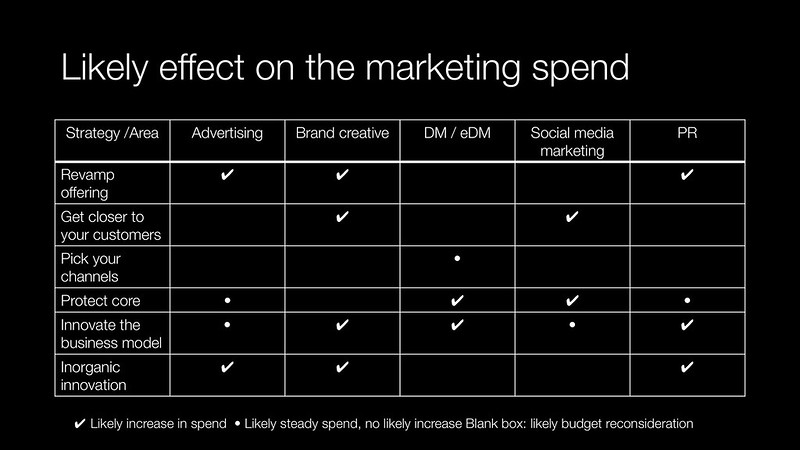
    Zero-Based Budgeting

    Public relations agencies are not the sole source of expertise in generating ‘PR coverage’. In some respects many marketing agencies already fulfil a public relations role, but won’t describe it in that way. It tends to be attached to their social teams and might be called something like influence, content marketing or earned media. This tends to be in some of the media agencies at least. Ad agency creative if sufficiently emotive can foster talkability and social sharing – which is another form of earned media that is usually considered to be also public relations role.

    Historically Japanese advertising agencies like Dentsu have sold public relations as an integrated part of their advertising led programmes. The perception by western agencies has been that PR was thrown in for free like a plastic toy in a box of breakfast cereal. In reality the Dentsu Way, called cross marketing –  is a holistic, tightly integrated approach, though public relations was definitely the junior discipline.

    It would would be wrong of the industry to assume that they are the only experts in this space. I also believe that public agencies should have more to offer than generation of earned media, more on that later.

    A lot of PR leaders I’ve met don’t understand public relations role in the client’s marketing strategy and when it will make the biggest difference. I’ve never heard an PR agency leader turn around to a client and say ‘advertising or direct response marketing is more suitable for your needs’. Clients tend to believe that they need to support each initiative that they get budget for, even if the contribution that their efforts make are marginal. It shows that they have an ‘A-grade’ team spirit, but is harder to justify from a strategic point-of-view and may even devalue the currency of marketing communications-orientated PR in the business.

    It would be great if the CIPR could mandate PR leaders to read Sharp.

    • To the best of my knowledge the PR industry has never published campaign effectiveness research on a mass scale similar to the IPA’s  ‘The long and the short of it’
    • I don’t know if Sabres, CIPR or PRCA award entries have solid enough data for this?

    It would be great if the CIPR, PRCA or PRSA could make this happen.

    Planning in PR

    Frolich starts to get some of the points right about the fraught relationship between planning as a discipline when embedded in PR agencies. I would be far more aggressive and say a lot of PR senior leaders aren’t ready for it. Part of this is the generalist nature of public relations roles and also business structure within clients and agencies.

    Many PR agencies are run on very little capital. They’ve always had an asset light model and just been pure operating expenses. From a knowledge perspective you are seeing new hires being brought in at a more junior level than the people that they replace which will have a knock on effect throughout the industry.

    Securing funding for any kind of tooling beyond media databases is really hard when you’re working agency side.  That it’s just the cost of doing business in the industry nowadays struggles with a culture that tries to bill these back to a specific client. Which also explains why PR often struggles to present its ideas.

    I’ve known agencies being reluctant to subscribe to publications where their clients might get coverage or media monitoring services. Justifying social listening or SEO tools is really painful. I know, I fought that battle trying to get social listening tools into the business. It is nigh on impossible trying to get a WARC subscription. PR agency clients tend to value and pay for direct action tasks and reporting, not thinking, analysis, strategy or measurement. Having worked as strategist who has worked in PR agencies and other disciplines I ended up having to pay for some reports out of my own pocket when I was agency side and building up my own library of reports and presentations over time.

    This sole focus on direct action tasks probably explains the earlier points I made about agency leaders not turning around to a client and pointing out the alternative approaches they should be taking instead of PR to address a particular marketing challenge.

    William Gibson in his Blue Ant trilogy of novels (Pattern Recognition, Spook Country and Zero History), discusses PR as part of the plot. He enlightenedly considers PR beyond media relations. Instead he talks about its role mediating relations between an organsiation and its public. PR is considered by him to have its finger on the pulse of the zeitgeist. That should mean that planning is a greater fit than it is in reality. So an opportunity is there, but whether the industry can really step up to it en masse is quite another matter.

    Data and insights sharing between agencies of different working on the same project needs to improve. Often PR plans are done in isolation of planning process and IF YOU’RE LUCKY then recut to incorporate insights.

     

  • Fall of Nokia & other things this week

    BBC 4 ran a great hour long documentary film: The Rise and Fall of Nokia is an oral history on the fall of Nokia from Nokia veterans. You can’t give a good comprehensive telling on the rise and fall of Nokia story in just one hour, but you can get a sense of what Nokia was. Some of the culture change that came with success  was really, really  dark. More on Nokia here.

    Danny Dyer nailed the zeitgeist on Brexit last week. Which led some the B3ta community to put together the Danny Dyer Presents: “Pwopa Nawty Noises!” (B3ta.com) – livens up conference calls no end.

    I was a big fan of HBO’s The Newsroom drama; it was more of the intelligent dramas over the past few years. The intro to the first episode seems even more prescient now

    I am very late to this but Techcrunch’s Bubbleproof drama from last year neatly skewers the current state of technology start-up culture (in the west at least).

    I’ll leave you with this amazing animated film from Hong Kong. It’s on KickStarter for funding and looks amazing with hints of traditional martial arts films, science fiction and psychedelia. More information on the film website.